
SEO Content Guide: Expert Strategies for 2026 Success

Modest Mitkus · May 7, 2026
The world of seo content is shifting rapidly, driven by AI breakthroughs, smarter algorithms, and evolving user expectations in 2026. Organic visibility now demands more than surface-level tactics—success depends on mastering new ranking factors and adapting to AI-powered search engines.
This guide unlocks proven strategies and frameworks to help you create seo content that stands out, attracts traffic, and builds authority. Discover the latest trends, advanced keyword targeting, innovative content formats for AI search, expert optimization techniques, automation tools, and performance measurement methods.
Ready to future-proof your content and outpace competitors? Dive in, and leverage these insights to propel your visibility and growth.
The 2026 SEO Content Landscape: Trends & Challenges
The world of seo content is experiencing rapid transformation as we enter 2026. Search engines, user preferences, and AI platforms are reshaping how brands must approach visibility. Understanding these shifts is crucial for anyone aiming to stay competitive. Let’s break down the core trends and challenges defining the seo content landscape this year.

The Rise of AI Search and Generative Engines
AI-driven platforms are now at the forefront of seo content visibility. Tools like ChatGPT, Gemini, and Perplexity are routing over half of all search queries through generative engines, according to Backlinko. This seismic change means content must be optimized not just for traditional search, but for AI-driven discovery as well.
Generative Engine Optimization (GEO) is now a key part of seo content strategies. Brands are focusing on LLM seeding, ensuring their names and insights appear in AI-generated responses. Backlinko’s research highlights that those embracing GEO are seeing higher brand mentions and better engagement.
With AI engines shaping information delivery, seo content must adapt to new ranking factors and answer-centric formats. Staying ahead means understanding how these engines index and present content.
Evolving Search Algorithms & E-E-A-T
Google continues to refine its algorithms, with E-E-A-T—Experience, Expertise, Authoritativeness, and Trustworthiness—remaining central to seo content success. The October 2024 update penalized thin and generic content, pushing brands to provide real value and unique perspectives.
User signals, such as click-through rates and engagement, now play a bigger role in rankings. Google rewards seo content that demonstrates deep knowledge and offers information gain. This means authorship, transparency, and original research are more important than ever.
To maintain visibility, brands must focus on content uniqueness and ensure every piece of seo content stands out for quality and credibility. Adapting to these algorithmic shifts is essential for long-term authority.
User Intent & Content Personalization
Understanding and mapping user intent is critical in 2026 seo content strategies. Search behaviors are more nuanced, with queries split into transactional, informational, navigational, and even AI-specific categories. Advanced intent modeling helps brands align their content with what users truly seek.
Personalization is now a baseline expectation. Dynamic content adapts to user journeys, increasing relevance and engagement. WordStream advises building detailed personas to tailor seo content types and formats.
By leveraging analytics and user data, marketers can deliver content that resonates on a personal level. This approach not only increases conversion rates but also improves dwell time and repeat visits.
Content Saturation & Competitive Differentiation
The volume of seo content online has exploded. With 90% of marketers reporting heightened competition for top SERP spots, differentiation is no longer optional. Brands must offer true value, depth, and originality to rise above the noise.
Incorporating multimedia, such as video and infographics, is now standard practice. Unique research, expert commentary, and actionable frameworks set leading brands apart. For those seeking up-to-date tactics, SEO content strategies for 2026 provides practical ways to outpace the competition.
Staying visible requires a commitment to continuous innovation and a willingness to explore new content formats and channels. Success depends on delivering more than just information—delivering insight.
Multi-Platform & Multi-Format Content
To win in 2026, seo content must be optimized for every platform and format. Users now interact with brands across web, mobile, voice, and AI chat interfaces. Search engines prioritize content that adapts seamlessly to each environment.
The rise of video, interactive tools, and visual storytelling is reshaping SERPs. Competitors are leveraging infographics, short-form videos, and interactive guides to capture attention. Brands that diversify their seo content formats are more likely to secure higher rankings and broader reach.
A multi-platform mindset ensures content is accessible, engaging, and effective wherever audiences are searching or consuming information.
Advanced Keyword Research & Content Planning for 2026
Staying ahead in seo content requires a strategy that adapts to the rapidly changing search landscape. In 2026, keyword research and content planning must evolve to address AI-driven search, user intent, and the growing complexity of ranking factors. Let’s explore the frameworks and actionable steps you need to future-proof your seo content approach.
Understanding Keyword Evolution in the AI Era
In 2026, keywords are no longer just exact match phrases. Search engines and AI platforms now prioritize entity-based and conversational queries. This shift means seo content must target not only traditional keywords but also semantic clusters and topics related to user intent.
Topical authority has become crucial. Instead of focusing on a single keyword, content creators build clusters around core topics, connecting related subtopics. This approach helps search engines understand the depth and breadth of your expertise.
For a deeper dive into actionable techniques, see SEO content creation strategies, which outlines how to structure content for both AI and human users.
Tools & Techniques for High-Impact Keyword Discovery
Modern keyword research goes beyond basic volume and difficulty metrics. AI-powered tools like Semrush and Ahrefs now offer advanced features for uncovering hidden opportunities. These platforms analyze competitor content, identify keyword gaps, and suggest clusters that drive traffic.
Proprietary AI solutions can process huge datasets, revealing long-tail queries and emerging trends. By leveraging these tools, you ensure your seo content targets high-impact keywords that align with both audience needs and search engine priorities.
Consider mining competitor articles for related terms and using keyword gap analysis to strengthen your topical coverage.
Mapping Search Intent to Content Types
Matching keywords to search intent is essential for ranking in 2026. Today’s search landscape includes transactional, informational, navigational, and AI-specific queries. Each requires a tailored content format.
For example, guides and how-to articles satisfy informational intent, while lists and product pages address transactional needs. Video and interactive formats are increasingly favored for complex topics.
Data shows that 70 percent of top-ranking pages align their content format with search intent. By understanding what users want, your seo content becomes more relevant and authoritative.
Building a Future-Proof Content Calendar
Effective planning starts with an editorial calendar that balances keyword difficulty, seasonality, and business objectives. AI-driven tools automate scheduling, suggest trending topics, and help maintain consistency.
A future-proof calendar adapts to search trends and algorithm updates. Use analytics to refine publishing frequency and timing. Integrate topic ideation tools to fill gaps and expand your seo content reach.
Consistency is key. Regularly publishing well-optimized content ensures you stay visible in a crowded digital landscape.
Internal Linking & Topic Clustering for Authority
Structuring seo content into pillar pages and clusters builds topical depth and authority. This method helps users and search engines navigate your site, improving engagement and rankings.
Start with a comprehensive pillar page on a core topic. Then, create supporting articles that dive into subtopics, linking them back to the pillar. Internal links distribute authority and keep readers exploring related content.
Best practices include using descriptive anchor text and connecting new articles to established pages. This approach strengthens your site’s relevance and boosts overall seo content performance.
Automating Content Strategy with AI Platforms
AI-powered platforms like RankPill are transforming how businesses manage seo content. These solutions streamline keyword research, competitor analysis, and content calendar creation, saving time and increasing output.
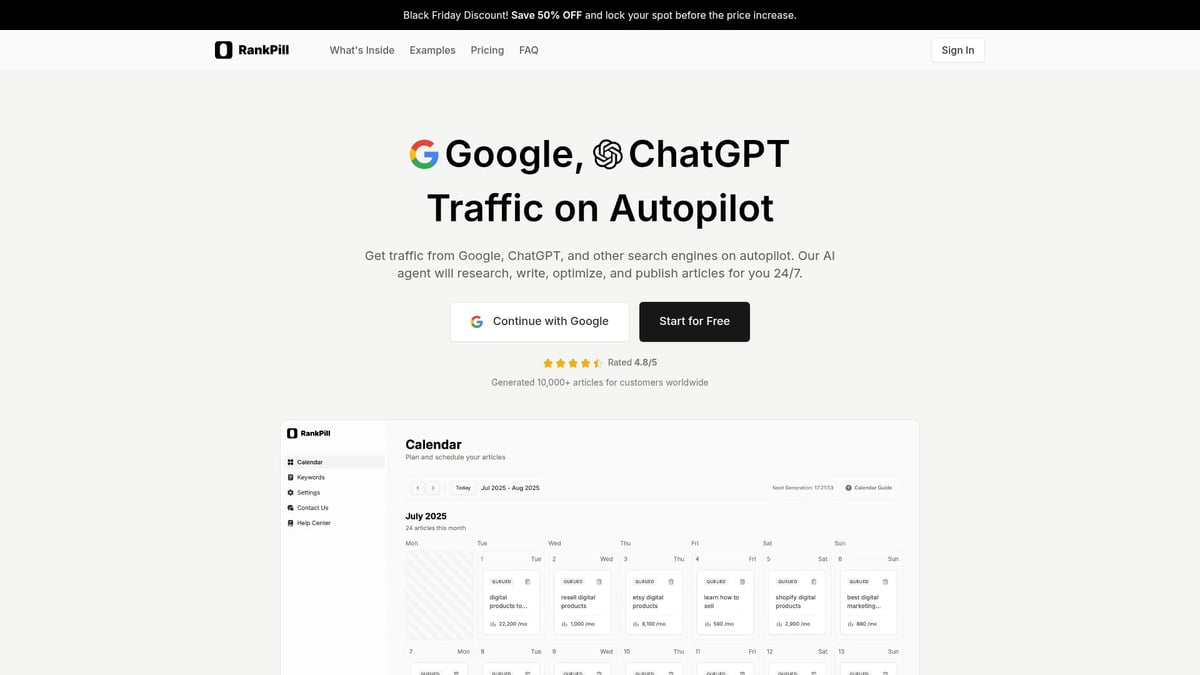
Automation tools offer personalized keyword targeting, topic ideation, and even daily article generation. Features such as auto-publishing, multilingual support, and real-time SEO scoring help maintain quality and consistency.
Small businesses and agencies especially benefit from these efficiencies, reporting significant gains in traffic and productivity. Embracing automation ensures your seo content strategy remains agile and scalable.
Creating SEO Content That Ranks in 2026: Step-by-Step Framework
Crafting seo content that consistently ranks in 2026 requires a precise, data-driven approach. The following framework breaks down each critical step, ensuring your content not only meets modern search demands but also outpaces competitors on AI and traditional platforms.

Step 1: Deep Audience & Persona Analysis
Understanding your audience is the foundation of successful seo content. Start by collecting data from analytics platforms, surveys, and CRM systems. These insights help you define detailed personas reflecting real user needs and behaviors.
Map out pain points, preferences, and the buyer’s journey for each persona. Use this information to personalize content, increasing engagement and dwell time. Remember, content that speaks directly to the reader’s intent is more likely to perform well in search.
Step 2: Topic Selection Based on Data & Trends
Effective seo content begins with topic selection rooted in data. Use tools like Google Trends and BuzzSumo to surface emerging subjects relevant to your audience. Monitor conversations on platforms such as Reddit and review competitor blogs for gaps and trending ideas.
Align chosen topics with both business objectives and user pain points. This ensures every piece of content serves a strategic purpose while matching current demand.
Step 3: Content Type & Format Selection
Selecting the right content type is essential for seo content success. Determine if your topic is best served as a guide, listicle, video, infographic, or interactive format. Match the content format to user intent and the search results page features you want to target.
Data shows that video content now appears in 65 percent of informational SERPs, making it a strong choice for many queries. Choose formats that maximize visibility and engagement.
Table: Matching Content Types to Intent
| Intent | Content Type | Example |
|---|---|---|
| Informational | Guide, Video | How-to, Tutorials |
| Transactional | List, Review | Top 10 Tools |
| Navigational | FAQ, Landing | Brand Pages |
Step 4: Comprehensive Content Creation
Creating authoritative seo content requires depth, originality, and value. Aim for articles exceeding 3,000 words to establish authority. Integrate visuals, up-to-date data, and expert quotes for added credibility.
Apply the “information gain” principle—offer unique insights not found elsewhere. Long-form content consistently earns more backlinks and trust. For advanced techniques, see this resource on advanced SEO content writing.
Step 5: On-Page SEO & User Optimization
On-page elements are critical to seo content performance. Place keywords strategically in titles, headers, meta tags, and naturally throughout the body. Organize content for clarity, using short paragraphs and bullet points for readability.
Enhance mobile user experience and ensure accessibility for all users. Internal and external linking boosts both SEO and user engagement. Well-optimized seo content increases both rankings and trust.
Step 6: Multimedia & AI Optimization
Modern seo content must leverage multimedia to stand out. Embed images, videos, and interactive elements to enrich user experience. Use schema markup to help search engines and AI platforms understand your content structure.
Optimize for AI engines by providing concise answers, clear headings, and structured data. Video transcripts and infographics can expand your content’s reach and visibility in SERPs and AI-generated results.
Step 7: Content Publishing & Promotion
Consistent publishing is vital for seo content strategy. Use editorial calendars and automation tools to schedule releases for optimal timing. Promote new content through social media, email newsletters, and targeted link-building outreach.
Maximize reach by repurposing content into different formats, such as infographics or short videos. A strategic promotion plan ensures your seo content continues to drive visibility and traffic long after publication.
Optimizing for AI Search Engines & Generative Platforms
The landscape for seo content is rapidly transforming as AI search engines and generative platforms reshape how information is discovered and ranked. To remain visible and authoritative, brands must adapt their optimization tactics for these new gatekeepers. Let us explore the actionable frameworks that will future-proof your seo content for AI-driven search.

Understanding How AI Engines Surface Content
AI search engines, powered by large language models (LLMs), now play a pivotal role in surfacing seo content. These engines select and cite content based on entity recognition, accuracy, and credibility. Unlike traditional search, AI platforms favor well-structured information that can be easily parsed and included in direct answers.
Content creators must prioritize clear entity definitions, concise facts, and robust trust signals. The right use of schema markup and structured data enhances discoverability, making it easier for LLMs to reference your seo content. For a deeper dive, see Optimizing for AI search engines, which covers essential best practices for AI-driven platforms.
Generative Engine Optimization (GEO) Best Practices
Generative Engine Optimization, or GEO, centers on tailoring seo content for snippetability and answer extraction. This means structuring information with direct, authoritative language and using clear headings for each intent-driven section. Well-formatted FAQs, how-to guides, and concise summaries are more likely to be cited by AI engines.
A table can help illustrate key GEO tactics:
| GEO Technique | Benefit |
|---|---|
| Clear headings | Improves AI parsing |
| Concise summaries | Boosts snippet inclusion |
| Structured data | Enhances content visibility |
For a strategic framework on GEO, consult Generative Engine Optimization Strategies, which outlines proven methods for achieving AI search visibility.
E-E-A-T Signals for AI & Search
Demonstrating E-E-A-T—Experience, Expertise, Authoritativeness, and Trustworthiness—is now essential for seo content to rank in AI and traditional search. LLMs assess content for author credentials, factual sourcing, and transparency. Including detailed author bios and citing reputable sources strengthens your content’s authority.
Showcasing real-world experience and unique insights further differentiates your seo content. Google’s E-E-A-T updates heavily influence rankings, so regularly update content to reflect the latest expertise and maintain trust with both users and AI platforms.
Building Digital Brand Presence Across AI Platforms
A strong digital brand presence ensures your seo content is referenced in AI-generated answers. Encourage citations and backlinks from authoritative sites to boost your visibility. Brands that actively participate in industry discussions and foster relationships with reputable sources are more likely to be mentioned by AI search engines.
Case studies show that consistent brand mentions across platforms enhance recognition and trust. Diversify your outreach to include forums, Q&A sites, and social channels, which increases the chances of your seo content being cited in LLM responses.
Technical Optimization for AI Discovery
Technical excellence is foundational for seo content in the AI era. Implement LLMs.txt files and structured data to make your site accessible to AI crawlers. Fast load times, mobile optimization, and secure protocols are critical ranking factors.
To ensure your seo content is AI-ready, use a technical SEO checklist. Regularly audit your site for crawl errors, schema implementation, and content freshness. These technical optimizations make it easier for AI engines to find, index, and surface your content in relevant search results.
Measuring, Analyzing & Iterating SEO Content Performance
Staying ahead in 2026 demands a rigorous approach to measuring, analyzing, and iterating seo content. The right metrics, tools, and adaptation strategies are vital for maintaining visibility and growth as search and AI platforms evolve.
Setting SEO Content KPIs for 2026
Defining the right KPIs is the foundation of any successful seo content strategy. In 2026, it is crucial to track not just traditional metrics but also those shaped by AI search and user behavior.
Key metrics include:
- Organic traffic growth and keyword rankings
- AI search mentions and featured answer placements
- Engagement rates, such as dwell time and scroll depth
- Conversion actions directly tied to seo content
Align each KPI with core business objectives. For example, if increasing brand authority is the goal, prioritize AI-driven visibility metrics and citation frequency alongside classic traffic indicators.
Leveraging Advanced Analytics & AI Tools
Modern analytics platforms are indispensable for monitoring seo content effectiveness. In addition to Google Search Console and Semrush, AI-powered dashboards now provide real-time insights into SERP features, user journeys, and AI-generated answer inclusions.
Leverage these tools to:
- Track rankings across traditional and AI search platforms
- Analyze competitor performance and spot emerging trends
- Monitor how seo content appears in AI Overviews and snippets
Custom reporting and automated alerts ensure you never miss critical shifts, allowing for proactive content strategy adjustments.
A/B Testing & Continuous Content Improvement
Iterative improvement is essential for seo content longevity. A/B testing headlines, calls-to-action, and content formats reveals what resonates best with evolving audiences and search engines.
Consider testing:
- Different meta titles and descriptions
- Visual elements, such as video embeds versus infographics
- Content structure, including FAQ sections for AI snippet optimization
Continuous updates based on performance data help maintain ranking stability. According to industry studies, this ongoing optimization leads to higher authority and sustained seo content success. For deeper insight into the balance between AI-generated and human-written content, refer to AI Writing's Influence on Web Content.
User Engagement & Behavioral Metrics
User engagement remains a primary indicator of seo content quality. Key behavioral metrics include bounce rate, average session duration, and scroll depth. These metrics reveal how effectively your content meets user needs and intent.
To optimize user engagement:
- Structure content for readability and scannability
- Integrate interactive elements to increase time on page
- Use clear internal linking to guide user journeys
Regularly reviewing these metrics allows you to identify content gaps and areas for improvement, ensuring your seo content continues to deliver value.
Adapting Strategy to Algorithm & Market Changes
The seo content landscape is constantly changing, driven by algorithm updates and AI advancements. Staying agile requires monitoring industry news, analyzing competitor adaptations, and rapidly updating strategies.
Steps to adapt effectively:
- Track algorithm and AI engine updates regularly
- Audit existing seo content for compliance with new ranking factors
- Pivot content formats and topics as user behavior shifts
For practical strategies on adapting to major changes, see this analysis of AI Overviews' Impact on Publishers. Proactive adaptation ensures your seo content remains competitive and visible across both search and AI-driven platforms.
As we’ve explored, succeeding with SEO content in 2026 means navigating AI-powered search, evolving algorithms, and fierce competition for organic visibility. If you’re ready to move from strategy to action and want a smarter, more efficient way to create content that actually ranks, you don’t have to do it alone. With RankPill, you can automate research, creation, and publishing—freeing up your time while ensuring your content stays ahead of the curve. Let’s put these expert strategies into practice together—Get Started and see how effortless SEO growth can be.
Unlock Traffic on Autopilot
Grow organic traffic on autopilot. RankPill will research, write, optimize, and publish articles to your website daily.
 WordPress