
Content Marketing ROI: Measure and Maximize Your Returns

Modest Mitkus
May 14, 2026
Understanding the financial impact of your content marketing efforts remains one of the most critical challenges facing marketers in 2026. While content continues to drive organic traffic and build brand authority, proving its value requires a systematic approach to measuring content marketing roi. Without clear metrics and attribution models, you're essentially creating content in the dark, unable to justify budgets or optimize your strategy for maximum returns.
Why Content Marketing ROI Matters More Than Ever
Business leaders demand accountability from every marketing dollar spent. Content marketing, despite its proven effectiveness, often struggles with measurement complexity compared to paid advertising channels. The average content marketing roi benchmark sits at 5:1, meaning for every dollar invested, businesses should expect five dollars in return.
However, measuring content marketing success involves tracking metrics across multiple touchpoints and customer journey stages. Content doesn't typically convert immediately. A prospect might read three blog posts, download two guides, and watch a webinar before finally requesting a demo months later.
The Business Case for Measurement
Organizations that track content marketing roi systematically outperform those that don't. According to industry statistics, companies with documented content strategies are 313% more likely to report success than those without clear measurement frameworks.
Beyond proving value to stakeholders, measuring returns helps you:
- Identify which content types generate the most revenue
- Allocate budget to high-performing channels and topics
- Eliminate wasteful spending on underperforming content
- Optimize your content calendar based on actual performance data
- Justify increased investment in content operations
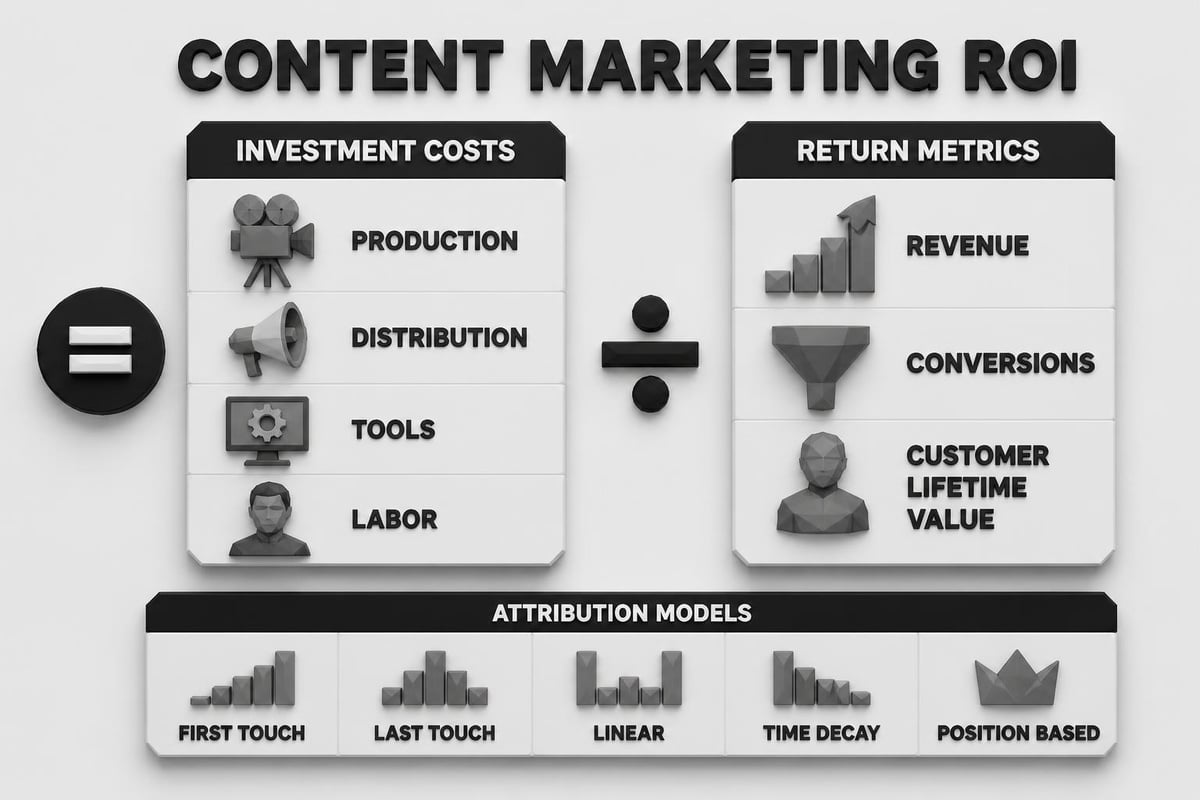
Calculating Content Marketing ROI: The Core Formula
The fundamental formula for content marketing roi follows the same structure as any return on investment calculation:
ROI = (Return - Investment) / Investment × 100
For content marketing specifically, this translates to:
Content Marketing ROI = (Revenue from Content - Content Marketing Costs) / Content Marketing Costs × 100
A result of 100% means you've doubled your investment. A 200% ROI indicates you've tripled it. Understanding this baseline calculation provides the foundation for more sophisticated attribution models.
Defining Your Investment Accurately
Content marketing costs extend far beyond writing articles. A comprehensive cost analysis includes:
| Cost Category | Components | Typical Percentage |
|---|---|---|
| Labor | Writers, editors, strategists, designers, SEO specialists | 40-50% |
| Tools & Software | SEO platforms, content management systems, analytics tools | 15-25% |
| Distribution | Paid promotion, email marketing platforms, social media ads | 20-30% |
| Production | Photography, videography, graphic design, stock assets | 10-15% |
Many organizations underestimate total costs by excluding internal salaries, tool subscriptions, or distribution expenses. This creates artificially inflated ROI numbers that don't reflect reality. For AI-powered approaches, platforms can significantly reduce labor costs while maintaining quality output.
Measuring Returns: Beyond Direct Revenue
Revenue attribution represents the most challenging aspect of calculating content marketing roi. Unlike paid ads with direct conversion tracking, content influences purchases across multiple touchpoints.
Consider these return metrics:
- Direct conversions: Sales directly attributed to content through last-click attribution
- Assisted conversions: Revenue where content played a supporting role in the customer journey
- Lead generation value: Qualified leads multiplied by average conversion rate and customer value
- Customer lifetime value: Long-term revenue from customers acquired through content
- Cost savings: Reduced spending on paid advertising or customer support
B2B companies with long sales cycles particularly struggle with attribution since content might influence a deal that closes nine months after initial engagement.
Key Performance Indicators That Predict ROI
Smart marketers track leading indicators that signal whether content will eventually drive returns. Rather than waiting months to measure revenue impact, these KPIs provide early warning signs and optimization opportunities.
Traffic and Engagement Metrics
Organic traffic growth serves as the foundation for content marketing roi. More qualified visitors create more conversion opportunities. Track these metrics monthly:
- Organic search traffic (overall and by content piece)
- Page views per session
- Average time on page
- Bounce rate by content type
- Return visitor percentage
Content that generates high traffic but poor engagement signals a mismatch between headlines and actual value delivered. Conversely, low traffic with high engagement indicates potential ranking opportunities through better keyword targeting.
Conversion Metrics
Every piece of content should move prospects closer to a purchase decision. Conversion tracking reveals which content actually drives business outcomes:
- Lead generation rate (form fills, email signups, demo requests)
- Content download conversions
- Progression to next funnel stage
- Conversion rate by content topic or format
- Cost per conversion compared to paid channels
Setting up proper conversion tracking requires connecting your content management system with analytics platforms and CRM tools. Many businesses lose attribution data in these handoffs, making accurate content marketing roi calculation impossible.
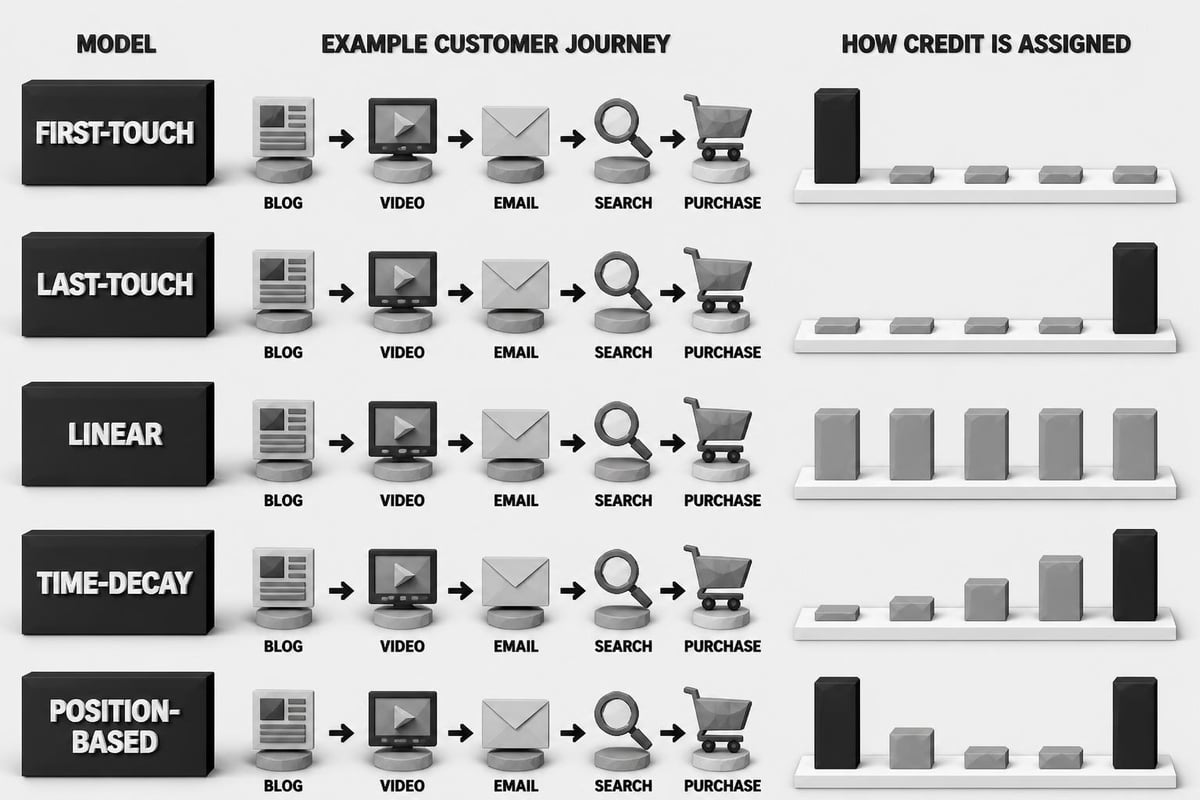
Attribution Models for Content Marketing
Choosing the right attribution model dramatically affects your content marketing roi calculations. Each model distributes credit differently across the customer journey.
Common Attribution Approaches
| Attribution Model | How Credit is Assigned | Best For |
|---|---|---|
| Last-touch | 100% credit to final interaction before conversion | Short sales cycles, direct response content |
| First-touch | 100% credit to initial discovery content | Brand awareness, top-of-funnel focus |
| Linear | Equal credit across all touchpoints | Understanding full journey impact |
| Time-decay | More credit to recent interactions | Medium-length sales cycles |
| Position-based | 40% first, 40% last, 20% distributed | Balancing awareness and conversion |
Most content marketing benefits from multi-touch attribution since prospects typically interact with multiple pieces before converting. Industry research shows that B2B buyers consume an average of 13 content pieces before making a purchase decision.
Implementing Multi-Touch Attribution
Advanced attribution requires technology that tracks user behavior across sessions and devices. Marketing automation platforms, CRM systems, and specialized analytics tools make this possible.
Start by identifying all content touchpoints in your customer journey. Map how prospects typically move from awareness to consideration to decision. Assign value to each stage based on historical conversion data and sales feedback.
For smaller businesses without enterprise attribution tools, simplified approaches work well. Track content interactions in your CRM manually or use UTM parameters consistently to understand which content sources drive the most valuable traffic.
Improving Your Content Marketing ROI
Once you've established baseline measurements, focus on optimization strategies that increase returns without proportionally increasing costs.
Content Quality Over Quantity
Publishing more content doesn't automatically improve content marketing roi. In fact, spreading resources too thin often decreases overall effectiveness. Focus on creating fewer, higher-quality pieces that genuinely serve audience needs.
Analyze your top-performing content to identify patterns:
- Which topics generate the most engagement and conversions?
- What content formats resonate best with your audience?
- Which distribution channels deliver the highest quality traffic?
- What content length and depth perform best in search results?
Automated SEO approaches help scale quality content production without the traditional cost barriers, allowing businesses to maintain consistency while improving ROI metrics.
Strategic Content Repurposing
One high-quality piece can generate returns across multiple channels and formats. A comprehensive guide becomes:
- Five social media posts highlighting key insights
- Three separate blog articles exploring specific subtopics
- One video walkthrough or webinar
- An email series breaking down main concepts
- An infographic visualizing key data points
This approach multiplies your content marketing roi by extracting maximum value from each production investment. The initial research and strategic thinking gets leveraged across numerous assets that reach different audience segments.
Distribution Optimization
Creating excellent content means nothing if your target audience never sees it. Strategic distribution accounts for 30-40% of content marketing success, yet many organizations invest 90% of resources in creation and only 10% in promotion.
Effective distribution strategies include:
- SEO optimization: Ensuring content ranks for relevant search queries
- Email marketing: Sharing new content with existing subscribers and leads
- Social media: Posting strategically on platforms where your audience engages
- Paid promotion: Boosting top-performing content to expand reach
- Influencer outreach: Getting industry voices to share and link to your content
- Content syndication: Republishing on relevant third-party platforms
Track distribution channel performance separately to understand which investments drive the best returns. You might discover that LinkedIn generates 10x more qualified leads than Twitter, suggesting a reallocation of promotional resources.
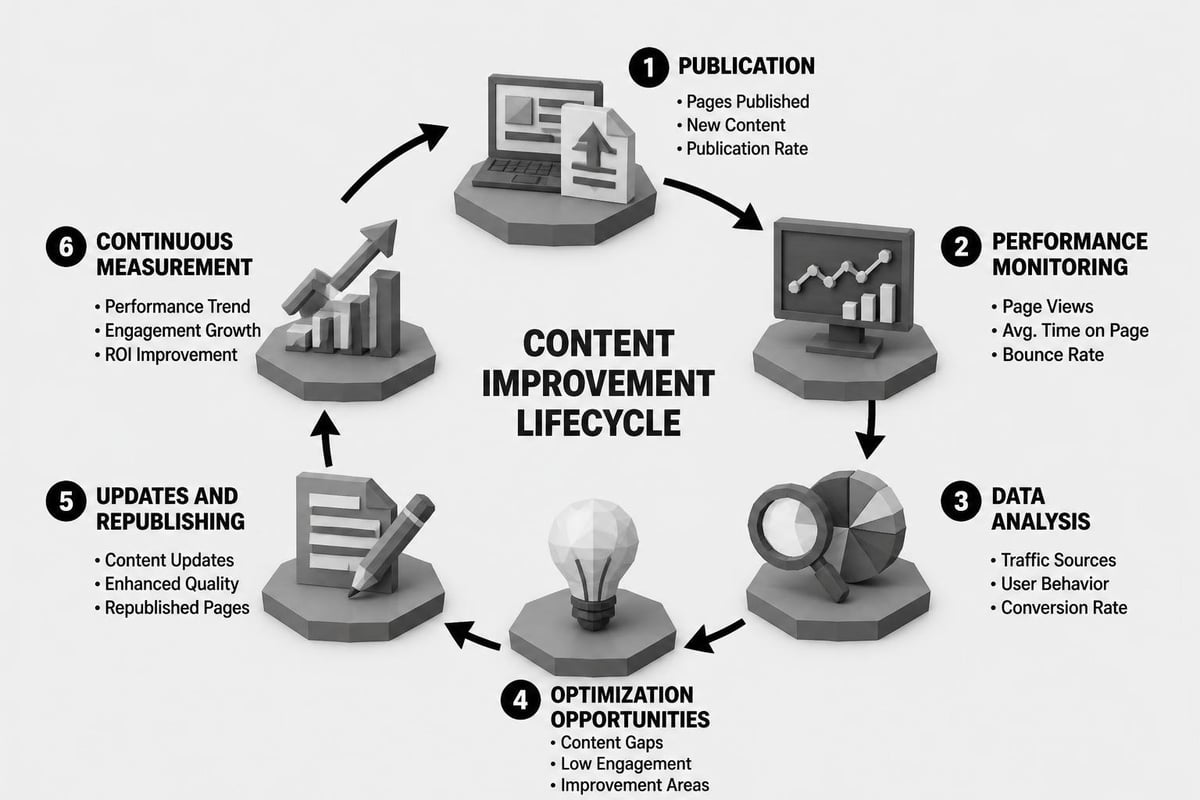
Advanced Strategies for Maximizing Returns
Sophisticated content marketers look beyond basic ROI calculations to unlock additional value from their content investments.
Content Refresh and Update Strategy
Existing content represents sunk costs, but refreshing high-performing pieces generates new returns with minimal additional investment. Research indicates that updating and republishing content can increase organic traffic by 106% on average.
Identify refresh candidates by analyzing:
- Articles that previously ranked well but have declined
- Evergreen topics with outdated statistics or examples
- High-traffic pages with poor conversion rates
- Content targeting keywords you now rank for on page two or three
Updating requires significantly less effort than creating new content from scratch, often improving content marketing roi by 200-300% compared to the original publication.
Competitive Content Analysis
Understanding what content drives results for competitors reveals opportunities and gaps in your own strategy. Analyze competitor content performance to identify:
- High-value keywords they rank for that you don't
- Content formats that generate significant engagement in your niche
- Distribution strategies that extend their content reach
- Topics that resonate with your shared target audience
This intelligence helps allocate resources toward content with proven demand, reducing the risk of investing in topics that won't generate returns.
Personalization and Segmentation
Generic content serves generic audiences and generates generic results. Segmenting content by audience persona, industry, company size, or journey stage increases relevance and conversion rates.
Personalized content experiences show dramatically higher engagement:
- 42% higher email open rates
- 74% higher click-through rates
- 19% faster sales cycles
- 20% higher customer satisfaction scores
The increased production complexity of personalized content gets offset by significantly improved conversion rates, ultimately enhancing content marketing roi. Modern AI platforms make this personalization scalable without proportional cost increases.
Common ROI Measurement Mistakes to Avoid
Even experienced marketers fall into traps that distort content marketing roi calculations and lead to poor strategic decisions.
Ignoring Long-Term Value
Content assets appreciate over time, unlike paid advertising that stops generating returns the moment you stop spending. A well-optimized blog post published today might drive traffic and conversions for years.
Industry benchmarks show that 76% of blog traffic comes from articles published more than 30 days ago. Evaluating content marketing roi over quarterly or annual periods dramatically undervalues the true long-term returns.
Calculate lifetime content value by tracking performance over 12-24 months, not just the first few weeks after publication. This longer view reveals which content types and topics deliver sustained returns.
Inconsistent Tracking and Attribution
Switching attribution models mid-campaign or failing to track consistently across time periods makes valid ROI comparisons impossible. Establish measurement standards and stick with them for at least six months before making changes.
Document your methodology clearly so all stakeholders understand what's being measured and how. This prevents confusion when presenting results and ensures everyone evaluates content marketing roi using the same framework.
Comparing Content to Direct Response Channels
Content marketing serves different purposes than paid search or display advertising. Expecting identical conversion rates or immediate returns ignores the fundamental differences in how these channels work.
Content builds authority, captures early-stage demand, and influences consideration over time. Direct response channels convert existing intent immediately. Both deserve investment, but measuring them against identical benchmarks misses the point.
Instead, compare content marketing roi against:
- Historical content performance (are we improving?)
- Industry benchmarks for similar businesses
- Total customer acquisition costs across all channels
- Blended CAC when content is included versus excluded
Building a Sustainable Content ROI Framework
Long-term content marketing success requires systematic measurement processes, not one-time calculations.
Monthly Reporting Cadence
Establish monthly reporting that tracks both leading and lagging indicators. Leading metrics predict future performance, while lagging metrics confirm actual results.
Your monthly content marketing roi dashboard should include:
- Production metrics: Content published, topics covered, formats created
- Traffic metrics: Organic visitors, page views, engagement rates
- Conversion metrics: Leads generated, MQLs, opportunities created
- Revenue metrics: Revenue attributed to content, customer acquisition costs
- Efficiency metrics: Cost per piece, cost per conversion, ROI percentage
Reviewing these metrics monthly reveals trends before they become problems and highlights opportunities for optimization.
Quarterly Strategy Reviews
Every quarter, step back from tactical metrics to evaluate strategic performance. Ask critical questions about your content marketing roi:
- Are we investing in the right content types and topics?
- Which distribution channels deserve more or less budget?
- How does our content performance compare to competitors?
- What emerging opportunities should we pursue?
- Where should we reduce or eliminate investment?
These quarterly reviews inform content calendar planning, budget allocation, and strategic pivots that keep your content marketing roi improving over time.
Technology Stack Optimization
The tools you use to create, distribute, and measure content directly impact both costs and returns. Many organizations pay for redundant tools or lack critical capabilities that would improve efficiency.
Audit your content technology stack annually to ensure you're getting maximum value. Modern platforms that automate content creation and SEO can dramatically reduce labor costs while maintaining or improving quality. For businesses looking to scale their content operations efficiently, SEO automation eliminates manual bottlenecks that traditionally limited content production volume. This automation approach allows companies to publish consistently without proportionally increasing headcount, fundamentally improving the cost side of the ROI equation.
Team Skill Development
Your team's capabilities directly influence content marketing roi. Investing in training and development improves both content quality and production efficiency.
Focus skill development on:
- SEO fundamentals: Understanding search intent and optimization best practices
- Data analysis: Interpreting performance metrics and identifying actionable insights
- Content strategy: Connecting content to business objectives and customer needs
- Distribution tactics: Maximizing reach through owned, earned, and paid channels
- Conversion optimization: Improving how content drives desired actions
Better-skilled teams produce higher-performing content more efficiently, improving returns without necessarily increasing investment.
Industry Benchmarks and Realistic Expectations
Understanding typical content marketing roi by industry helps set realistic goals and identify when your performance falls significantly above or below standards.
B2B vs. B2C Performance
Business-to-business content marketing typically shows different patterns than business-to-consumer:
| Metric | B2B Average | B2C Average |
|---|---|---|
| ROI Multiple | 4:1 to 5:1 | 3:1 to 4:1 |
| Time to Positive ROI | 6-9 months | 3-6 months |
| Cost per Lead | $35-$75 | $10-$25 |
| Conversion Rate | 2-5% | 5-10% |
B2B content marketing roi takes longer to materialize but often delivers higher lifetime customer value. B2C shows faster returns but typically lower per-customer revenue. Benchmark data helps contextualize your performance against similar businesses.
Content Type Performance Variations
Different content formats show varying ROI profiles:
- Blog posts: Consistent long-term returns, lower production costs, scalable
- Video content: Higher production costs, excellent engagement, strong social performance
- Ebooks and guides: High conversion rates, longer production time, valuable for lead generation
- Case studies: Strong influence on purchase decisions, requires customer cooperation
- Infographics: Highly shareable, good for backlinks, moderate production costs
- Podcasts: Building audience takes time, strong loyalty once established, recurring production
Match your content mix to business objectives rather than chasing the highest ROI format. A balanced portfolio typically outperforms putting all resources into a single content type.
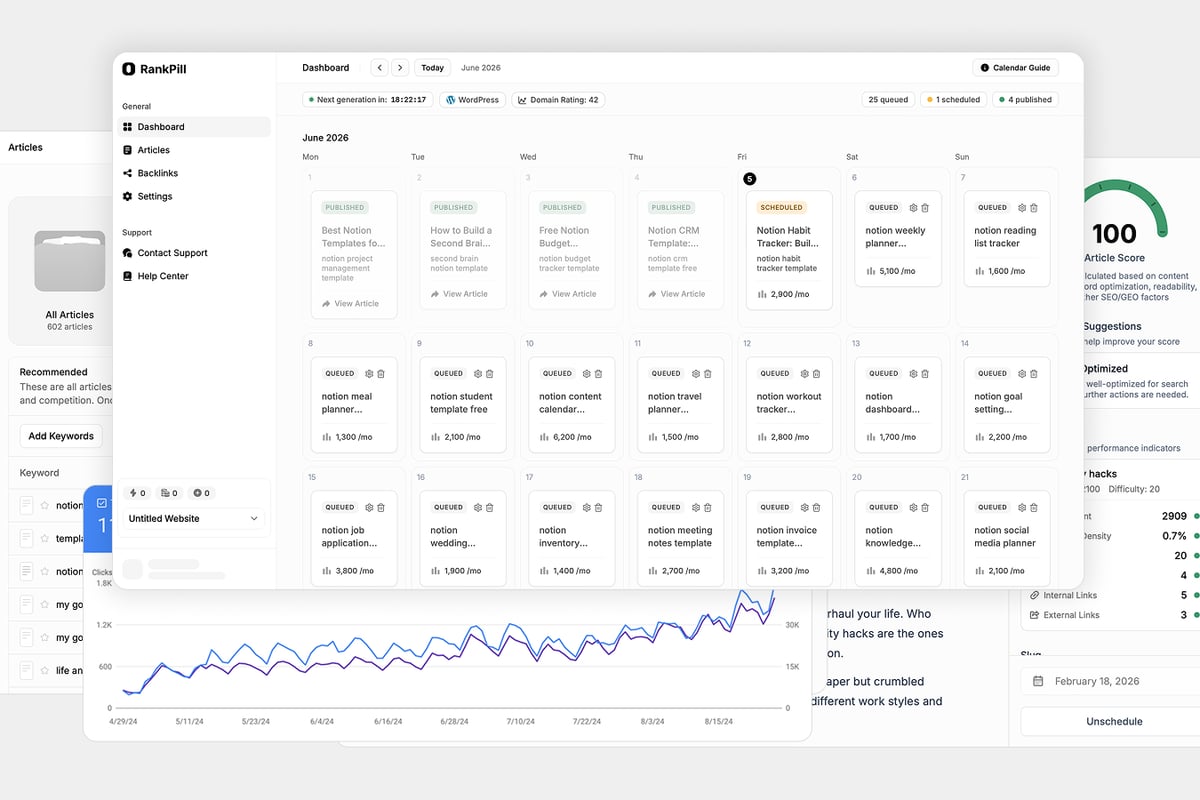
Measuring and optimizing content marketing roi transforms content from a cost center into a proven revenue driver that justifies continued investment. By implementing systematic measurement frameworks, choosing appropriate attribution models, and continuously optimizing based on performance data, you'll build a content engine that delivers predictable, scalable returns. RankPill automates the entire SEO content creation process, from keyword research through publishing, helping businesses maximize their content marketing roi by reducing production costs while maintaining quality and consistency that drives organic traffic growth.