
Backlink Monitoring Tools: What They Track and Why

Modest Mitkus · October 30, 2026
Your link profile changes every day. New sites link to you, old links disappear, competitors build links faster than you do. Backlink monitoring tools automate the tracking so you know what's happening and can act before problems snowball. They crawl the web, find who's linking to your site, and alert you to gains, losses, and quality shifts. For founders running lean SEO operations, these tools turn what used to be a manual spreadsheet into a daily dashboard. This article explains how backlink monitoring tools work, which metrics actually matter, and how to pick one that fits your workflow and budget.
How Backlink Monitoring Tools Crawl and Index Links
Backlink monitoring tools operate their own web crawlers, separate from Google's. These bots visit billions of pages, identify outbound links, and store them in massive databases. When you add your domain, the tool scans its index for every URL pointing to your site. The freshness of that index determines how quickly you see new links.
Most tools crawl the web continuously, but update individual sites on different schedules. Premium tiers refresh your backlink profile daily. Budget plans might update weekly or monthly. The lag matters if you're running outreach campaigns or competitive campaigns and need to verify links quickly.

Key crawling metrics to check:
- Index size (how many domains the tool's crawler has visited)
- Update frequency (how often your specific profile refreshes)
- Historical data depth (how far back you can track link changes)
- Coverage of non-English and regional sites
Google's documentation on crawlable links explains what search engines can and cannot follow, which helps you understand what monitoring tools detect versus what they miss.
Tools with larger indexes catch more links, but size alone doesn't guarantee quality. A smaller, well-maintained index that updates daily often beats a stale database with trillions of URLs.
Metrics That Actually Matter in Link Monitoring
Backlink count is the most visible number, but it's also the least useful on its own. A hundred links from spam directories hurt more than they help. A single link from a trusted publication in your niche moves the needle. The metrics below separate signal from noise.
Domain Authority and Trust Scores
Most tools assign a proprietary score to each referring domain. Moz calls it Domain Authority. Ahrefs uses Domain Rating. Semrush has Authority Score. These numbers estimate how much link equity a domain passes. Higher scores mean the link carries more weight.
Trust scores layer on spam detection. They flag sites with unnatural link patterns, thin content, or known manipulation tactics. A link from a DR 70 site with a low trust score is a red flag, not a win.
| Metric | What It Measures | Why It Matters |
|---|---|---|
| Domain Rating / Authority | Link equity strength | Prioritizes outreach targets and audits |
| Trust / Spam Score | Quality and manipulation risk | Filters toxic links before disavow |
| Referring Domains | Unique sites linking to you | Better indicator than total backlinks |
| Link Velocity | New links gained per week | Tracks campaign momentum |
Anchor Text Distribution
Anchor text is the clickable words in a link. Natural link profiles show variety: branded anchors, naked URLs, generic phrases like "click here," and a small percentage of exact-match keywords. Unnatural profiles skew heavily toward exact-match commercial keywords.
Monitoring tools track anchor text ratios and flag patterns that look manipulative. If 60% of your links use the same keyword phrase, that's a penalty risk. Healthy profiles stay under 10% for any single exact-match anchor.
You want to see:
- 40-50% branded or domain name anchors
- 20-30% naked URLs and generic text
- 10-15% topical or partial-match phrases
- Under 10% exact-match commercial keywords
Link Context and Placement
Where a link appears on a page changes its value. Links in the main content body pass more equity than footer or sidebar links. Links surrounded by relevant text perform better than isolated links in lists.
Advanced tools analyze placement and context. They flag footer links, author bio links, and sitewide links separately. This helps you understand which links actually contribute to rankings versus which are just noise in your profile.
Tracking New Links and Lost Links
The most practical use of backlink monitoring tools is daily change tracking. You get alerts when new links appear or old links disappear. This matters for several reasons.
New link alerts let you:
- Verify outreach results within 24-48 hours
- Spot unsolicited press mentions and amplify them
- Identify competitor tactics you can replicate
- Catch negative SEO attacks early
Lost link alerts help you:
- Reach out to restore valuable links before they hurt rankings
- Identify patterns (site migrations, expired content) causing link loss
- Track link rot and plan for long-term link decay
According to Pew Research Center's 2024 report on disappearing online content, 38% of links from 2013 no longer work in 2024. Persistent monitoring catches these losses before they compound.

Most tools send email or Slack alerts. You can set thresholds: notify me only if the link is from a domain with DR 30 or higher. This cuts noise and keeps alerts actionable.
Competitor Link Analysis and Gap Identification
Every backlink monitoring tool doubles as competitive intelligence. You add competitor domains and see their full link profiles. This reveals opportunities you're missing.
What competitor analysis shows:
- Referring domains linking to them but not to you
- Content topics that attract links in your niche
- Guest post targets and partnership sites
- Link velocity trends (are they building faster than you?)
Link gap reports automate this. The tool compares your profile to 3-5 competitors and generates a list of domains linking to multiple competitors but not to you. Those domains already cover your niche, making them high-probability outreach targets.
Search Engine Journal's 2026 audit guide recommends running competitor link audits quarterly. New competitors enter, old ones pivot, and link landscapes shift. Quarterly checks keep your target list fresh.
Disavow File Management and Toxic Link Cleanup
Google's disavow tool lets you tell the search engine to ignore specific backlinks. You upload a text file listing URLs or domains you want disavowed. Backlink monitoring tools automate the process of identifying which links to disavow.
Toxic link detection uses spam scores, anchor text patterns, and domain trust signals. Tools flag links from:
- Known link farms and private blog networks
- Sites with unnatural link velocity spikes
- Domains with thin or duplicate content
- Sites flagged for malware or phishing
You review the flagged links, mark them for disavow, and the tool generates the file. Some tools submit it to Google Search Console automatically. Others let you download and upload manually.
Red flags that justify disavowal:
- Links from adult, gambling, or pharmacy sites unrelated to your niche
- Exact-match anchor text from low-quality directories
- Sitewide footer or sidebar links from irrelevant sites
- Links from domains with 50%+ spam score
Academic research on link spam, including the Stanford TrustRank paper, shows that proximity to trusted seed sites matters more than raw link counts. Tools that incorporate trust propagation algorithms catch manipulation patterns simple spam scores miss.
Backlink Verification and Outreach Pipeline Tracking
If you're building links through outreach, monitoring tools close the loop. You send a pitch, the publisher agrees, they publish your guest post. Two weeks later, your tool confirms the link is live and indexed.
Verification answers three questions:
- Did the link go live?
- Is it dofollow or nofollow?
- Did they use the anchor text you requested?
Some tools integrate with outreach platforms. You log a prospect, track emails, and automatically check for the link once the article publishes. This keeps your outreach pipeline in one place instead of scattered across spreadsheets and email threads.
| Feature | Basic Plan | Pro Plan | Enterprise Plan |
|---|---|---|---|
| Link verification | Weekly | Daily | Hourly |
| Historical tracking | 6 months | 2 years | Unlimited |
| Competitor monitoring | 3 domains | 10 domains | Unlimited |
| Disavow automation | Manual | Semi-auto | Fully automated |
Pipeline tracking also helps with earned media. When a journalist mentions your brand, the tool catches it. You can follow up, share the article, and turn a single mention into more visibility.
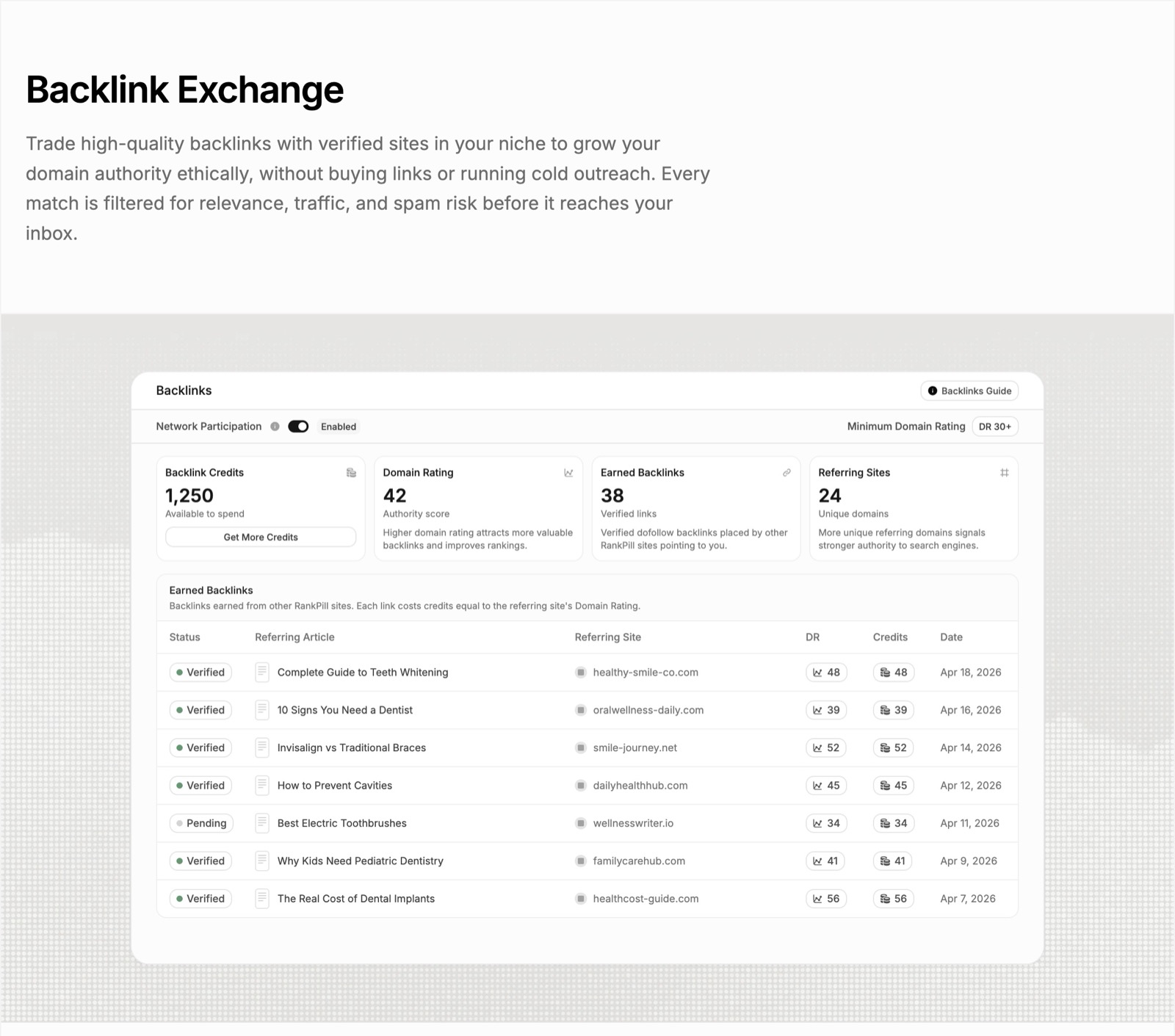
Building backlinks at scale requires both outreach and verification. RankPill's Backlink Exchange automates link building by trading links between verified sites in your niche, with matches filtered for relevance, traffic, and spam risk. Every plan includes 30 backlink credits per month, and each earned link costs credits equal to the referring site's Domain Rating.
Integration with SEO Dashboards and Reporting Tools
Backlink data lives alongside keyword rankings, traffic trends, and technical audits. Most monitoring tools integrate with Google Analytics, Google Search Console, and SEO platforms like Screaming Frog or Sitebulb. This centralizes reporting.
Integrations let you:
- Overlay link gains with traffic spikes to measure impact
- Correlate lost links with ranking drops
- Pull backlink metrics into client reports automatically
- Trigger alerts in Slack or project management tools
API access is critical for agencies and teams running custom workflows. You can pull fresh data into dashboards, automate monthly reports, or feed link data into internal CRMs.
TechRadar's 2026 SEO tool roundup notes that the best backlink tools are often modules within broader SEO suites, not standalone products. If you already use an all-in-one platform, the built-in link monitor might be enough.
Advanced Use Cases Beyond SEO
Backlink monitoring isn't just for ranking higher. Researchers, intelligence analysts, and brand teams use link data for entirely different purposes.
Non-SEO applications:
- Tracking misinformation spread by analyzing which sites amplify false claims
- Mapping influence networks in academia or journalism
- Monitoring brand mentions and sentiment across the web
- Investigating coordinated inauthentic behavior in propaganda campaigns
A 2024 AAAI paper on webgraph-based detection demonstrates how link structures reveal coordinated networks. The same tools SEOs use to find guest post opportunities can identify bot farms or influence operations.
Security and intelligence practitioners have adopted backlink analysis for provenance tracking and source verification. If a suspicious domain suddenly gains links from dozens of newly registered sites, that pattern flags coordination.
These use cases require the same core features: crawl coverage, historical data, and relationship mapping. The difference is interpretation, not tooling.

Choosing the Right Backlink Monitoring Tool for Your Workflow
Your choice depends on budget, team size, and how you build links. Solo founders need different features than agencies managing 50 client sites.
Questions to answer before choosing:
- How many domains do you need to track?
- Do you run active outreach, or just monitor organic growth?
- Do you need competitor analysis, or just your own profile?
- How often do you need fresh data?
Budget tools work if you're monitoring one site, checking once a week, and not running aggressive link building. You'll get the basics: referring domains, anchor text, and spam scores.
Mid-tier tools add daily updates, competitor tracking, and integrations. This is the sweet spot for founders and small teams who want visibility without enterprise pricing.
Enterprise tools offer unlimited domains, hourly updates, API access, and white-label reporting. Agencies and in-house teams managing large portfolios pay for these features.
Microsoft's SEO checklist for entrepreneurs emphasizes starting with one or two tools and expanding as you scale. Don't pay for features you won't use in the first six months.
Common Pitfalls and How to Avoid Them
Even experienced SEOs make mistakes with backlink monitoring. These errors waste time or lead to bad decisions.
Mistake 1: Obsessing over total backlink count
Total links include duplicates, sitewide links, and low-value footer links. Focus on unique referring domains instead. Ten links from ten different DR 50 sites beat a thousand links from one domain.
Mistake 2: Disavowing too aggressively
Google ignores most spam automatically. Disavowing legitimate links by mistake can hurt rankings. Only disavow when you're certain a link is toxic and manual action is likely.
Mistake 3: Ignoring lost links
Link rot is real. A Pew study found that 8% of links disappear every year. Set up lost link alerts and reach out to restore high-value links.
Mistake 4: Not tracking competitors
You can't outpace competitors if you don't know what they're doing. Add at least three competitors and review their link gains monthly.
Mistake 5: Relying on a single metric
No single score (DA, DR, Trust) tells the full story. Look at anchor text, link velocity, and placement together. Context beats any individual number.
Automation and Workflow Integration
Manual backlink checks don't scale. Automation turns monitoring into a background task that only surfaces actionable changes.
Set up weekly digests instead of daily alerts. Most links don't require immediate action. A weekly summary keeps you informed without inbox overload.
Use conditional alerts for high-priority changes:
- New link from a domain with DR 60+
- Lost link from a domain you've explicitly marked as valuable
- Spike in toxic links (10+ in a single day)
Integrate with your content calendar. If you publish a new guide on Tuesday, set a reminder to check for new links two weeks later. Organic links from that content should start appearing.
For agencies, white-label reporting saves hours. You set up templates, the tool pulls fresh data, and clients get branded PDFs every month. No manual exports or reformatting.
Founders building SEO as a growth channel benefit from automation that pairs content creation with link monitoring. RankPill's SEO automation runs the full pipeline in the background: it finds keywords, writes articles, publishes daily, and builds backlinks, so you can focus on product and customers instead of managing writers or tracking links manually.
How Monitoring Fits into a Broader SEO Strategy
Backlink monitoring is one piece of a larger system. It works best when paired with keyword tracking, content publishing, and technical audits.
A complete SEO stack includes:
- Keyword research to find what to target
- Content creation to publish resources worth linking to
- Backlink monitoring to track and verify link growth
- Rank tracking to measure impact on visibility
- Technical audits to catch indexing or crawl issues
Monitoring without content is pointless. You need assets that attract links. Monitoring without keyword tracking leaves you guessing whether links actually move rankings.
Build a quarterly review cycle. Check your link profile, keyword rankings, and traffic together. Look for patterns: did a link spike correlate with a ranking jump? Did lost links cause a drop? This feedback loop improves your link building over time.
For practical guidance on integrating monitoring into your workflow, building backlinks systematically requires tracking what works and doubling down on those tactics.
Backlink monitoring tools give you visibility into who's linking to you, which links matter, and where your profile has gaps or risks. The best tools update daily, integrate with your SEO stack, and surface actionable changes without overwhelming you. For founders and small teams who want steady organic growth, pairing link monitoring with consistent content publishing creates compounding returns. RankPill handles both: it researches keywords, publishes 3,000+ word articles daily, and builds backlinks through its exchange, so you grow Google and ChatGPT traffic without hiring writers or agencies. Plans start at $99/month with a 90-day money-back guarantee if traffic hasn't grown.
Unlock Traffic on Autopilot
Grow organic traffic on autopilot. RankPill will research, write, optimize, and publish articles to your website daily.
 WordPress