
Blog Examples: Formats, Styles & Real Case Studies

Modest Mitkus · November 1, 2026
Studying blog examples is faster than guessing what works. You see real structure, real formatting, real results. The best examples show how other founders solve the same problems you face: turning research into content, getting Google to rank it, and keeping readers on the page long enough to take action. This article breaks down blog examples by format, industry, and purpose so you can pick what fits your business and skip what doesn't.
Why Blog Examples Matter More Than Templates
Templates give you placeholders. Examples show you decisions.
When you look at a live blog that ranks on page one, you see what that writer chose to emphasize, how they balanced detail against readability, and where they placed calls to action. You see the trade-offs. A 500-word guide might rank if the keyword has low competition, but a 3,000-word deep dive usually wins when buyers are comparing solutions.
Blog examples also reveal what Google rewards today. Search updates in 2026 prioritize experience, expertise, and helpfulness, as outlined in Google's documentation updates. That means citing sources, linking to data, and writing from a position of real knowledge.
What separates high-performing blog examples from filler
High-performing blogs answer the question faster, then go deeper. They use subheadings that match what people search. They include tables, lists, and images to break up text. They link to related content without sending readers away too early.
Filler blogs repeat the same point in different words. They bury the answer. They use vague phrases like "industry-leading" or "comprehensive solution" without showing proof.
The difference shows up in time on page, scroll depth, and whether readers click through to your product.
Common Blog Formats and When to Use Each
Different formats solve different problems. Picking the right one depends on search intent, not personal preference.
How-to and tutorial blogs
How-to blogs walk readers through a process step by step. They work when someone searches "how to [do a task]" and expects a clear answer.
Structure:
- Short intro that promises a specific outcome
- Numbered steps with subheadings
- Screenshots or examples at each step
- A summary or next steps at the end
Example: A post titled "How to Set Up Google Analytics 4 in 15 Minutes" would list every click, every menu, every setting. No filler. Just the path from zero to done.
These posts rank well because they match high-intent searches. People want the answer, not a preamble.
Listicles and roundup posts
Listicles organize information into numbered or bulleted lists. They work for comparisons, tool recommendations, and collections of tips.
| Format | Best for | Example title |
|---|---|---|
| Numbered list | Rankings, ordered steps | "7 SEO Tools for Startups Under $100/Month" |
| Bulleted list | Feature comparisons, tips | "Email Marketing Best Practices for SaaS" |
| Roundup | Product/service reviews | "12 Notion Templates for Content Teams" |
Listicles are easy to scan and easy to update. You can add a new item each quarter without rewriting the whole post. They also perform well when someone searches "[number] + [topic]" or "best [tools/tips/examples] for [goal]."

Case studies and success stories
Case studies show real results from real customers. They work when buyers are evaluating solutions and need proof that your product delivers.
Structure:
- Customer background and problem
- What they tried before
- How they used your product
- Specific results with numbers
- Optional: a quote or testimonial
Example: "How [Company Name] Cut Content Costs by 60% with Automated SEO" would include the tools they replaced, the workflow before and after, and the traffic or revenue increase over three months.
These posts convert better than feature lists because they answer "will this work for someone like me?" with evidence. GitHub's corporate blog redesign is a strong case study example that ties strategy to measurable outcomes.
Opinion and thought leadership posts
Opinion posts take a position on a trend, tool, or strategy. They work when you have expertise that differentiates your brand or when you want to start a conversation.
These posts need a clear thesis in the first paragraph, supporting arguments with subheadings, and examples or data to back up each claim. They rank when the topic is timely and when other sites link to them as a reference.
Avoid vague statements. "AI will change SEO" is not a thesis. "Why AI-generated content needs human editors to rank in 2026" is.
Blog Examples by Industry and Audience
Format matters, but so does audience. A blog for developers looks different than a blog for ecommerce founders.
SaaS and B2B software blogs
SaaS blogs target founders, product managers, and technical buyers. They focus on solving workflow problems and comparing tools.
Common topics:
- Integration guides
- Feature comparisons
- Use cases by role or team size
- Data-driven case studies
Example structure: A post titled "Webflow vs. WordPress for SaaS Landing Pages" would compare speed, CMS flexibility, hosting, and cost in a table, then explain which fits which use case.
SaaS readers want specifics. They compare features in tabs. They check whether a tool integrates with their stack before they read the rest of the post.
Ecommerce and retail blogs
Ecommerce blogs focus on product education, buying guides, and content that ranks for transactional keywords.
| Blog type | Goal | Example |
|---|---|---|
| Buying guide | Rank for "[product type] for [use case]" | "Best Running Shoes for Flat Feet" |
| Product comparison | Own comparison searches | "Shopify vs. WooCommerce for Print-on-Demand" |
| How-to with product tie-in | Show product in use | "How to Style a Capsule Wardrobe with 10 Pieces" |
These posts often link directly to product pages. The content educates, the internal links convert.
Agency and service provider blogs
Agencies use blogs to demonstrate expertise and attract inbound leads. The best examples show process, results, and transparency.
Common formats:
- Client case studies with before/after metrics
- Industry trend analysis
- Process breakdowns (e.g., "Our 6-Step Website Redesign Process")
- Tool recommendations and stack reviews
Agency blogs compete on trust. Publishing detailed case studies, audits, or frameworks signals that you know the work and aren't hiding behind jargon.

What Makes a Blog Example Worth Studying
Not every high-traffic blog is worth copying. Some rank because of domain authority, backlinks, or legacy content. You want examples that succeed because of structure and execution.
Look for clear search intent match
The best blog examples answer the search query in the first 200 words, then expand. If someone searches "how to build backlinks," they don't want a history of SEO. They want methods.
Check whether the title, H2s, and intro align with what Google shows in the "People also ask" section. That reveals what the algorithm thinks the searcher wants.
Check readability and formatting
Walls of text lose readers. High-performing blogs use:
- Short paragraphs (2-4 sentences)
- Subheadings every 200-300 words
- Bullet lists for scannability
- Bold text to emphasize key terms
- Tables for comparisons
Google's guidance on page experience ties readability, mobile usability, and Core Web Vitals to ranking. If a blog is hard to read on mobile or slow to load, it won't rank.
Evaluate internal and external linking
Strong blog examples link to related content on the same site and credible external sources. Internal links keep readers on your site and help Google understand your content structure. External links signal that you researched the topic and aren't just guessing.
Look for:
- 3-5 internal links per post
- 2-4 external links to authoritative sources
- Descriptive anchor text (not "click here")
Assess originality and depth
Generic advice doesn't rank anymore. The best examples add something new: original research, a unique framework, or a perspective that challenges the default wisdom.
Depth matters too. A 500-word post on "how to make money blogging" won't outrank a 3,000-word guide that covers monetization methods, realistic timelines, and case studies with numbers.
How to Apply Blog Examples to Your Content Strategy
Studying examples is step one. Applying what you learn is step two.
Map formats to your keyword list
Look at your target keywords and assign a format to each one. Informational keywords ("what is X") usually need explainer posts. Transactional keywords ("best X for Y") need listicles or comparisons. Navigational keywords ("X review") need in-depth product breakdowns.
If you already track keywords, tag them by format. If you're just starting, a keyword research tool that groups keywords by topic and intent saves hours of manual work.
Adapt structure without copying
Take the structure from a high-ranking example, but write your own content. If a competitor's "10 Tips for X" post ranks, your version might be "12 Tips for X" or "10 Tips for X (with Real Examples)."
Change the angle. Add your experience. Update outdated advice. Google rewards helpfulness, not templates.
Test and refine based on performance
Publish the post, wait 30 days, then check:
- Impressions and clicks in Google Search Console
- Time on page and scroll depth in analytics
- Internal link clicks and conversions
If a post gets impressions but no clicks, rewrite the title and meta description. If it gets clicks but high bounce rate, improve the intro or add more formatting.
Every post is a test. The examples you study show what worked for someone else. Your analytics show what works for your audience.
Real Blog Examples You Can Learn From Today
Here are specific blogs worth studying, sorted by what they do well.
Content marketing and strategy blogs
Content Marketing Institute's top 40 list curates high-quality content blogs across industries. These examples show professional formatting, strong storytelling, and consistent publishing.
What to study:
- How they structure long-form guides
- Their use of original research and data
- The balance between educational and promotional content
Platform and tool comparison blogs
TechRadar's guide to blogging platforms is a neutral, well-researched comparison. It covers WordPress, Ghost, Squarespace, and others with pros, cons, and use cases.
What to study:
- How they organize comparison tables
- The way they explain trade-offs without bias
- Their use of subheadings to segment audiences (e.g., "Best for beginners" vs. "Best for developers")
SEO and technical blogs
SEO blogs succeed when they combine depth with clarity. Posts that rank for competitive keywords like "how to generate SEO" or "how to build backlinks" typically include step-by-step processes, tool recommendations, and examples.
What to study:
- How they cite sources and link to data
- The way they break down complex topics into simple steps
- Their use of screenshots and annotated images

Common Mistakes in Blog Examples (and How to Avoid Them)
Even high-ranking blog examples make mistakes. Knowing what to skip saves time.
Keyword stuffing and unnatural repetition
Repeating the exact keyword in every paragraph hurts readability and doesn't help ranking. Google uses semantic search. It understands synonyms and context.
Use the main keyword in the title, intro, and one H2. Use variations everywhere else. If your keyword is "blog examples," you can also write "example blog posts," "sample articles," or "real blog content."
Weak or missing calls to action
Many blogs end without telling the reader what to do next. A strong call to action links to a related post, a product page, or a lead magnet.
Make it specific. "Learn more" is vague. "See how RankPill's SEO automation publishes one article every day" is clear.
Ignoring mobile formatting
More than half of web traffic comes from mobile. If your blog has tiny fonts, no line breaks, or wide tables that force horizontal scrolling, readers leave.
Test your posts on a phone before you publish. Check load time, readability, and whether images display correctly.
Publishing without updating
Old blog posts lose relevance. If a post from 2024 still says "in 2024" or recommends a tool that shut down, readers lose trust.
Set a quarterly review. Update dates, refresh screenshots, add new examples, and remove outdated advice. Google rewards freshness when the topic changes over time.
How Automation Fits Into Blogging at Scale
Writing one blog post takes hours. Writing one every day takes a system.
Some teams hire writers. Others use freelancers or agencies. A third option is automation that handles keyword research, writing, and publishing in the background. RankPill's SEO content writer studies the top-10 results for a keyword, builds an outline that matches search intent, and writes a 3,000+ word article with cited sources, clear headings, and internal and external links. Every article gets an SEO score, and you can edit it before it publishes or let it go live automatically.
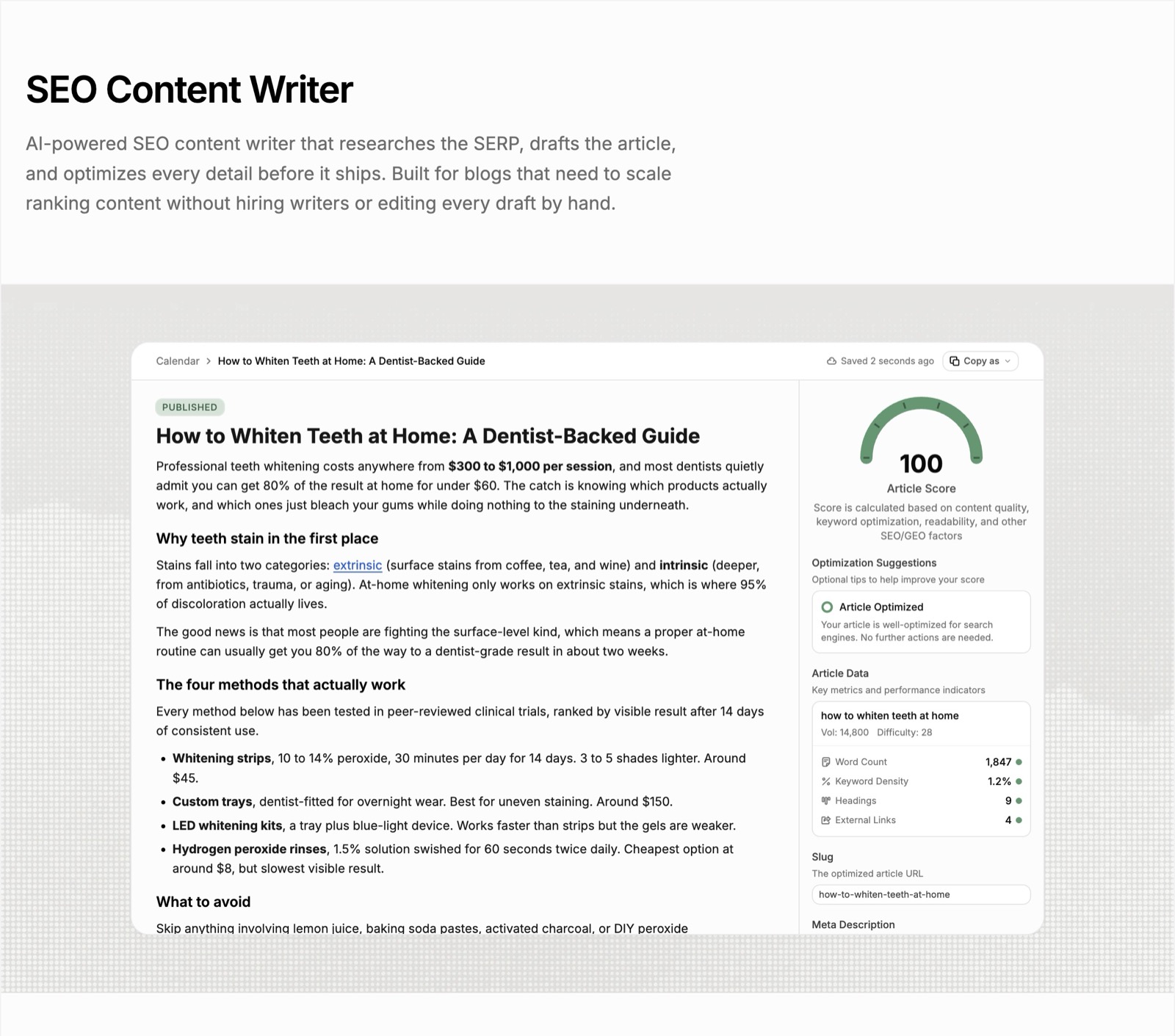
Automation works when you need volume and consistency. It doesn't replace strategy. You still pick the keywords, set the brand voice, and decide what gets published. The tool handles the repetitive work: research, outlining, drafting, formatting, and linking.
This approach fits founders and small teams who want steady organic growth without hiring a full content team. It's not right for brands that need highly creative or opinion-driven content. But for how-to guides, listicles, and product comparisons, automation closes the gap between what you should publish and what you have time to write.
Building a Swipe File of Blog Examples
A swipe file is a collection of examples you can reference when you're stuck. It's faster than searching Google every time you start a new post.
What to save:
- Titles that make you click
- Intros that hook you in the first sentence
- Tables, lists, or diagrams that explain a concept clearly
- Calls to action that feel natural, not pushy
Organize your swipe file by format or topic. Use a tool like Notion, Airtable, or a simple Google Doc. Add a note on what makes each example effective.
Over time, you'll spot patterns. You'll see which formats your audience prefers, which intros convert, and which calls to action drive clicks. Your swipe file becomes a playbook built on evidence, not guesses.
Studying blog examples shows you what works and why. You learn structure, formatting, and how to match content to search intent without wasting time on guesswork. Start by analyzing five high-ranking posts in your niche, map formats to your keywords, and test what resonates with your readers. If you want to publish consistently without hiring a team, RankPill researches keywords, writes SEO-optimized articles with images and links, and publishes one post to your site every day. It's built for founders who need traffic, not another task on their list.
Unlock Traffic on Autopilot
Grow organic traffic on autopilot. RankPill will research, write, optimize, and publish articles to your website daily.
 WordPress