
Claude vs ChatGPT for Writing: Which AI Writes Better?

Modest Mitkus · October 28, 2026
Founders choosing between Claude and ChatGPT for writing face a practical question: which one produces better content faster? Both models write well, but they differ in how they handle long documents, factual accuracy, creative tone, and pricing. This matters when you're publishing daily blog posts, drafting product documentation, or scaling content without hiring writers. The choice impacts output quality, editing time, and monthly costs.
How Context Windows Shape Long-Form Writing
Context windows determine how much text a model can process at once. Claude 3.5 Sonnet supports 200,000 tokens, roughly 150,000 words. GPT-4 Turbo handles 128,000 tokens. When you're writing a 3,000-word article with research notes, outlines, and reference material, the larger window matters.
Claude's advantage shows in multi-document tasks:
- Analyzing five competitor blog posts while drafting your own
- Maintaining brand voice from a 10-page style guide throughout an article
- Incorporating product specs, customer quotes, and SEO research in one prompt
- Keeping narrative consistency across chapter-length content
ChatGPT still handles most blog posts and documentation without hitting limits. The 128k token window covers typical writing projects. You hit constraints when combining dense research, long transcripts, or technical specifications in a single session.
For routine content creation, both models work. When you're feeding entire competitor analyses or product catalogs into your prompt, Claude's extended context reduces the need to split work across multiple conversations.

Speed and Response Time Across Writing Tasks
Response speed affects workflow when you're drafting multiple pieces daily. ChatGPT with GPT-4 Turbo typically returns a 1,500-word article draft in 15-25 seconds. Claude 3.5 Sonnet delivers similar output in 20-30 seconds. The difference is measurable but rarely workflow-breaking.
Where speed matters:
- Rapid iteration - testing five headline variations or three intro paragraphs
- Bulk content production - generating outlines for 20 articles in one session
- Real-time collaboration - editing during live calls with clients or teammates
Both models slow down with complex prompts combining research, formatting, and specific instructions. A prompt asking for a 2,000-word article with competitor analysis, SEO optimization, and table formatting can take 45-60 seconds on either platform.
ChatGPT Plus and Claude Pro both throttle heavy usage. ChatGPT limits GPT-4 to roughly 40 messages per three hours. Claude Pro caps usage at a similar rate during peak times. If you're generating 10+ articles daily, API access removes these limits but adds per-token costs.
Factual Accuracy and Hallucination Rates
Hallucinations remain a problem across all LLMs. Claude and ChatGPT both invent plausible-sounding facts when uncertain. Research on detecting hallucinations shows these errors appear in 5-15% of outputs, depending on topic complexity and prompt design.
| Error Type | Claude Behavior | ChatGPT Behavior |
|---|---|---|
| Made-up statistics | Tends to hedge with "approximately" or "around" | Often states specific numbers confidently |
| Fake citations | Rarely fabricates URLs or paper titles | More likely to invent realistic-looking sources |
| Product features | Conservative about claiming capabilities | Sometimes overstates what software can do |
| Dates and events | Acknowledges knowledge cutoff clearly | May confuse timeline of recent events |
In practice, both models require fact-checking. Claude often adds caveats like "based on my training data" or "as of my last update." ChatGPT presents information more confidently, which makes errors harder to spot during quick reviews.
For SEO content and product documentation, this translates to editing time. You'll catch Claude's hedging and rephrase for clarity. You'll verify ChatGPT's specific claims against source material. Neither eliminates the need for human review, especially for topics involving numbers, technical specs, or recent events.
Writing Style and Tone Control
Claude vs ChatGPT for writing diverges most in default tone. Claude writes with more hedging, longer explanations, and academic phrasing. ChatGPT adopts a confident, direct style closer to marketing copy. Both adapt when you specify tone in your prompt, but their defaults differ.
Claude's natural style:
- Balanced, cautious phrasing
- Longer sentences with qualifying clauses
- Reluctance to make strong claims
- Prefers "might" and "could" over "will" and "does"
ChatGPT's natural style:
- Direct, declarative sentences
- Confident assertions
- Shorter paragraphs
- Active voice by default
You can override these tendencies with clear instructions. A prompt like "Write in short sentences, active voice, no hedging" moves Claude closer to ChatGPT's output. Similarly, "Use balanced language and acknowledge limitations" makes ChatGPT more cautious.
The editing burden shifts based on your target. If you're writing founder-to-founder content that values honesty about trade-offs, Claude's default saves editing time. If you need punchy landing page copy or social posts, ChatGPT requires less tightening.

Cost Structure for High-Volume Writing
Pricing matters when you're producing content daily. ChatGPT Plus costs $20/month for unlimited GPT-4 access within usage caps. Claude Pro also runs $20/month with similar limits. For API access, costs scale with token usage.
API pricing (October 2026):
| Model | Input (per 1M tokens) | Output (per 1M tokens) |
|---|---|---|
| Claude 3.5 Sonnet | $3.00 | $15.00 |
| GPT-4 Turbo | $10.00 | $30.00 |
| GPT-4o | $5.00 | $15.00 |
A 3,000-word article uses roughly 4,000 tokens of input (prompt + instructions) and 4,000 tokens of output. At those rates, Claude 3.5 Sonnet costs about $0.07 per article. GPT-4o runs $0.08. GPT-4 Turbo hits $0.16.
Volume changes the math. At 30 articles per month, Claude costs about $2.10 via API versus $60/month for unlimited access through Pro. At 300 articles monthly, API pricing reaches $21 for Claude, still cheaper than the subscription. ChatGPT's higher API rates mean subscription makes sense above 150-200 articles monthly.
Most founders and small teams stay under the Plus/Pro usage caps. If you're publishing one article daily and running a few rewrites, the $20 subscription works. When you're generating 10+ pieces daily or batch-processing hundreds of prompts, API access becomes cost-effective.
Performance on Specific Content Types
Different writing tasks expose different strengths. Claude vs ChatGPT for writing shows clearer winners when you narrow the use case.
Blog Posts and SEO Content
ChatGPT handles SEO-focused writing with fewer reminders about keyword placement and meta descriptions. It naturally incorporates headers, lists, and formatting that match search-optimized structure. Claude requires more explicit instruction about SEO elements.
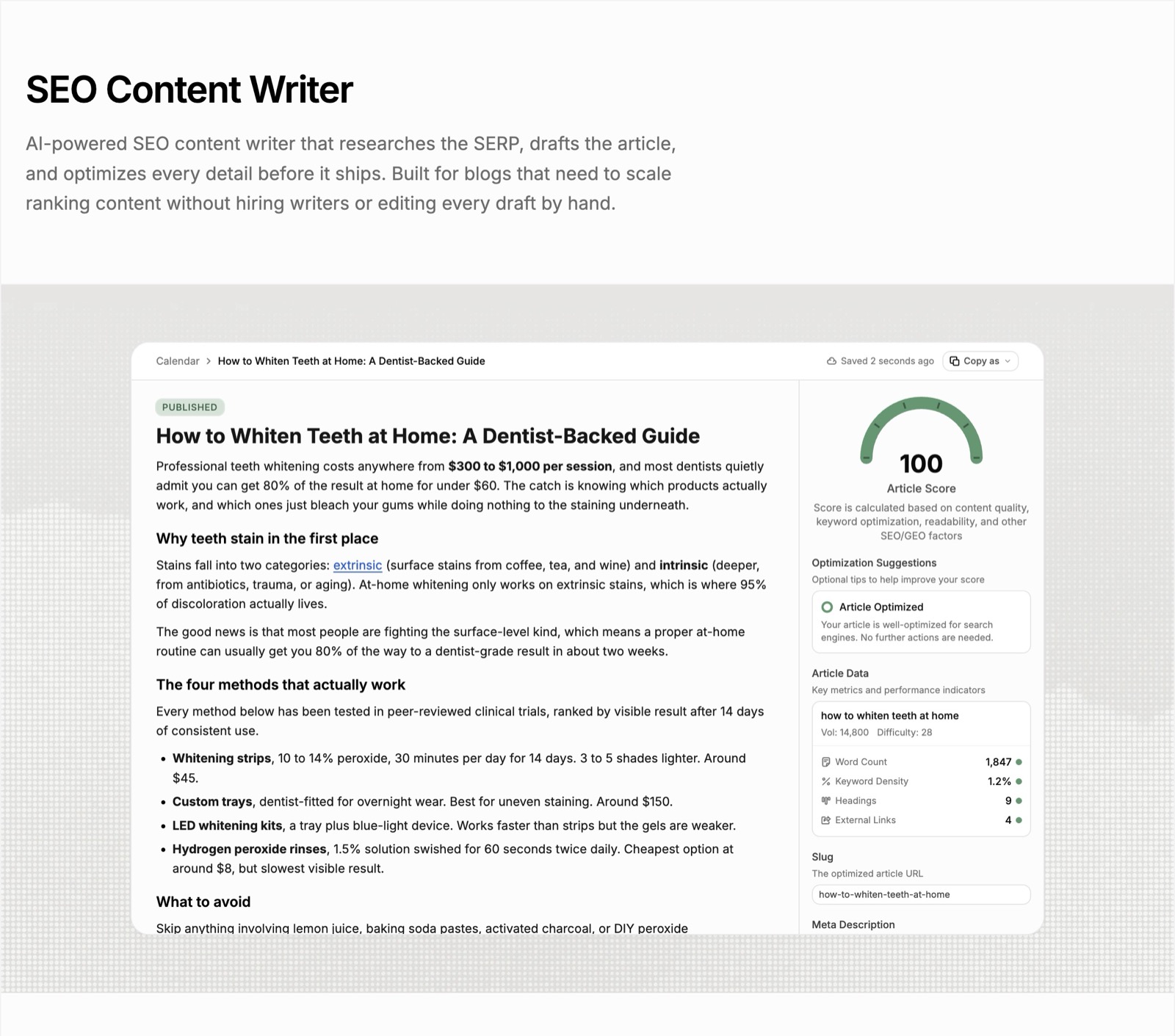
RankPill's SEO content writer uses AI models to study top-ranking articles, build outlines that match search intent, and generate 3,000+ word posts with internal links, external citations, and alt text. The system adds structure and SEO scoring that raw ChatGPT or Claude lack, but the underlying model affects tone and first-draft quality.
Technical Documentation
Claude excels at explaining complex systems step-by-step. Its longer, more careful explanations suit API documentation, user guides, and troubleshooting content. ChatGPT tends to oversimplify or skip edge cases that technical readers need.
Marketing Copy and Landing Pages
ChatGPT writes punchier headlines and value propositions. Its confident tone fits sales pages, email sequences, and ad copy. Claude's hedging weakens conversion-focused content unless you explicitly prompt for boldness.
Academic and Research Writing
Claude's citation style and balanced argumentation align better with academic conventions. Benchmark studies on expert-level questions show Claude performs slightly better on domain-specific reasoning tasks that require careful logic.
Multilingual Writing Capabilities
Both models write in dozens of languages, but quality varies. Research on hallucination across languages shows English outputs are most reliable. Spanish, French, and German perform well on both platforms. Less common languages see higher error rates and awkward phrasing.
Language-specific differences:
- Claude - more literal translations, preserves formality levels better, occasionally too stiff
- ChatGPT - more natural idioms, sometimes misses cultural context, better at casual tone
For founders targeting multiple markets, test both models in your target languages. A prompt that works in English may need adjustments in French or Japanese. Nuance gets lost in translation, and both models struggle with region-specific expressions.
If you're scaling content across languages, tools that run separate keyword research per market and write natively in each language avoid translation artifacts. Multilingual SEO approaches that research local search volume produce better results than translating English articles.
Integration and Workflow Automation
API access determines how easily you automate writing tasks. Both Claude and ChatGPT offer robust APIs, but integration patterns differ.
Claude API strengths:
- Simpler authentication and rate limiting
- Better handling of very long prompts
- Clearer documentation for streaming responses
ChatGPT API strengths:
- More third-party integrations and plugins
- Function calling for tool use
- Broader ecosystem of no-code connectors
If you're building custom workflows that auto-generate content, publish to WordPress or Shopify, and manage revisions, the API choice affects development time. ChatGPT's ecosystem means more pre-built Zapier actions and Make.com modules. Claude requires more custom code but offers cleaner long-context handling.
For teams without developers, web interfaces matter more than APIs. ChatGPT's plugin ecosystem adds features like web browsing and image generation directly in the chat. Claude focuses on core text generation without native extensions.

Comparative Analysis from Independent Reviews
Third-party testing provides data beyond vendor claims. TechTarget's detailed comparison highlights privacy and safety differences alongside writing quality. Tom's Guide's practical tests show use-case-specific winners rather than an overall champion.
Key findings across multiple reviews:
- Claude handles nuanced instructions better when prompts exceed 1,000 words
- ChatGPT produces more varied creative writing with stronger narrative voice
- Both models perform similarly on straightforward blog posts and documentation
- Claude's safety filters block fewer business use cases than GPT-4's guardrails
Independent benchmarks matter because vendor-published results optimize for their own strengths. Anthropic's research on model interpretability and OpenAI's GPT-4 technical report reveal architectural differences but don't predict which model fits your writing workflow.
Choosing Based on Your Content Goals
The right model depends on volume, content type, and editing capacity. Small teams generating 1-3 articles weekly see minimal practical difference. Both platforms work at that scale.
Choose Claude when:
- Writing long-form content over 2,000 words regularly
- Incorporating extensive research or multiple source documents
- Prioritizing cautious, balanced tone
- Working with technical or academic subject matter
Choose ChatGPT when:
- Drafting marketing copy and conversion-focused content
- Needing fast iteration on headlines and short-form pieces
- Preferring confident, direct writing style
- Using third-party integrations and plugins frequently
Use both when:
- Testing content approaches for different audiences
- Comparing outputs for quality control
- Leveraging specific strengths per content type
Teams running SEO content operations at scale often abstract the model choice behind automation. Platforms focused on autopilot SEO handle model selection based on keyword difficulty, content length, and topic, removing the need to choose manually for each piece.
Privacy and Data Handling Differences
Data retention policies affect what you can safely input. Claude does not train on user conversations submitted via API. ChatGPT offers a similar opt-out, but default settings vary.
Privacy considerations for business content:
- Proprietary product details
- Unreleased feature descriptions
- Customer data and case studies
- Financial projections and internal metrics
Both platforms allow enterprise agreements with custom data handling. For startups and small teams using consumer accounts, read the terms. Default ChatGPT conversations may inform future training unless you opt out in settings. Claude API conversations are not used for training.
If you're drafting content about unreleased products or confidential strategies, verify your account settings or use API access with clear data agreements. Most blog content and public-facing documentation carries less risk.
Claude and ChatGPT both produce strong first drafts, but Claude handles longer contexts better while ChatGPT writes punchier marketing copy. Your editing time and monthly costs depend on matching the model to your content type and volume. RankPill automates the full SEO pipeline by researching keywords, writing articles daily, and publishing to your site without requiring you to choose models or manage prompts. It's built for founders and small teams who want organic growth without hiring writers or juggling AI subscriptions.
Unlock Traffic on Autopilot
Grow organic traffic on autopilot. RankPill will research, write, optimize, and publish articles to your website daily.
 WordPress