
Content Marketing Tools: A Founder's Guide to What Works

Modest Mitkus · October 21, 2026
Most founders know they need content. Few know which tools to use or where to start. The content marketing tools landscape is crowded with platforms that promise to solve everything but deliver on little. You need tools that handle real work: finding topics, creating articles, publishing consistently, and tracking what actually drives traffic. This guide breaks down the categories that matter, what each tool type does, and how to pick the right stack for your stage and budget.
What Content Marketing Tools Actually Do
Content marketing tools fall into six categories: research, creation, design, distribution, SEO, and analytics. Each category solves a specific problem in your content pipeline.
Research tools find topics your audience searches for and questions they ask. Creation tools help you write, edit, and produce content at scale. Design tools create visuals, graphics, and branded assets. Distribution tools get your content in front of readers through email, social, or search. SEO tools optimize for ranking and backlinks. Analytics tools measure traffic, conversions, and revenue.
Most founders make the same mistake: buying tools for every category at once. You end up with 12 subscriptions, none of them integrated, and no clear workflow. Start with the bottleneck. If you can't publish consistently, fix creation first. If traffic is flat, focus on SEO and distribution.
The best content marketing tools stack looks different at 0 articles versus 100 articles per month. At zero, you need speed and simplicity. At 100, you need workflow, delegation, and measurement.

Research Tools That Find What People Actually Search
You can't write content that ranks without knowing what people search for. Research tools pull keyword volume, difficulty, and competitive data so you choose topics you can actually win.
Keyword Research Platforms
Keyword research tools show monthly search volume, ranking difficulty, and related terms. The best ones connect keywords to business value, not just traffic. A keyword with 10,000 searches but zero buying intent wastes time. A keyword with 300 searches that converts at 5% builds a business.
- Ahrefs: Deep backlink data, keyword explorer, content gap analysis
- Semrush: Keyword magic tool, topic research, competitive tracking
- DataForSEO: API access to search volume and difficulty for custom workflows
If you're running SEO automation, you need tools that integrate with your publishing pipeline. Manual exports and spreadsheets break down fast.
Audience Research Platforms
Reddit, Quora, and niche forums show what your audience actually asks. These platforms surface questions, pain points, and language your customers use. Tools like SparkToro and AnswerThePublic aggregate this data into reports.
The trade-off: audience research takes time. You read threads, identify patterns, and validate demand before writing. It's slower than pulling keyword volume but surfaces topics competitors miss.
Creation Tools That Scale Your Output
Writing is the bottleneck for most teams. Creation tools help you draft, edit, and produce articles without hiring full-time writers or agencies.
AI writing assistants like Jasper, Copy.ai, and ChatGPT generate drafts from outlines or prompts. Quality varies. You still edit, fact-check, and add examples. These tools speed up first drafts but don't replace thinking.
Long-form editors like Notion, Google Docs, and Hemingway help structure and refine content. Notion works well for teams managing multiple projects and content calendars. Hemingway flags dense sentences and passive voice.
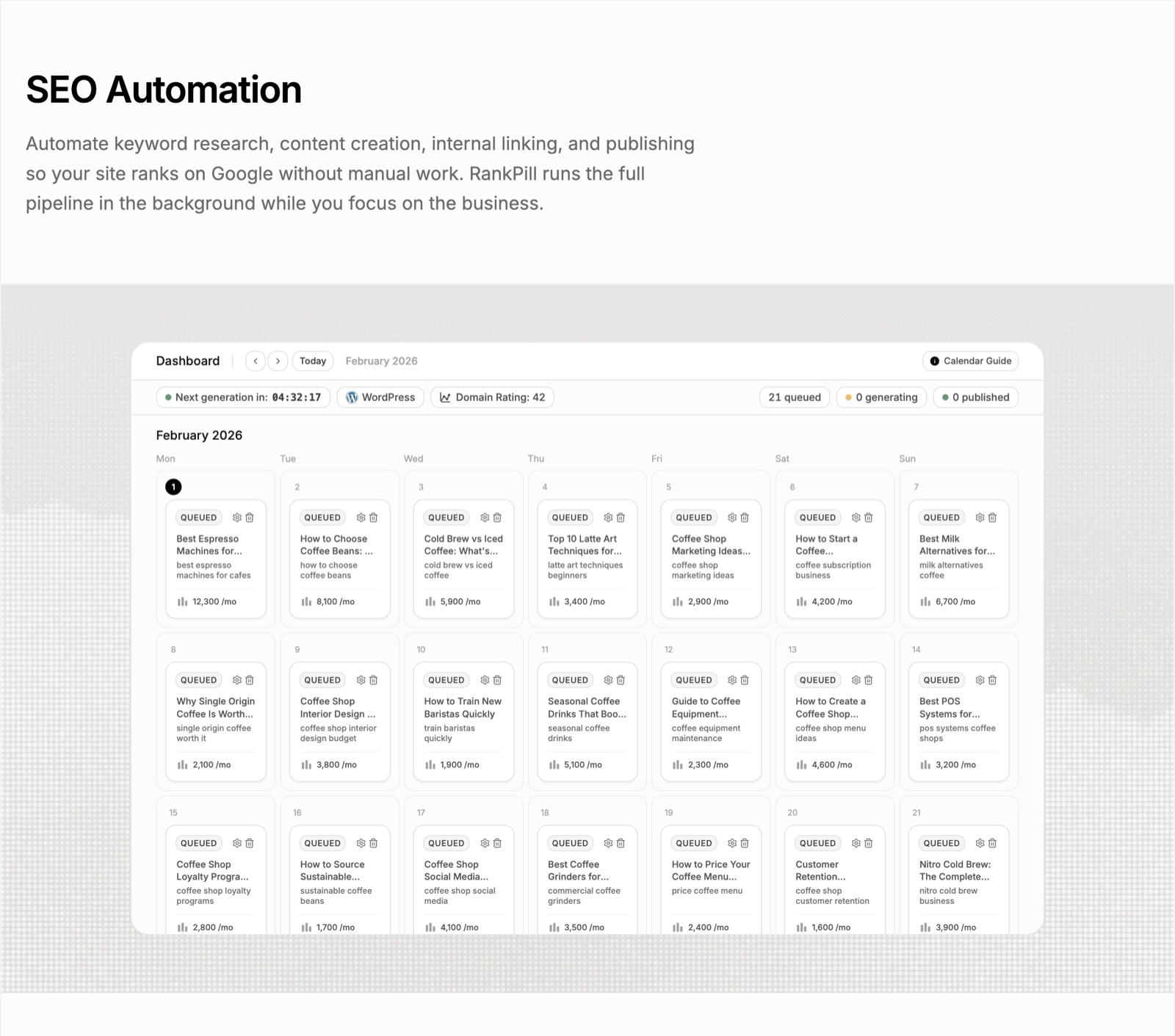
End-to-end content platforms combine research, writing, and publishing in one workflow. RankPill's SEO content writer studies top-ranking articles for your keyword, builds an outline, writes a 3,000+ word draft with citations and internal links, and scores it for SEO before publishing. You edit or approve, but the heavy lifting is automated.
| Tool Type | Best For | Trade-off |
|---|---|---|
| AI assistants | Fast drafts, ideation | Requires heavy editing |
| Long-form editors | Team collaboration | Manual workflow |
| End-to-end platforms | Consistent publishing | Less customization |
The right choice depends on volume. If you publish 1-2 articles per month, an AI assistant and Google Docs work fine. At 20+ articles, manual workflows break. You need automation.
Design Tools for Visuals Without a Designer
Articles with images get 94% more views than text-only posts. Design tools create featured images, graphics, charts, and social assets without hiring a designer.
Canva is the default choice for most teams. It offers templates, stock photos, and drag-and-drop editing. Figma works for more complex design systems and brand assets. Both have free tiers that cover basic needs.
AI image generators like Midjourney, DALL-E, and Stable Diffusion create custom visuals from text prompts. Quality improved significantly in 2025 and 2026. You still need to edit prompts, regenerate, and refine outputs. These tools work for concept images but struggle with precise branding.
Screenshots and annotated images often outperform designed graphics. Tools like CleanShot, Snagit, and Loom let you capture, annotate, and explain product features or workflows. Readers trust real screenshots more than stock photos.

Distribution Tools That Get Content in Front of Readers
Publishing content is not the same as distributing it. Distribution tools amplify reach through email, social, search, and communities.
Email Marketing Platforms
Email converts better than any other channel. Tools like ConvertKit, Mailchimp, and Beehiiv let you build lists, send newsletters, and automate sequences. The best platforms segment subscribers by behavior and send targeted content.
The trade-off: email lists take time to build. You need lead magnets, opt-in forms, and consistent value. Early on, focus on owned channels before paid distribution.
Social Scheduling Tools
Buffer, Hootsuite, and Later schedule posts across Twitter, LinkedIn, Facebook, and Instagram. You batch-create content once and schedule it across platforms. This saves hours per week.
Social traffic spikes fast and fades faster. It's not reliable for consistent growth. SEO and email compound over time. Use social for launches and community building, not as your primary distribution channel.
SEO and Search Distribution
Google and ChatGPT are the highest-intent channels. Readers actively search for answers. If your content ranks, traffic compounds month over month.
Content marketing tools built for SEO handle keyword targeting, internal linking, meta descriptions, and schema markup. Platforms like WordPress with Yoast or RankPress automate most of this. RankPill goes further by building backlinks through its exchange, which accelerates ranking for new content.
The Content Marketing Institute emphasizes distribution strategy in its research: most teams under-invest in amplification and over-invest in creation.
SEO Tools That Drive Rankings and Backlinks
SEO tools optimize content for search engines and build authority through backlinks. These tools directly impact traffic growth.
On-Page SEO Tools
Yoast, Rank Math, and Surfer SEO analyze keywords, readability, and structure. They flag missing meta descriptions, short paragraphs, and weak internal linking. On-page tools improve rankings for content you already published.
Surfer SEO compares your draft to top-ranking competitors and suggests word count, headings, and terms to include. It's data-driven but can lead to keyword stuffing if you follow suggestions blindly.
Backlink and Authority Tools
Backlinks remain the strongest ranking signal. Tools like Ahrefs, Moz, and Majestic track your backlink profile, identify toxic links, and find link opportunities.
Building backlinks is slow. Outreach, guest posting, and PR take months. RankPill's backlink exchange trades links between verified sites in your niche, filtered for relevance and spam risk. It's faster than manual outreach and costs credits instead of cash.
| SEO Tool Type | Function | Time Investment |
|---|---|---|
| On-page optimization | Improve existing content | Low |
| Backlink analysis | Audit link profile | Medium |
| Link building | Earn new backlinks | High |
| Technical SEO | Fix site speed, crawl errors | Medium |
Most founders skip technical SEO until traffic stalls. Site speed, mobile optimization, and crawl errors matter. Tools like Screaming Frog and Google Search Console surface issues before they hurt rankings.
Analytics Tools That Connect Content to Revenue
Analytics tools measure traffic, engagement, and conversion. The best ones connect content performance to business outcomes.
Google Analytics 4 is the default choice. It tracks page views, sessions, bounce rate, and conversions. Set up goals for newsletter signups, demo requests, and purchases. This shows which content drives revenue, not just traffic.
Hotjar and Microsoft Clarity add heatmaps and session recordings. You see where readers click, scroll, and drop off. This qualitative data identifies friction points that quantitative analytics miss.
Attribution tools like HubSpot and Segment track the full customer journey. They connect first touch (blog post) to conversion (purchase) across multiple sessions. This matters for longer sales cycles where readers visit 5-10 times before buying.
The IAB Tech Lab publishes measurement standards that help teams track content performance across channels without vendor lock-in. Their guides are technical but worth reading if you run a multi-channel strategy.
What to Actually Measure
Most teams track vanity metrics: total traffic, followers, impressions. Focus on metrics tied to growth:
- Organic traffic growth month-over-month: Shows if your content strategy works
- Conversion rate by content type: Reveals which formats drive signups or sales
- Time to first conversion: Measures how fast new content generates leads
- Cost per acquisition from content: Compares content ROI to paid channels
If analytics don't change decisions, stop tracking. Measure what you'll act on.
Building Your Content Marketing Tools Stack
Your stack depends on team size, budget, and publishing volume. A solo founder needs different tools than a 10-person content team.
Stack for Solo Founders (0-10 Articles/Month)
You're the writer, editor, and publisher. Prioritize speed and simplicity.
- Research: Ahrefs or Semrush (start with the trial)
- Creation: ChatGPT or Claude for drafts, Google Docs for editing
- Design: Canva free tier
- Distribution: Buffer for social, ConvertKit for email
- SEO: Yoast or Rank Math plugin
- Analytics: Google Analytics 4
Budget: $100-300/month depending on keyword tool tier.
Stack for Small Teams (10-50 Articles/Month)
You have a writer or two. You need collaboration, templates, and workflow.
- Research: Semrush or Ahrefs with team access
- Creation: Notion for collaboration, AI assistant for speed
- Design: Canva Pro for brand kit and templates
- Distribution: ConvertKit or Beehiiv, Buffer, manual outreach
- SEO: Surfer SEO for optimization, backlink exchange for links
- Analytics: GA4 plus Hotjar for qualitative data
Budget: $400-800/month.

Stack for Agencies (50+ Articles/Month)
You manage multiple clients. You need white-label options, reporting, and delegation.
- Research: Enterprise SEO platform with API access
- Creation: End-to-end platform or team of writers with project management in Notion or Asana
- Design: Figma for brand systems, Canva for production
- Distribution: Multi-client email and social tools
- SEO: Automated platforms that handle publishing, linking, and backlinks
- Analytics: Custom dashboards in Looker Studio or HubSpot
Budget: $1,500-5,000/month depending on client count.
Agencies benefit most from automation. Manual workflows don't scale past 30-40 articles per month. Platforms that handle keyword research, writing, and publishing save hours per client.
Avoiding Common Tool Selection Mistakes
Founders waste money on three mistakes: buying tools too early, never consolidating, and chasing features they won't use.
Mistake one: buying tools before validating demand. You don't need a $200/month SEO suite if you haven't published 10 articles. Start with free tools. Upgrade when free plans limit growth.
Mistake two: tool sprawl. You subscribe to 15 tools that don't integrate. You export CSVs, copy-paste between platforms, and waste hours on manual work. Consolidate where possible. One platform that handles three jobs beats three platforms that barely talk to each other.
Mistake three: feature bloat. Enterprise platforms sell on features you'll never use. A 10-person team doesn't need SSO, role-based permissions, or API access. Pay for what you use, not what sounds impressive.
The Forrester Wave report on content platforms evaluates vendors on strategy, current offering, and market presence. It's a good starting point for enterprise buyers but overkill for most founders.
When to Automate Your Content Pipeline
Automation makes sense when manual work blocks growth. If you spend 10 hours per week on keyword research, outlining, and publishing, automate. If you publish twice per month, stick with manual.
Signs you're ready to automate:
- You publish 15+ articles per month
- Writers or agencies cost more than automation tools
- Keyword research and outlining take longer than writing
- Publishing and linking are bottlenecks
- You need backlinks but don't have time for outreach
Automation trades control for speed. You review instead of writing from scratch. You set brand voice and guidelines, then let tools execute. This works if you trust the output and have a quality bar.
RankPill automates the full pipeline: it finds keywords from your competitors and site gaps, writes SEO-optimized articles in your brand voice, publishes daily to WordPress, Shopify, Webflow, Wix, or Framer, and builds backlinks through its exchange. You review the content calendar and approve or edit before it goes live. It's built for founders who want steady traffic growth without hiring writers.
Choosing Tools That Grow With You
The best content marketing tools scale as your team and volume grow. Tools that work at 5 articles per month should still work at 50, even if you upgrade tiers.
Look for platforms with clear pricing tiers and feature limits. Avoid tools with arbitrary caps (5 users, 10 projects) that force you to switch platforms as you grow. Switching costs time: you migrate content, retrain team members, and rebuild workflows.
Check integration options. Tools that connect to Zapier, Make, or native APIs let you automate workflows between platforms. If your keyword tool exports to your CMS and your CMS triggers social posts, you save hours per article.
Free trials matter. Most content marketing tools offer 7-14 day trials. Test the workflow before subscribing. Cancel if it doesn't save time or improve output.
How Content Marketing Tools Fit Into Growth Strategy
Tools are tactics, not strategy. The best stack won't save a bad content strategy. Start with goals: traffic, leads, revenue. Work backward to the content that drives those outcomes. Then pick tools that produce that content efficiently.
If your goal is 10,000 monthly visitors from organic search by end of 2027, you need 50-100 ranking articles. That means publishing 4-8 articles per month for 12-18 months. Now you can pick tools that support that volume and timeline.
Content marketing tools should reduce the gap between strategy and execution. If tools complicate your workflow or add steps, cut them. Simplicity wins.
Track cost per article. If you spend $500/month on tools and publish 10 articles, that's $50 per article in tool costs. Add writer time or agency fees. Compare that to alternatives. Automation platforms that publish daily often cost less per article than hiring writers.
The right content marketing tools depend on your team size, publishing volume, and growth timeline. Most founders over-invest in tools and under-invest in strategy. Start simple, automate bottlenecks, and measure what drives revenue. If you want to publish SEO-optimized articles daily without hiring writers or managing multiple tools, RankPill handles keyword research, content creation, publishing, and backlink building in one platform. It's built for founders who need consistent traffic growth without the overhead.
Unlock Traffic on Autopilot
Grow organic traffic on autopilot. RankPill will research, write, optimize, and publish articles to your website daily.
 WordPress