
How to Choose a Dentist SEO Agency in 2026

Modest Mitkus · November 20, 2026
A good dentist SEO agency gets your practice found in local search, turns that visibility into booked appointments, and reports on both in plain numbers. The right one costs real money and takes months to show results, so vet it on local proof, pricing, contract terms and reporting before you sign anything.
This guide covers what these agencies actually do, what they charge, how to compare them, and when a lighter option makes more sense for a small practice.
What does a dentist SEO agency actually do?
SEO agencies improve how a website appears in unpaid search results, and a dental-focused one narrows that to local patient searches like "emergency dentist near me" or "Invisalign cost in [your city]." The work usually falls into five buckets:
- Local SEO: Google Business Profile setup, categories, services, photos, posts and review management.
- On-page SEO: Service pages, location pages, title tags, internal links and page speed.
- Content: Articles and service pages that answer patient questions.
- Citations and links: Consistent listings on directories and links from local sites.
- Reporting: Rankings, traffic, calls and booked appointments.
Google says local results are mainly based on relevance, distance and prominence. Distance is fixed by where your office sits. An agency can only work on the other two: relevance (do your profile and pages match what the patient searched?) and prominence (links, reviews and brand recognition).
That same Google page says there is no way to request or pay for a better local ranking. Any agency that guarantees a position is selling something Google does not sell. Treat a guarantee of "#1 in 30 days" as a reason to walk away.
How much does a dentist SEO agency cost in 2026?
Retainers vary widely, so ask every agency for a written quote and check exactly what it includes. Setup fees, ad spend and website rebuilds are often extra.
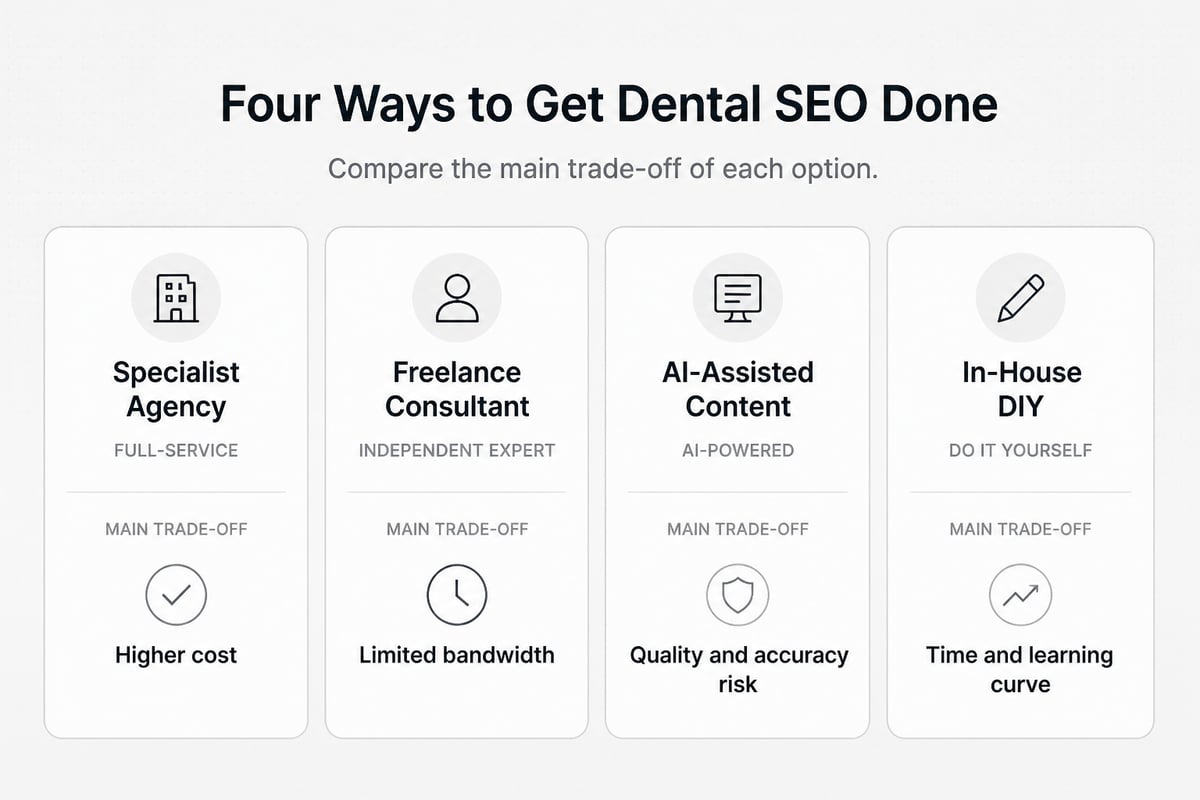
Here is how the main options compare:
| Option | Typical monthly cost | What you get | Main trade-off |
|---|---|---|---|
| Dental-specialist agency | Typically higher-priced | Strategy, local SEO, content, reporting | Contracts, slower pace, price |
| Generalist SEO agency | Typically mid-priced | SEO work with less dental context | Less patient-acquisition knowledge |
| Freelance SEO consultant | Typically lower to mid-priced | Flexible, senior help | One person, limited capacity |
| In-house or AI-assisted content | Typically the lowest cost | Steady article output | You handle local profile and reviews yourself |
If you want a deeper breakdown of retainers versus project pricing, our guides on SEO costs and SEO price cover the ranges in more detail.
One more cost to plan for: your own time. Even a full-service agency needs patient photos, practice details, provider bios and approvals from you. Budget a few hours a month.
What should you check before hiring a dentist SEO agency?
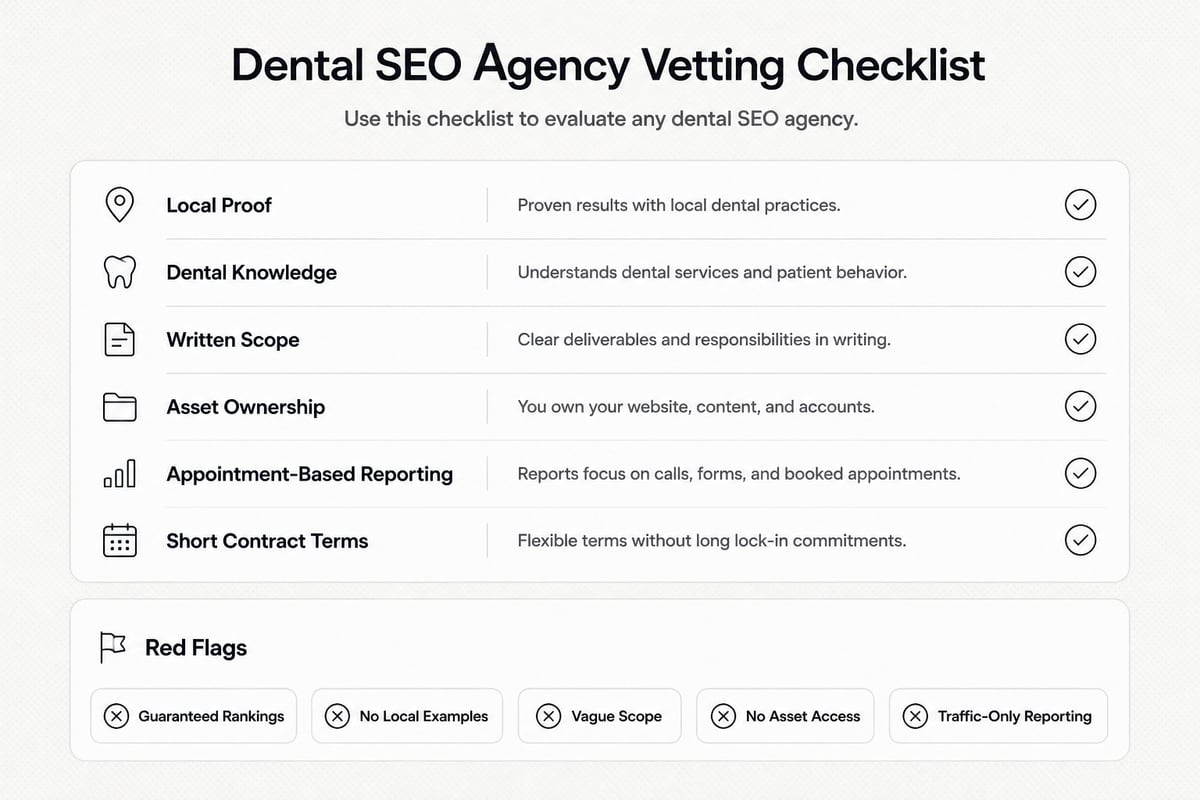
Check six things before you sign: local proof, a real dental track record, a clear scope, ownership of your assets, reporting tied to appointments, and contract terms you can exit. Use this as a vetting list:
- Local proof. Ask for two or three practices in markets similar to yours (similar city size and competition) and look up their Google Business Profiles yourself. Do they rank for the main service terms? Do they have a steady stream of recent reviews?
- Dental knowledge. Can they explain the difference between a search for "dentist" and one for "dental implants cost"? Do they understand that new-patient value varies by service?
- Written scope. The proposal should list deliverables per month: pages, articles, profile updates, links, reports. "Ongoing optimization" with no detail is a warning sign.
- Asset ownership. Your website, domain, Google Business Profile and analytics must stay in your name. Get this in the contract.
- Reporting. Reports should show calls, form fills and booked appointments, not just rankings. Ask to see a sample.
- Exit terms. Month-to-month or a short initial term beats a 12-month lock-in. Ask what happens to your content and links if you leave.
Also ask who does the work. Some agencies sell you a senior strategist and hand your account to a junior or an outsourced team. Ask for the name of the person who will write and review your pages.
Which signals show an agency can rank local dental searches?
The strongest signals are visible ones: the agency's own local rankings, its clients' Google Business Profiles, and how it handles reviews. You can verify all three in ten minutes without asking them anything.
Google notes that prominence can reflect things like links to a business and its review count, and that more reviews and positive ratings can help local ranking. So a good agency should have a review process: asking happy patients at the right moment, responding to every review, and never buying or gating reviews.
Reviews also shape patient decisions. In BrightLocal's 2025 Local Consumer Review Survey, 48% of respondents said they read Google's review summary before reading a range of positive and negative reviews. Your reputation is partly what an AI-generated summary says about you, so review volume and recency matter beyond rankings.
Look for these behaviors in how an agency talks about local work:
- They ask about your service mix and which procedures you want more of.
- They talk about your Google Business Profile before they talk about blog posts.
- They mention schema markup. Google's local business structured data guidance says to validate markup with the Rich Results Test and check pages with URL Inspection. An agency that does this routinely is sweating the details.
- They don't promise rankings, only a plan and a measurement method.
What dental compliance and advertising rules should an agency know?
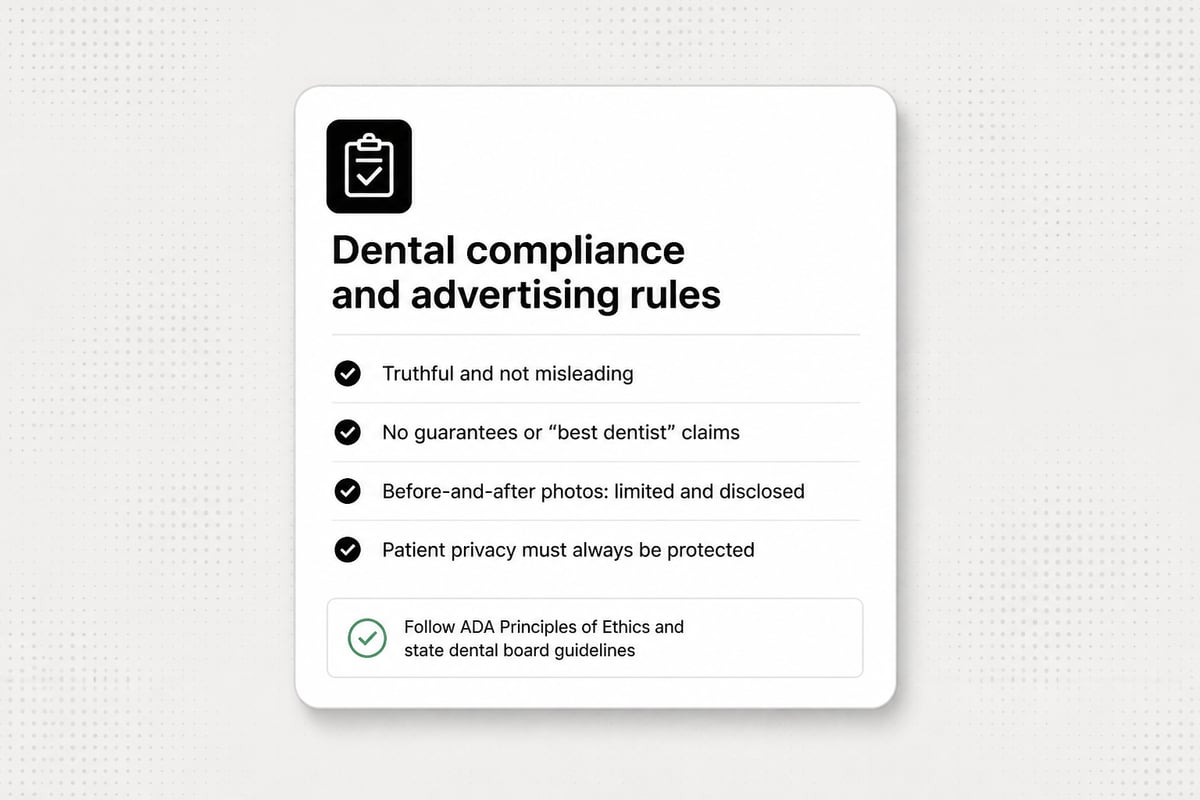
A competent agency knows that healthcare marketing carries extra rules, and it can tell you which parts apply to organic SEO versus paid ads. Organic SEO has fewer restrictions, but patient claims, before-and-after photos and treatment outcomes still need to be accurate and approved by you and your state board's rules.
Paid search is stricter. Google says healthcare-related ads and destinations must follow applicable laws and industry standards, and some healthcare content is restricted or allowed only in certain locations or for approved advertisers. Google also treats personal health content as a sensitive interest category, which means advertiser-curated audiences can't be used to promote it. That limits retargeting options a generalist agency might pitch you out of habit.
Ask any agency how it handles patient privacy on forms and tracking, and who signs off on claims before they go live. If the answer is vague, that is your answer.
The American Dental Association also publishes guidance on practice website design and patient-focused content, which is a useful baseline when you judge whether an agency's pages serve patients or just keywords.
How long does dental SEO take to work?
Results vary with competition, your starting site and how fast changes ship, so ask agencies for a timeline in writing. No one can guarantee a timeline, and an agency that does is guessing.
Local results can move sooner than organic ones. Fixing a Google Business Profile, adding service pages and collecting reviews can shift map visibility within weeks in a low-competition town. A dense market with ten established practices within two miles will take longer.
Set expectations in writing at the start. A reasonable 90-day plan has milestones you can verify:
- Month 1: audit complete, profile fixed, tracking set up for calls and forms.
- Month 2: core service and location pages live, review process running.
- Month 3: first content published, baseline rankings and calls reported.
If those milestones slip and nobody explains why, raise it early.
What red flags should make you walk away?
Walk away when an agency promises rankings, hides its methods, or won't give you control of your own accounts. These are the common ones:
- Guaranteed #1 rankings. Google says there is no way to request or pay for a better local ranking.
- Owning your assets. The agency registers your domain or Business Profile under its own account.
- Link packages with no detail. Bulk links from unrelated sites can hurt more than help.
- Fake or incentivized reviews. This risks suspension of your profile.
- Vanity reporting. Reports full of impressions and keyword counts, with no calls or appointments.
- Long lock-ins with no performance clause. Twelve months, auto-renewing, no exit.
- Copy-paste content. The same service page text used across dozens of practices.
If you want the safe version of link building and content, our overview of white hat SEO explains what separates durable tactics from the risky ones.
Do you need a dentist SEO agency, or can you do it in-house?
You need an agency if you lack the time to manage your profile, reviews and website, and you have budget for $1,500 or more a month. You can often do it in-house if your biggest gap is publishing steady content and you are willing to handle the local basics yourself.
The local basics are small and cheap: claim and complete your Google Business Profile, ask every satisfied patient for a review, keep your hours and services accurate, and make sure your site loads fast. A WordPress SEO checklist covers the on-site items if your site runs on WordPress.
Content is the part that eats time. Service pages, procedure explainers and answers to patient questions ("Does a root canal hurt?" "How long do veneers last?") build the relevance Google looks for, but writing them weekly is a real job. This is where automation helps. RankPill plans, writes and publishes SEO articles to your site on a schedule you set, up to 30 a month, with images, internal and external links and meta tags. It costs $99 a month per website, with a 3-day trial for $1, and you can set it to hold each article for your approval before it goes live.
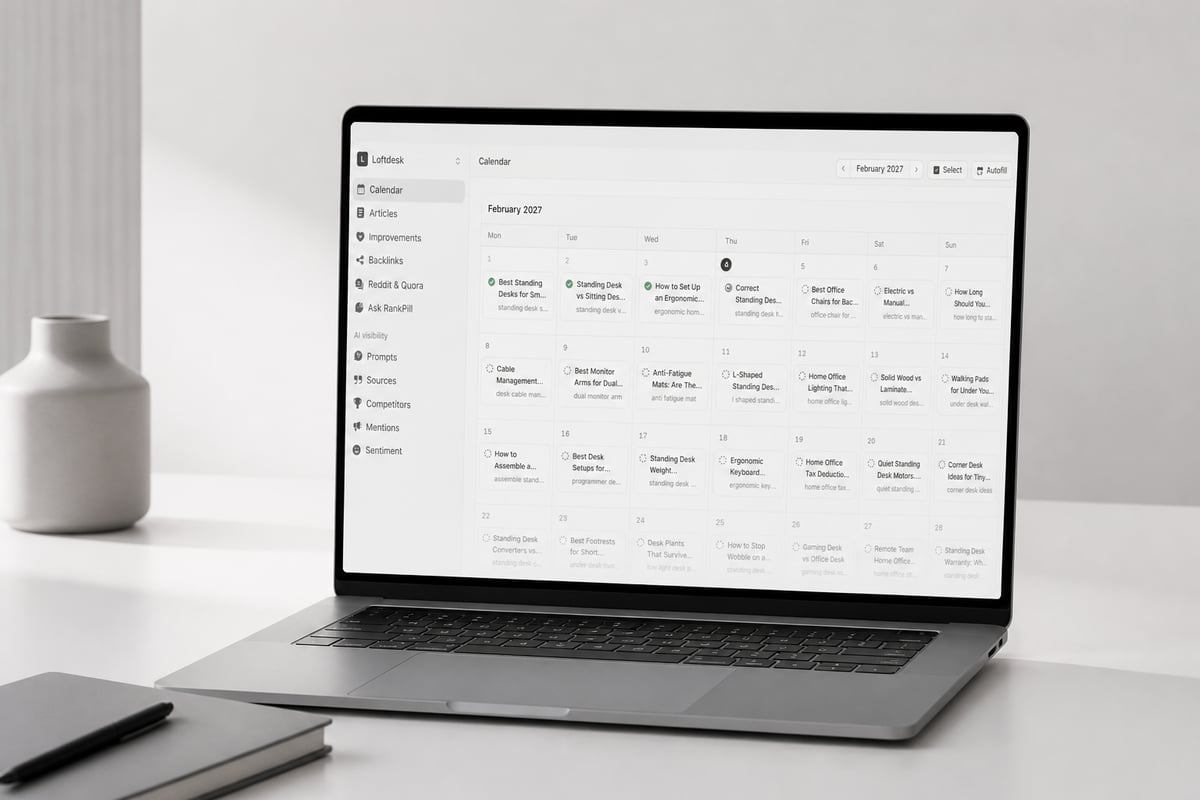
Be honest about the limit: RankPill does not run your Google Business Profile, collect reviews or fix your office's local citations. It is a content engine, not a full local SEO retainer. A practice that needs profile management, link outreach and strategy calls still needs an agency or a consultant. For a deeper look at how it fits dental sites, see the SEO for dentists page.
If your practice wants hand-written content only, or your site can't connect to a supported publishing platform, an automated tool is the wrong fit.
How should you compare proposals side by side?
Score each proposal on the same five criteria so price doesn't win by default. A simple 1 to 5 score per row keeps the conversation honest:
- Scope clarity: Are deliverables listed by month?
- Local proof: Did they show verifiable results in comparable markets?
- Reporting: Does it include calls and booked appointments?
- Ownership and exit: Are assets yours and the term short?
- Fit: Do they understand your service mix and your patients?
Ask each agency the same four questions in writing: Who does the work? What will month one look like? How do you measure success? What happens if I cancel? Compare the answers, not the sales pitch.
If you run several locations or manage SEO for multiple practices, the math changes. Per-location retainers add up fast, and a repeatable content process starts to matter more. A guide to SEO tools for agencies covers how multi-client teams keep output consistent.
FAQ
How much does SEO cost in the USA?
Retainer prices vary widely across agencies and markets, so get written quotes and check what each one includes.
What do SEO agencies do?
They audit your site, fix technical and local listing issues, build pages and content around the searches your customers use, earn links and citations, and report on results. For a dental practice, the heaviest work usually sits in Google Business Profile management, service pages and review generation.
How do dentists advertise?
Most practices combine local SEO and Google Business Profile, paid search ads, patient referrals, reviews, email to existing patients and social media. Paid ads for healthcare services have extra Google policy limits, so check the rules before you spend.
Your next step is to pull up the Google Business Profiles of two agencies' dental clients and check their rankings and reviews before you take a single sales call. If your biggest gap is steady, patient-focused content rather than full local management, RankPill can plan, write and publish articles to your site on your schedule while you handle reviews and your profile. You can start with the 3-day trial for $1 and cancel anytime.
Unlock Traffic on Autopilot
Grow organic traffic on autopilot. RankPill will research, write, optimize, and publish articles to your website daily.