
Find Trending Keywords: How to Spot and Use Them

Modest Mitkus · November 3, 2026
The difference between a keyword that drives traffic and one that sits at zero clicks often comes down to timing. When you find trending keywords early, you rank before the competition notices, capture demand while search volume is rising, and build authority in a topic that might stick around for months or years. The goal is not to chase every spike but to spot the trends that align with what you sell and where your site already has authority.
What Makes a Keyword Trending
A trending keyword is one where search volume is increasing over a defined period. That period matters. A spike that lasts three days (a news event, a viral tweet) behaves differently than a steady climb over twelve weeks (a new product category, seasonal demand building early).
You need to know which type you're looking at before you write anything.
Short-term trends appear in Google Trends with sharp peaks. They include breaking news, celebrity events, product launches, or memes. These keywords rarely justify a 3,000-word article unless your site already ranks for the core topic and you can publish same-day.
Medium-term trends build over weeks or months. Examples: "AI image generator" in early 2023, "GLP-1 peptide" in mid-2024, "import tariffs 2026" this year. These are worth targeting if you can rank within the trend's growth phase.
Evergreen trends are seasonal or cyclical keywords that rise predictably. "Tax deduction checklist" peaks January through April. "Black Friday SaaS deals" climbs in October. You can plan content for these six months in advance and update it annually.

The mistake most people make is treating all trends the same. If you're a founder with limited time, focus on medium-term and evergreen trends that align with what you already rank for.
Where to Find Trending Keywords
Start with tools that surface real-time or recent search data. Google Trends is free and shows relative search interest over time, broken down by region and related queries. Set the timeframe to "Past 90 days" or "Past 12 months" to filter out daily noise.
Enter a broad topic related to your niche. Scroll to "Related queries" and switch from "Top" to "Rising." Rising queries show percentage increases in search volume. A query marked "Breakout" means its growth exceeded 5,000%, often indicating a new or rapidly accelerating topic.
Bing Webmaster Tools offers keyword research features with search volume and trend data from Bing. While smaller than Google's index, Bing data often highlights trends that appear in Microsoft Edge, ChatGPT citations, and Windows search.
Reddit and Twitter (now X) show what people are asking in real time. Search your niche on Reddit and sort by "New" or "Hot" in the past month. Look for recurring questions, frustration threads, or product comparisons. These signal unmet demand that hasn't fully translated to Google yet.
YouTube's search suggest and trending tab reveal video topics gaining traction. If people search YouTube for a topic, they'll search Google for written guides within weeks. Pay attention to topics outside the usual influencer cycle.
| Tool | Best for | Update frequency | Cost |
|---|---|---|---|
| Google Trends | Spotting breakout topics and regional interest | Real-time | Free |
| Bing Webmaster Tools | Trend data with lower competition | Weekly | Free |
| Reddit (sorted by New) | Early signals before Google volume appears | Real-time | Free |
| YouTube Trending | Video topics moving to written content | Daily | Free |
Manual monitoring works if you check these sources weekly. Founders running multiple projects need automation. That's where keyword research platforms with trend filters come in.
How to Validate a Trending Keyword
Just because a keyword is rising doesn't mean you should write about it. Validation separates opportunities from distractions.
Check if the trend matches search intent
Pull the top 10 results for the keyword in an incognito window. Are they blog posts, product pages, videos, or Reddit threads? If Google shows Reddit threads and forums, written content might not rank. If it shows buying guides and reviews, a detailed article can work.
Look at the dates. If all results are from the past two weeks, the keyword might be too new and volatile. If results are six months old and still ranking, the topic has staying power.
Estimate search volume and difficulty
Use a keyword tool that shows monthly search volume and difficulty score. Look for keywords with:
- At least 100 searches per month (preferably 500+)
- Difficulty score below 40 if your domain rating is under 30
- Upward or steady volume trend over the past 90 days
A keyword with 50 searches and rising is often better than one with 5,000 searches and declining. You're betting on the future, not the past.
Assess your site's relevance
Can you write a genuinely useful article on this keyword? Do you have product expertise, data, or a unique angle? If the only way to cover it is to rewrite what already ranks, skip it.
Trending keywords work best when they connect to content you've already published. If you rank for "email marketing automation" and see "AI email subject lines" trending, that's a strong fit. If you sell project management software and "keto meal prep" is trending, it's not.

Track Trends Before They Peak
The best time to publish is when a keyword is rising but hasn't peaked. By the time a keyword hits "Trending" lists on major platforms, you're already late.
Set up alerts in Google Trends for your core topics. You'll get weekly emails when search interest changes significantly. Combine this with RSS feeds from niche subreddits and Google Alerts for product names or concepts adjacent to what you cover.
Track competitors' new content. Use a tool that monitors their blog or set up a page monitor on their site's blog index. When a competitor publishes on a new topic, check Google Trends to see if it's rising. If three competitors write about the same topic in one month, it's probably trending.
For founders and small teams looking to find trending keywords at scale, RankPill's keyword research tool scans your site and competitors, pulls real monthly search volume and difficulty scores, and tags every keyword by opportunity level. Keywords are grouped into topic clusters, so you see which trends connect to your existing authority. You can queue an article in one click, and the system tracks whether volume is rising or flat.
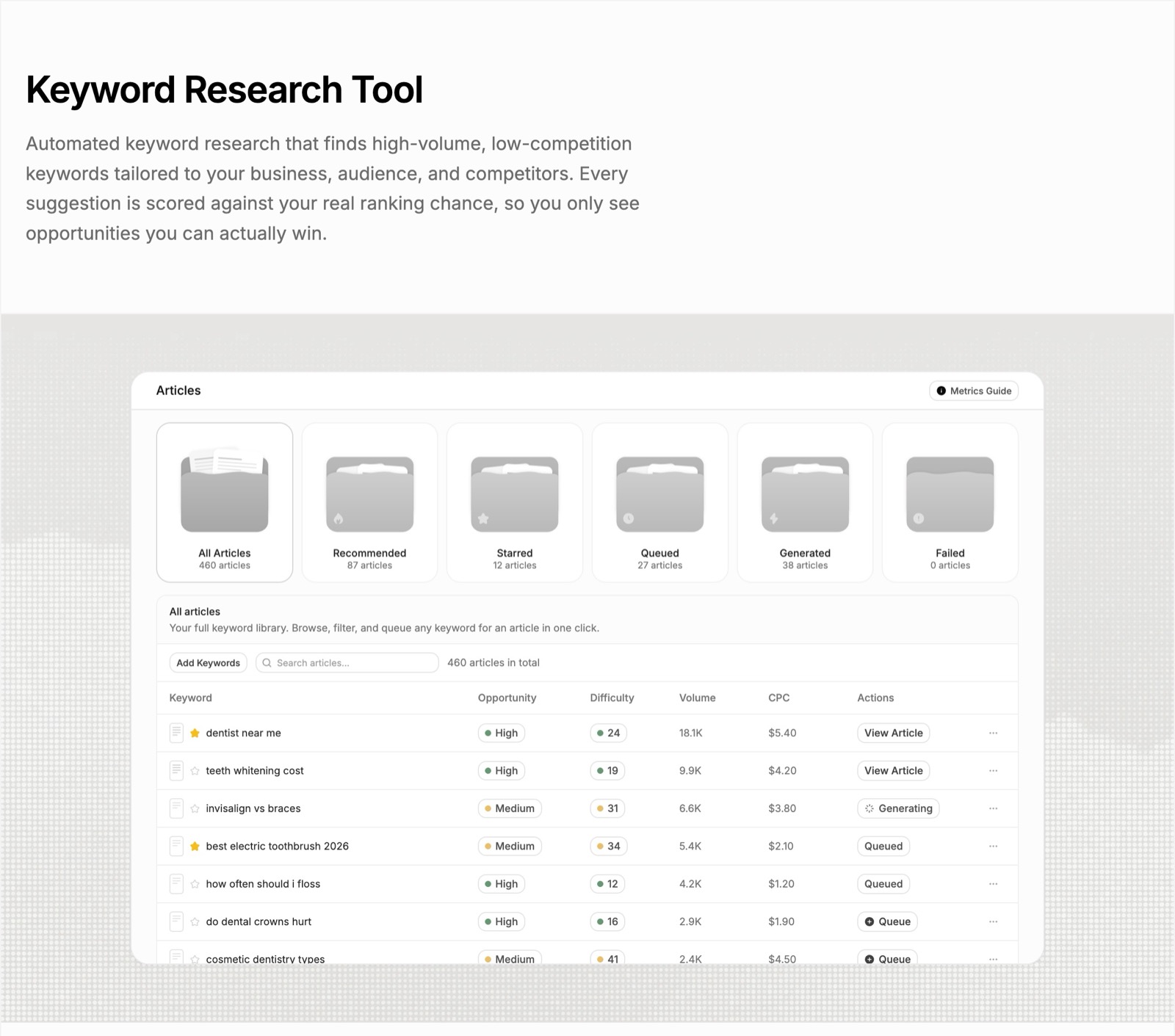
Most keyword tools show a snapshot. Trend tracking requires comparing data over weeks. Export your keyword list monthly and compare volume changes in a spreadsheet, or use a platform that logs historical data automatically.
Turn Trending Keywords Into Rankable Content
Once you find trending keywords worth targeting, speed and depth both matter. A thin 800-word post won't rank if the topic is competitive, but a 3,000-word guide published three months late won't either.
Write for the current year
Always reference the current year (2026) in your title, meta description, and intro. "Best AI tools 2026" will outrank "Best AI tools" when both target the same keyword, because Google favors freshness for trending topics.
Update older articles if they cover the same trend. If you published "how to use ChatGPT" in 2024 and the keyword is trending again in 2026, refresh the article with new examples, updated screenshots, and a new publish date.
Match the search intent at each stage
Early in a trend, people search for definitions and overviews. Later, they want comparisons, how-tos, and case studies. If a keyword just started trending, write an explainer. If it's been rising for eight weeks, write a detailed guide or comparison.
HubSpot's keyword research guide walks through how to map keywords to buyer journey stages. The same logic applies to trends: awareness content early, decision content later.
Optimize for entities and related queries
Google understands topics, not just keywords. If "AI video editor" is trending, your article should also cover related entities like "text-to-video," "B-roll generation," and specific tool names. These co-occurring terms signal topical depth.
Pull related queries from Google Trends and "People also ask" boxes. Weave them into H2 and H3 headings. This helps you rank for the main keyword and capture long-tail variations as the trend matures.
Publish quickly without sacrificing quality
Trending keywords reward fast movers, but only if the content is good enough to rank. A 2,000-word article with clear structure, examples, and links will beat a 5,000-word wall of text every time.
Write the outline first. Use the top-ranking articles and "People also ask" to structure your headings. Then fill in each section with your perspective, data, or process. Don't rewrite what already exists. Add something new.
If you're publishing daily or weekly, you need a system. SEO automation tools like RankPill handle the research, writing, internal linking, and publishing loop so you can focus on strategy instead of execution.
Build a Trend Monitoring Workflow
To find trending keywords consistently, you need a repeatable process. Here's a weekly workflow that takes about 30 minutes:
- Monday: Review Google Trends alerts for your niche. Export any rising queries to a spreadsheet.
- Tuesday: Check competitor blogs for new content. Add any new topics to your trend list.
- Wednesday: Pull fresh keyword data from your research tool. Compare volume to last month and flag increases above 20%.
- Thursday: Validate top 5 trends using search intent, difficulty, and relevance filters.
- Friday: Queue articles for validated keywords and assign publish dates.
This workflow assumes you're evaluating trends, not chasing every spike. If a topic doesn't fit your niche or your site's authority, skip it.
Agencies managing multiple clients can run this workflow per client or per industry vertical. Tag keywords by client in your research tool so trends don't get mixed up.
Common Mistakes When Targeting Trends
Writing for trends outside your niche. A SaaS blog publishing about celebrity news because it's trending will not rank and will confuse your audience. Stick to trends that connect to your product or expertise.
Ignoring search intent. If the top results are all videos or product pages, a blog post won't rank no matter how well written. Check the SERP before you write.
Publishing too late. If the keyword already peaked and is declining, you missed the window. Focus on trends still in the growth phase or plan for the next cycle.
Chasing every spike. Not every trending keyword justifies an article. Filter by relevance, volume, and your site's ability to rank before committing time.
Forgetting to update. Trends evolve. If you published an article six months ago when a keyword started trending, update it now that the topic has matured. Google rewards fresh content for trending topics.
When to Skip a Trending Keyword
Not every trend is worth your time. Skip a keyword if:
- It's outside your niche and you can't add unique value
- Search intent doesn't match your content format (e.g., the SERP is all videos and you write text)
- The trend is declining by the time you notice it
- Your domain authority is too low to compete with sites already ranking
- The topic is too broad and you'd need to write 10 articles to cover it properly
Be selective. A handful of well-targeted trending keywords will drive more traffic than dozens of poorly chosen ones.
Track What Works
After publishing content on trending keywords, measure what happened. Did the article rank? Did it drive traffic? Did that traffic convert?
Use Google Search Console to track impressions, clicks, and average position over time. If the keyword is still trending and your article ranks on page two, update the content and build internal links to it.
If the keyword stopped trending and your article never ranked, analyze why. Was the competition too strong? Did you miss the search intent? Use that insight to improve your validation process.
Track conversion rate separately. Traffic from trending keywords often has lower intent than bottom-of-funnel searches. That's fine if you're building awareness, but don't expect the same conversion rate as "buy [product]" keywords.

Advanced Trend Detection Methods
If you want to find trending keywords before they appear in Google Trends, you need access to larger datasets or more specialized signals.
Search suggestion APIs let you pull autocomplete data at scale. When new phrases start appearing in autocomplete, it often precedes volume growth in keyword tools by weeks.
Reddit API and social listening tools surface questions and complaints in real time. Tools like Brandwatch or Sprout Social aggregate mentions and hashtags, but manual Reddit monitoring works for smaller operations.
ChatGPT and LLM citation tracking is becoming a new signal. If a topic starts appearing in ChatGPT responses or cited sources, search volume often follows. Pew Research has studied how AI search behavior differs from traditional search, and early data suggests people research on ChatGPT before Googling.
Dataset analysis is overkill for most teams but useful for research. The GoogleTrendArchive dataset provides timestamped trending-search data for large-scale trend analysis, primarily for academic or data science use cases.
For most founders, sticking to Google Trends, Reddit, and a good keyword tool is enough. Advanced methods add marginal gains unless you're operating at scale.
Prioritize Trends That Compound
The best trending keywords are ones that turn into evergreen traffic. A spike that drives 1,000 visits this month and zero next month doesn't help you. A trend that drives 200 visits per month for two years builds a foundation.
Look for trends tied to:
- New product categories that will grow for years (e.g., "AI code editor" in 2024)
- Regulatory or policy changes that create long-tail demand (e.g., "GDPR compliance checklist" in 2018)
- Seasonal cycles you can update annually (e.g., "tax software comparison")
- Behavioral shifts that redefine how people search (e.g., "how to use ChatGPT for research")
When you find trending keywords in these categories, you're not just capturing a moment. You're building assets that compound.
Spotting trends early gives you a ranking advantage, but only if you validate the opportunity and publish before the window closes. The process is simple: monitor sources that surface rising queries, filter by intent and relevance, and publish fast without cutting quality. RankPill automates the research, writing, and publishing loop so you can focus on choosing the right trends instead of executing every step manually. If you're ready to turn search trends into steady organic growth, start with a clear filter and a repeatable workflow.
Unlock Traffic on Autopilot
Grow organic traffic on autopilot. RankPill will research, write, optimize, and publish articles to your website daily.
 WordPress