
Framer SEO: Complete 2026 Guide to Ranking Your Site

Modest Mitkus
June 28, 2026
Framer has emerged as a powerful visual design platform that combines stunning aesthetics with functional website development. As more businesses migrate to Framer for their web presence, understanding how to optimize these sites for search engines becomes critical. The platform offers native SEO capabilities that, when properly configured, can help your website compete effectively in search results. However, achieving strong rankings requires more than just relying on default settings-it demands a strategic approach to content, technical optimization, and ongoing performance monitoring.
Understanding Framer's Native SEO Architecture
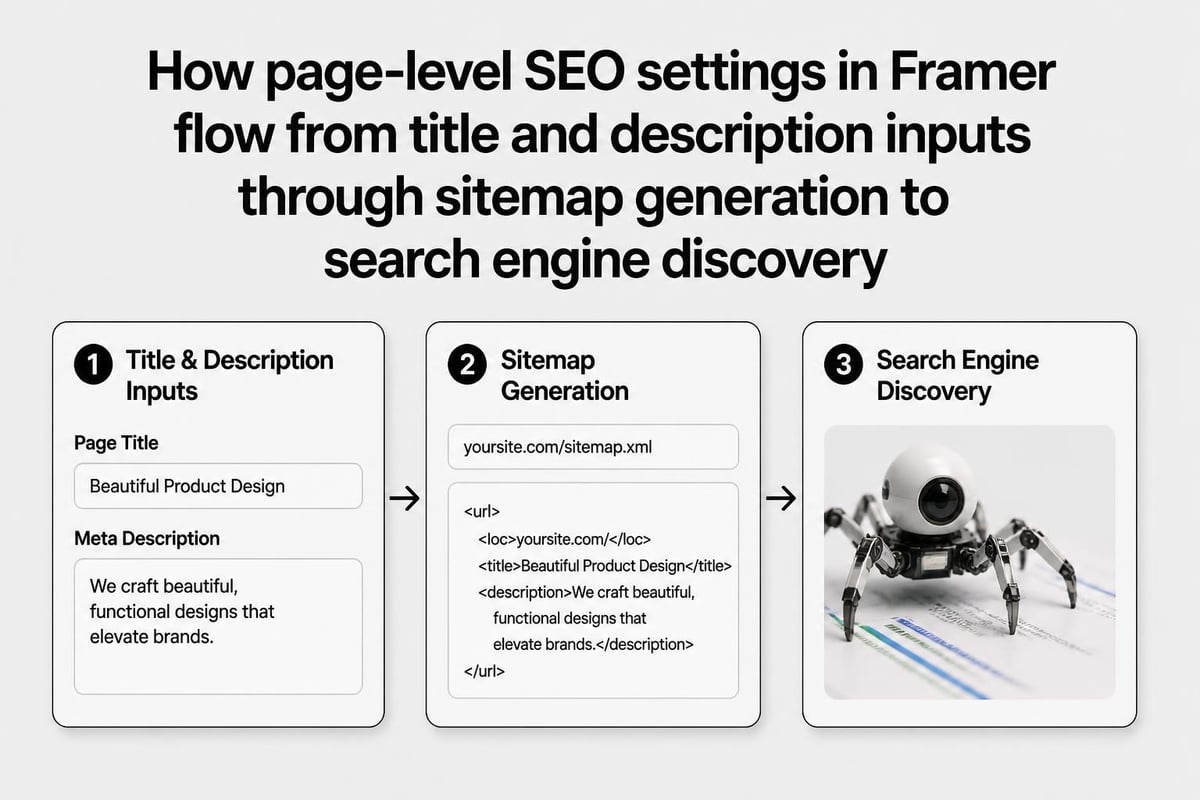
Framer provides built-in SEO tools that handle many fundamental optimization tasks automatically. The platform generates clean, semantic HTML and manages essential technical elements like sitemaps and meta tags through its interface.
Core SEO Features in Framer
The platform includes several key capabilities that form the foundation of framer seo:
- Automatic sitemap.xml generation that updates when you publish new pages
- Robots.txt configuration for controlling search engine crawler access
- Meta title and description fields for every page
- Open Graph and Twitter Card support for social sharing optimization
- Canonical URL management to prevent duplicate content issues
- Alt text fields for images to improve accessibility and indexing
These features provide a solid starting point, but they require proper configuration to deliver results. Many users assume that having these tools means their site is automatically optimized, but that's far from the reality.
Technical Performance Considerations
Framer sites are built on modern web technologies that generally perform well, but framer seo success depends on understanding the platform's technical characteristics:
| SEO Factor | Framer Capability | Optimization Required |
|---|---|---|
| Page Speed | Generally fast loading | Image optimization, minimal custom code |
| Mobile Responsiveness | Fully responsive by default | Test across devices |
| HTTPS/SSL | Automatic for all sites | None-built in |
| Structured Data | Manual implementation | Add JSON-LD schema |
| Core Web Vitals | Good baseline performance | Monitor and optimize heavy components |
The platform's performance foundation is strong, but optimization still requires attention to details like image compression and efficient component usage.
Optimizing Content Structure for Search Visibility
Content remains the most critical factor in framer seo success. Search engines rank pages based on relevance, authority, and user experience-all of which stem from how you structure and present your content.
Page Title and Description Optimization
Every page on your Framer site needs unique, compelling metadata. Framer's SEO title and description workflow makes this straightforward, but the quality of what you write matters more than the tool itself.
Title tag best practices:
- Keep titles under 60 characters to prevent truncation
- Include your primary keyword near the beginning
- Make each title unique across your site
- Write for users first, search engines second
Meta description guidelines:
- Aim for 140-160 characters
- Include a clear value proposition
- Incorporate secondary keywords naturally
- Add a subtle call-to-action when appropriate
These elements don't directly impact rankings but significantly affect click-through rates from search results, which indirectly influences your position over time.
URL Structure and Hierarchy
Clean, descriptive URLs help both users and search engines understand your content. Framer allows you to customize page slugs, giving you control over URL structure.
Design your URL hierarchy to reflect your site's information architecture. For a blog, this might look like:
/blog/category/article-title/resources/topic/guide-name/products/product-category/product-name
Avoid changing URLs after publication unless absolutely necessary. If you must restructure, implement proper 301 redirects to preserve link equity and prevent broken links.
Advanced Framer SEO Techniques
Beyond the basics, several advanced strategies can significantly improve your search performance on Framer.
Implementing Structured Data
While Framer doesn't include built-in structured data tools, you can add JSON-LD schema markup through custom code components. This helps search engines understand your content context and can enable rich results in search.
Common schema types for business websites:
- Organization schema for your brand
- Article schema for blog posts
- Product schema for e-commerce
- FAQ schema for support content
- Review schema for testimonials
Add these using Framer's custom code component in the <head> section of relevant pages.
Image Optimization Strategy
Images significantly impact both page speed and SEO potential. Framer automatically optimizes images to some degree, but you should prepare assets before upload.
- Resize images to actual display dimensions before uploading
- Compress files using tools like TinyPNG to reduce file size
- Choose appropriate formats: WebP for photographs, SVG for logos
- Write descriptive alt text that explains image content and context
- Use meaningful file names before upload (not "IMG_1234.jpg")
These practices improve load times and make your visual content discoverable through image search.
Integrating Content Automation with Framer
For businesses publishing content regularly, manual optimization becomes time-consuming. Automated workflows can maintain SEO quality while scaling output. Platforms like RankPill's Framer integration enable you to publish optimized content directly to your Framer site without manual intervention.
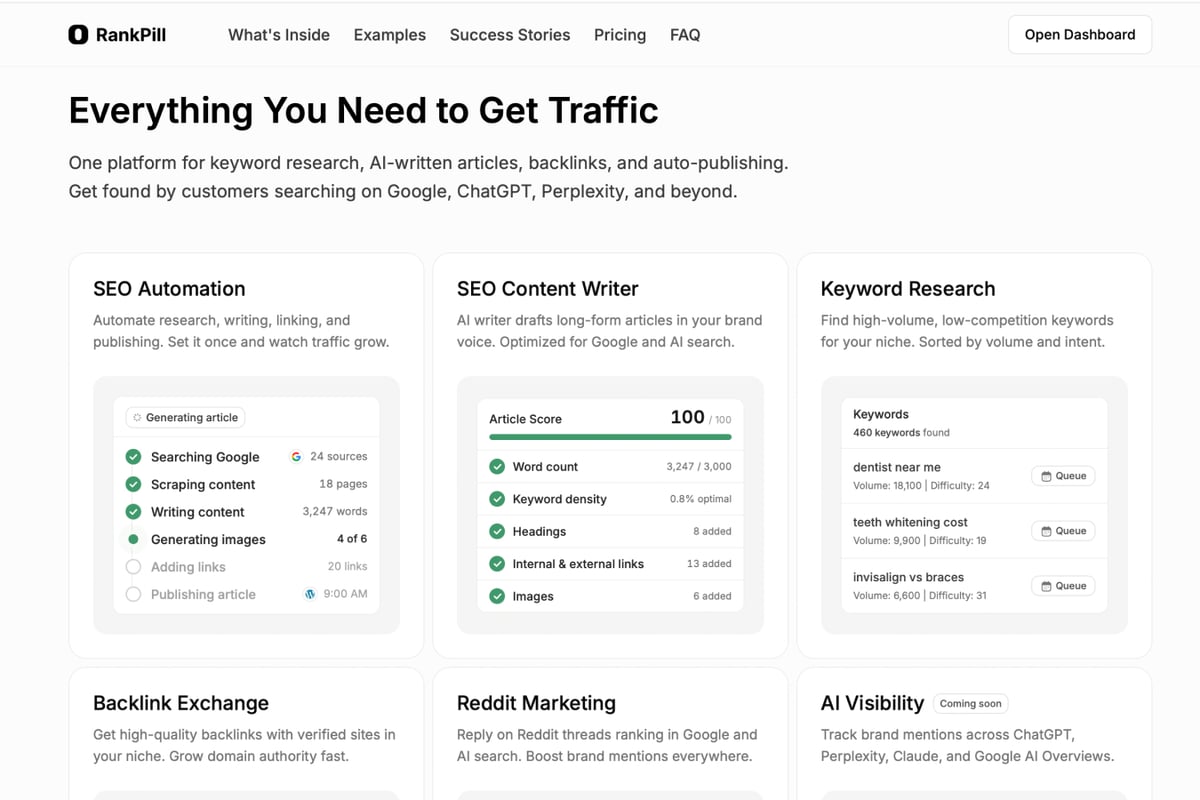
This approach combines keyword research, content generation, and proper formatting into a single automated process, ensuring every published piece follows SEO best practices consistently.
Content Publishing Workflows
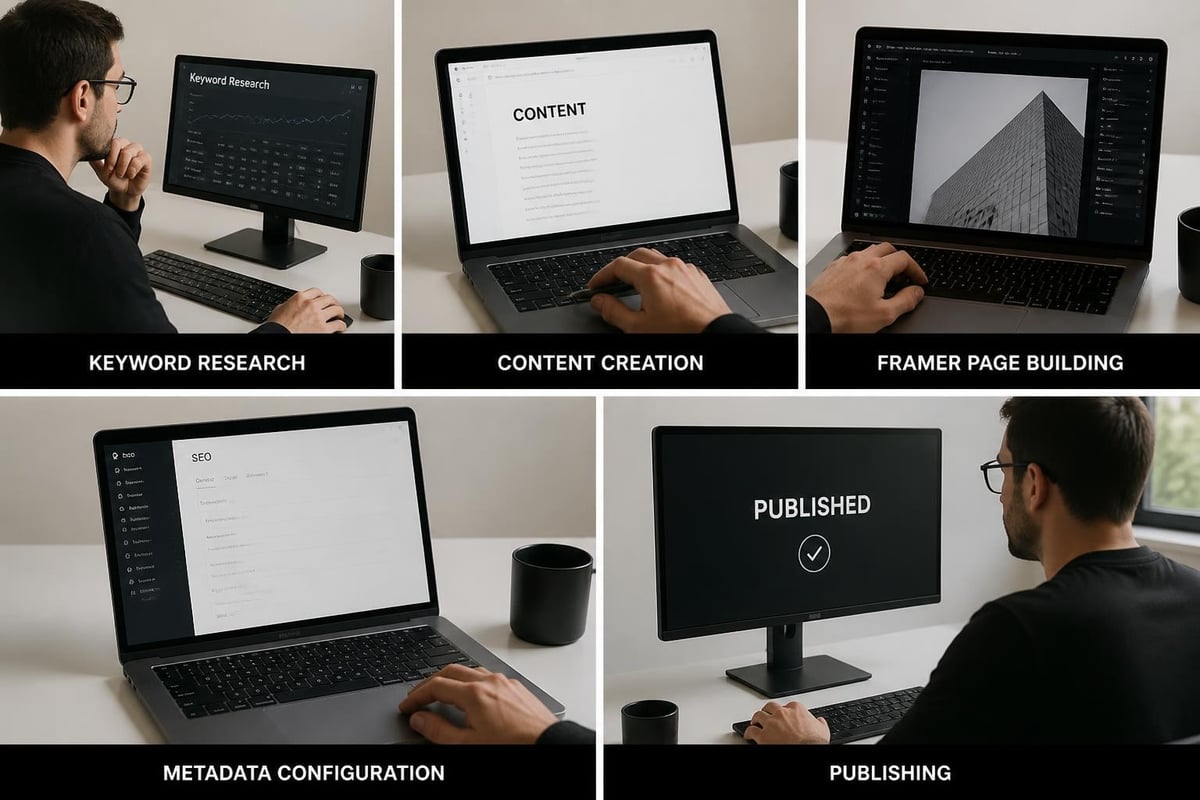
Whether you're automating or publishing manually, establish a consistent workflow:
- Conduct keyword research to identify target terms
- Create content that matches search intent
- Structure with proper headings (H1, H2, H3 hierarchy)
- Add internal links to related pages on your site
- Include external links to authoritative sources
- Optimize metadata for title and description
- Add relevant images with alt text
- Review on mobile before publishing
- Submit to Search Console for faster indexing
This systematic approach ensures nothing falls through the cracks when scaling content production.
Monitoring and Improving Framer SEO Performance
Optimization isn't a one-time task-it requires ongoing monitoring and refinement based on performance data.
Essential Tracking Tools
Set up these monitoring systems immediately after launching your Framer site:
| Tool | Purpose | Key Metrics |
|---|---|---|
| Google Search Console | Monitor search performance | Impressions, clicks, rankings, errors |
| Google Analytics 4 | Track user behavior | Traffic sources, engagement, conversions |
| Framer Analytics | Built-in page views | Visitor counts, popular pages |
| Lighthouse | Technical performance | Core Web Vitals, accessibility scores |
Framer makes it simple to add Google Analytics and Search Console through its integrations panel-no manual code insertion required.
Identifying Optimization Opportunities
Regular performance reviews reveal where to focus improvement efforts. Understanding Framer's SEO features and tools helps you know what's possible within the platform.
Monthly SEO audit checklist:
- Review pages with declining traffic in Search Console
- Identify high-impression, low-click pages needing better titles
- Find pages with slow load times in PageSpeed Insights
- Check for crawl errors in Search Console
- Analyze top-performing content for expansion opportunities
- Review internal linking structure for improvements
Address issues in order of potential impact, focusing on pages that already receive significant impressions but have low click-through rates.
Common Framer SEO Mistakes to Avoid
Even with Framer's user-friendly interface, several pitfalls can undermine your search performance.
Duplicate Content Issues
Creating multiple pages with similar or identical content confuses search engines about which version to rank. This commonly happens when businesses create separate pages for minor variations of the same service or product.
Solutions:
- Use canonical tags to indicate preferred versions
- Consolidate similar pages into comprehensive resources
- Differentiate content substantially when covering related topics
- Implement proper 301 redirects when removing duplicate pages
Neglecting Mobile Experience
While Framer sites are responsive by default, complex custom designs sometimes break on smaller screens. Search engines use mobile-first indexing, meaning they evaluate your site based on the mobile version.
Test every page on actual mobile devices, not just desktop browser simulations. Pay attention to:
- Touch target sizes for buttons and links
- Text readability without zooming
- Navigation usability on small screens
- Form functionality and input methods
Overlooking Page Speed
Framer provides good baseline performance, but heavy use of animations, large images, or complex components can slow pages significantly. Framer's optimization warnings alert you to some issues, but regular testing with tools like PageSpeed Insights reveals additional opportunities.
Building Content Authority with Framer
Strong framer seo requires more than technical optimization-it demands authoritative, comprehensive content that satisfies search intent.
Topic Clustering Strategy
Organize content around core topics rather than individual keywords. This approach, called topic clustering, helps establish topical authority.
- Identify pillar topics relevant to your business
- Create comprehensive pillar pages covering topics broadly
- Develop cluster content addressing specific subtopics
- Link cluster pages to the pillar page
- Update regularly as topics evolve
For a marketing agency, pillar topics might include "Content Marketing," "SEO," and "Social Media Marketing," with cluster content addressing specific tactics, tools, and strategies within each area.
Internal Linking Architecture
Strategic internal linking distributes authority throughout your site and helps search engines understand content relationships. Comprehensive Framer SEO guides emphasize the importance of deliberate linking strategies.
Internal linking best practices:
- Link from high-authority pages to newer content
- Use descriptive anchor text that includes relevant keywords
- Link to related content within blog posts
- Create hub pages that connect related resources
- Avoid excessive links-focus on most relevant connections
Don't link randomly just to increase link count. Each link should add value by connecting genuinely related content.

Scaling SEO on Framer for Growth
As your business grows, manually managing framer seo becomes unsustainable. Strategic automation and systematic processes enable consistent optimization at scale.
Automation Opportunities
Several aspects of SEO work can be automated without sacrificing quality:
- Keyword research using tools that identify opportunities based on search data
- Content briefs generated from top-ranking competitor analysis
- Article publishing through CMS integrations
- Internal linking through automated relevant content suggestions
- Performance monitoring with automated reports
When implementing automation, understanding AI and SEO integration helps you leverage technology effectively while maintaining content quality.
Template-Based Optimization
Create standardized templates for common page types to ensure consistent optimization:
| Page Type | Template Elements | SEO Focus |
|---|---|---|
| Blog Posts | Heading structure, image placement, CTA | Long-tail keywords, internal links |
| Service Pages | Feature lists, benefits, testimonials | Commercial intent keywords |
| Product Pages | Specifications, images, reviews | Product-specific search terms |
| Landing Pages | Headlines, value props, conversion forms | High-intent keywords |
Templates don't mean identical content-they ensure structural consistency while allowing unique messaging.
Technical SEO Configuration in Framer
Several technical elements require one-time configuration but significantly impact long-term performance.
Robots.txt and Sitemap Management
Framer automatically generates both files, but you should verify their configuration. Access your robots.txt at yoursite.com/robots.txt and sitemap at yoursite.com/sitemap.xml.
Robots.txt considerations:
- Ensure it doesn't block important pages
- Verify sitemap location is correctly specified
- Check that staging sites use noindex directives
Sitemap optimization:
- Confirm all important pages appear
- Remove pages you don't want indexed
- Submit sitemap to Google Search Console
Redirect Management
When restructuring your site or removing pages, proper redirects preserve SEO value. Framer's redirect capabilities allow you to implement 301 redirects through the site settings.
Redirect best practices:
- Redirect old URLs to the most relevant new page
- Avoid redirect chains (A→B→C)
- Test redirects after implementation
- Document redirects for future reference
Never delete important pages without implementing redirects-you'll lose accumulated SEO value and create broken link issues.
Content Strategy for Sustainable Growth
Long-term framer seo success comes from publishing valuable content consistently rather than sporadic bursts of activity.
Editorial Calendar Planning
Plan content months in advance based on keyword research, seasonal trends, and business priorities. This ensures steady publishing rhythm and strategic topic coverage.
Calendar components:
- Publishing dates for each piece
- Target keywords and search intent
- Content format (guide, tutorial, case study)
- Internal linking opportunities
- Promotion channels
Consistency matters more than volume. Publishing one excellent article weekly outperforms seven mediocre posts followed by weeks of silence.
Content Quality Standards
Every piece published represents your brand in search results. Establish quality baselines:
- Minimum word count appropriate to topic depth (typically 1,500+ for pillar content)
- Original research or perspective rather than rehashed information
- Proper source citation for claims and statistics
- Professional editing for grammar and clarity
- Visual elements to enhance understanding
- Actionable takeaways readers can implement
Quality content naturally attracts backlinks, social shares, and engaged readers-all signals that improve search rankings.
Measuring ROI from Framer SEO Efforts
SEO requires sustained investment, so tracking return on that investment keeps efforts focused on valuable activities.
Key Performance Indicators
Beyond vanity metrics like total traffic, focus on business outcomes:
- Organic traffic to conversion rate
- Revenue generated from organic visitors
- Cost per acquisition compared to paid channels
- Keyword rankings for business-critical terms
- Domain authority growth over time
These metrics connect SEO activities to business results, justifying continued investment and guiding strategy adjustments.
Attribution and Reporting
Set up proper tracking to understand which content and keywords drive conversions. Google Analytics 4's event-based model allows detailed attribution of actions to traffic sources.
Create monthly reports that show:
- Traffic trends with year-over-year comparisons
- Top-performing content by traffic and conversions
- Ranking improvements for target keywords
- Technical issues discovered and resolved
- Competitive analysis of ranking changes
Share these insights with stakeholders to demonstrate SEO's contribution to business growth and secure ongoing support for optimization efforts.
Framer provides a solid foundation for search engine optimization through its native features and technical architecture, but achieving strong rankings requires strategic content creation, ongoing optimization, and systematic monitoring. The platform's visual design capabilities shouldn't overshadow the importance of technical SEO fundamentals and authoritative content. For businesses looking to scale their SEO efforts beyond manual optimization, RankPill automates the entire content workflow-from keyword research through publishing-ensuring consistent, optimized content production that builds organic traffic while you focus on other business priorities.