
How to Rank Higher on Google: 2026 SEO Guide

Modest Mitkus
June 21, 2026
Ranking higher on Google isn't about luck or secret hacks. It's about understanding what search engines value and delivering exactly that: helpful, authoritative content that solves real problems. In 2026, Google's algorithms are smarter than ever, with AI-powered search experiences like SGE (Search Generative Experience) reshaping how users find information. Yet the fundamentals remain consistent: quality content, technical excellence, and genuine authority. This guide breaks down exactly how to rank higher on Google using strategies that work today and will continue working tomorrow.
Understanding Google's Ranking Factors
Google evaluates hundreds of signals to determine where your page should rank. While the exact algorithm remains proprietary, extensive research from Ahrefs has identified the most impactful factors that consistently correlate with higher rankings.
Content Quality and Relevance
Content remains the foundation of SEO success. Google's helpful content system now prioritizes material created primarily for humans, not search engines. This means your pages must demonstrate expertise, provide comprehensive answers, and match user intent.
Key quality signals include:
- Depth of coverage: Thorough exploration of topics with supporting details
- Original research or insights: Unique perspectives that can't be found elsewhere
- Updated information: Fresh content reflecting 2026 data and trends
- Clear structure: Logical organization with proper headings and formatting
- User satisfaction metrics: Low bounce rates and high engagement time
The shift toward AI and SEO has also introduced new considerations. Content must now satisfy both traditional search algorithms and AI-powered answer engines.
Technical SEO Foundations
Your site's technical infrastructure directly impacts crawlability and indexation. Even brilliant content won't rank if Google can't properly access and understand it.
| Technical Element | Impact on Rankings | Priority Level |
|---|---|---|
| Page Speed | High - affects user experience and Core Web Vitals | Critical |
| Mobile Responsiveness | High - mobile-first indexing standard | Critical |
| HTTPS Security | Medium - trust signal and ranking factor | High |
| XML Sitemap | Medium - aids discovery and crawling | High |
| Structured Data | Medium - enables rich results | Medium |
Google's PageSpeed Insights tool provides free analysis of your site's technical performance, highlighting specific issues that impact rankings.

Keyword Research That Actually Works
Learning how to rank higher on Google starts with targeting the right keywords. Too many businesses chase high-volume terms they'll never rank for, ignoring easier opportunities with real business value.
Finding Low-Competition Keywords
The sweet spot exists where search volume meets achievable competition. Instead of targeting "insurance" (impossible for most sites), focus on longer, more specific phrases like "commercial property insurance for restaurants in Austin."
Strategic keyword identification involves:
- Brainstorm seed topics relevant to your business and audience
- Expand with keyword research tools to discover related searches
- Analyze competition levels for each potential target
- Assess search intent to ensure alignment with your content
- Prioritize based on difficulty and business value
The RankPill keyword research tool helps you discover these opportunities without expensive enterprise software, revealing gaps your competitors haven't exploited.
Understanding Search Intent
Google has become exceptionally skilled at matching results to user intent. A search for "Nike shoes" triggers different results than "how to clean Nike shoes" because the intent differs completely.
Four primary intent types:
- Informational: Users seeking knowledge or answers
- Navigational: Users looking for a specific website or page
- Commercial: Users researching products before purchase
- Transactional: Users ready to buy or take action
Your content must match the dominant intent for your target keyword. Ranking a product page for an informational query is nearly impossible because Google knows that's not what users want.
Creating Content That Ranks
Once you've identified the right keywords, the next step in how to rank higher on Google is creating content that deserves to rank. Quality trumps quantity every time.
Content Structure Best Practices
Organization matters as much as the words themselves. Google's algorithms can now understand document structure, identifying main topics, subtopics, and supporting details.
Effective content architecture includes:
- Compelling headlines that incorporate target keywords naturally
- Clear hierarchy using H2 and H3 subheadings logically
- Scannable paragraphs mixing short and long for readability
- Visual elements like images, tables, and lists breaking up text
- Internal links connecting related content across your site
Modern SEO also requires optimizing for featured snippets and AI overviews. This means providing direct answers to questions in concise, well-formatted sections.
Comprehensive Topic Coverage
Thin content no longer ranks. Google favors comprehensive resources that fully address a topic. This doesn't mean padding word count with fluff; it means thoroughly covering all relevant subtopics users care about.
When writing about "how to rank higher on Google," comprehensive coverage includes keyword research, on-page optimization, technical SEO, link building, and content strategy. Missing any major component creates gaps that competitors can exploit.

On-Page Optimization Essentials
On-page SEO involves optimizing individual pages to rank higher and earn more relevant traffic. These elements communicate your page's topic and value to search engines.
Title Tags and Meta Descriptions
Your title tag remains one of the most important on-page signals. It should include your target keyword, preferably near the beginning, while remaining compelling for human readers.
Title tag guidelines:
- Keep under 60 characters to avoid truncation
- Include primary keyword naturally
- Make it unique for each page
- Add brand name at the end for recognition
Meta descriptions don't directly impact rankings but significantly affect click-through rates. A compelling description that includes your keyword can dramatically increase organic traffic.
Header Tags and Content Organization
Headers (H1, H2, H3) create content hierarchy that both users and search engines rely on. Your H1 should clearly state the page topic and typically includes your main keyword.
| Header Level | Purpose | Keyword Usage |
|---|---|---|
| H1 | Page title - one per page | Primary keyword |
| H2 | Main section headings | Primary and related keywords |
| H3 | Subsection headings | Supporting keywords naturally |
| H4-H6 | Further subdivisions | Natural language, minimal keyword focus |
Adding keywords to your website requires balance. Overoptimization triggers spam filters, while underoptimization misses ranking opportunities.
Image Optimization
Images improve user experience but can slow page speed if not optimized properly. Every image should include descriptive alt text for accessibility and SEO.
Image optimization checklist:
- Compress file sizes without sacrificing quality
- Use descriptive, keyword-rich file names
- Add alt text describing the image content
- Implement lazy loading for below-fold images
- Use next-gen formats like WebP when possible
Building Authority Through Backlinks
Links from other websites remain one of Google's strongest ranking signals. They function as votes of confidence, indicating your content is valuable enough to reference.
Quality Over Quantity
Not all backlinks are created equal. A single link from a highly authoritative, relevant site carries more weight than dozens of links from low-quality directories or spam sites.
Google evaluates links based on:
- Domain authority of the linking site
- Relevance between linking and linked content
- Link placement within the content (contextual links matter more)
- Anchor text used in the link
- Follow vs. nofollow attributes (though both have value)
Building quality backlinks requires creating content worth linking to, then conducting strategic outreach to relevant sites that benefit from referencing your material.
White-Hat Link Building Strategies
The safest approach involves earning links through genuine value creation. RankPill's backlink exchange connects you with quality websites for legitimate link swaps that grow domain authority without risking penalties.
Proven link building tactics include:
- Creating linkable assets like original research, tools, or comprehensive guides
- Guest posting on relevant industry publications
- Broken link building by finding dead links and offering your content as replacement
- Digital PR generating newsworthy content that attracts media coverage
- Community engagement in forums and communities where your expertise adds value
Avoid purchasing links, participating in link schemes, or using automated link building tools that violate Google's guidelines. The short-term gains aren't worth the long-term penalties.

Technical Performance and User Experience
Google's Core Web Vitals update made user experience an official ranking factor. Sites that load quickly, respond to interactions promptly, and maintain visual stability rank higher than slow, clunky competitors.
Core Web Vitals Metrics
Three key metrics measure page experience:
- Largest Contentful Paint (LCP): Measures loading performance, should occur within 2.5 seconds
- First Input Delay (FID): Measures interactivity, should be less than 100 milliseconds
- Cumulative Layout Shift (CLS): Measures visual stability, should maintain a score under 0.1
Improving these metrics often requires technical interventions like optimizing server response times, eliminating render-blocking resources, and ensuring ads don't cause layout shifts.
Mobile-First Optimization
Google predominantly uses the mobile version of your site for indexing and ranking. If your mobile experience is poor, your rankings suffer across all devices.
Mobile optimization requirements:
- Responsive design that adapts to any screen size
- Touch-friendly buttons and navigation elements
- Fast loading even on slower mobile connections
- No intrusive interstitials blocking content access
- Properly sized text without requiring zoom
Testing mobile performance should be part of your regular SEO maintenance routine.
Measuring and Improving Rankings
Understanding how to rank higher on Google requires tracking your progress and adjusting based on data. Guesswork doesn't work in modern SEO.
Essential Tracking Metrics
| Metric | What It Measures | Why It Matters |
|---|---|---|
| Keyword Rankings | Position for target terms | Direct ranking progress indicator |
| Organic Traffic | Visitors from search engines | Business impact of rankings |
| Click-Through Rate | Percentage who click your result | Title and description effectiveness |
| Bounce Rate | Visitors leaving immediately | Content relevance and quality signal |
| Conversion Rate | Visitors taking desired action | Ultimate business goal achievement |
Google Search Console provides free data on your search performance, showing which queries trigger your pages and where you rank. Google Analytics tracks user behavior once visitors arrive.
Iterative Optimization Process
SEO isn't set-and-forget. Rankings fluctuate based on algorithm updates, competitor actions, and changing search patterns. Continuous improvement separates winners from losers.
Regular optimization activities include:
- Updating older content with fresh information and data
- Expanding thin pages with additional comprehensive sections
- Improving internal linking to distribute authority
- Optimizing underperforming pages based on analytics data
- Monitoring competitors to identify new opportunities
Free SEO tools from RankPill help you track performance without expensive enterprise software subscriptions.
Automation and Scaling SEO Efforts
For businesses serious about organic growth, manually executing all these strategies becomes unsustainable. The most successful sites in 2026 leverage automation to maintain consistency at scale.
Where Automation Adds Value
Certain SEO tasks are perfect for automation because they're repetitive, data-driven, and time-consuming when done manually.
High-value automation opportunities:
- Keyword research and opportunity identification
- Content outline generation based on top-ranking competitors
- Internal linking suggestions across site content
- Technical SEO audits and monitoring
- Rank tracking and performance reporting
However, automation should enhance human expertise, not replace it. Strategic decisions, relationship building, and creative content ideation still require human judgment.
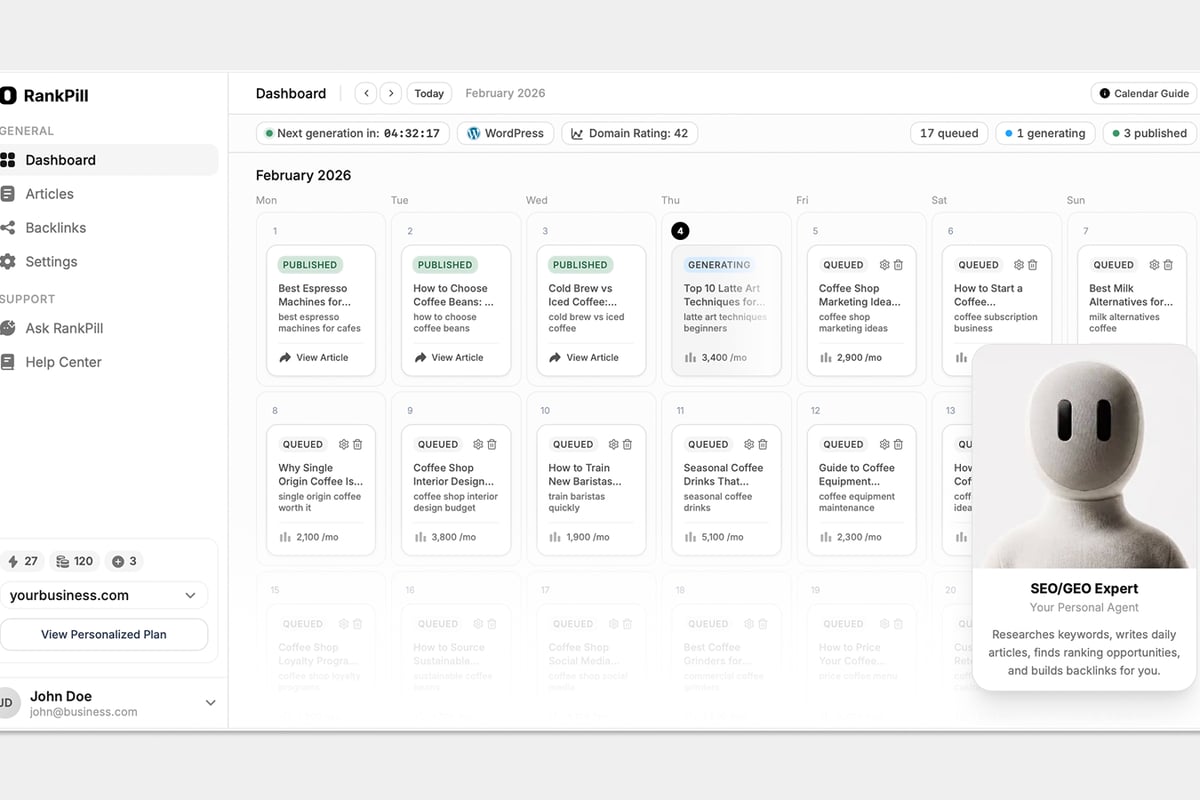
For businesses looking to scale their content production without sacrificing quality, platforms that automate the entire workflow from keyword research through publishing offer significant advantages. RankPill's SEO automation handles the repetitive technical work while maintaining the quality standards Google rewards, letting you focus on strategy and business growth.
Maintaining Quality at Scale
The biggest challenge in automated SEO is preserving quality. Google's algorithms specifically target low-quality content produced at scale, so automation must enhance rather than compromise standards.
Quality control measures include:
- Editorial review processes for AI-generated content
- Brand voice and tone guidelines built into automation
- Fact-checking protocols for accuracy
- User feedback integration to improve output
- Regular audits comparing automated and manual content performance
Content Freshness and Update Strategies
Google favors fresh, current content for many queries, particularly those where recency matters. Knowing when to update versus create new content impacts efficiency and results.
When to Update Existing Content
Refreshing older content often delivers better ROI than creating new pages. If you already rank on page two or three for a valuable keyword, updating that existing page typically moves it to page one faster than starting from scratch.
Update existing content when:
- It ranks positions 11-30 for target keywords
- Information has become outdated or inaccurate
- Competitors have published more comprehensive alternatives
- It generates significant impressions but low clicks
- Related content has been published that should be linked
Add new sections, update statistics, expand thin areas, improve formatting, and refresh the publish date to signal freshness.
Creating New Content Strategically
New content makes sense when you're targeting entirely new keywords, addressing different search intent, or expanding into new topic areas where you lack coverage.
Strategic new content creation:
- Identify keyword gaps competitors rank for but you don't
- Research emerging topics gaining search volume
- Create content targeting different funnel stages
- Develop linkable assets that attract backlinks
- Expand into related semantic territories
The key is balancing new content creation with optimization of existing assets rather than endlessly churning out new pages that cannibalize existing rankings.
Local SEO Considerations
For businesses serving specific geographic areas, local SEO strategies significantly impact how to rank higher on Google in location-based searches.
Google Business Profile Optimization
Your Google Business Profile (formerly Google My Business) is critical for local visibility. Complete profiles with accurate information, regular posts, and positive reviews rank higher in local pack results.
Essential profile elements:
- Accurate business name, address, phone (NAP consistency)
- Correct business category selection
- Complete business hours including special hours
- High-quality photos of location, products, team
- Regular posts about offers, events, and updates
Encourage satisfied customers to leave reviews and respond to all reviews (positive and negative) professionally.
Local Content and Citations
Creating content targeting local keywords and building citations (mentions of your business name, address, phone) across relevant directories strengthens local signals.
Target keywords like "[service] in [city]" or "[city] [service] provider" that indicate local intent. Ensure your NAP information appears consistently across all citations to avoid confusing Google about your actual location.
Staying Current with Algorithm Updates
Google releases thousands of algorithm updates annually, with several major core updates that can dramatically shift rankings. Staying informed helps you adapt quickly.
Responding to Algorithm Changes
When rankings drop after an update, resist the urge to make drastic changes immediately. Research from academic sources on search engine ranking methods shows that initial volatility often settles within weeks.
Effective response strategy:
- Monitor official Google communications for update details
- Analyze which pages were most affected
- Identify common patterns in ranking changes
- Compare your content to new top-ranking pages
- Make targeted improvements based on competitive analysis
- Allow time for changes to take effect before further modifications
Focus on long-term quality improvements rather than chasing short-term ranking fluctuations.
Common Ranking Mistakes to Avoid
Understanding how to rank higher on Google also means knowing what not to do. These common mistakes sabotage even well-intentioned SEO efforts.
Keyword Stuffing and Over-Optimization
Forcing keywords unnaturally into content triggers spam filters. Modern natural language processing easily detects unnatural keyword density and repetition patterns.
Write primarily for humans, incorporating keywords where they fit naturally. Synonyms, related terms, and semantic variations often work better than exact-match repetition.
Neglecting Mobile Experience
With mobile-first indexing, your mobile site IS your site in Google's eyes. Desktop-only optimization leaves rankings on the table.
Ignoring Search Intent
Ranking for keywords that don't match your content type rarely succeeds. Don't try to rank a product page for an informational query or vice versa.
Buying or Exchanging Low-Quality Links
Link schemes remain one of the fastest ways to incur penalties. Focus on earning links through genuine value creation and legitimate relationship building.
Duplicate Content Issues
Publishing identical or substantially similar content across multiple pages confuses Google about which version to rank and often results in none ranking well.
Use canonical tags to indicate preferred versions, consolidate thin pages into comprehensive resources, and ensure each page targets a unique primary keyword with distinct content.
Ranking higher on Google in 2026 requires a comprehensive approach combining quality content, technical excellence, strategic link building, and consistent optimization. The fundamentals haven't changed, but the execution has become more sophisticated with AI-powered search and increasingly competitive SERPs. Success comes from understanding these principles and applying them systematically over time. RankPill automates the most time-consuming aspects of SEO, from keyword research and content creation to publishing and backlink building, helping businesses achieve consistent organic growth without the manual workload or agency costs.