
LLM SEO Tool: How AI Models Are Reshaping Content Work

Modest Mitkus · October 22, 2026
An llm seo tool applies large language model technology to the mechanics of search optimization. It automates keyword research, content generation, on-page optimization, and publishing. The systems use transformer-based models (GPT-4, Claude, Llama) to write articles that match search intent, insert links, generate meta tags, and schedule publication. For founders and small teams, these tools compress weeks of content work into hours. But the quality depends on how the model is prompted, what data it retrieves, and how you evaluate output.
What an LLM SEO Tool Actually Does
An llm seo tool runs a pipeline. It starts with keyword discovery, analyzes the top-ranking pages for each term, builds an outline that mirrors search intent, writes the draft, adds structured data, and pushes it to your CMS.
Each stage uses a different prompt or model call:
- Keyword research: the model scans your site and competitor domains, extracts topic clusters, and tags each keyword by difficulty and opportunity
- Outline generation: it reads the top 10 results, identifies shared headings and questions, and builds a structure that covers the same ground
- Drafting: the LLM writes each section, citing sources and matching the tone you define in custom instructions
- Optimization: it inserts internal links to related pages, adds external references, writes alt text for images, and generates title and meta tags
- Publishing: the tool connects to WordPress, Shopify, Webflow, or a webhook and schedules the article
Google's guidance on AI-generated content emphasizes that the method of creation matters less than whether the content is helpful and meets E-E-A-T standards. An llm seo tool that sources real data, cites evidence, and writes for human readers can produce pages that rank.

How Retrieval-Augmented Generation Improves Output
Base LLMs hallucinate facts and dates. Retrieval-augmented generation (RAG) fixes this by fetching real-time data before the model writes.
A RAG-enabled llm seo tool works like this:
- You provide a keyword (e.g., "project management for remote teams")
- The tool fetches the top-ranking pages and extracts their content
- It builds a vector database of that content
- When the LLM writes each section, it retrieves the most relevant chunks and uses them as context
- The output includes citations and fewer invented statistics
Microsoft Research's DRIFT Search combines retrieval with knowledge graphs to improve answer quality. The same principle applies to content tools: the more structured, cited context the model receives, the more accurate the article.
Setting Up RAG in Your Workflow
Most llm seo tools handle RAG automatically. You configure:
- Data sources: which competitors or reference sites to scrape
- Chunk size: how much text each retrieval query returns (typically 500-1,000 tokens)
- Citation style: inline links, footnotes, or a reference list
The trade-off: RAG adds latency (3-10 seconds per retrieval call) and cost (embedding APIs and vector databases charge by query volume). If you generate 30 articles per month, the overhead is negligible. At 500 articles, it adds up.
Measuring Quality and Relevance
Not every LLM-generated article ranks. Quality depends on how well the output matches what Google and readers expect.
Microsoft's evaluation metrics guide lists key dimensions:
| Metric | What It Measures | How to Check |
|---|---|---|
| Relevance | Does the content answer the query? | Compare headings to top-10 results |
| Factual accuracy | Are statistics and claims correct? | Cross-reference citations |
| Coherence | Do paragraphs flow logically? | Read the full draft aloud |
| Completeness | Does it cover all subtopics? | Check for gaps vs. competitor content |
| Originality | Is the phrasing unique or derivative? | Run a plagiarism scan |
An llm seo tool that scores these dimensions before publishing will catch low-quality drafts. Some platforms show an SEO/GEO score that combines keyword placement, readability, link density, and structure.

Manual Review vs. Auto-Publish
You have two workflows:
Manual review: the tool drafts, you edit, then you publish. Takes 10-30 minutes per article. Best when accuracy or brand voice matters more than speed.
Auto-publish: the tool queues and publishes daily with no human step. Best when volume and consistency matter more than per-article polish.
The right choice depends on your niche. Legal, medical, or financial content demands manual review. SaaS tutorials, how-to guides, or ecommerce category pages often work fine on autopilot.
Keyword Research and Topic Clustering
An llm seo tool scans your site, pulls sitemap URLs, and extracts entities and topics. Then it compares those to competitors you specify and builds a gap analysis.
The output is a keyword library with:
- Search volume (monthly queries)
- Keyword difficulty (0-100 score)
- Opportunity tag (high, medium, low)
- Topic cluster (grouped by parent theme)
Each keyword can be queued as an article in one click. The tool drafts an outline, checks it against search intent, and writes the piece.
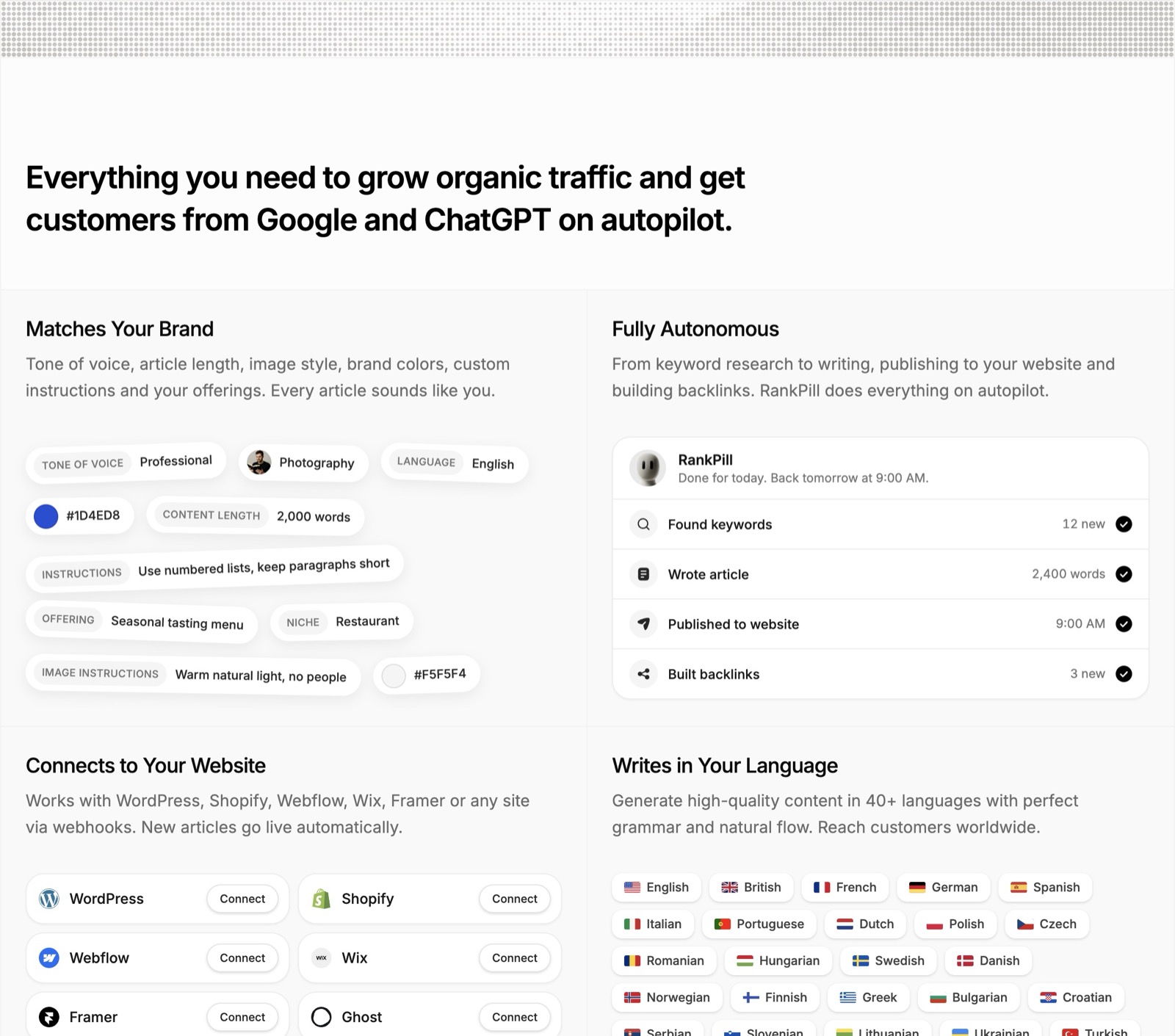
RankPill's keyword research tool uses DataForSEO to pull real search volume and groups keywords into clusters so you can target a topic family (e.g., "social media scheduling") with several related articles instead of isolated posts.
Filtering for Quick Wins
Not every keyword is worth writing. Use these filters:
- Difficulty below 30: you have a realistic shot at page one
- Volume above 100: enough monthly searches to matter
- Intent match: the keyword asks a question your product or content can answer
A common mistake: targeting high-volume, high-difficulty terms that will sit on page three for months. Better to write 10 articles for low-difficulty keywords and rank fast.
Integrations and Auto-Publishing
An llm seo tool connects to your content management system so it can publish without manual copy-paste.
Supported integrations:
- WordPress: via REST API or plugin
- Shopify: blog API
- Webflow: CMS API
- Wix: blog endpoints
- Framer: custom webhook
- Custom sites: webhook or Zapier
Each integration requires API credentials. Once connected, the tool schedules articles, uploads images, sets meta tags, and handles categories or tags.
Webhook Setup for Custom Platforms
If your site isn't on a major CMS, use a webhook:
- Create an endpoint that accepts POST requests with JSON
- Parse the JSON payload (title, body, meta, images)
- Insert the content into your database
- Return a 200 status code
The llm seo tool sends the article as structured data. Your backend script formats and publishes it. This works for headless CMSs, static site generators, or custom platforms.
Backlink Building with LLM Tools
Publishing content isn't enough. You need inbound links. Some llm seo tools include backlink features that use AI to identify link opportunities and draft outreach.
One approach is a backlink exchange: verified sites in your niche trade links. The llm seo tool matches sites by relevance, traffic, and spam risk. You review each match and approve or skip.
RankPill's backlink exchange filters matches by Domain Rating and topic cluster. Every earned link costs credits equal to the referring site's DR, so high-authority links cost more. Plans include 30 credits per month. This avoids buying links or doing cold email, which saves time and reduces spam-flag risk.
Outreach Templates Generated by LLMs
If you do manual outreach, an llm seo tool can draft pitches:
- Find pages with broken links in your niche
- Suggest your article as a replacement
- Write a personalized email based on the site owner's bio or recent posts
The model tailors each message. You review and send. Response rates are higher than templated blasts because the copy references specific context.
Adapting Content for Generative Search
Google and Bing now show AI-generated answers above traditional links. Google's May 2026 resource on optimizing for generative AI features recommends structured content, clear headings, and cited sources.
An llm seo tool can format articles for these experiences:
- Concise summaries: a 100-word intro that answers the core question
- Bulleted lists and tables: easier for LLMs to parse and cite
- Schema markup: structured data that identifies entities, FAQs, and how-tos
- External citations: links to authoritative sources increase trust
When ChatGPT or Perplexity cites your page, it drives referral traffic even if users never click through to Google. The content needs to be quotable and fact-dense.
Ethical and Technical Risks
LLMs produce plausible-sounding nonsense. An llm seo tool that doesn't validate facts will publish hallucinations, damaging your credibility.
Stanford's foundation-models report documents risks: bias amplification, memorization of training data, and adversarial manipulation. For SEO, the key threats are:
- Plagiarism: the model paraphrases copyrighted text too closely
- Misinformation: invented statistics or outdated facts
- Spam signals: over-optimized keyword stuffing that triggers penalties
Mitigation steps:
- Run every article through a plagiarism checker
- Cross-reference all numbers and dates against primary sources
- Use keyword density tools to avoid over-optimization (0.8-1.5% for the primary term is safe)
- Monitor Google Search Console for manual actions or traffic drops
ICLR 2025 research on adversarial SEO for LLMs shows how bad actors can manipulate model outputs. The same techniques apply in reverse: you need to defend against competitors or scrapers poisoning your training data.
Multi-Language Content at Scale
If you operate in several markets, an llm seo tool can write directly in 40+ languages instead of translating.
Each language runs as its own project:
- Separate keyword research with local search volume
- Native-language drafting (not machine translation)
- Region-specific examples and currency
This matters because Google ranks content by language and location. A translated article often ranks lower than one written natively. The cost: each language requires its own subscription and keyword library.
When an LLM SEO Tool Isn't the Right Fit
These tools work best when you need volume and consistency. They're less suited to:
- Thought leadership: original insights and personal stories require a human voice
- Investigative journalism: deep research and interviews can't be automated
- Highly regulated content: legal disclaimers and compliance checks need manual oversight
- Brand storytelling: emotional resonance and creative narrative need human craft
If your content strategy depends on unique data (proprietary research, customer case studies), the LLM can help format and optimize, but a human has to provide the substance.
Pricing Models and ROI Calculation
Most llm seo tools charge per article or per month. Typical ranges:
- $0.10-0.50 per article for basic drafts (no publishing, no optimization)
- $50-150 per month for 10-30 fully optimized and published articles
- $200-500 per month for agencies managing multiple clients
Calculate ROI by comparing the tool cost to your current content spend:
| Scenario | Monthly Cost | Articles Produced | Cost per Article |
|---|---|---|---|
| Freelance writer | $1,200 | 8 | $150 |
| Content agency | $3,000 | 12 | $250 |
| LLM SEO tool | $99 | 30 | $3.30 |
The difference funds other growth work (product, sales, support). You trade per-article quality for consistent output.
Real-World Workflow Example
Here's how a SaaS founder uses an llm seo tool to grow organic traffic:
- Monday: review the keyword library, queue 7 articles for the week
- Tuesday-Friday: the tool drafts, optimizes, and auto-publishes one article per day
- Saturday: check Google Search Console for new impressions and clicks
- Sunday: approve or skip backlink exchange matches
Total time: 90 minutes per week. Traffic grows 15-25% per quarter if the keyword targeting is accurate and the content matches intent.
The founder also uses RankPill's Reddit marketing feature to find threads that rank for target keywords and drafts helpful replies. That combination (owned content + third-party presence) accelerates ranking.
Custom Instructions and Brand Voice
Generic LLM output sounds like every other AI article. Custom instructions fix this.
You define:
- Tone: casual, technical, confident, cautious
- Sentence length: short (5-10 words) vs. long (15-25 words)
- Forbidden words: superlatives, buzzwords, jargon
- Preferred phrases: specific terms your audience uses
The llm seo tool saves these as a profile. Every article follows the same voice. Over time, readers won't notice the difference between human and machine drafts.
Tracking Performance Post-Publication
Publishing is step one. You need to measure what ranks and what doesn't.
Key metrics:
- Impressions: how often your page shows in search results
- Click-through rate: percentage of impressions that turn into visits
- Average position: where your page ranks for target keywords
- Backlinks gained: how many sites link to each article
An llm seo tool with built-in analytics shows this in one dashboard. You can see which topics drive traffic and double down on those clusters.
If an article sits on page two for 60 days, rewrite the intro, add a table, or update the publish date. Small tweaks often push it to page one.
Experimentation and Iteration
No llm seo tool is perfect out of the box. You improve output by testing:
- Prompt variations: try different instructions and compare readability scores
- Model selection: GPT-4 vs. Claude vs. Llama for your niche
- Outline depth: 5 headings vs. 10 headings per article
- Link density: 3 internal links vs. 7 internal links
Research on stochastic experience optimization for LLMs proposes model-agnostic methods to tune behavior without retraining. For SEO, this means A/B testing prompts and measuring which versions rank faster.
Run experiments in parallel: publish half your articles with one prompt set and half with another. After 30 days, compare average position and traffic. Keep the winner.
An llm seo tool automates the content pipeline, but it doesn't replace strategy or human judgment. You still choose keywords, set brand voice, and review output. The benefit is speed and consistency. If you want to publish daily without hiring writers, RankPill handles keyword research, drafting, optimization, publishing, and backlink building in one platform. Set it up once and it runs on autopilot.
Unlock Traffic on Autopilot
Grow organic traffic on autopilot. RankPill will research, write, optimize, and publish articles to your website daily.
 WordPress