
Real Estate SEO: Rank Above Zillow and Realtor.com

Modest Mitkus · November 5, 2026
Real estate agents and brokerages spend thousands on Zillow leads while their own websites sit invisible in Google. The problem is not lack of content or beautiful property photos. It is that most real estate sites never compete for the keywords buyers actually search. Real estate seo is different from other local industries because you are fighting national portals with billion-dollar SEO budgets, not just other agents. This guide shows you how to rank for keywords that drive listing inquiries and buyer leads without paying per click or per referral.
Why Real Estate SEO Is Harder Than Other Local Industries
Most local businesses compete with other shops in town. Real estate agents compete with Zillow, Realtor.com, Redfin and national mortgage lenders for every keyword. These portals have 10+ years of content, millions of backlinks and engineering teams optimizing for Google 24/7.
Your advantage is specificity. Portals target broad keywords like "homes for sale Phoenix" because they serve every neighborhood. You can target "craftsman homes in Roosevelt Row Phoenix" or "single family homes near Desert Ridge schools" and build content that answers hyper-local questions the portals cannot scale.
The math: a national portal might rank #1 for "Phoenix real estate" (33,000 monthly searches) but never crack the top 10 for "Arcadia neighborhood golf course homes" (90 searches). You do not need to beat them on volume. You need to own the keywords your actual buyers search when they are ready to tour.
The Keyword Gap National Portals Leave Open
Big portals optimize listing pages for "[city] homes for sale" and "[zip code] real estate". They rarely create content around school districts, commute times, new construction timelines or neighborhood character. Those are the gaps you fill.
Keyword categories where agents can win:
- Neighborhood guides: "best neighborhoods in [city] for young families"
- School-focused searches: "homes near [specific school name]"
- Lifestyle queries: "walkable neighborhoods in [city]"
- Market updates: "[neighborhood] home prices 2026"
- Buyer education: "how to buy a house in [state]" with local lender/title info
Each piece of content targets a different stage of the buyer journey. Neighborhood guides attract browsers. School and commute content attracts serious buyers. Market updates attract sellers. Layer them together and you build topical authority Google rewards.

Build a Keyword Library That Matches Search Intent
Most agents start with a list of neighborhoods and write "Best Neighborhoods in [City]" posts. That works for one article. It does not scale to 50+ pages or differentiate you from the brokerage down the street publishing the same list.
Start with your MLS data. Export the last 200 listings you have shown or sold. Look at the features buyers asked about: school ratings, lot size, HOA rules, walkability scores, new construction vs. resale. Each question is a keyword cluster.
Use a keyword research tool to find search volume and difficulty for each cluster. Prioritize keywords with 50-500 monthly searches and low competition. These drive fewer clicks than "[city] real estate" but they convert at 10x the rate because intent is clear.
How to Structure Your Keyword Clusters
Organize keywords by buyer stage, not alphabetically. Awareness-stage keywords (neighborhood overviews, market trends) go at the top of your funnel. Consideration-stage keywords (school comparisons, commute calculators) go in the middle. Decision-stage keywords (how to make an offer, closing costs in [county]) go at the bottom.
Example cluster for a Phoenix agent:
| Stage | Keyword Example | Monthly Searches | Intent |
|---|---|---|---|
| Awareness | Best Phoenix suburbs for families | 320 | Browsing markets |
| Consideration | Scottsdale vs Gilbert schools | 110 | Comparing options |
| Decision | How to buy a house in Maricopa County | 90 | Ready to act |
Each stage links to the next. A neighborhood guide links to school comparisons. School comparisons link to buyer guides. Buyer guides link to your contact form. This is how you turn blog traffic into listing appointments.
Create Location Pages That Rank Without Keyword Stuffing
Every real estate site has a "Neighborhoods" page with a grid of photos and two-sentence descriptions. Google does not rank those pages because they do not answer questions. They are navigation, not content.
A location page that ranks is 1,500-2,000 words covering what buyers ask: typical home prices, property types, school ratings, commute times to employment centers, walkability, parks, dining and recent sales trends. Include a map embed, recent sold listings (if your MLS allows) and links to related neighborhood pages.
Write in plain language. Avoid realtor jargon like "premier location" or "sought-after community". Buyers search "quiet neighborhoods Phoenix" or "Phoenix neighborhoods with good schools". Use their words.
What to Include on Every Neighborhood Page
- Overview paragraph: what defines the neighborhood (historic, new development, golf course community)
- Home types and price ranges: single family, townhome, condo with current median prices
- Schools: elementary, middle and high school names with ratings if public data exists
- Commute and transportation: drive time to downtown, airport, major employers
- Amenities: parks, trails, shopping, restaurants within 1 mile
- Market snapshot: median price, days on market, inventory levels (update quarterly)
- Internal links: to related neighborhoods, buyer guides, market reports
If you manage 15 neighborhoods, that is 15 pages. Publish one per week. Update quarterly with new price data. Each page earns backlinks from local blogs, chamber sites and community forums over time.

Optimize Google Business Profile for Local Pack Rankings
A significant portion of real estate searches show a local map pack: three businesses with reviews, hours and a map pin. Ranking in the pack drives more calls than ranking #1 in organic results because the pack appears above organic listings on mobile.
Your Google Business Profile (GBP) is the signal Google uses to decide pack placement. Optimize it by filling every field: business name (do not add keywords), exact address, phone number, website URL, hours, categories (real estate agency, real estate agent), service areas and a 750-word business description using natural keyword variations.
Add photos every week: office exterior, team headshots, neighborhood photos, open house snapshots. Google rewards fresh images. Upload photos with descriptive filenames like "downtown-phoenix-loft-open-house.jpg" instead of "IMG_1234.jpg".
Collect reviews consistently. Ask every closed client to leave a Google review. Respond to every review (positive and negative) within 48 hours. Review velocity and recency matter more than total count. Ten reviews in the last 30 days beats 100 reviews from 2024.
GBP Tactics That Move the Needle
- Post weekly updates: new listings, market reports, open house announcements (Google Posts expire after 7 days)
- Add service-area cities: if you serve multiple cities, list them all in your service area settings
- Use Q&A strategically: seed your GBP Q&A with common questions buyers ask, then answer them with keyword-rich responses
- Track insights: GBP shows search queries that surfaced your profile; add those keywords to your content calendar
Local pack ranking factors include proximity (how close your office is to the searcher), relevance (how well your GBP categories and description match the query) and prominence (review count, review rating, backlinks to your site). You control relevance and prominence. Proximity is fixed unless you open a satellite office.
Build Backlinks Without Buying Links or Cold Emailing
Real estate seo depends on backlinks. Google uses links as votes of trust. A site with 50 quality backlinks outranks a site with zero backlinks even if the content is better.
Most link-building advice (guest posting, broken link outreach, digital PR) takes 10+ hours per link. Real estate agents do not have that time. Focus on tactics that scale: local sponsorships, community partnerships and resource links.
Sponsor a little league team, a local charity 5k or a high school theater program. Most sponsorships include a logo and link on the organization's website. Cost: $250-$1,000 per sponsorship. Value: a local backlink from a site Google trusts.
Partner with local businesses that serve the same audience: mortgage brokers, home inspectors, interior designers, moving companies. Offer to write a "what to know about [your city] real estate" guest post for their blog in exchange for a link. They get free content. You get a relevant backlink.
Create a resource worth linking to. Examples: a downloadable first-time homebuyer checklist, a school district comparison map, a neighborhood walkability tool. Promote it to local bloggers and journalists. If it is genuinely useful, they will link to it without you asking.
The modern link-building approach prioritizes earning links through value, not pitching. Build something people want to reference, then let them discover it through social, local press and community groups.
Publish Consistently Without Hiring a Content Team
Real estate agents do not have time to write 2,000-word neighborhood guides every week. You are showing houses, negotiating offers and managing clients. Content falls to the bottom of the priority list.
The solution is automation. Tools that research keywords, write drafts and publish on schedule let you maintain a content calendar without hiring writers. SEO automation handles research, writing and publishing so you focus on editing and promotion.
Set up a content calendar with one article per week. Front-load neighborhood pages (your highest-value SEO content). Follow with market updates, buyer guides and school comparisons. Automate publishing so articles go live every Tuesday at 9 AM without manual uploads.
Every article should include 3-5 internal links to related pages (other neighborhoods, your contact page, your listings page) and 2-3 external links to authoritative sources like Zillow research, NAR statistics or local news. Internal links keep visitors on your site. External links signal to Google that your content is well-researched.
Content Calendar Template for Real Estate Agents
- Week 1: Neighborhood overview (1,500 words, focus keyword "[neighborhood] homes for sale")
- Week 2: Market update ("[city] housing market 2026", 1,200 words)
- Week 3: Buyer guide ("how to buy a house in [county]", 2,000 words)
- Week 4: School comparison ("[city] top-rated schools", 1,400 words)
Repeat monthly. After 12 months you have 48 articles covering your service area from every angle buyers search. Update neighborhood pages quarterly with new price data. Google rewards fresh content.
Technical SEO Basics Real Estate Sites Cannot Skip
Most real estate websites are built on platforms like IDX Broker, Placester or WordPress with a real estate theme. These platforms handle basic technical SEO (XML sitemaps, mobile responsiveness) but leave gaps that hurt rankings.
Check these technical issues first:
- Mobile-first indexing: Google indexes your mobile site, not desktop. Test your site on a phone. If navigation breaks, forms do not load or images overflow the screen, mobile-first indexing will hurt your rankings.
- Page speed: Real estate sites load slowly because of high-resolution property photos and IDX map scripts. Compress images, lazy-load photos below the fold and use a CDN. Aim for 3-second load times on mobile.
- Duplicate content: If you syndicate MLS listings, those listings appear on Zillow, Realtor.com and 50 other sites. Use canonical tags pointing to the MLS source to avoid duplicate content penalties.
- Structured data: Add schema markup for RealEstateListing, Place and LocalBusiness. This helps Google understand your content and display rich results (star ratings, price, address) in search. Follow the schema.org style guide for correct implementation.
Run a free site audit with Google Search Console or a tool like Semrush. Fix critical errors (broken links, missing meta descriptions, slow pages) before investing in content. Technical issues block Google from crawling and indexing your pages. Content does not rank if Google cannot see it.

Use Content to Capture Leads Without Annoying Pop-Ups
Real estate seo drives traffic. Traffic does not matter if visitors leave without contacting you. Every piece of content should include one low-friction conversion path.
Skip the pop-up that appears 3 seconds after page load. It hurts user experience and Google penalizes intrusive interstitials on mobile. Instead, use inline CTAs within your content.
Example: in a neighborhood guide, after the schools section, add a sentence: "Want a full list of homes for sale near [school name]? Request the list here." Link to a simple form (name, email, preferred neighborhoods). No phone number required. No multi-step form.
Offer value in exchange for contact info:
- Downloadable buyer guides: "First-Time Buyer Checklist for [City]"
- Market reports: "Monthly [Neighborhood] Market Update"
- Saved searches: "Get email alerts for new listings in [Neighborhood]"
Each offer targets a different stage. Buyer checklists attract awareness-stage visitors. Market reports attract consideration-stage visitors. Saved searches attract decision-stage visitors ready to tour.
Track Rankings and Adjust Your Strategy
You cannot improve what you do not measure. Track keyword rankings weekly for your target keywords. Use Google Search Console (free) to see which queries drive clicks, impressions and average position.
Focus on keywords where you rank #11-#20 (page two). These are low-hanging fruit. A few internal links, a content refresh or one quality backlink can push them to page one. Ignore keywords where you rank #50+. Those need months of work.
Set quarterly goals:
- Q1 2026: Rank page one for 5 neighborhood keywords
- Q2 2026: Rank page one for 10 neighborhood keywords + 3 buyer guide keywords
- Q3 2026: Earn 50 organic clicks per day from Google
- Q4 2026: Generate 10 leads per month from organic search
Adjust your content calendar based on what ranks. If neighborhood guides rank faster than market updates, publish more neighborhood guides. If school comparison posts drive more leads than buyer guides, double down on school content.
Real estate seo is a 6-12 month investment. You will not rank #1 in 30 days. But after six months of consistent publishing and link building, you will rank for 20-30 keywords and drive 500+ organic visits per month. After 12 months, you will generate 10-20 leads per month without paying Zillow or running Google Ads.
What Google Considers Acceptable SEO Practices
Google penalizes tactics designed to manipulate rankings. Avoid keyword stuffing (repeating "Phoenix real estate" 50 times per page), buying backlinks from link farms, cloaking (showing different content to Google than to users) and auto-generated content with no human review.
The official Google guidance is simple: create content for people, not search engines. If your content answers real questions buyers ask, Google will rank it. If your content exists only to rank for keywords, Google will ignore it or penalize it.
Safe real estate seo practices:
- Write unique content for every neighborhood page (do not copy-paste templates)
- Earn backlinks through sponsorships, partnerships and valuable resources
- Use keywords naturally in headings, body text and image alt text
- Update content regularly with fresh data (new listings, price changes)
- Build internal links between related pages
If a tactic feels sketchy, skip it. The risk is not worth a short-term ranking boost that disappears when Google updates its algorithm.
How Real Estate Teams Scale Content Production
Solo agents can publish one article per week. Teams and brokerages need 3-5 articles per week to cover multiple neighborhoods and agent profiles. Hiring writers is expensive ($200-$500 per article). Managing freelancers takes time you do not have.
Agencies and brokerages use automation to scale. A tool that researches keywords, writes drafts and publishes daily lets a two-person team produce 20 articles per month. One person edits drafts and adds local insights. One person promotes content and tracks rankings.
For example, RankPill's SEO content writer studies top-ranking pages for each keyword, builds an outline that matches search intent, writes a 3,000+ word article with sources, headings, meta descriptions, internal and external links, and AI images. You edit the draft to add your voice and local expertise, then publish. This approach combines AI speed with human quality control.
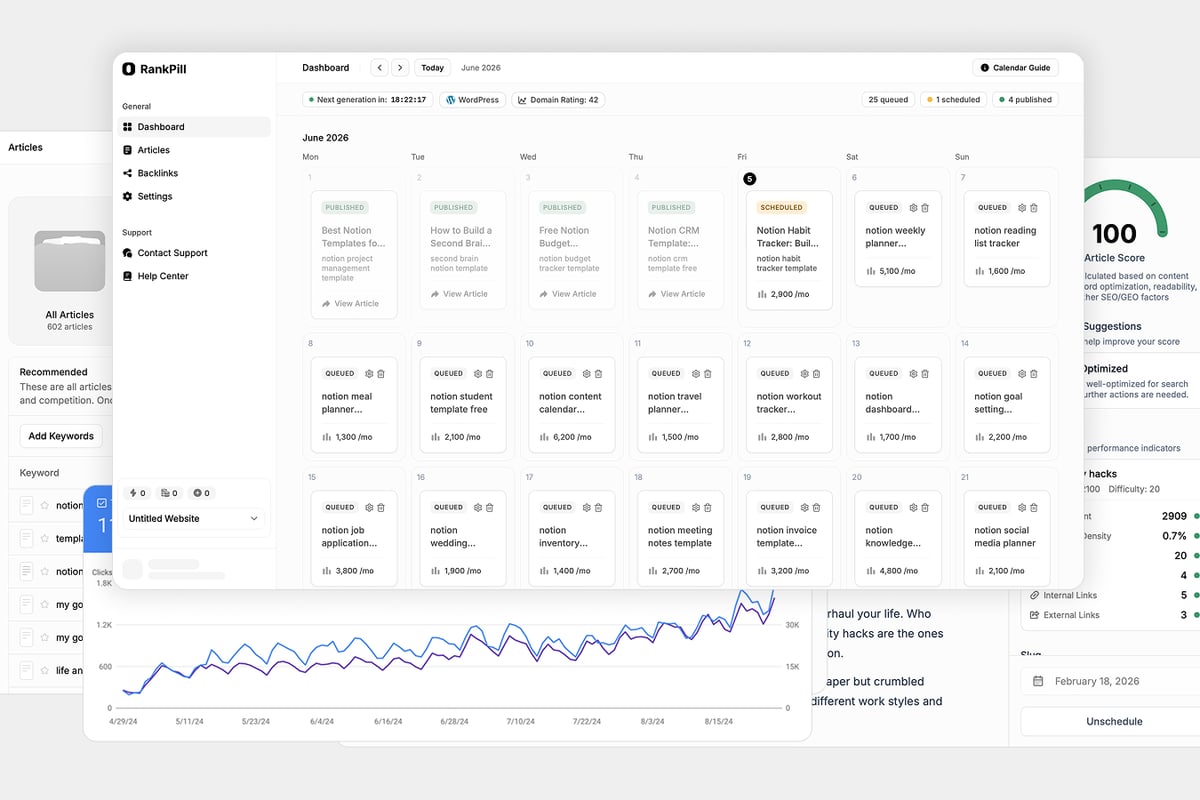
Automation works when you feed it the right inputs: your target keywords, your brand voice, your service areas. It does not replace your expertise. It replaces the research and first-draft writing so you spend time on editing and client work instead of staring at a blank screen.
Compete With Zillow on Local Content, Not National Keywords
You will never outrank Zillow for "Phoenix real estate". They have 15 years of content, 10 million backlinks and a team of 50 engineers optimizing their site. Accept that and move on.
You can outrank Zillow for "Arcadia Lite homes under $800k" or "Camelback East walkable neighborhoods". Zillow does not create hyper-local content at that level. Their business model is national scale, not neighborhood depth.
Build a content moat around your service area. Cover every neighborhood, every school district, every lifestyle question buyers ask. Answer questions in detail: "What is it like to live in [neighborhood]?" with insights on noise levels, street parking, HOA rules, planned developments. Zillow lists homes. You provide context.
Link every neighborhood page to related pages: nearby neighborhoods, school comparisons, buyer guides. This internal link structure signals to Google that you are an authority on your local market. Over time, your domain builds topical authority that lets you rank for competitive keywords.
The data-driven approach from Ahrefs shows that agents who target long-tail local keywords (3-5 words, low competition) rank faster and generate higher-quality leads than agents chasing broad keywords. Focus on the keywords your buyers search, not the keywords with the highest volume.
Build a Referral Engine Through SEO Content
Real estate seo is not just about ranking. It is about building trust. When a buyer finds your neighborhood guide through Google, reads 1,500 words of useful information and sees you know the market, they contact you. Even if they do not buy right away, they remember your name.
Every piece of content is a trust signal. Market updates show you track trends. Buyer guides show you understand the process. School comparisons show you care about families. Stack enough trust signals and buyers choose you over the agent they were referred to.
SEO content also drives referrals. A past client searches "best neighborhoods in [city]" and finds your guide. They send it to a friend who is relocating. The friend contacts you. You earn a referral without asking for it. This happens more often as your content library grows.
The compounding effect: one article published in 2026 drives traffic for years. It ranks, earns backlinks, gets shared and brings in leads every month with no additional effort. After 12 months of publishing, you have 50 articles working for you 24/7. That is 50 opportunities to be discovered, 50 trust signals, 50 referral engines.
Real estate seo takes time but the ROI compounds. Publish one neighborhood guide per week, optimize your Google Business Profile and build backlinks through local sponsorships. After six months you will rank for 20+ keywords. After 12 months you will generate leads without paying portals. RankPill automates the research, writing and publishing so you focus on clients instead of content calendars. One AI-written article published daily, with keyword research, images, internal links and backlinks included.
Unlock Traffic on Autopilot
Grow organic traffic on autopilot. RankPill will research, write, optimize, and publish articles to your website daily.
 WordPress