
Search Engines Other Than Google (2026 Guide)

Modest Mitkus · October 31, 2026
Google dominates search, but you shouldn't ignore the other engines that deliver billions of queries every month. Search engines other than Google serve specific audiences, prioritize different values, and often surface different results for the same query. If you're optimizing content for organic traffic, treating Google as the only game in town leaves opportunity on the table. In 2026, Bing reaches 10% global desktop share, DuckDuckGo processes over 100 million daily queries, and regional engines like Yandex and Baidu dominate entire countries. Each engine has its own webmaster guidelines, ranking signals, and user base. This guide covers the engines worth your attention, how they differ from Google, and what that means for your SEO strategy.
Why Search Engines Other Than Google Matter
Search engine market share varies dramatically by country, device, and demographic. StatCounter data shows that while Google commands 90%+ globally, regional splits tell a different story. Bing holds 30-40% of desktop search in the United States. Yandex dominates Russia with over 60% share. Baidu owns 70%+ in China. Naver leads in South Korea.
Device type also shifts the landscape. Desktop users choose alternative engines more often than mobile users, who default to whatever shipped on their phone. Privacy-conscious users actively select DuckDuckGo or Brave Search. Enterprise environments often default to Bing because of Microsoft ecosystem integration.
For SEO-driven businesses, ignoring these engines means ignoring potential customers. If 10% of your target market uses Bing, and you rank well on Google but poorly on Bing, you're leaving 10% of organic traffic unclaimed. The effort to optimize for multiple engines is smaller than most founders assume because the fundamentals overlap.

Bing (Microsoft)
Bing is the only credible Western alternative to Google by market share. Microsoft integrates Bing into Windows, Edge, Office 365, and Copilot, giving it distribution Google can't match in enterprise settings. Bing powers Yahoo search results, DuckDuckGo's web index, and Ecosia's search. When you optimize for Bing, you're also optimizing for several downstream engines.
Bing's ranking algorithm shares DNA with Google (quality content, backlinks, page speed, mobile optimization), but Bing weighs certain signals differently. Bing gives more credit to exact keyword matches in titles and headers. It values social signals more heavily. Bing also indexes and ranks pages faster in some cases because its index is smaller and its crawl queue is less congested.
Microsoft publishes Bing Webmaster Guidelines that spell out what the algorithm prioritizes. Key differences from Google:
- Exact match domains and keyword-rich URLs still help more than they do on Google
- Social shares from Facebook, Twitter, and LinkedIn correlate with rankings
- Multimedia content (video, images, infographics) gets weighted more heavily
- Structured data markup is rewarded visibly with rich snippets and enhanced listings
Bing Webmaster Tools is free and gives you crawl reports, index status, keyword performance, and SEO recommendations. Setup takes five minutes, and the interface is cleaner than Google Search Console for basic tasks.
DuckDuckGo
DuckDuckGo built its brand on privacy. It doesn't track searches, build user profiles, or personalize results based on history. DuckDuckGo's privacy model appeals to a specific audience: privacy-conscious users, developers, tech workers, and people who don't want their search history monetized.
DuckDuckGo doesn't maintain a full independent web index. It sources most web results from Bing, with additional data from its own crawler (DuckDuckBot), Yandex, Wikipedia, and vertical sources. That means if your site ranks well on Bing, you'll likely rank well on DuckDuckGo. The reverse isn't guaranteed.
One key difference: DuckDuckGo doesn't personalize results, so every user sees the same ranking for a given query. That makes A/B testing rankings easier and removes the guesswork around personal search bubbles. Rankings are also more stable day-to-day because there's no personalization algorithm shifting results.
From an SEO perspective, DuckDuckGo rewards the same fundamentals:
- Clear page titles and meta descriptions
- Fast load times and mobile optimization
- Quality backlinks from trusted domains
- Well-structured content that answers the query
DuckDuckGo also surfaces "Instant Answers" (similar to Google's featured snippets) pulled from structured sources like Wikipedia, Stack Overflow, and GitHub. If you maintain documentation or a knowledge base, marking it up with structured data increases your chances of appearing in these boxes.

Brave Search
Brave Search launched in 2021 and quickly grew by bundling with the Brave browser. By 2026, it processes millions of daily queries and claims to operate the only fully independent search index outside Google, Bing, Yandex, and Baidu. Brave's model combines privacy (no tracking, no profiling) with independence (no reliance on Google or Bing for web results).
Brave's index is smaller than Google's or Bing's, which means newer content can take longer to appear. However, Brave prioritizes crawling high-quality sites and fresh content in established niches. If your site has authority and publishes regularly, Brave's crawler will visit frequently.
Brave Search also includes an AI-powered "Summarizer" that generates answer boxes for certain queries. The summarizer cites sources, so well-optimized pages can earn visibility even when the user doesn't click through. Structured content, clear headings, and cited data increase your chances of being referenced.
Brave Search doesn't yet offer a formal webmaster tool or submission process, but it respects standard robots.txt, sitemaps, and meta tags. The same SEO automation practices that work for Google (clean HTML, internal linking, backlinks, fast hosting) apply to Brave.
Ecosia
Ecosia is a Bing-powered search engine that donates ad profits to tree-planting projects. It's mission-driven and attracts users who want their searches to fund environmental work. Ecosia's transparency reports publish monthly financials and tree counts, which builds trust with its audience.
From a technical standpoint, Ecosia uses Bing's index and ranking algorithm. Optimizing for Bing means optimizing for Ecosia. Rankings are nearly identical. The user base skews younger and more environmentally conscious, which can matter if your product or service aligns with sustainability.
Ecosia also privacy-focused. It doesn't create user profiles, anonymizes searches within a week, and encrypts all queries. For marketers, this means less granular analytics when users arrive from Ecosia, but the traffic quality is comparable to Bing.
Yandex and Baidu (Regional Leaders)
If you operate in Russia or China, you can't ignore Yandex and Baidu. Both engines dominate their home markets and use entirely different algorithms, ranking signals, and webmaster tools than Google.
Yandex is Russia's default search engine. It offers Yandex.Webmaster tools similar to Google Search Console, with crawl stats, indexing reports, and performance data. Yandex prioritizes user behavior signals (click-through rate, dwell time, bounce rate) more than Google does, which means pages that satisfy user intent rise faster. Yandex also weights site age and domain history heavily. New domains take longer to rank.
Baidu powers 70%+ of search queries in China. It requires Chinese hosting, an ICP license, and compliance with local content regulations. Baidu's algorithm favors sites hosted in China, written in simplified Chinese, and registered with Chinese domain registrars. Meta keywords (deprecated by Google in 2009) still influence Baidu rankings. Baidu also indexes Flash content better than Google, though that matters less every year.
Both engines require localized strategies. Machine-translating English content and submitting it to Yandex or Baidu rarely works. You need native content, local hosting, and region-specific keyword research. If those markets matter to your business, build dedicated projects in each language and region rather than trying to stretch a global site.
Optimizing for Multiple Search Engines
You don't need to build separate sites for every engine. The core ranking factors overlap across search engines other than Google. Clean HTML, fast load times, quality backlinks, clear content, and mobile optimization work everywhere. The differences are in emphasis, not fundamentals.
| Ranking Factor | Bing | DuckDuckGo | Brave | Yandex | |
|---|---|---|---|---|---|
| Backlinks | High | High | High | High | Medium |
| Content quality | High | High | High | High | High |
| Page speed | High | Medium | Medium | Medium | Medium |
| Exact match keywords | Low | Medium | Medium | Low | Medium |
| Social signals | Low | Medium | Low | Low | High |
| User behavior | High | Medium | N/A | Medium | Very High |
Universal SEO Checklist
These practices improve rankings across all engines:
- Submit your sitemap to Google Search Console, Bing Webmaster Tools, and Yandex.Webmaster
- Use descriptive titles and meta descriptions with target keywords near the front
- Optimize images with alt text, compression, and descriptive filenames
- Internal linking to connect related content and distribute page authority
- Backlinks from relevant, trusted domains in your niche
- Mobile optimization with responsive design and fast mobile load times
- HTTPS for security (required by most engines for ranking consideration)
- Structured data markup (Schema.org) for rich snippets and answer boxes
Engine-Specific Adjustments
Minor adjustments can lift rankings on specific engines:
For Bing:
- Include target keywords in URL slugs
- Add schema markup for products, reviews, events, and FAQs
- Publish multimedia content (videos, infographics, image galleries)
- Share content on social platforms to generate signals Bing tracks
For DuckDuckGo and Brave:
- Focus on Bing optimization (since DuckDuckGo uses Bing's index)
- Use clear, structured content that works well without personalization
- Mark up technical documentation and how-to content with schema
For Yandex:
- Prioritize user experience (low bounce rate, high dwell time)
- Build older, trusted domains or buy aged domains if expanding to Russia
- Host content in Russia or nearby regions for speed
- Monitor click-through rates and adjust titles to improve them

Privacy and Search Quality Trade-Offs
Choosing a search engine involves trade-offs between privacy, result quality, and personalization. Google delivers the most relevant results for most queries because it personalizes based on search history, location, device, and browsing behavior. That relevance comes at the cost of privacy. Google tracks everything.
Search engines other than Google often prioritize privacy, which means less personalization and sometimes less relevant results. Privacy International research documents how major engines collect, store, and monetize user data. Google and Bing collect the most. DuckDuckGo and Brave collect almost nothing.
A 2024 arXiv study compared Google, Bing, and Apple search quality for coding advice. It found that Google returned the most accurate and up-to-date results, but also injected the most ads and tracked users most aggressively. Bing and Apple offered better privacy but occasionally surfaced outdated Stack Overflow threads or irrelevant documentation.
For users, the choice depends on priorities. For marketers, the takeaway is that audiences on privacy-focused engines have opted out of personalization. Your content needs to match broad search intent, not personal context.
Building Content That Ranks Everywhere
The best way to rank across multiple engines is to write for humans, not algorithms. Every major engine (including Google) rewards content that answers the user's question clearly, loads fast, and links to credible sources. Keyword stuffing, thin content, and manipulative link schemes get penalized everywhere.
When you build content strategy around one engine, you introduce risk. Algorithm updates, policy changes, and competitive shifts can cut traffic overnight. When you optimize for the fundamentals that work across all engines, you build resilience.
A few practices consistently improve rankings across search engines other than Google:
- Research keywords with real search volume on the engines you care about. Bing Webmaster Tools shows Bing-specific volume. Yandex.Wordstat shows Yandex volume.
- Study the top 10 results on each engine for your target keyword. Note what formats (listicles, how-tos, comparisons) rank highest.
- Write long-form content (2,000-4,000 words) that covers the topic thoroughly. Length alone doesn't rank, but comprehensive content earns more backlinks and satisfies more search intents.
- Add visuals (screenshots, diagrams, charts) to support the text. Bing and Yandex particularly reward multimedia.
- Link to authoritative sources to back up claims. External links to trusted domains signal quality.
- Build internal links to connect related articles and distribute page authority across your site.
- Earn backlinks from relevant sites in your niche. Guest posts, original research, and link exchanges all work if done ethically.
For founders running lean teams, automating the content pipeline makes multi-engine optimization feasible. A tool that researches keywords, writes in your brand voice, adds internal and external links, and publishes daily lets you build authority across search engines without hiring a team of writers. If you're publishing one article per day, you can target different engines with different articles and cover more keyword opportunities.
Diversifying Your SEO Strategy
Relying on a single search engine creates concentration risk. Google's helpful content update in 2023 wiped out traffic for thousands of sites overnight. Bing's AI integration in 2024 shifted click patterns toward zero-click answers. Algorithm changes happen without warning, and most sites have no recourse.
Diversification reduces that risk. When you rank on Bing, DuckDuckGo, Brave, and Google, a negative update on one engine doesn't kill your organic channel. You still have traffic from the others while you diagnose and fix the issue.
Diversification also exposes your content to different audiences. Bing users skew older and more enterprise-focused. DuckDuckGo users tend to be more technical. Brave users overlap with crypto and privacy communities. If your product serves multiple demographics, showing up on their preferred engines increases discoverability.
The mechanics are simple:
- Submit sitemaps to every engine's webmaster tool
- Monitor rankings on each engine separately (tools like Ahrefs and SEMrush support multi-engine tracking)
- Analyze traffic sources in Google Analytics or your preferred analytics platform to see which engines send visitors
- Adjust content based on what's working on each engine (if Bing sends more traffic for how-to queries, write more how-tos)
Most sites get 85-95% of organic traffic from Google. If you can lift that other 5-15% by optimizing for Bing and DuckDuckGo, you're growing the channel without fighting for hyper-competitive Google keywords. The ROI is higher because the competition is lower.
Regional and Vertical Search Engines
Beyond the global players, niche engines serve specific regions or verticals. These matter if your business operates in those spaces.
Qwant (Europe): A privacy-focused engine based in France, popular in the EU. Uses Bing's index but emphasizes European privacy regulations (GDPR compliance).
Swisscows (Switzerland): Family-friendly search with a privacy focus. Filters explicit content by default. Uses Bing's index.
Mojeek (UK): Operates an independent index (smaller than Brave or Google). Prioritizes privacy and unbiased results. Useful for testing how your site performs on a truly independent crawler.
Neeva (Subscription, US): Ad-free search funded by subscriptions instead of ads. Shut down in 2023 but illustrates the model: users pay, so the engine has no incentive to track or sell data.
You.com (AI-focused): Integrates large language models to generate summarized answers alongside traditional web results. Useful for understanding how AI-native search engines surface content.
For SEO, these engines are secondary priorities unless your audience clusters in their user base. But they're worth monitoring because they experiment with new models (subscriptions, AI summaries, privacy-first) that larger engines may adopt later.
Measuring Success Across Multiple Engines
You can't improve what you don't measure. Tracking performance on search engines other than Google requires separate reports for each engine. Google Analytics lumps non-Google organic traffic into "Organic Search" without breaking out Bing, DuckDuckGo, or others by default.
To see engine-specific traffic:
- Go to Acquisition > All Traffic > Source/Medium in GA4
- Filter for organic sources (Bing, DuckDuckGo, Yahoo, Ecosia, etc.)
- Compare sessions, bounce rate, conversion rate, and revenue per source
You can also use UTM parameters on backlinks and social shares to tag which engine drove the click, but that only works for external links, not organic search.
For rankings, tools like Ahrefs, SEMrush, and Moz support Bing keyword tracking. Set up separate campaigns for each engine and track the same keyword set. Compare ranking positions over time to see where you're gaining or losing ground.
Another metric: crawl frequency. Check Bing Webmaster Tools, Yandex.Webmaster, and Google Search Console to see how often each engine crawls your site. Higher crawl frequency means the engine values your content and checks for updates often. Lower frequency suggests the engine sees your site as low-priority.
When to Prioritize Alternatives
Not every business should optimize for search engines other than Google. The decision depends on your market, audience, and resources.
Prioritize alternatives if:
- Your target market is outside the US (Yandex in Russia, Baidu in China, Naver in Korea)
- Your audience values privacy (developers, security professionals, privacy advocates)
- You operate in a niche with low competition on Bing or DuckDuckGo
- You already rank well on Google and want incremental traffic
- You're building a content site and can publish daily to cover more keywords
Stick with Google if:
- You're just starting and have limited resources
- Your market is consumer-focused and mobile-first (Google dominates mobile)
- You operate in a highly competitive niche where even Google rankings are hard
- Your site is new and doesn't have authority yet (build Domain Rating first, then expand)
The best approach for most founders is to start with Google, build content that follows universal SEO principles, and expand to Bing and DuckDuckGo once you have a baseline of traffic and authority. Trying to optimize for five engines at once dilutes focus and slows progress.
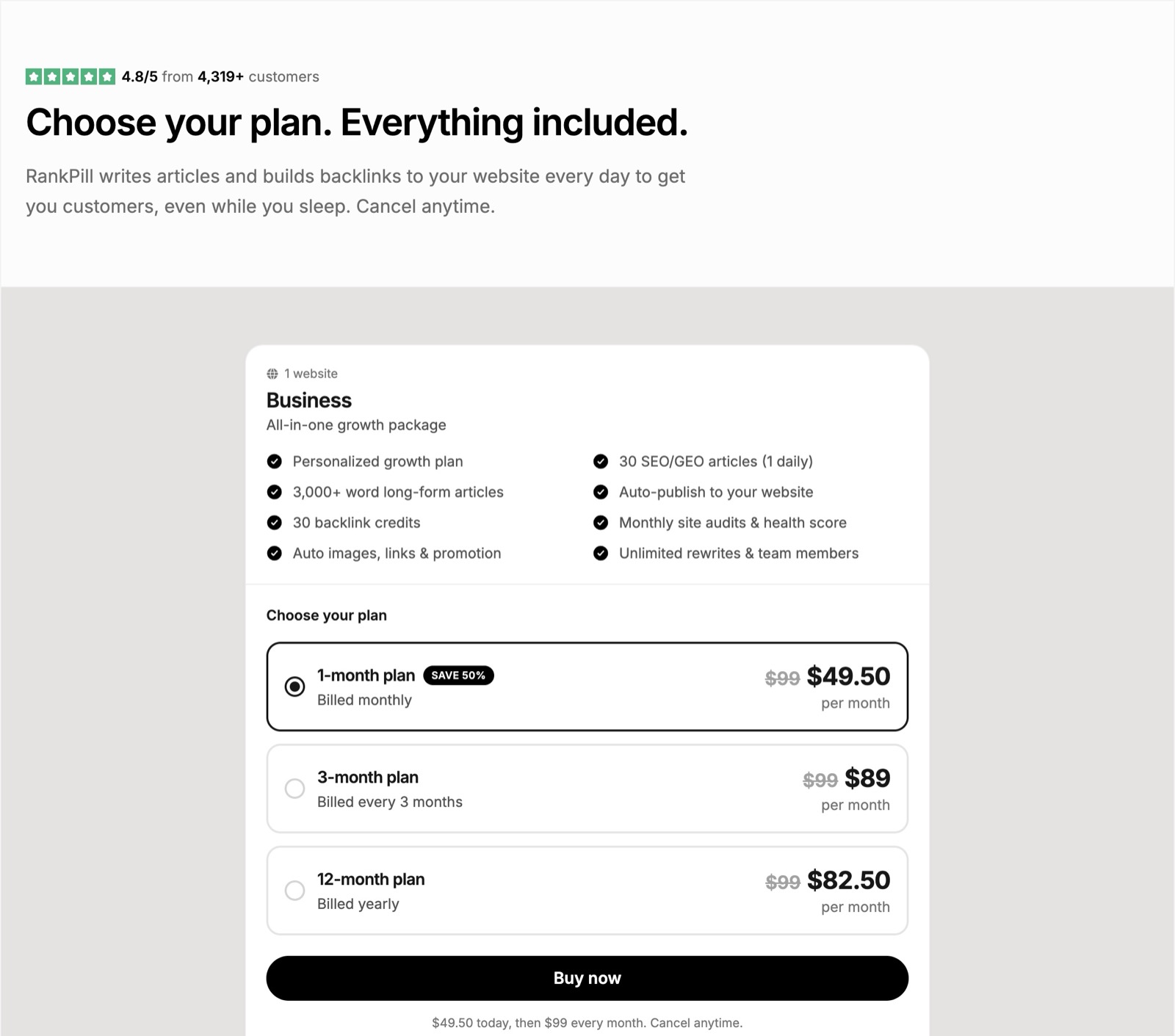
Search engines other than Google represent real traffic and real customers, especially if your audience values privacy, uses specific devices, or lives outside the US. Bing, DuckDuckGo, Brave, and regional engines like Yandex and Baidu each have distinct user bases and ranking signals, but the fundamentals overlap. Quality content, backlinks, fast load times, and clear structure work across all engines. RankPill helps you publish optimized content daily, build backlinks, and grow organic traffic across multiple search engines without hiring a team. Built for founders who want steady growth on autopilot, RankPill starts at $99/month with a 90-day money-back guarantee.
Unlock Traffic on Autopilot
Grow organic traffic on autopilot. RankPill will research, write, optimize, and publish articles to your website daily.
 WordPress