
SEO Agency for Ecommerce: What Works in 2026

Modest Mitkus · October 20, 2026
Ecommerce stores compete on search results pages every day. A good SEO agency for ecommerce knows how to optimize product pages, category structures, technical crawl issues, and content strategy across thousands of SKUs. The wrong agency bills you monthly while your rankings stay flat. This guide explains what ecommerce SEO agencies actually do, how to evaluate them, what you should expect to pay, and when building your own content pipeline makes more sense than hiring outside help.
What an Ecommerce SEO Agency Actually Does
An SEO agency for ecommerce focuses on driving qualified traffic to product and category pages. They handle technical audits, on-page optimization, content creation, and link building tailored to online stores.
Most agencies start with a technical audit. They review site speed, Core Web Vitals, mobile responsiveness, and crawl errors that prevent Google from indexing your catalog. Ecommerce platforms like Shopify, WooCommerce, and BigCommerce each have quirks that affect SEO, and a specialized agency knows how to fix them.

Technical SEO for Online Stores
Technical work includes fixing duplicate content from filter pages, setting up canonical tags, and creating XML sitemaps. Many ecommerce sites accidentally index thousands of low-value pages (sorting options, color filters, price ranges) that dilute crawl budget.
Agencies also implement Product structured data so Google can display rich snippets with pricing, availability, and reviews directly in search results. This markup improves click-through rates and surfaces your products in Google Shopping and Merchant listings.
Another key task: optimizing your URL structure for ecommerce sites. Clean URLs help Google understand your site hierarchy and improve user experience. Agencies also configure hreflang tags if you sell in multiple countries or languages, following multilingual SEO best practices.
On-Page Optimization and Content Strategy
After fixing technical issues, agencies optimize your existing pages. They rewrite product titles, meta descriptions, and category page copy to target buyer-intent keywords. They add internal links between related products and categories to help Google understand your catalog.
Content strategy is where most ecommerce SEO agencies differentiate themselves. Some focus only on product and category pages. Others build out blog content to capture top-of-funnel traffic. For example, Tealyra, an online tea store, could rank for "how to brew green tea" or "best teas for sleep" before pushing readers toward product pages.
Agencies working with brands like CCN Sport, which produces custom cycling apparel, might create comparison guides, sizing advice, and care instructions that rank for informational queries. The goal is to bring in users earlier in the buying journey, then guide them to products through internal links.
| Content Type | Search Intent | Conversion Stage | Example |
|---|---|---|---|
| Product pages | Commercial | Bottom-funnel | "buy organic matcha powder" |
| Category pages | Commercial | Mid-funnel | "loose leaf green tea" |
| Buying guides | Informational | Mid-funnel | "matcha vs sencha tea" |
| How-to articles | Informational | Top-funnel | "how to steep white tea" |
| Comparison posts | Commercial/Informational | Mid-funnel | "best tea infusers 2026" |
Link Building for Ecommerce Sites
Links still matter. An SEO agency for ecommerce builds backlinks to your domain, category pages, and high-value product pages. Tactics include guest posts, product reviews, partnerships with complementary brands, and digital PR campaigns.
Ecommerce link building requires a different approach than SaaS or local SEO. Agencies pitch product features to bloggers, send samples to reviewers, and create linkable assets like industry reports or tools. For example, a store selling sustainable products like Tinc might publish a zero-waste living guide that attracts links from eco blogs.
Agencies also look for unlinked brand mentions and reach out to convert them into backlinks. They monitor competitors' backlink profiles and replicate high-quality opportunities. Some use digital PR to get featured in gift guides, roundups, and seasonal buying guides published by media outlets.
How to Pick an SEO Agency for Your Store
Choosing the right agency comes down to experience, pricing, process, and results. Ask specific questions before signing a contract.
Questions to Ask During Discovery Calls
Start by asking how many ecommerce clients they've worked with in your niche. Generic SEO agencies often struggle with the scale and technical complexity of online stores. You want someone who has optimized sites with hundreds or thousands of products, not just local service businesses.
Ask for case studies with actual metrics: organic traffic growth, keyword rankings, and revenue impact. Avoid agencies that only show vanity metrics like domain authority or total backlinks. You care about whether they drove more sales.
- How do you handle duplicate content from faceted navigation and filters?
- What platforms (Shopify, WooCommerce, Magento) have you worked with?
- Do you write product descriptions, category copy, or just optimize existing content?
- How many backlinks do you build per month, and what quality benchmarks do you use?
- What reporting do you provide, and how often?
Request a sample audit or strategy document. Good agencies will show you their process upfront. If they promise page-one rankings in 30 days or guaranteed traffic, walk away.

Pricing Models and What You Get
Most agencies charge between $2,000 and $10,000 per month depending on store size, competition, and scope. Smaller stores might pay $2,000 to $4,000 for basic technical work and on-page optimization. Larger catalogs or competitive niches can run $6,000 to $10,000+ per month.
Some agencies charge project fees for one-time work like migrations, audits, or restructuring. Expect $5,000 to $15,000 for a full technical audit and implementation roadmap.
| Pricing Tier | Monthly Cost | What You Get |
|---|---|---|
| Basic | $2,000 - $4,000 | Technical audit, on-page optimization, monthly reporting |
| Standard | $4,000 - $7,000 | Technical + content creation (4-8 articles/month) + link outreach |
| Premium | $7,000 - $10,000+ | Full-service: technical, content, links, conversion optimization, dedicated account manager |
You should also know what's not included. Many agencies don't write product descriptions or optimize every SKU. They focus on high-traffic category pages and a subset of hero products. If you need every product page optimized, expect to pay more or hire a separate copywriter.
Red Flags to Avoid
Walk away if the agency guarantees specific rankings. Google's algorithm changes constantly, and no one controls search results. Promises like "first page in 60 days" are either lies or based on low-competition keywords that won't drive revenue.
Avoid agencies that won't share their methods. If they refuse to explain their link-building tactics or say it's "proprietary," they're likely using risky techniques like PBNs or paid links that can get your site penalized.
Check contract terms carefully. Some agencies lock you into 12-month agreements with no option to cancel. Look for month-to-month contracts or at least a 90-day trial period. If they're confident in their work, they won't need to trap you in a long-term deal.
What Results to Expect and How Long It Takes
SEO is not instant. Most ecommerce stores see measurable traffic increases within three to six months. Revenue impact depends on your conversion rate, average order value, and how well the agency targets commercial keywords.
Realistic Timelines for Ecommerce SEO
In the first 30 days, expect technical fixes and foundational work. The agency will set up analytics, fix crawl errors, and start keyword research. You won't see ranking changes yet.
Months two through four: new content goes live, on-page optimization rolls out, and initial link-building campaigns launch. You'll start seeing movement on low-competition keywords. Traffic may increase 10% to 30% if you had technical issues holding you back.
Months five through twelve: compound growth kicks in. More content ranks, backlinks pass authority to your pages, and Google trusts your site more. Stores often see 50% to 150% organic traffic growth in the first year if the agency executes well.
Key milestone tracking:
- Month 1: Technical audit complete, tracking installed, keyword list finalized
- Month 3: First wave of optimized pages live, initial backlinks secured
- Month 6: 20-40 new keywords ranking in top 50, traffic up 30-60%
- Month 12: 100+ keywords ranking in top 20, traffic doubled or more
How to Measure Agency Performance
Track organic sessions in Google Analytics or Shopify Analytics. Filter out branded traffic (people searching for your store name) to see how much new customer acquisition is happening.
Monitor keyword rankings for your top category and product pages. Tools like Ahrefs, SEMrush, or Google Search Console show which queries are driving impressions and clicks. Focus on keywords with commercial intent (product names, "buy [product]," "[category] for sale").
Revenue attribution is harder but critical. Use UTM parameters or attribution models to see how much revenue comes from organic search. Compare month-over-month organic revenue, not just traffic. A 50% traffic increase that doesn't move sales means the agency is targeting the wrong keywords.
Ask your agency for monthly reports that include:
- Organic traffic (new vs. returning, branded vs. non-branded)
- Keyword rankings for top 20 target keywords
- Backlinks acquired (domain rating, anchor text, placement)
- Pages optimized or published
- Conversion rate and revenue from organic traffic
If they can't show clear progress after six months, it's time to re-evaluate or switch agencies.
When to Build Your Own SEO Engine Instead
Hiring an SEO agency for ecommerce makes sense if you need technical expertise, have a complex site, or lack internal resources. But agencies are expensive, slow to scale, and often not focused on your store full-time.
Building your own SEO content pipeline gives you control, speed, and better economics over time. Instead of paying $4,000+ per month for 4 to 8 articles, you can publish daily and own the entire process.
RankPill automates the full SEO content workflow. It researches keywords your store can rank for, writes 3,000+ word articles with images and internal links, and publishes them directly to Shopify, WordPress, Webflow, or any platform via webhooks. You get 30 articles per month for $99, and it includes backlink credits to build domain authority without outreach.
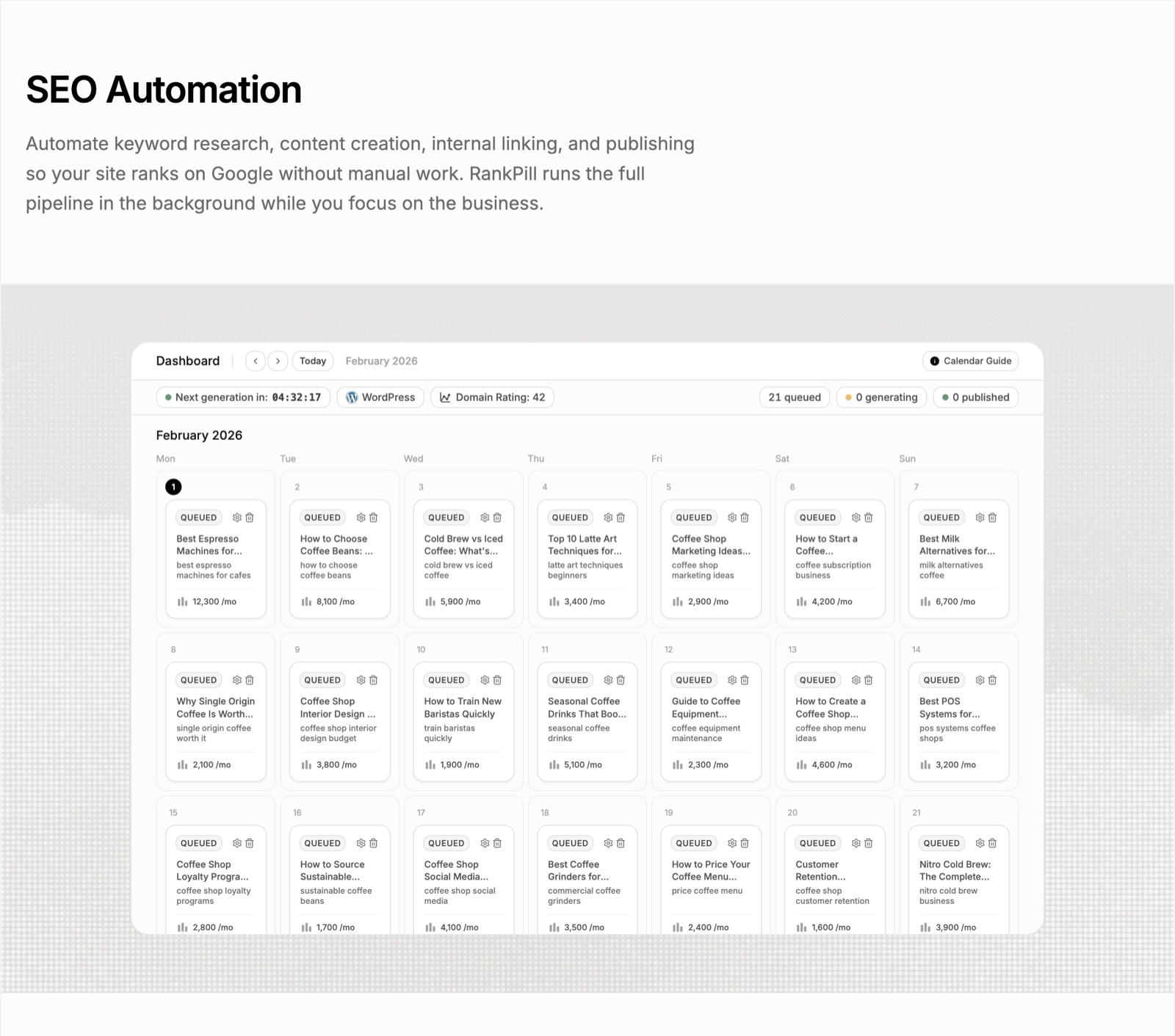
This works especially well for stores that can create informational content around their products. If you sell cycling apparel, publish guides on bike maintenance, route planning, and gear reviews. If you sell botanical scents like HAUS OF SMELL, write about fragrance notes, candle care, and scent pairing. Those articles bring in top-of-funnel traffic, and internal links push visitors toward product pages.
Agencies typically produce 4 to 8 articles per month at the $4,000 to $7,000 pricing tier. Automation tools let you publish daily, which means 30 articles per month. More content means more keyword coverage, faster authority building, and better long-tail rankings.
Trade-Offs: Agency vs. Automation
Agencies bring strategic thinking and custom execution. They can run digital PR campaigns, negotiate partnerships, and handle complex technical migrations. Automation handles volume and consistency but won't build relationships or pitch journalists.
| Factor | SEO Agency | Automation Tool |
|---|---|---|
| Monthly cost | $2,000 - $10,000+ | $99 - $250 |
| Articles per month | 4 - 12 | 30+ |
| Strategy & planning | Custom plans, quarterly reviews | Keyword research, auto-scheduling |
| Technical SEO | Full audits, custom fixes | Limited (publishing, basic on-page) |
| Link building | Outreach, PR, partnerships | Backlink exchange, earned links |
| Best for | Complex sites, competitive niches, strategic campaigns | Consistent content volume, budget-conscious teams, foundational SEO |
If you're a small store with limited budget, automation makes more sense. You control the content, publish faster, and can always hire an agency later for technical work or link campaigns.
If you're in a highly competitive niche (fashion, electronics, supplements) or need advanced technical work (site migrations, international SEO, JavaScript rendering), an agency adds value. But even then, you can use automation for content production and hire an agency just for technical and link-building work.
Ecommerce SEO Tactics That Work in 2026
The fundamentals haven't changed, but execution has. Stores that win in search focus on user experience, structured data, and content that matches buyer intent.
Optimize for Core Web Vitals and Page Speed
Google's ranking algorithm weighs page experience heavily for ecommerce sites. Slow product pages lose rankings and conversions. Compress images, lazy-load below-the-fold content, and use a CDN to serve assets faster.
Run your top pages through PageSpeed Insights and fix issues flagged in the Core Web Vitals report. Mobile experience matters more than desktop. Most ecommerce traffic comes from phones, and Google uses mobile-first indexing.
Use Structured Data for Rich Snippets
Implement Product schema on every product page. Include price, availability, reviews, and SKU. This helps Google show rich results with star ratings and pricing, which increases click-through rates.
Add FAQ schema to common questions on product and category pages. Use BreadcrumbList schema to show your site structure in search results. These small markup additions improve visibility and user trust.
Shopify stores can follow Shopify's SEO best practices for built-in schema and sitemap configurations. Yoast's ecommerce SEO checklist covers on-page and technical tasks in detail.
Target Long-Tail Keywords for Product and Category Pages
Most ecommerce stores chase high-volume keywords like "running shoes" or "organic tea." Those are saturated. Long-tail keywords like "best trail running shoes for wide feet" or "organic green tea for weight loss" convert better and rank faster.
Use a keyword research tool to find low-competition, high-intent queries. Cluster them into topic groups and create category pages or blog posts that target the entire cluster. Link from the blog post to the relevant product or category page to pass authority.
Build Links to Category Pages, Not Just Your Homepage
Most agencies focus backlinks on the homepage. That helps domain authority but doesn't push specific pages up. Target category pages and high-margin product pages with editorial links, guest posts, and product reviews.
A backlink exchange can help you trade links with relevant sites in your niche without buying links or doing cold outreach. Look for stores or blogs with similar traffic and domain ratings, then swap contextual links in blog posts.
Create Buying Guides and Comparison Content
Informational content brings in users earlier in the buyer journey. Write guides like "how to choose cycling apparel for winter" or "best zero-waste kitchen swaps." These rank for top-funnel keywords and introduce your brand to new customers.
Comparison posts also work well. "Matcha powder vs. green tea bags" or "organic cotton vs. bamboo fabric" target users evaluating options. Link to your products within the article, and you'll capture buyers as they decide.
Stores that publish consistently (daily or weekly) build topical authority faster than those that publish sporadically. SEO automation handles the research, writing, and publishing so you can scale content production without hiring a full editorial team.
An SEO agency for ecommerce can drive real growth if they understand your platform, target the right keywords, and build quality backlinks. But agencies are expensive and slow to scale, especially for stores on a tight budget. If you want consistent content production without the agency price tag, automation gives you speed and control. RankPill publishes one SEO-optimized article to your store every day, builds backlinks, and handles keyword research so you can grow organic traffic without hiring writers or paying agency retainers. Try it risk-free with a 90-day money-back guarantee.
Unlock Traffic on Autopilot
Grow organic traffic on autopilot. RankPill will research, write, optimize, and publish articles to your website daily.
 WordPress