
SEO Automation for Framer: Complete 2026 Guide

Modest Mitkus
June 20, 2026
Framer has emerged as one of the most powerful no-code website builders in 2026, offering designers and developers unparalleled freedom to create stunning, interactive websites. However, building a beautiful site is only half the equation. Without proper search engine optimization, even the most visually impressive Framer site will struggle to attract organic visitors. This is where seo automation for framer becomes essential, enabling website owners to streamline their optimization workflows while focusing on design and content strategy. By implementing automated SEO processes, Framer users can maintain consistent optimization standards across their entire site without dedicating countless hours to manual tasks.
Why SEO Automation Matters for Framer Sites
Framer's visual design capabilities have made it a favorite among creative professionals and startups. Yet many users discover that maintaining SEO best practices across dozens or hundreds of pages becomes overwhelming quickly. Manual optimization requires constant attention to meta descriptions, title tags, image alt text, internal linking structures, and content updates.
Traditional SEO workflows demand repetitive tasks that drain time and mental energy. You need to research keywords for each page, optimize images individually, craft unique meta descriptions, and ensure proper heading hierarchy. These tasks multiply exponentially as your site grows.
SEO automation for Framer addresses these challenges by systematically handling repetitive optimization tasks. Rather than manually updating meta tags or researching keywords for every blog post, automation tools can analyze your content, suggest improvements, and even implement changes automatically. This shift from manual to automated processes allows creators to maintain enterprise-level SEO standards without hiring dedicated specialists.
The platform's integration capabilities make it particularly well-suited for automation. Framer's built-in SEO features provide a solid foundation, including customizable meta tags, automatic sitemap generation, and social sharing optimization. When combined with automation tools, these native features become exponentially more powerful.

Core Components of Framer SEO Automation
Automated Keyword Research and Content Planning
Every successful SEO strategy begins with identifying the right keywords. Traditional keyword research involves hours spent in tools like SEMrush or Ahrefs, analyzing search volumes, competition levels, and user intent. Automation transforms this process into a systematic, data-driven operation.
Automated keyword research tools continuously monitor search trends, competitor content, and ranking opportunities. They identify content gaps in your niche and suggest topics that align with actual search demand. For Framer users, this means receiving a steady stream of validated content ideas without manual investigation.
The automation extends beyond simple keyword lists. Advanced systems analyze semantic relationships between terms, understanding that someone searching for "website builder" might also be interested in "no-code design tools" or "responsive web frameworks." This contextual understanding helps create comprehensive content strategies.
- Continuous monitoring of keyword difficulty and search volume changes
- Competitor gap analysis identifying topics your rivals haven't covered
- Search intent classification matching keywords to informational, commercial, or transactional content types
- Long-tail keyword discovery finding specific, low-competition opportunities
- Seasonal trend prediction anticipating search volume fluctuations throughout the year
Content Optimization and Publishing Workflows
Once you have your keywords, the next challenge is creating and optimizing content efficiently. SEO automation for Framer streamlines this entire process from ideation to publication. Modern automation platforms can draft content frameworks, suggest heading structures, and ensure optimal keyword density without stuffing.
The content optimization process includes several automated checkpoints. Systems analyze readability scores, heading hierarchy, paragraph length, and keyword placement. They flag issues like missing alt text, broken internal links, or duplicate meta descriptions before content goes live.
For Framer users specifically, automation can integrate directly with the platform's CMS capabilities. Content moves from creation to publication without manual copying, pasting, or formatting. This seamless workflow reduces human error and maintains consistency across your entire site.
| Automation Feature | Manual Process | Automated Process | Time Saved |
|---|---|---|---|
| Meta Tag Generation | 5 min per page | Instant | 99% |
| Internal Link Insertion | 10 min per article | Automatic | 100% |
| Image Optimization | 3 min per image | Batch processing | 95% |
| Content Publishing | 15 min setup | Scheduled auto-publish | 90% |
Technical SEO Maintenance
Technical SEO encompasses the behind-the-scenes elements that search engines evaluate when crawling and indexing your site. While Framer handles many technical aspects automatically, certain optimizations benefit significantly from automation.
Sitemap updates happen automatically as you add or remove pages, ensuring search engines always have the latest map of your site structure. Automated monitoring detects broken links, slow-loading resources, and mobile responsiveness issues before they impact rankings.
Schema markup implementation, once a task requiring deep technical knowledge, can now be automated based on content type. Blog posts automatically receive Article schema, product pages get Product schema, and local business pages include LocalBusiness markup. This structured data helps search engines understand and display your content more effectively in search results.
Performance monitoring tools track Core Web Vitals continuously, alerting you when metrics like Largest Contentful Paint or Cumulative Layout Shift deteriorate. Understanding how to master SEO involves monitoring these technical signals that directly impact user experience and search rankings.
Implementing SEO Automation on Your Framer Site
Choosing the Right Automation Platform
Not all automation tools work equally well with Framer. The ideal platform offers native integration or robust API connections that work seamlessly with Framer's architecture. When evaluating options, consider how the tool handles content ingestion, publishing workflows, and data synchronization.
The automation platform should complement rather than complicate your existing workflow. Look for systems that integrate with your current tools, whether that's Google Analytics, Search Console, or content management systems. The goal is creating a unified ecosystem where data flows automatically between platforms.
Platforms designed specifically for seo automation for framer understand the platform's unique capabilities and limitations. They account for Framer's component-based structure, its approach to dynamic content, and its publishing workflow. This specialized knowledge prevents integration headaches and ensures smooth operation.
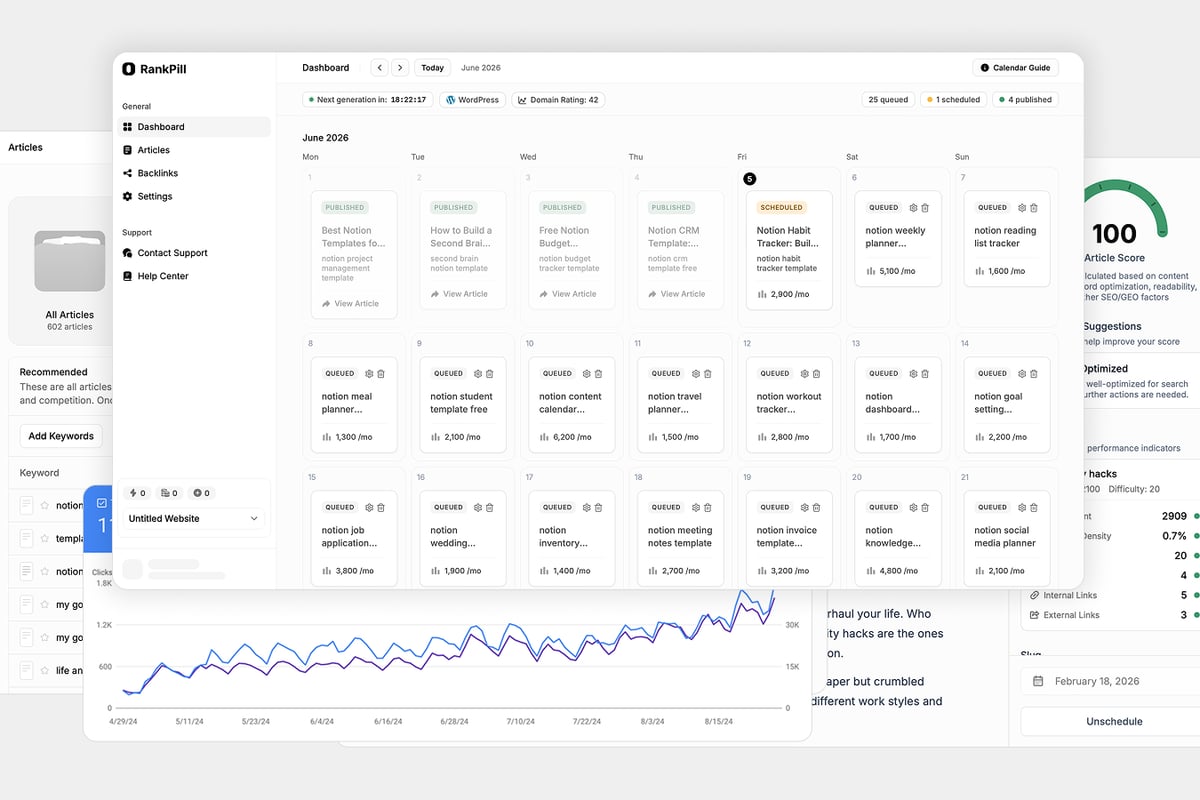
RankPill's SEO Automation platform exemplifies this specialized approach, offering automated keyword research, content creation, and publishing workflows that integrate seamlessly with Framer sites. The system handles everything from initial keyword discovery through final publication, maintaining SEO best practices at every step without requiring constant manual oversight.
Setting Up Automated Content Workflows
- Connect your Framer site to your automation platform using API keys or native integrations
- Define your content parameters including target keywords, publishing frequency, and content types
- Configure optimization rules for meta tags, heading structures, and internal linking patterns
- Establish quality checkpoints ensuring automated content meets your standards before publication
- Schedule publishing cadence maintaining consistent content flow without manual intervention
- Set up monitoring alerts to catch issues like broken links or indexing problems immediately
The initial setup requires thoughtful configuration, but once established, the workflow operates autonomously. Your automation system researches keywords, identifies content opportunities, drafts optimized articles, and publishes them according to your schedule.
Monitoring and Refining Automated Processes
Automation doesn't mean "set it and forget it." Regular monitoring ensures your automated systems continue delivering results as search algorithms evolve. Track key performance indicators like organic traffic growth, keyword ranking improvements, and content engagement metrics.
A/B testing different automation approaches reveals what works best for your specific audience and niche. Test variations in meta description formats, heading structures, or internal linking patterns. Let data guide your optimization strategy rather than assumptions.

Advanced Automation Strategies for Framer
Multi-Language SEO Automation
International expansion requires optimizing content for multiple languages and regions. Traditional approaches involve hiring translators, conducting separate keyword research for each market, and managing multiple content calendars. This complexity multiplies costs and coordination challenges.
Automated multi-language SEO streamlines international growth by researching region-specific keywords, creating localized content, and managing publication across different language versions of your site. The system understands that keyword intent varies across cultures, ensuring content resonates with local audiences rather than simply translating English content.
For Framer sites targeting global markets, automation handles the technical complexity of hreflang tags, regional sitemaps, and localized meta data. This technical precision prevents common internationalization mistakes that can confuse search engines and dilute your SEO efforts.
AI-Powered Content Generation and Optimization
The integration of artificial intelligence with SEO automation has transformed content creation in 2026. AI systems don't just fill templates; they understand context, user intent, and semantic relationships. This intelligence produces content that genuinely answers searcher questions while maintaining natural readability.
AI and SEO integration enables systems to analyze top-ranking content for target keywords, identify common themes and structures, then generate original content incorporating those success factors. The result is content optimized for both traditional search engines and emerging AI-powered answer engines.
As Answer Engine Optimization becomes mainstream, automated systems adapt content formats to appear in AI-generated responses. This includes structuring information for featured snippets, optimizing for voice search queries, and formatting data for direct answers.
Automated Link Building and Internal Linking
Link building remains one of SEO's most time-intensive activities. Finding relevant link opportunities, crafting outreach emails, and tracking responses demands significant effort. Automation platforms identify relevant websites in your niche, analyze linking opportunities, and even facilitate connection processes.
Internal linking automation offers even more immediate value. Systems analyze your content repository, identify relevant connections between articles, and insert contextual links automatically. This creates the strong internal linking structure search engines favor while improving user navigation.
For Framer sites, automated internal linking ensures new content immediately connects with existing pages. The system identifies semantic relationships between topics, creating natural link patterns that guide both users and search engine crawlers through your site architecture.
Measuring ROI from SEO Automation
Key Performance Indicators
Tracking the right metrics determines whether your seo automation for framer investment delivers returns. Focus on indicators that directly connect to business outcomes rather than vanity metrics that look impressive but don't drive results.
Organic traffic growth represents the most fundamental measure of SEO success. Monitor not just total visits but traffic to high-value pages, conversion rates from organic visitors, and the diversity of keywords driving traffic. A healthy SEO automation strategy increases both traffic volume and quality.
Keyword ranking improvements show whether your content reaches target audiences. Track rankings for money keywords that drive conversions, informational keywords that build authority, and branded keywords that indicate growing awareness. Automated rank tracking provides daily updates without manual checking.
- Content production velocity measuring articles published per week
- Indexation rate tracking percentage of published content appearing in search results
- Time-to-rank monitoring how quickly new content achieves target positions
- Domain authority growth as measured by backlink quality and quantity
- SERP feature appearances in featured snippets, People Also Ask boxes, and other rich results
Cost Comparison: Automation vs. Manual SEO
| Approach | Monthly Cost | Articles/Month | Cost per Article | Hours Required |
|---|---|---|---|---|
| In-House SEO Manager | $6,000+ | 8-12 | $500-750 | 160 hours |
| Freelance Writers + SEO | $3,000+ | 10-15 | $200-300 | 80 hours |
| SEO Agency | $5,000-15,000 | 8-20 | $250-1,875 | Outsourced |
| Automation Platform | $99-299 | 30-100 | $1-10 | 5-10 hours |
The financial case for automation becomes clear when comparing costs per article and time investment. While human expertise remains valuable for strategy and oversight, automation handles execution at a fraction of the cost.
Overcoming Common Automation Challenges
Maintaining Content Quality
The primary concern with automated SEO is whether quality suffers compared to manually crafted content. Early automation tools produced robotic, keyword-stuffed text that provided little value to readers. Modern AI-powered systems have largely solved this problem through advanced natural language processing.
Quality control mechanisms ensure automated content meets standards before publication. Review workflows can require human approval for certain content types while allowing others to publish automatically. This hybrid approach balances efficiency with quality assurance.
Establishing clear brand guidelines helps automation systems maintain your unique voice. Provide examples of preferred writing styles, tone specifications, and topic expertise levels. Well-configured systems produce content indistinguishable from manually written articles.
Avoiding SEO Penalties
Search engines penalize sites using automation to manipulate rankings through spammy tactics. However, using legitimate SEO tools and following white-hat practices ensures automation enhances rather than endangers your rankings.
The key distinction lies in using automation to produce valuable content versus generating thin, duplicative pages solely for keyword targeting. Focus your automation on creating comprehensive resources that genuinely help your audience. Search engines reward this approach regardless of whether humans or machines produce the content.
Transparency about automation also matters. While you don't need to disclose every automated process, ensure your content provides real value rather than simply gaming algorithms. This user-first approach aligns with how modern search engines evaluate content quality.
Balancing Automation with Human Creativity
Complete automation risks creating homogeneous content that lacks the creative insights and unique perspectives human experts provide. The most successful approach combines automated efficiency with strategic human input.

Reserve human effort for high-level strategy, brand positioning, and complex topics requiring nuanced expertise. Let automation handle research, optimization, and publishing logistics. This division of labor maximizes both efficiency and quality.
Regular reviews of automated output help maintain standards and identify improvement opportunities. As you refine your automation rules based on performance data, the system becomes increasingly effective at producing content that resonates with your specific audience.
Future Trends in Framer SEO Automation
Voice Search and Conversational Queries
Voice search continues growing as smart speakers and voice assistants become ubiquitous. By 2026, conversational queries represent a significant portion of searches, requiring different optimization approaches than traditional keyword targeting.
Automation platforms now optimize content for natural language queries, question-based searches, and conversational patterns. This includes creating FAQ-structured content, optimizing for featured snippets, and formatting answers for voice assistant responses.
For Framer sites, this means automated content increasingly focuses on directly answering specific questions rather than just targeting keyword phrases. The automation systems identify common questions in your niche and structure content to provide concise, authoritative answers.
Visual Search Optimization
Image-based searches are expanding rapidly as visual search technology improves. Users can now search using photos rather than text, requiring new optimization approaches. Automated systems optimize images with detailed alt text, structured data, and descriptive filenames.
Framer's strong visual capabilities make it particularly important for sites built on the platform to optimize for visual search. Automation ensures every image includes proper metadata, compressed file sizes for fast loading, and descriptive context helping search engines understand visual content.
Predictive SEO and Trend Forecasting
The most advanced automation platforms now predict content opportunities before trends peak. By analyzing search pattern changes, social media signals, and news cycles, these systems identify emerging topics when competition remains low.
This predictive capability allows Framer site owners to publish content before topics become saturated. Early publication on trending topics builds authority and captures initial search demand, providing lasting ranking advantages even as competition increases.
Free SEO tools increasingly incorporate predictive analytics, democratizing access to insights previously available only to enterprise operations with dedicated data science teams.
Integration Ecosystem for Framer SEO
Analytics and Reporting Automation
Understanding SEO performance requires analyzing data from multiple sources including Google Analytics, Search Console, and ranking trackers. Automation consolidates these data streams into unified dashboards, eliminating manual report compilation.
Automated reporting provides scheduled updates on key metrics, highlighting significant changes and identifying opportunities or issues requiring attention. Rather than spending hours in analytics platforms, you receive actionable insights delivered directly to your inbox.
For Framer users managing multiple sites or clients, this centralized reporting becomes essential for maintaining oversight without overwhelming administrative work. The automation scales effortlessly from single sites to large portfolios.
CMS Integration and Publishing
Seamless integration between automation platforms and Framer's CMS capabilities ensures content flows smoothly from creation through publication. API connections enable automated systems to create new pages, update existing content, and manage site structure without manual intervention.
This integration extends to media management, automatically uploading optimized images, configuring alt text, and inserting media into appropriate content locations. The result is publication-ready content requiring minimal human review before going live.
Third-Party Tool Connectivity
Comprehensive SEO automation connects with broader marketing and business tools. Integration with email marketing platforms enables automated content promotion. Connection to social media management tools schedules content distribution across channels. Links to CRM systems track how SEO efforts influence lead generation and customer acquisition.
This ecosystem approach ensures SEO automation doesn't exist in isolation but contributes to overall business growth. Data flows between systems, providing holistic understanding of how organic search supports broader business objectives.
SEO automation for Framer represents a fundamental shift from manual, time-intensive optimization to systematic, scalable processes that deliver consistent results. By automating repetitive tasks like keyword research, content optimization, and technical maintenance, Framer users can focus creative energy on design and strategy while maintaining enterprise-level SEO standards. The combination of Framer's powerful design capabilities with modern automation platforms creates sustainable competitive advantages in organic search. RankPill helps businesses implement comprehensive SEO automation, delivering daily optimized content, strategic keyword targeting, and continuous technical optimization to grow organic traffic on complete autopilot.