
How to Build an SEO Plan That Actually Works in 2026

Modest Mitkus · October 27, 2026
Most founders treat SEO like a side project. You publish a few blog posts, fix some meta tags, maybe add a sitemap. Three months later, nothing has changed. Traffic is flat. Rankings are stagnant. The problem is not your content or your site. It's the lack of a real SEO plan. A good seo plan is a system that connects keyword research, content production, technical maintenance, and link building into a repeatable process. It tells you what to write, when to publish, what to fix, and how to measure progress. This article walks through how to build one from scratch.
What Makes a Good SEO Plan Different From a Content Calendar
A content calendar lists topics and publish dates. An seo plan is broader. It includes the calendar, but also the keyword targets for each piece, the technical issues blocking indexing, the backlink strategy, and the metrics that tell you if it's working.
Here's what belongs in a complete SEO plan:
- Keyword library with search volume, difficulty, and topic clusters
- Content queue with target keyword, outline, and publish date for each article
- Technical audit checklist covering crawl errors, site speed, mobile usability, and schema markup
- Link building plan with outreach targets, guest post opportunities, or backlink exchanges
- Monthly KPIs like organic sessions, ranking keywords, click-through rate, and conversions from organic traffic
The content calendar is just one part. If you're only scheduling posts without tracking rankings or fixing crawl issues, you're running half a plan.

Step One: Build Your Keyword Library
Every seo plan starts with keywords. Not a list of 500 random phrases from a free tool. A curated library of terms your site can actually rank for in the next 6 to 12 months.
Start by auditing your current rankings. Export your Google Search Console data for the past 90 days. Filter for queries where your average position is between 11 and 30. These are keywords where you're on page two. A few updates, better internal links, or a stronger backlink can push them to page one.
Next, analyze your competitors. Pick three sites that rank for topics you want to own. Use Ahrefs, Semrush, or a simpler tool to see which keywords send them traffic. Focus on keywords with difficulty scores between 10 and 40. Higher scores mean you'll need stronger backlinks and more authority.
Group your keywords into clusters. If you're writing about project management software, your clusters might be "features," "comparisons," "use cases," and "tutorials." Each cluster becomes a pillar page with supporting articles. This structure helps Google understand your site's topical authority.
Tag every keyword by priority:
- High: Low competition, commercial intent, under 500 words of existing content on your site
- Medium: Moderate competition, clear search intent, you have related content already
- Low: High competition, informational intent, or tangential to your core business
Your content queue should pull from high-priority keywords first. Most founders do the opposite. They write what's easy or interesting, not what ranks.
Step Two: Map Content to Intent and Build Your Queue
Search intent is what the user wants when they type a query. Google groups intent into four categories: navigational, informational, commercial, and transactional. Your seo plan should include content for all four.
| Intent Type | Example Query | Content Format | Goal |
|---|---|---|---|
| Navigational | "RankPill login" | Landing page or app page | Capture branded traffic |
| Informational | "how to write SEO articles" | Blog post or guide | Build authority, earn backlinks |
| Commercial | "best AI SEO tools 2026" | Comparison or listicle | Influence buyers researching options |
| Transactional | "buy backlinks for SaaS" | Product page or service page | Convert ready buyers |
Most small teams focus only on informational content. That builds traffic but not revenue. Add commercial and transactional keywords to your queue. They convert better and often have lower competition than broad informational terms.
For each keyword in your queue, write a one-sentence content brief. Example: "Article on 'SEO plan template' should include a downloadable spreadsheet, steps to fill it out, and examples from SaaS and ecommerce sites." This keeps your writers on target and prevents generic fluff.
Set a realistic publishing cadence. If you're a solo founder, one article per week is sustainable. If you have a small team or use automation, you can publish daily. Consistency beats volume. A plan that publishes one article every Monday for 12 months will outperform a plan that publishes 30 articles in January and then nothing.
Step Three: Run a Technical Audit and Fix Blockers
Content won't rank if Google can't crawl it, index it, or understand it. Your seo plan needs a technical audit every quarter.
Use Google Search Console and a crawler like Screaming Frog or Sitebulb. Look for these issues:
Crawl and Indexing Errors
- Pages blocked by robots.txt or noindex tags
- 404 errors from broken internal links
- Redirect chains (page A redirects to B, which redirects to C)
- Orphan pages (no internal links pointing to them)
Fix these first. A page that's not indexed can't rank, no matter how good the content is.
Site Speed and Core Web Vitals
Google uses page experience as a ranking signal. Check your Core Web Vitals in Search Console or PageSpeed Insights. The three metrics that matter are Largest Contentful Paint (LCP), First Input Delay (FID), and Cumulative Layout Shift (CLS). Google's Web Vitals documentation explains the thresholds and how to optimize each one.
Common fixes:
- Compress images (use WebP format)
- Minify CSS and JavaScript
- Enable browser caching
- Use a CDN for static assets
If your LCP is above 2.5 seconds, prioritize image optimization and server response time.
Mobile Usability
More than 60% of Google searches happen on mobile. Test your site with Google's Mobile-Friendly Test. Fix issues like text too small to read, clickable elements too close together, and horizontal scrolling.
Structured Data
Add schema markup to help Google understand your content. Product schema for ecommerce, Article schema for blog posts, FAQ schema for support pages. Use Schema.org's documentation and validate with Google's Rich Results Test.
Technical fixes don't bring traffic overnight, but they remove the ceiling. A site with fast load times, clean code, and proper schema will always outrank a slow, broken site with the same content.

Step Four: Build Links Without Buying Them
Backlinks are still a top-three ranking factor. Your seo plan should include a link building strategy that doesn't rely on buying links or spamming forums.
Guest Posts and Contributor Articles
Pitch articles to blogs, SaaS publications, or niche media sites that already rank for your target keywords. Offer a unique angle, data, or case study. Include one contextual link back to a relevant page on your site. Focus on sites with Domain Rating above 40 and organic traffic above 5,000 per month.
Backlink Exchanges
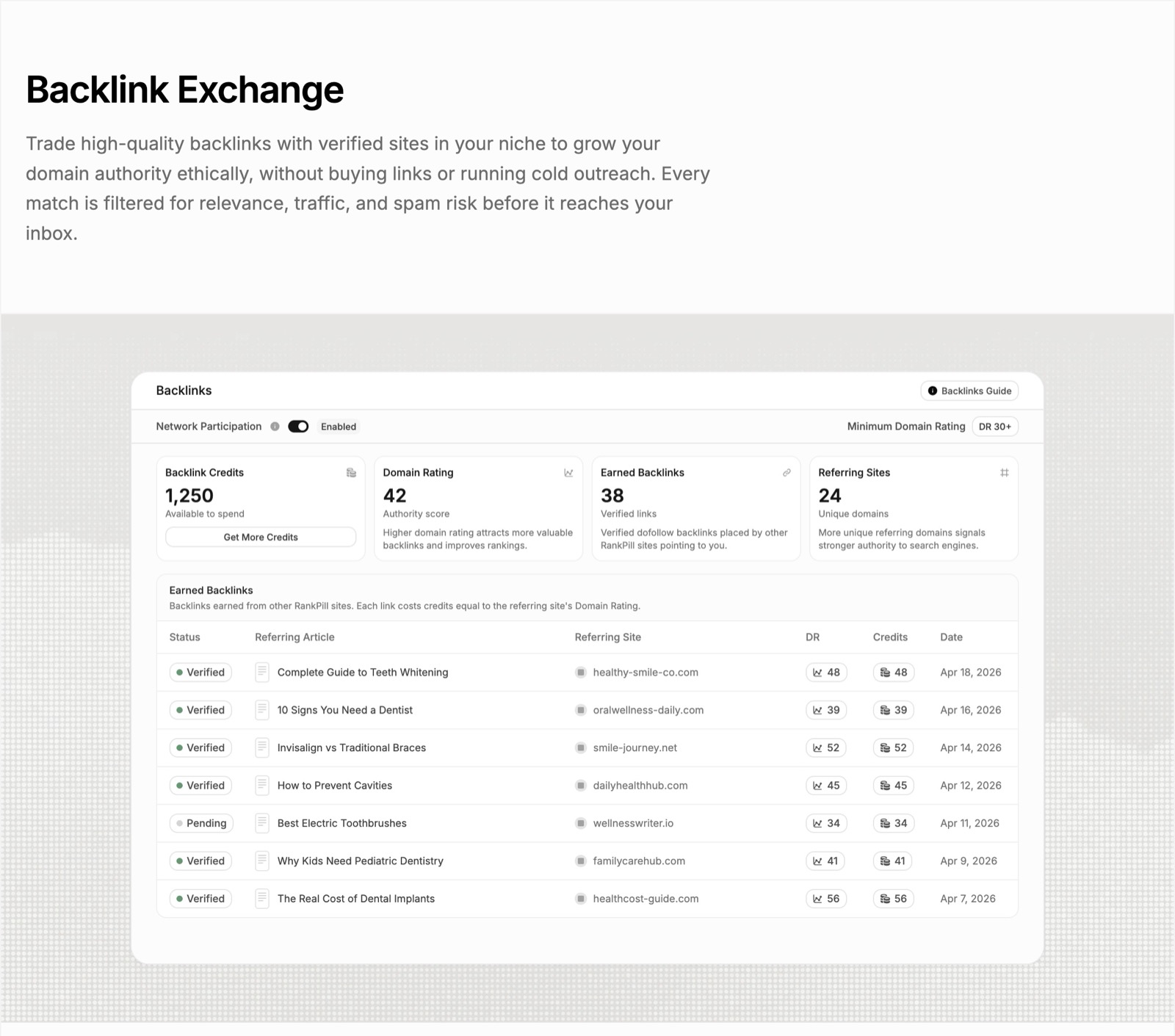
Link exchanges used to mean reciprocal links on footer pages. Modern exchanges are different. Tools like RankPill's backlink exchange match sites in similar niches based on traffic, spam score, and relevance. You earn links by giving links, but only to verified, high-quality sites. Each link costs credits equal to the referring site's Domain Rating, so you're incentivized to link to strong sites. It's a white-hat way to build authority without cold outreach or buying placements.
Digital PR and Data Studies
Publish original research, surveys, or data analysis. Journalists and bloggers link to primary sources. If you run a SaaS tool, analyze your anonymized user data and publish a trend report. For example, "How 1,000 ecommerce brands structure their SEO workflows in 2026." Pitch it to industry blogs and newsletters.
Broken Link Building
Find broken links on high-authority sites in your niche. Reach out to the site owner, point out the broken link, and suggest your content as a replacement. Tools like Ahrefs and Check My Links (Chrome extension) make this easy.
Track every backlink in a spreadsheet or tool. Include the referring domain, anchor text, link type (dofollow or nofollow), and date acquired. Review this monthly to see which tactics bring the best links.
Step Five: Track the Metrics That Matter
A plan without measurement is just hope. Your seo plan should define clear KPIs and a monthly review process.
Primary Metrics
- Organic sessions: Total visits from Google, Bing, and other search engines
- Ranking keywords: Number of keywords in positions 1-10, 11-20, and 21-50
- Click-through rate (CTR): Clicks divided by impressions in Search Console
- Conversions from organic: Sign-ups, purchases, or leads attributed to organic traffic
Secondary Metrics
- Pages indexed: Total pages in Google's index (check Search Console)
- Average position: Mean ranking across all tracked keywords
- Backlinks acquired: New referring domains per month
- Core Web Vitals: LCP, FID, and CLS scores
Set a baseline in month one. Track progress monthly. If organic sessions grow but conversions don't, your traffic is coming from the wrong keywords. If rankings improve but CTR drops, your titles and meta descriptions need work.
Google's documentation on creating helpful content and HubSpot's SEO strategy guide both emphasize measurement. The metrics you choose should tie directly to revenue or pipeline growth.
Common Mistakes That Break SEO Plans
Even experienced teams make these errors. Avoid them and your plan will stay on track.
Publishing Without Keyword Targets
Writing content for "engagement" or "thought leadership" without a keyword target wastes time. Every article should rank for at least one primary keyword. If you can't name the keyword, don't publish the article.
Ignoring Low-Hanging Fruit
Founders chase high-volume keywords and ignore terms with 50 or 100 searches per month. Those low-volume keywords convert better because they're more specific. A search for "AI SEO tool for Shopify stores" shows stronger intent than "AI SEO tool."
Skipping Internal Links
Internal links pass authority and help Google understand your site structure. Every new article should link to at least three related pages on your site. Update older articles to link to new ones. This creates a web of topical relevance.
Treating SEO as Set-and-Forget
Algorithms change. Competitors publish new content. Your seo plan should include a quarterly review. Update underperforming articles, refresh outdated statistics, and re-optimize for new keyword opportunities.
Copying Competitors Without Adding Value
If you're writing the same listicle as five other sites, you won't rank. Study the top-ranking pages for your target keyword. Ask: what do they miss? Where can you add data, screenshots, examples, or a stronger point of view? Google's Search Quality Rater Guidelines reward Experience, Expertise, Authoritativeness, and Trustworthiness (E-E-A-T). Generic rewrites don't score well on any of those.
How to Scale Your SEO Plan Without Hiring an Agency
Most small teams hit a wall at 4 to 8 articles per month. Writing, editing, publishing, and promoting each piece takes time. Scaling past that point usually means hiring writers or an agency.
There's a middle path: automation that handles the repeatable parts while you focus on strategy.
SEO automation tools research keywords, generate outlines, write drafts, add internal links, and publish to your CMS. You review the output and approve or edit before it goes live. This turns a five-hour article into a 30-minute review.
The trade-off is control. Automation works best for informational content and cluster articles. For high-stakes commercial pages or brand-defining pillar posts, you'll want to write those yourself.
If you're publishing one article per day, automation makes sense. If you're publishing one per week, the ROI is lower. Match the tool to your cadence.
What a 90-Day SEO Plan Looks Like in Practice
Let's walk through a realistic 90-day seo plan for a SaaS company with a small team.
Month One: Foundation
- Week 1: Keyword research. Build a library of 50 keywords across four clusters.
- Week 2: Technical audit. Fix crawl errors, improve site speed, add schema to product pages.
- Week 3-4: Publish four cluster articles (one per week) targeting high-priority keywords.
Month Two: Production
- Week 5-8: Publish 16 articles (four per week). Two informational, one commercial, one transactional per week.
- Week 6: Reach out to five blogs for guest post opportunities.
- Week 8: Launch backlink exchange or broken link outreach campaign.
Month Three: Optimization
- Week 9-12: Publish 16 more articles.
- Week 10: Update the five worst-performing articles from month one with better titles, new sections, and stronger CTAs.
- Week 12: Monthly review. Measure organic sessions, ranking keywords, CTR, and conversions. Adjust the plan based on what's working.
By day 90, you'll have 36 new articles, a technical foundation that supports growth, and at least 10 new backlinks. That's enough signal to see ranking movement and traffic growth.

When to Adjust Your SEO Plan
No plan survives first contact with reality. You'll need to adjust based on what you learn.
Adjust if:
- A keyword cluster drives 5x more traffic than expected (double down on that cluster)
- A topic you thought was low-competition turns out to be dominated by high-authority sites (pivot to easier keywords)
- Organic traffic grows but conversions don't (shift from informational to commercial content)
- A competitor launches a major content push in your niche (speed up your publishing cadence or target different keywords)
Don't adjust if:
- You've only been running the plan for 30 days (SEO takes 60 to 90 days to show results)
- One article underperforms (not every piece will rank; focus on the average)
- A technical issue slows you down temporarily (fix it and get back on schedule)
The best teams review their seo plan monthly, but only make major changes quarterly. This balances agility with the patience SEO requires.
Tools That Make Execution Easier
You don't need a $500/month toolstack to run an seo plan. Here's what actually helps:
| Tool Type | Purpose | Budget-Friendly Option | Pro Option |
|---|---|---|---|
| Keyword research | Find keywords, volume, difficulty | Google Keyword Planner, Ubersuggest | Ahrefs, Semrush |
| Rank tracking | Monitor position changes | Google Search Console | AccuRanker, Nightwatch |
| Technical audit | Crawl site, find errors | Screaming Frog (free up to 500 URLs) | Sitebulb, DeepCrawl |
| Content production | Write, edit, publish | Google Docs + WordPress | RankPill (automates research, writing, publishing) |
| Backlink analysis | Track links, find opportunities | Ahrefs Backlink Checker (free) | Ahrefs, Majestic |
| Analytics | Measure traffic, conversions | Google Analytics 4, Search Console | Same (GA4 is best-in-class) |
Start with the free tools. Upgrade when you're publishing 10+ articles per month and need better data or automation.
How to Keep Your Plan Alive When You're Busy
The hardest part of any seo plan is consistency. You'll have product launches, customer emergencies, fundraising sprints. SEO will slide.
Here's how to keep it going:
- Batch your content work. Write three articles in one sitting, then schedule them to publish over three weeks.
- Set a minimum viable cadence. If daily publishing isn't realistic, commit to one article per week. Never go below that floor.
- Use a project management tool. Track your content queue in Notion, Asana, or Trello. Seeing the pipeline keeps you accountable.
- Automate the repeatable parts. Keyword research, outlines, image sourcing, and publishing can all be automated. Save your energy for strategy and editing.
- Hire a part-time editor or VA. If writing is your bottleneck, hire someone to clean up drafts or format articles. A $500/month contractor can double your output.
The teams that grow organic traffic are the ones that show up every week, even when it's not exciting.
An seo plan is the difference between random blog posts and a system that compounds over time. It connects keyword research, content production, technical maintenance, and link building into a repeatable process that you can measure and improve. Most founders skip the plan and wonder why their traffic stays flat. RankPill automates the full SEO pipeline so you can run a daily publishing plan without hiring writers or an agency. It finds keywords, writes articles in your brand voice, publishes to your site, and builds backlinks. If you want steady organic growth without the manual work, that's the fastest path.
Unlock Traffic on Autopilot
Grow organic traffic on autopilot. RankPill will research, write, optimize, and publish articles to your website daily.
 WordPress