
SEO Startup: How to Build Organic Traffic in 2026

Modest Mitkus · October 26, 2026
Every seo startup faces the same problem: you need customers before you run out of money, but ads are expensive and referrals take time. Organic search gives you compounding growth. The traffic you earn in month three still shows up in month twelve. But most founders treat SEO like a side project, writing a blog post when they feel inspired and hoping Google notices. That doesn't work. You need a system that runs whether you're shipping features, talking to customers, or raising money.
Why SEO Matters More for Startups in 2026
Paid ads worked when Facebook and Google were cheap. Now customer acquisition costs are up 60% since 2020. You're competing with funded companies that spend six figures a month on performance marketing.
SEO flips the math. You invest time upfront to rank for keywords, and the traffic keeps coming without ongoing spend. A well-ranked article from 2024 still drives leads in 2026.
The shift to AI search makes this more urgent, not less. ChatGPT, Perplexity, and Google's AI overviews cite sources. If your content isn't indexable and structured, you don't exist in AI results. The a16z analysis of Generative Engine Optimization shows that the same fundamentals (clear answers, cited claims, topical authority) win in both traditional and AI-driven search.
The Three SEO Channels That Actually Work
You don't need to master every tactic. Focus on three channels:
- Programmatic SEO: Template-driven pages that target thousands of long-tail keywords (comparison pages, location pages, feature grids)
- Editorial content: Long-form articles that answer buyer questions and rank for commercial keywords
- Backlinks: Links from relevant sites that tell Google your domain is worth ranking
Most early-stage teams try to do all three at once and do none of them well. Pick one, build a system, then add the second.

Setting Up Keyword Research That Finds Opportunities
Keyword research sounds boring because most tools make it boring. You export a CSV with 10,000 rows and no idea where to start.
Start with competitor analysis instead. Find three competitors who rank for the keywords you want. Run them through Ahrefs, Semrush, or a simpler tool that pulls their ranking keywords.
Filter for:
- Search volume: 100 to 5,000 searches per month (high enough to matter, low enough that you can rank)
- Keyword difficulty: Under 30 if your domain is new, under 50 if you have some authority
- Intent: Look for keywords with "how to", "best", "vs", "review", "guide" - those convert better than informational keywords
Export the list and tag each keyword by topic cluster. A topic cluster groups related keywords under one pillar page. For example, a startup selling project management software might have clusters for "remote team tools", "Gantt chart software", and "agile project management".
How to Prioritize What to Write First
Rank keywords by a simple score: (search volume × business relevance) ÷ keyword difficulty. Business relevance is subjective. A keyword that your ideal customer searches right before buying gets a 10. A keyword they search when they're just learning gets a 3.
You'll end up with a prioritized list. Write the top 20 articles first, publish one per week, and track what ranks. Many seo startup founders waste months writing content that doesn't rank because they never filtered for difficulty.
| Keyword Type | Example | Monthly Volume | Difficulty | Priority |
|---|---|---|---|---|
| High-intent | "best CRM for startups" | 1,200 | 35 | High |
| Comparison | "HubSpot vs Salesforce" | 2,800 | 42 | High |
| How-to | "how to build a sales pipeline" | 800 | 28 | Medium |
| Informational | "what is a CRM" | 12,000 | 55 | Low |
The Google SEO Starter Guide explains how search intent should drive content structure, not just keyword placement.
Building a Content System That Scales
One article per month won't move the needle. You need volume and consistency.
The mistake most founders make: hiring a freelance writer, waiting two weeks for a draft, editing it for another week, and publishing one piece per month. At that pace, you'll have twelve articles by the end of the year.
The Weekly Publishing Cadence
Set a goal of one article per week minimum. That's 52 articles in year one. If each article ranks for an average of three keywords and drives ten visits per month per keyword, you're looking at 1,560 visits per month by month twelve. That's before compounding and before any of those articles break out and rank for dozens of keywords.
To hit weekly publishing:
- Batch research: Spend one day per month researching and outlining the next four articles
- Set a word count: 2,000 to 3,500 words is enough to cover most topics and rank
- Write in-house or automate: Either block time to write or use an AI tool that writes, publishes, and tracks articles on a schedule
- Edit for accuracy, not perfection: Fix factual errors, add examples, tighten intro and conclusion
Founders who treat content like code ship faster. You don't rewrite the entire article three times. You publish, track performance, and update the winners.

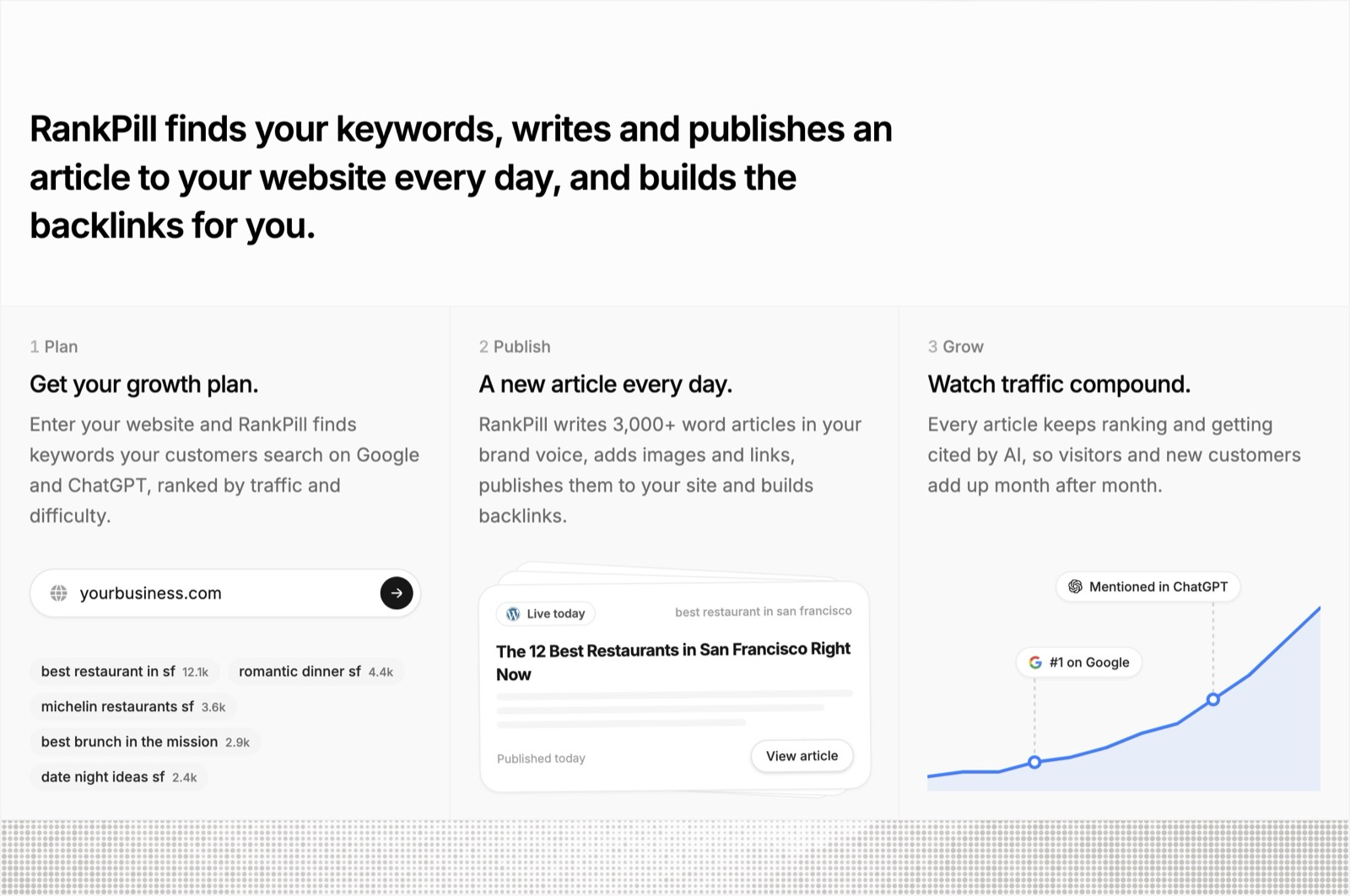
For teams that want to scale past one article per week without hiring, RankPill automates the entire pipeline. It researches keywords your site can rank for, writes 3,000+ word articles with images and links, and auto-publishes one article per day to WordPress, Shopify, Webflow, or any CMS. You review and approve, or let it run on autopilot.
Writing Content That Ranks and Converts
Google's helpful content system penalizes articles written for search engines instead of people. That means keyword-stuffed posts with no original insight get filtered out.
Google's guidance on people-first content is clear: write for your audience, demonstrate expertise, and provide value beyond what already ranks.
Here's what works in 2026:
- Answer the query in the first 100 words: If someone searches "how to reduce churn", tell them the top three tactics in the intro
- Use examples and data: "We reduced churn by 15% by adding a usage report email" beats "engagement emails reduce churn"
- Link to sources: Cite studies, link to tools, reference case studies. External links build trust and help with AI search citations
- Add internal links: Link to related articles and product pages. This spreads authority across your site and keeps readers engaged
Structuring Articles for Readability and SEO
Break content into short sections with clear H2 and H3 headings. Use bullet lists for features, numbered lists for steps, and tables for comparisons.
Most readers skim. They scroll until they find the section that answers their question. If your article is five long paragraphs with no headings, they leave.
Good structure for a typical how-to article:
- Intro: State the problem and preview the solution (100-150 words)
- Why this matters: Context and consequences (200-300 words)
- Step-by-step process: Numbered list with detail under each step (800-1,200 words)
- Common mistakes: What to avoid (200-300 words)
- Tools and resources: Links to tools, templates, related articles (200-300 words)
This structure keeps readers on the page longer (a ranking signal) and increases the chance they click through to your product.
Technical SEO Basics Every Founder Should Fix
You can write perfect content and still not rank if your site has technical issues. The good news: most technical SEO is a one-time fix.
Site Speed and Core Web Vitals
Google ranks faster sites higher, especially on mobile. Core Web Vitals measure loading speed, interactivity, and visual stability.
Run your site through PageSpeed Insights. If your score is below 70, fix these first:
- Compress images (use WebP format, lazy load below the fold)
- Minimize JavaScript (defer non-critical scripts)
- Enable browser caching
- Use a CDN for static assets
Most of this can be handled with a plugin if you're on WordPress, or built into your setup if you're on Webflow or Framer.
Crawlability and Indexing
Google can't rank pages it can't crawl. Check Google Search Console for crawl errors and submit your sitemap. Your sitemap should list every page you want indexed.
Make sure your robots.txt file isn't blocking important pages. A common mistake: accidentally blocking your blog or product pages during development and forgetting to unblock them at launch.
| Technical Issue | Impact | Fix Time |
|---|---|---|
| Slow page load | Lower rankings, higher bounce rate | 2-4 hours |
| Missing sitemap | Pages not indexed | 15 minutes |
| Broken internal links | Wasted crawl budget, poor UX | 1-2 hours |
| Duplicate content | Confuses Google, dilutes authority | 1-3 hours |
| Missing alt text | Missed image search traffic, accessibility | 30 minutes |
Link Building for Startups Without a Budget
Links are still the strongest ranking signal. A site with 100 quality backlinks will outrank a site with zero backlinks, even if the content is worse.
The problem: link building takes time, and buying links is risky. Google penalizes paid links, and most link-selling sites are low-quality spam farms.
Tactics That Work in 2026
Guest posts on relevant blogs: Reach out to blogs your customers read. Offer to write an article that teaches something useful. Include one link back to a relevant page on your site. This works if you target small to mid-size blogs that actually accept contributions.
Digital PR and newsjacking: If you have data, an opinion on a trending topic, or a contrarian take, pitch it to journalists. Tools like HARO connect you with reporters looking for sources. One link from a high-authority news site can drive traffic and lift your entire domain.
Competitor backlink replication: Find your competitors' backlinks in Ahrefs or Semrush. Filter for links from blogs, directories, or resource pages. Reach out to those same sites and pitch why your content is worth linking to.
Backlink exchanges with verified sites: Some tools connect you with other sites in your niche for reciprocal or three-way link exchanges. The key is filtering for relevance and avoiding spammy networks. RankPill's backlink exchange matches you with verified sites, and you set a minimum Domain Rating to avoid low-quality links.
The Search Engine Journal link building guide covers these tactics in detail and includes templates for outreach.
How Many Links Do You Actually Need?
It depends on your niche. A local service business might rank with 20 links. A SaaS startup in a competitive category might need 200.
Start with a goal of five new backlinks per month. Track the Domain Rating of each referring site. A link from a DR 50 site is worth more than ten links from DR 10 sites.
Measuring What Matters
Most founders track the wrong metrics. They celebrate traffic spikes without checking if that traffic converts.
The Metrics That Predict Revenue
Organic traffic: Total visits from Google, Bing, and AI search engines. Track month-over-month growth. Anything above 10% per month is strong for an early-stage seo startup.
Keyword rankings: Track your top 20 target keywords. If you're moving up from position 15 to position 8, you're on the right path. Position 1 to 3 get 50% of all clicks.
Click-through rate (CTR): If you rank in position 5 but your CTR is 2%, your title and meta description aren't compelling. Rewrite them.
Conversion rate from organic traffic: Set up goals in Google Analytics for demo requests, signups, or purchases. If your conversion rate from organic is lower than paid traffic, your content might be attracting the wrong audience or your CTAs are weak.
| Metric | Good Benchmark | How to Improve |
|---|---|---|
| Organic traffic growth | 10%+ month-over-month | Publish more, build links, update old content |
| Keyword rankings | 5+ keywords in top 10 | Target lower-difficulty keywords, improve content depth |
| CTR in search | 5%+ for position 5 | Rewrite titles with numbers, questions, benefits |
| Organic conversion rate | 2-5% for B2B SaaS | Improve CTAs, match content to buyer stage |
Use Google Search Console to find pages with high impressions but low CTR. Those are quick wins. Rewrite the title and description, and you can double your traffic without changing the content.
Common Mistakes That Kill SEO Startups
Publishing inconsistently: You write five articles in January, nothing in February, three in March. Google rewards sites that publish regularly. Set a schedule and stick to it.
Ignoring search intent: You rank for "project management software" but your article explains what project management is, not which tools to buy. Searchers bounce, and Google drops your ranking.
Skipping internal links: Every new article should link to two or three older articles. This spreads authority and helps Google understand your site structure.
Neglecting mobile: Over 60% of searches happen on mobile. If your site is hard to read or slow on a phone, you won't rank.
Chasing trends instead of building authority: You write one article on every trending topic instead of building deep coverage in your niche. Google rewards topical authority. Twenty articles about email marketing will rank better than twenty random articles.
When to Hire and When to Automate
Most seo startup founders ask: should I hire a writer, an agency, or use a tool?
Hire a writer if you need custom case studies, interviews, or highly technical content. Expect to pay $200 to $800 per article, depending on length and expertise. Writers are flexible and can match your brand voice, but they don't scale past a few articles per month unless you build a team.
Hire an agency if you want a full-service team handling strategy, content, technical SEO, and link building. Agencies charge $3,000 to $15,000 per month. They make sense if you have budget and want hands-off execution, but many agencies overpromise and underdeliver. You're also locked into long contracts.
Use automation if you want consistent output without managing freelancers or paying agency retainers. Tools like RankPill handle research, writing, publishing, and link building for $99 per month. You get 30 articles per month, auto-published to your site. The trade-off: you review and edit instead of writing from scratch, and you need to make sure the AI matches your brand voice (though most tools let you set custom instructions).
For most early-stage teams, automation is the fastest way to build a content library and start ranking. You can always layer in custom content later once you have revenue.
How Local SEO Fits In
If your startup serves a specific city or region, local SEO drives high-intent traffic. Someone searching "SEO agency in Austin" is ready to buy, not browsing.
Set up a Google Business Profile, add your address and hours, and get reviews from early customers. Optimize your homepage and service pages for "your service + your city" keywords.
The BrightLocal Local SEO guide covers citations, review management, and local link building. For most startups, local is a quick win if it applies to your business model.
Content Strategy for Long-Term Growth
SEO compounds. The article you publish today might rank in three months and still drive traffic two years later. That's why content strategy matters more than one-off posts.
Build topic clusters around your core product categories. Each cluster has one pillar page (a comprehensive guide) and ten to twenty supporting articles that link back to the pillar.
Example for a CRM startup:
- Pillar page: "Complete Guide to CRM for Small Businesses" (4,000 words)
- Supporting articles: "How to choose a CRM", "CRM vs spreadsheet", "Best CRM integrations", "How to migrate to a new CRM", "CRM pricing models explained"
Every supporting article links to the pillar, and the pillar links to each supporting article. This structure tells Google you're an authority on the topic.
The Content Marketing Institute's search-focused strategy guide explains how to plan content that survives algorithm changes and platform shifts.
Building an seo startup in 2026 comes down to systems, not inspiration. Pick keywords you can rank for, publish consistently, earn links from relevant sites, and measure what converts. Most founders overthink it and undership. If you write one article per week for a year, you'll rank for hundreds of keywords and drive traffic that compounds. RankPill automates the research, writing, publishing, and link building so you can focus on product and customers instead of managing writers or agencies. Start with 30 articles per month, track what ranks, and scale from there.
Unlock Traffic on Autopilot
Grow organic traffic on autopilot. RankPill will research, write, optimize, and publish articles to your website daily.
 WordPress