
White Label SEO Software: Scale Your Agency in 2026

Modest Mitkus · March 15, 2026
Digital marketing agencies face increasing pressure to deliver comprehensive SEO services while managing costs and maintaining brand consistency. White label SEO software offers a strategic solution, enabling agencies to provide sophisticated SEO tools and reporting under their own branding without developing proprietary technology. This approach allows businesses to scale operations, serve more clients, and compete with larger firms while focusing on core competencies like strategy and client relationships.
Understanding White Label SEO Software
White label SEO software represents platforms and tools designed specifically for rebranding and resale by marketing agencies. Unlike standard SEO tools marketed directly to end users, these solutions allow agencies to customize interfaces, reports, and dashboards with their own logos, color schemes, and branding elements.
The fundamental value proposition centers on outsourcing technical development while maintaining client ownership. Agencies purchase access to proven software infrastructure, then present it as their own service offering. This arrangement creates efficiency for both software providers and agency customers.
Key Components of White Label Solutions
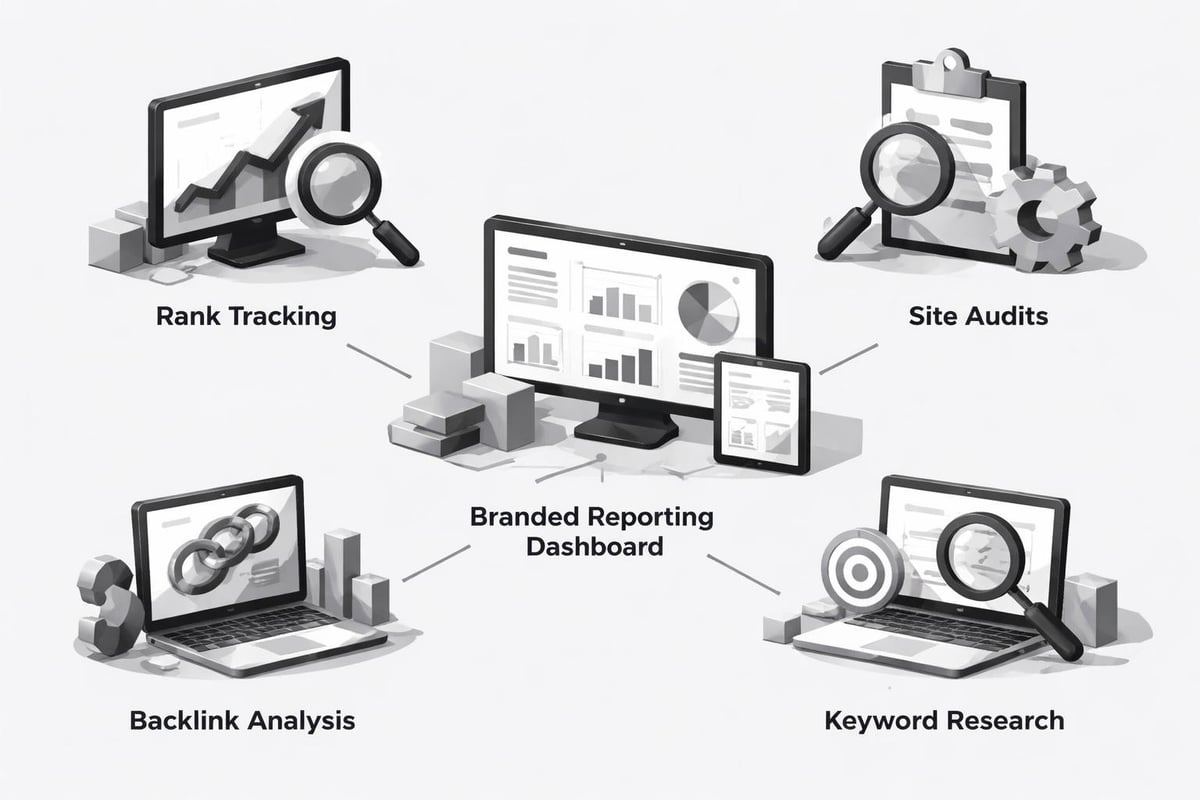
Most white label SEO software includes several core functionalities that agencies need to serve clients effectively:
- Rank tracking and monitoring across search engines and locations
- Site auditing tools that identify technical SEO issues
- Backlink analysis for competitive intelligence and link building
- Keyword research capabilities to identify opportunities
- Customizable reporting dashboards with agency branding
The software architecture typically separates the backend functionality from the frontend presentation layer. This separation enables agencies to maintain their brand identity throughout the client experience while leveraging sophisticated technology.
Benefits for Marketing Agencies
Implementing white label SEO software delivers tangible advantages that impact both operational efficiency and financial performance. Agencies can expand service offerings without proportional increases in overhead costs or technical staff.
Cost Reduction and Resource Optimization
Building proprietary SEO software requires significant investment in development talent, infrastructure, and ongoing maintenance. White label solutions eliminate these expenses, allowing agencies to access enterprise-grade tools for predictable monthly fees.
The typical agency saves between 60-80% compared to in-house development costs. These savings extend beyond initial development to include updates, security patches, and feature enhancements that software providers handle automatically.
Resource allocation improves dramatically when technical maintenance moves off the agency's plate. Teams redirect time toward client strategy, content development, and relationship management. This shift creates better client outcomes while reducing burnout among agency staff.
Scalability Without Complexity
Traditional agency growth models require hiring additional specialists for each new client tier. White label SEO software breaks this constraint by automating routine tasks and standardizing delivery processes.
| Growth Metric | Traditional Model | White Label Model |
|---|---|---|
| Time to onboard new client | 2-3 weeks | 1-2 days |
| Staff required per 10 clients | 3-4 specialists | 1-2 account managers |
| Report generation time | 4-6 hours/client | 15-30 minutes/client |
| Monthly cost per client | $800-1,200 | $200-400 |
Agencies using white label platforms report serving 3-5 times more clients with the same team size. Automation handles data collection, analysis, and initial reporting, while human expertise focuses on interpretation and strategic recommendations.
Essential Features to Evaluate
Selecting the right white label SEO software requires careful assessment of both current needs and future requirements. Not all platforms offer equivalent functionality or customization depth.
Branding and Customization Options
The extent of branding customization varies significantly across providers. Basic solutions might only allow logo replacement, while comprehensive platforms enable complete white labeling of user interfaces, email communications, and PDF reports.
Look for platforms offering:
- Full domain customization using your agency's URL structure
- Custom color schemes matching brand guidelines
- Personalized email templates for automated communications
- Branded mobile applications for client access
- Custom report templates with flexible layout options
Sitechecker provides extensive customization capabilities that allow agencies to create fully branded client experiences. The depth of customization directly impacts client perception of your agency's technological sophistication.
Integration and Workflow Automation
Modern agencies operate across multiple platforms for project management, CRM, and communication. White label SEO software should integrate seamlessly with existing technology stacks to avoid creating data silos.
Priority integrations include:
- Google Analytics and Search Console for comprehensive data aggregation
- WordPress, Shopify, and other CMS platforms for direct implementation
- Zapier or native API access for custom workflow automation
- Slack, Teams, or email for alert notifications
- CRM systems like HubSpot or Salesforce
Automation capabilities separate basic tools from advanced platforms. The best white label solutions automate report scheduling, alert generation, and data synchronization without manual intervention. This automation becomes critical when managing SEO for small business clients who expect regular updates without premium pricing.

Comparing Top White Label Platforms
The white label SEO software market includes dozens of providers, each with distinct strengths and target audiences. Understanding platform differences helps agencies select solutions aligned with their service models.
Enterprise-Grade Solutions
Rank Ranger offers comprehensive white label capabilities designed for agencies managing large client portfolios. Their platform emphasizes customizable dashboards and automated reporting at scale.
Key differentiators include multi-channel rank tracking across Google, Bing, and voice search, plus integration with paid search and social media data. Enterprise platforms typically command higher price points but deliver proportional value for agencies with sophisticated clients.
Mid-Market Options
SEOReseller provides balanced functionality suitable for growing agencies. Their white label dashboard includes essential SEO tools without overwhelming complexity or enterprise pricing.
This tier works well for agencies serving 20-100 clients with standard SEO needs. The platforms offer adequate customization while maintaining accessibility for team members without extensive technical backgrounds.
Specialized Platforms
Some white label solutions focus on specific aspects of SEO rather than comprehensive suites. SeoSamba combines CMS, CRM, and SEO tools in an integrated marketing automation platform.
Specialized platforms excel when agency service models emphasize particular methodologies or vertical markets. The trade-off involves potentially needing multiple tools to deliver complete SEO services.
Implementing White Label Software Successfully
Acquiring white label SEO software represents just the first step. Successful implementation requires strategic planning and organizational alignment to maximize return on investment.
Client Migration Strategies
Transitioning existing clients to white label platforms demands careful communication and expectation management. Clients accustomed to specific reporting formats may resist changes without clear value articulation.
Best practices for smooth transitions:
- Pilot with new clients first to refine processes before migrating existing accounts
- Demonstrate enhanced capabilities through side-by-side comparison of old and new reporting
- Maintain familiar metrics while introducing additional data points gradually
- Offer training sessions for clients who access dashboards directly
- Gather feedback actively during the first 90 days to address concerns
Many agencies maintain parallel systems for 30-60 days, allowing clients to experience both approaches before fully committing. This reduces risk while building confidence in the new platform.
Team Training and Adoption
Internal adoption challenges can undermine white label software benefits if team members struggle with new interfaces or workflows. Structured training programs accelerate competency development and minimize resistance.
Effective training approaches include:
- Role-based curriculum tailored to account managers versus technical specialists
- Hands-on workshops using real client data in sandbox environments
- Video tutorials for asynchronous learning and reference
- Certification programs that validate proficiency levels
- Regular refresher sessions when platforms release new features
The most successful agencies designate platform champions who develop deep expertise and serve as internal resources. These champions bridge the gap between software providers and daily users, customizing best practices for the agency's specific context.
Pricing Models and ROI Calculations
Understanding white label SEO software economics helps agencies make informed investment decisions and structure profitable service packages.
Common Pricing Structures
Providers typically offer several pricing models, each with distinct advantages depending on agency size and growth trajectory:
| Pricing Model | Structure | Best For |
|---|---|---|
| Per-seat | Monthly fee per user account | Small agencies with defined team sizes |
| Per-client | Fee per active client account | Agencies with fluctuating client counts |
| Tiered usage | Scaled pricing based on features and volume | Growing agencies needing flexibility |
| Revenue share | Percentage of client billings | Startups minimizing upfront costs |
Per-client pricing aligns costs directly with revenue, making it attractive for agencies with high client turnover or seasonal fluctuations. Per-seat models offer predictability but may create inefficiency if team members don't fully utilize available access.
Calculating Return on Investment
White label SEO software ROI extends beyond direct cost comparisons to include time savings, capacity expansion, and client retention improvements.
A typical mid-sized agency scenario:
- Monthly software cost: $500-800
- Time saved per client monthly: 3-4 hours
- Additional clients served: 10-15 with same team
- Reduced churn from improved reporting: 15-20%
- Incremental monthly revenue: $5,000-8,000
The payback period usually ranges from 2-4 months, after which the software generates substantial positive returns. Agencies should track both hard costs and opportunity costs when evaluating performance.
AI Integration and Future Capabilities
The intersection of artificial intelligence and white label SEO software represents the industry's most significant evolution in 2026. AI-powered platforms transform how agencies deliver value while reducing manual effort.
Automated Content and Analysis
Modern white label solutions increasingly incorporate AI for content generation, keyword research, and competitive analysis. These capabilities enable agencies to scale content production without proportional increases in writing staff.
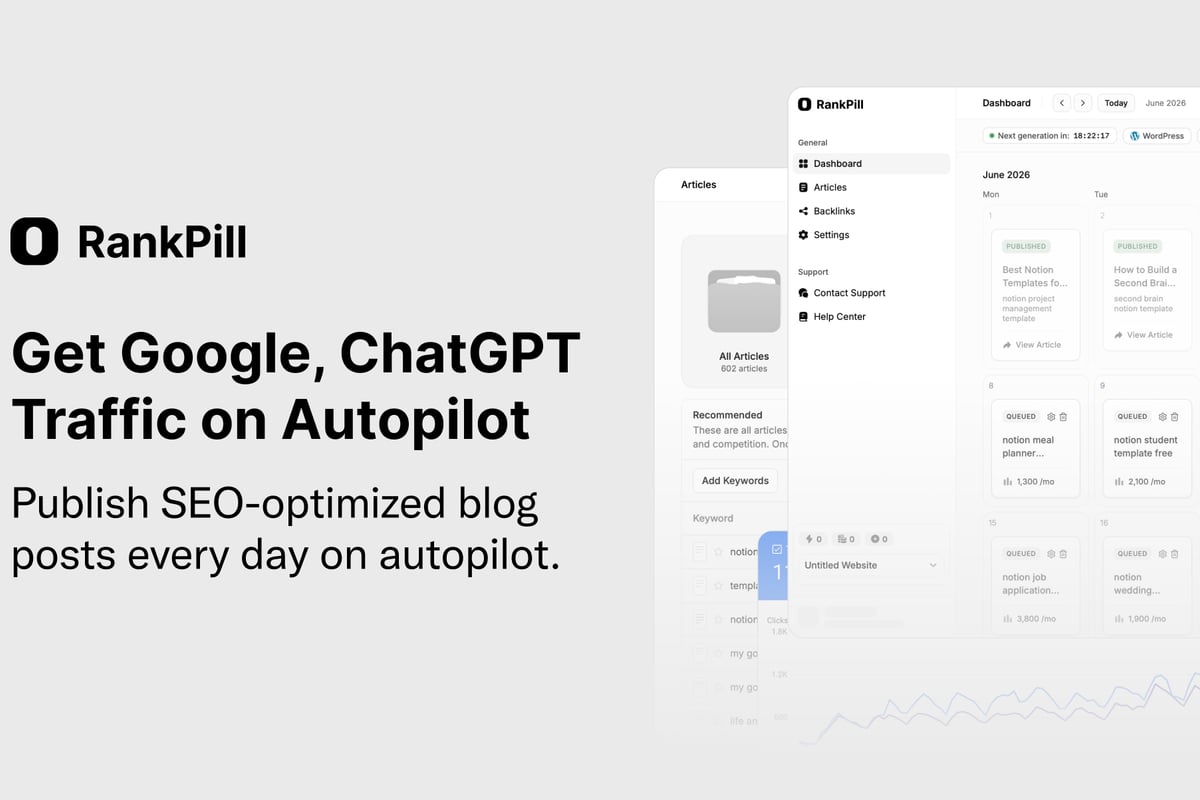
For agencies looking to maximize efficiency, platforms like RankPill automate the entire content creation workflow. By generating optimized articles, conducting competitor keyword analysis, and automatically publishing content 24/7, agencies can deliver consistent SEO results at a fraction of traditional costs.
Predictive Analytics and Recommendations
Advanced white label platforms now offer predictive modeling that forecasts ranking potential, traffic estimates, and competitive threats. These AI-driven insights help agencies move from reactive reporting to proactive strategy development.
Predictive capabilities currently include:
- Ranking probability scores for target keywords based on current authority and content
- Traffic forecasts using historical patterns and competitive dynamics
- Content gap identification through semantic analysis of top-ranking pages
- Technical SEO prioritization based on impact likelihood
- Competitor movement detection triggering strategic alerts
Agencies incorporating these AI features report 40-60% improvements in campaign performance as strategies become more data-driven and precisely targeted. The technology handles pattern recognition at scales impossible for human analysts.
Compliance and Data Security
White label SEO software handles sensitive client data and website access credentials, making security and compliance critical evaluation criteria.
Data Protection Standards
Reputable white label providers implement enterprise-grade security measures including:
- SOC 2 Type II certification validating security controls
- GDPR compliance for European client data
- Encrypted data transmission using TLS 1.3 protocols
- Role-based access controls limiting data exposure
- Regular security audits by independent third parties
Agencies should review security documentation before committing to platforms, particularly when serving clients in regulated industries like finance or healthcare. Data breaches can destroy agency reputations regardless of where the technical failure occurred.
Client Data Ownership
Contract terms should explicitly clarify data ownership, export rights, and portability. Some providers claim ownership of aggregated data or limit export functionality, creating dependencies that complicate platform switching.
Key contractual elements include:
- Unrestricted data export in standard formats
- Client data deletion upon contract termination
- No vendor claims to client insights or proprietary information
- Backup access independent of ongoing subscription
- Transition assistance if changing providers
Understanding these terms before implementation prevents unpleasant surprises when business needs evolve or provider relationships sour.
Maximizing Client Retention Through Reporting
Strategic use of white label SEO software's reporting capabilities transforms client relationships from transactional to consultative partnerships.
Building Custom Dashboards
Generic reporting templates rarely align perfectly with individual client priorities or sophistication levels. Click Intelligence research shows that customized dashboards significantly improve client satisfaction and retention rates.
Effective dashboard customization strategies:
- Stakeholder-specific views showing relevant metrics for executives versus marketing teams
- Goal-aligned KPIs tracking client-defined success metrics prominently
- Competitive context positioning performance relative to key competitors
- Trend visualization highlighting progress over strategic timeframes
- Action-oriented insights connecting data to recommended next steps
The most effective agencies create dashboard templates for common client archetypes, then customize individual instances based on discovery conversations. This approach balances efficiency with personalization.
Automated Alert Systems
Proactive communication about ranking changes, technical issues, or competitive threats demonstrates attentiveness that strengthens client relationships. White label platforms should enable customized alert configurations based on client-specific thresholds.
Configure alerts for:
- Ranking fluctuations exceeding defined percentage changes
- Technical errors affecting crawlability or indexation
- New backlinks from high-authority domains
- Competitor content publication in target topic areas
- Traffic anomalies suggesting algorithm updates or penalties
Automated alerts positioned agencies as vigilant partners monitoring client interests continuously, not just during monthly review meetings. This perception of constant attention justifies premium pricing and reduces churn risk.
Integration with Broader Marketing Strategies
White label SEO software delivers maximum value when integrated into comprehensive digital marketing strategies rather than operating as an isolated service line.
Cross-Channel Attribution
Modern client expectations include understanding how SEO contributes to overall marketing performance alongside paid search, social media, and other channels. White label platforms with multi-channel capabilities enable unified attribution modeling.
Integration points include:
- Google Ads performance showing organic and paid keyword overlap
- Social media traffic from content promotion efforts
- Email marketing featuring blog content distribution
- Conversion tracking connecting organic visits to business outcomes
- Customer journey mapping showing SEO's role in multi-touch attribution
Agencies demonstrating SEO's contribution to broader business objectives justify higher budgets and strategic positioning versus tactical vendors. Understanding how to increase traffic to websites requires viewing SEO as one component of integrated strategies.
Content Marketing Synergy
The relationship between SEO and content marketing grows increasingly interconnected as search engines prioritize comprehensive, authoritative information. White label software should facilitate content planning aligned with keyword opportunities.
Content-SEO integration features:
- Keyword clustering identifying topic groups for content planning
- Content gap analysis revealing competitor coverage advantages
- Search intent mapping categorizing keywords by user goals
- Performance tracking measuring content ROI by piece
- Update recommendations suggesting content refresh priorities
Agencies using AI for SEO content creation can dramatically accelerate production while maintaining quality standards. The combination of white label analytics and AI content generation creates powerful efficiency gains.
Selecting the Right Provider
The white label SEO software decision impacts agency operations for years, making thorough evaluation essential before committing to long-term contracts.
Trial Period Evaluation
Most reputable providers offer 14-30 day trial periods enabling hands-on assessment before purchase. Maximize trial value by:
- Loading actual client data to test real-world workflows
- Involving multiple team members to gather diverse perspectives
- Testing customer support responsiveness and expertise
- Reviewing documentation quality for self-service problem solving
- Exploring API capabilities for custom integrations
Create structured evaluation rubrics scoring platforms across predetermined criteria weighted by importance. Systematic assessment reduces bias and enables objective comparison across multiple options.
Vendor Stability and Roadmap
The SEO software landscape includes both established players and venture-funded startups. Each brings distinct advantages and risks regarding longevity, innovation pace, and acquisition likelihood.
Assess vendor stability through:
- Years in operation and client base size
- Funding sources and financial sustainability
- Product update frequency indicating active development
- Public roadmap showing future capabilities
- Client references from similar agency profiles
Newer platforms often deliver more innovative features and responsive support but carry higher discontinuation risk. Established providers offer stability but may lag in adopting emerging technologies like AI-driven analysis.
Advanced Use Cases
Sophisticated agencies leverage white label SEO software for applications beyond standard client reporting and campaign management.
Multi-Location Enterprise Clients
Brands with multiple locations present unique challenges requiring specialized white label capabilities. Location-based tracking, competitive analysis by market, and franchisee-level reporting demand robust platform architectures.
Essential multi-location features:
- Unlimited location tracking without per-location fees
- Hierarchical reporting rolling up location data to regional and national views
- Local pack monitoring tracking map pack rankings
- Review integration aggregating reputation data
- Franchisee portals providing location-specific insights
Agency Platform specializes in enterprise-scale white label solutions supporting complex organizational structures. These capabilities enable agencies to compete for larger contracts traditionally dominated by enterprise software vendors.
Reseller and Partnership Networks
Some agencies build reseller networks where partners white label the agency's white label solution. This multi-tier approach requires platforms supporting sub-branding and permission hierarchies.
Network management considerations:
- Partner-level branding allowing resellers to customize further
- Revenue sharing automation calculating and tracking commissions
- Permission inheritance managing access across organizational levels
- Training materials for partner onboarding
- Performance visibility monitoring partner success rates
Multi-tier white labeling creates additional complexity but enables exponential scaling beyond the agency's direct sales capacity. The model works particularly well for agencies with vertical expertise valuable to geographically dispersed partners.
White label SEO software empowers agencies to deliver sophisticated solutions while maintaining brand consistency and operational efficiency. By carefully evaluating platforms based on customization depth, integration capabilities, and pricing alignment, agencies can select solutions that support sustainable growth and enhanced client satisfaction. RankPill offers agencies an AI-powered approach to content creation that complements white label reporting platforms, automating the research, writing, and publishing processes that drive organic traffic growth at scale.
Unlock Traffic on Autopilot
Grow organic traffic on autopilot. RankPill will research, write, optimize, and publish articles to your website daily.
 WordPress