
ChatGPT for Marketing: What Works in 2026

Modest Mitkus · October 17, 2026
Marketing teams in 2026 face a clear problem: buyers expect personalized content across every channel, but most teams don't have the headcount to deliver it. ChatGPT for marketing has moved from experiment to daily tool because it handles repetitive writing tasks faster than humans while maintaining quality when prompted correctly. The challenge isn't whether to use it - it's knowing which tasks to hand off, how to maintain brand voice, and where human judgment still matters.
What ChatGPT Actually Does Well for Marketing
ChatGPT excels at tasks with clear structure and established patterns. It writes first drafts quickly, adapts tone across channels, and generates variations without fatigue.
Content Ideation and Topic Generation
Most marketing teams waste hours in brainstorming meetings. ChatGPT produces 50 blog post ideas in 30 seconds when you give it your target audience, pain points, and keyword themes. The ideas aren't all winners, but having quantity lets you pick the best three instead of struggling to come up with three from scratch.
Feed it your existing top-performing content and ask for similar angles. Tell it which topics your competitors cover and request gaps. The model recognizes patterns in successful content and suggests variations.
Practical prompt structure:
- Your audience (job title, company size, main challenge)
- Content format (blog post, email, social thread)
- Goal (education, conversion, engagement)
- Constraints (word count, keyword inclusion, tone)
Social Media Copy and Ad Variations
Writing 20 ad variations for A/B testing takes hours manually. ChatGPT writes them in minutes. You paste your product description, target keyword, and value proposition, then request variations emphasizing different benefits.
The output needs editing - AI-generated ad copy often lacks the punch of human-written hooks - but it gives you a starting point. Most teams find that ChatGPT handles middle-of-funnel educational content better than top-of-funnel attention-grabbing copy.
| Task Type | ChatGPT Performance | Human Review Needed |
|---|---|---|
| Social media captions | Good (8/10) | Light edit for voice |
| Ad headlines | Fair (6/10) | Heavy edit for impact |
| Email subject lines | Good (7/10) | A/B test vs human |
| Product descriptions | Excellent (9/10) | Fact-check only |
| Blog post outlines | Excellent (9/10) | Structure validation |

Email Campaign Development
ChatGPT writes email sequences when you provide the campaign goal, audience segment, and key messages. A five-email nurture sequence that would take a copywriter three hours takes ChatGPT three minutes to draft.
The model handles structure well: subject line, preview text, body copy, call-to-action. It maintains consistency across the sequence and can adjust tone from email one (awareness) to email five (conversion).
What requires human oversight:
- Subject lines (test AI vs human performance)
- Personalization tokens and merge fields
- Links and tracking parameters
- Brand voice consistency
- Legal disclaimers and compliance language
SEO Content at Scale
ChatGPT for marketing becomes most valuable when you need to produce SEO content consistently. Single articles are easy - maintaining a publishing schedule for months is where teams struggle.
Keyword Research and Content Mapping
The model analyzes keyword lists and groups them into topic clusters. You paste 100 keywords from your research tool, and ChatGPT organizes them by search intent, suggests primary and secondary keywords for each article, and identifies content gaps.
This works because keyword research follows logical patterns. Informational keywords cluster around how-to content, commercial keywords around comparisons and reviews, and transactional keywords around product pages.
ChatGPT also generates related questions and long-tail variations. Feed it a head term like "email marketing" and request 50 long-tail variations. The output includes "email marketing for ecommerce", "email marketing automation workflows", and "email marketing metrics that matter" - all real search queries.
Article Outlines and Structure
The model builds article outlines by analyzing search intent. Tell it your target keyword and ask for an outline that matches what currently ranks. It identifies common H2 sections, suggests word count, and notes which supporting topics to cover.
Teams using ChatGPT for marketing content report that outlines are 80% accurate on first pass. The remaining 20% needs human adjustment for differentiation - you don't want to publish the same structure as every competitor.
Outline prompt template:
- Target keyword: [keyword]
- Search intent: [informational/commercial/transactional]
- Current top-ranking articles: [paste titles]
- Our unique angle: [what we know that competitors don't]
- Required word count: [minimum]
First Drafts and Content Production
Writing 3,000-word articles daily exhausts human writers. ChatGPT doesn't get tired. The challenge is maintaining quality and avoiding generic output.
Effective teams build detailed brand voice documents that include:
- Vocabulary (words to use, words to avoid)
- Sentence structure (average length, complexity)
- Tone markers (confident, technical, friendly)
- Example paragraphs in the correct voice
- Common phrases unique to your brand
Feed this document into every content generation prompt. The model adapts its output to match your examples. According to research on marketing analytics copilots, fine-tuning on company-specific data improves output quality by 40% compared to generic prompts.

Brand Voice and Consistency Challenges
The biggest complaint about ChatGPT for marketing is that everything sounds the same. The model has default patterns: it loves lists, uses certain transitional phrases repeatedly, and tends toward formal language unless specifically instructed otherwise.
Training ChatGPT on Your Voice
Upload 10-15 examples of your best content. Ask ChatGPT to analyze the writing style and create a style guide. Then reference that guide in future prompts.
This works better than trying to describe your voice in abstract terms. Showing examples lets the model extract actual patterns - average sentence length, paragraph structure, vocabulary choices, humor level.
Voice training process:
- Collect 10 pieces of content in your ideal voice
- Ask ChatGPT to analyze patterns across all 10
- Save the analysis as a custom instruction
- Test new content against original examples
- Refine the instructions based on output gaps
The Copy-Paste Problem
When 500 marketing teams use identical ChatGPT prompts, search results fill with identical articles. Google's algorithms detect this. Rankings suffer.
Differentiation comes from adding:
- Proprietary data (your customer research, case studies, metrics)
- Specific examples (real companies, real numbers, real outcomes)
- Original frameworks (your process, your terminology)
- Contrarian takes (where you disagree with conventional wisdom)
ChatGPT can't invent these - you provide them, and the model incorporates them into the structure. Teams that win with AI and SEO treat ChatGPT as a research assistant and first-draft writer, not a replacement for expertise.
Automation and Workflow Integration
ChatGPT for marketing gets more powerful when connected to other tools. The API lets you build workflows that run without manual prompting.
Content Calendar Automation
Connect ChatGPT to your content calendar. The system reads your publishing schedule, checks which articles are due, generates outlines for each, and sends them to your team for approval.
You set rules:
- Monday: How-to article targeting informational keywords
- Wednesday: Product comparison targeting commercial keywords
- Friday: Industry news roundup
The model generates appropriate content for each slot. Human editors review, refine, and publish. This workflow reduces content planning meetings from weekly to monthly.
Social Media Scheduling
ChatGPT reads your published blog posts and generates social media promotion. You publish an article, and the automation creates:
- Three Twitter threads (different angles)
- Five LinkedIn posts (professional tone)
- Ten tweet variations (for testing)
- One Instagram caption (visual focus)
Each piece links back to the article. You review the batch, pick winners, schedule them, and move on. What took 90 minutes now takes 15.
| Integration Type | Setup Time | Time Saved Per Week | Complexity |
|---|---|---|---|
| Content calendar | 2 hours | 5 hours | Medium |
| Social scheduling | 1 hour | 3 hours | Low |
| Email sequences | 3 hours | 4 hours | High |
| SEO optimization | 4 hours | 8 hours | High |
SEO Publishing Pipelines
The most complete automation combines keyword research, content creation, and publishing. SEO automation tools like RankPill connect all three steps: the system identifies rankable keywords, writes articles targeting those keywords, and publishes them to your website daily without manual intervention.
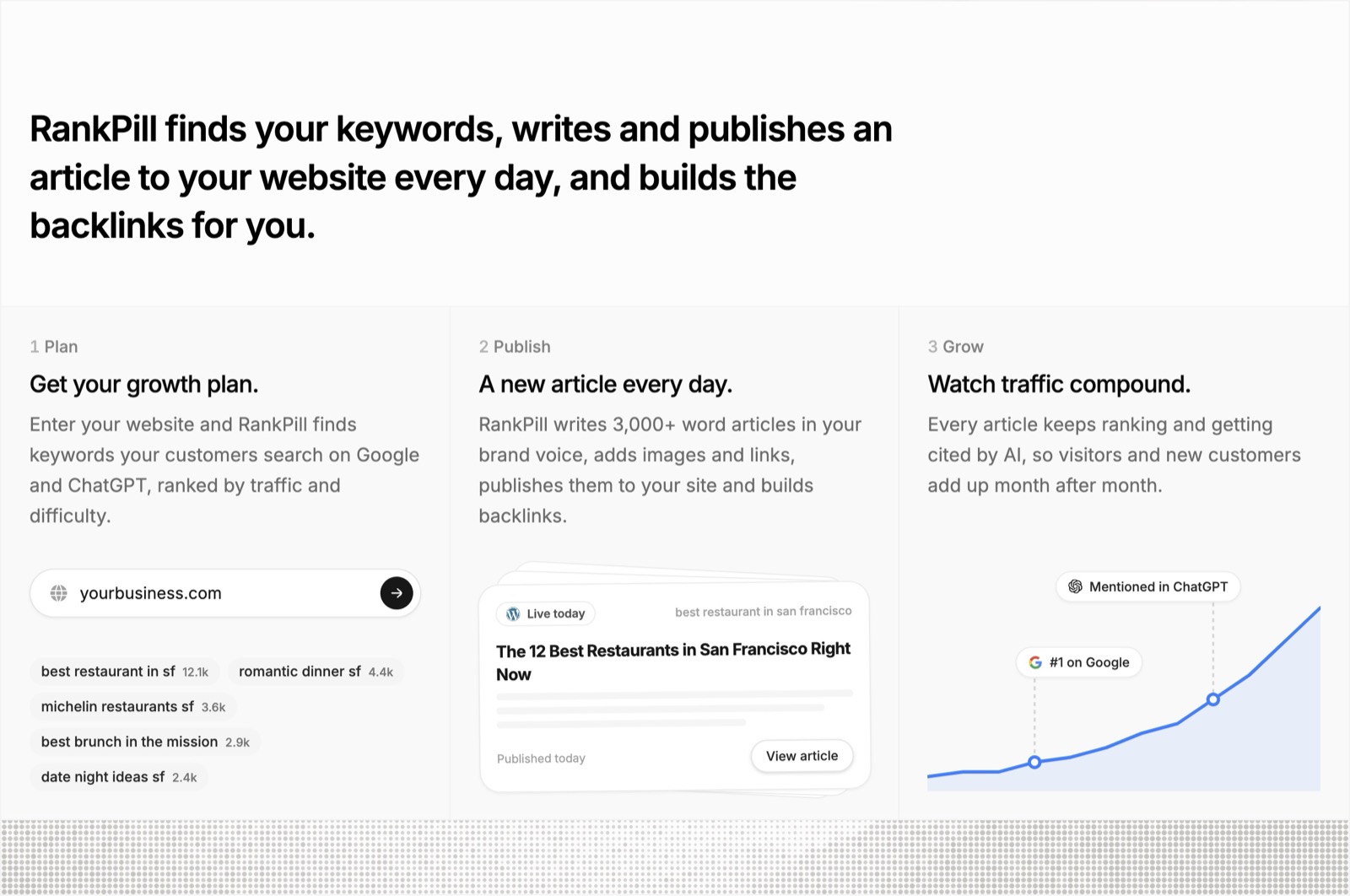
This matters for teams that need consistent output. Missing a week of publishing kills momentum. Automated pipelines maintain your schedule even when your team is busy with other projects.
Personalization and Audience Segmentation
ChatGPT adapts content for different audience segments faster than human writers can. You write one master version, then generate variations for each persona.
Persona-Based Content Variations
Feed ChatGPT your customer personas: startup founders, enterprise IT managers, and marketing directors. Provide one article about your product. Request three variations, each emphasizing benefits relevant to that persona.
The startup version focuses on speed and cost. The enterprise version emphasizes security and compliance. The marketing director version highlights ROI and reporting.
Each variation needs:
- Different headline (persona-specific pain point)
- Reordered benefits (most relevant first)
- Persona-appropriate examples
- Adjusted technical depth
- Unique CTAs
This approach follows OpenAI's guidance on scaling AI use cases in marketing teams - start with one template, then multiply it across segments.
Dynamic Landing Page Copy
ChatGPT generates landing page variations based on traffic source. Visitors from Google see educational content. Visitors from paid ads see conversion-focused copy. Visitors from email see personalized messages referencing their previous behavior.
You define the rules and provide the base content. The model creates variations. Your marketing automation platform serves the right version to each visitor.
Legal and Compliance Considerations
Using ChatGPT for marketing creates legal questions. The IAB's legal guidance on generative AI covers key issues marketing teams face.
Copyright and Originality
Content generated by AI doesn't carry copyright protection in the US. You can't sue someone who copies it. More importantly, AI-generated content that too closely resembles training data creates infringement risk.
Risk mitigation steps:
- Always edit AI output significantly
- Add original examples and data
- Run plagiarism checks before publishing
- Disclose AI assistance where legally required
- Keep human oversight in the workflow
Disclosure Requirements
Some jurisdictions require disclosure when AI generates marketing content. The rules vary by region and content type. Advertising has stricter requirements than blog posts.
The IAB's AI governance playbook recommends establishing clear policies now before regulations tighten. Document which content uses AI assistance, who reviews it, and what approval process applies.
Data Privacy and Training
ChatGPT's API doesn't train on your data by default, but the web interface does unless you disable it. Marketing teams handling customer data need to be careful what they paste into prompts.
Data handling rules:
- Never paste customer names, emails, or PII
- Anonymize case studies before using them as examples
- Use generic examples in prompts, add real data during editing
- Review your organization's AI use policy
- Train team members on what not to share with AI tools
Performance Measurement and Optimization
ChatGPT for marketing only works if you measure results. Track which AI-generated content performs and which fails.
A/B Testing AI vs Human Content
Run controlled tests. Write five articles with ChatGPT, five with human writers. Publish both sets with identical promotion. Measure:
- Organic traffic after 90 days
- Average time on page
- Bounce rate
- Conversion rate
- Social shares
- Backlinks earned
Most teams find that AI-generated content with human editing performs 80-90% as well as fully human-written content, but gets published 5x faster. The throughput advantage outweighs the quality gap for most use cases.
Conversion Tracking by Content Source
Tag content by creation method: human-written, AI-drafted-human-edited, or fully automated. Track which source drives conversions. You'll likely find that different content types perform better with different approaches.
Typical performance patterns:
- Top-of-funnel educational content: AI performs well
- Product comparison pages: AI needs heavy editing
- Landing pages: Human-written wins on conversion
- Blog posts: AI-drafted-human-edited wins on volume
- Email sequences: Mixed - test both approaches
Iterating on Prompts
Your first ChatGPT prompts for marketing won't be your best. Save every prompt that produces good output. Build a library. When something works, analyze why and apply that pattern to other tasks.
Track metrics by prompt version. If version A of your blog post prompt generates articles that rank, but version B doesn't, revert to version A and iterate from there.

Common Mistakes and How to Avoid Them
Teams new to ChatGPT for marketing make predictable mistakes. Learning from others' errors saves time.
Treating AI as a Finished Product
The biggest mistake is publishing AI output without editing. Even the best prompts produce content that needs refinement. ChatGPT doesn't know your latest product updates, your specific customer objections, or your unique insights.
Budget time for editing. If ChatGPT saves you three hours on first drafts, plan to spend one hour on editing and fact-checking.
Over-Relying on Generic Prompts
Copying prompts from prompt libraries produces generic content. Everyone else is using those same prompts. Your output blends into the noise.
Build custom prompts that include:
- Your specific product details
- Your customer research findings
- Your company's unique point of view
- Examples of your best existing content
- Constraints specific to your brand
Ignoring Search Intent
ChatGPT writes fluently, but fluency doesn't equal relevance. The model might produce a beautifully written article that completely misses why people search for that keyword.
Always check search intent before generating content. Look at what currently ranks. If the top 10 results are all product comparisons, don't ask ChatGPT to write a how-to guide for that keyword.
Skipping Quality Control
Automated doesn't mean unmonitored. Set up review processes. Have humans spot-check a sample of AI-generated content weekly. Look for:
- Factual errors (ChatGPT invents statistics)
- Outdated information (training data has a cutoff date)
- Off-brand language
- Broken logic or contradictions
- Missing context that human readers need
Building Your ChatGPT Marketing Workflow
Start small and expand as you learn what works. Most successful implementations follow this pattern:
Month 1: Single use case
- Pick one repetitive task (social media captions, email subject lines)
- Create detailed prompts with examples
- Compare AI output to your current process
- Measure time saved and quality delivered
Month 2: Refine and expand
- Improve prompts based on what worked
- Add a second use case (blog post outlines, ad variations)
- Build a prompt library
- Train team members on best practices
Month 3: Integrate and automate
- Connect ChatGPT to your existing tools
- Build workflows that reduce manual steps
- Document processes so knowledge doesn't live in one person's head
- Set quality standards and review cadences
Month 4+: Scale strategically
- Identify which content types benefit most from AI assistance
- Allocate human time to high-value tasks
- Continue measuring performance
- Adjust workflows based on data
The Content Marketing Institute's playbook recommends this phased approach because it builds team confidence while managing risk.
Future-Proofing Your AI Marketing Strategy
ChatGPT for marketing will evolve. Models improve, regulations change, and competitor usage increases. Build flexibility into your approach.
Stay Model-Agnostic
Don't build workflows that only work with one specific model. ChatGPT 4 performs differently than ChatGPT 5. Future models will have different strengths.
Structure your prompts and workflows so you can swap models. Test new versions as they release. Be ready to switch if a better option emerges.
Maintain Human Expertise
AI tools amplify expertise - they don't replace it. Teams that understand marketing strategy, customer psychology, and search behavior get better results from ChatGPT than teams that just know how to prompt.
Keep learning. Stay current on marketing fundamentals. As Think with Google notes, AI excellence in marketing comes from combining technical capability with strategic thinking.
Build for Search and Chat
Google search and ChatGPT responses both matter for visibility. Content that ranks in traditional search needs different optimization than content that gets cited by AI assistants.
Optimize for both channels. Include clear facts and data that language models can extract. Structure content with semantic clarity. Use natural language that answers questions directly. Ranking on ChatGPT requires many of the same signals as traditional SEO, plus additional emphasis on authoritative sourcing and factual accuracy.
ChatGPT for marketing works best when you treat it as a productivity multiplier, not a replacement for strategy or expertise. The teams seeing real results combine AI efficiency with human creativity and judgment. If you want consistent content output without hiring a full writing team, RankPill handles the complete workflow: keyword research, content creation, publishing, and backlink building, with one new SEO-optimized article published to your site every day. Built for founders who want organic growth on autopilot, starting at $99/month with a 90-day money-back guarantee.
Unlock Traffic on Autopilot
Grow organic traffic on autopilot. RankPill will research, write, optimize, and publish articles to your website daily.
 WordPress