
Does Google Penalize AI Content? The 2026 Truth

Modest Mitkus · June 11, 2026
The question "does Google penalize AI content" has sparked countless debates among SEO professionals, content creators, and business owners. With artificial intelligence tools becoming mainstream for content production, understanding Google's stance on AI-generated material has never been more critical. The short answer is nuanced: Google does not penalize content simply because AI created it, but the search giant does penalize low-quality content designed to manipulate rankings, regardless of how it was produced. This distinction fundamentally shapes how businesses should approach AI content strategies in 2026.
Understanding Google's Official Position on AI Content
Google has repeatedly clarified its stance through official communications and documentation. The search engine evaluates content based on quality, relevance, and user value, not the method of creation. According to Google's AI content guidelines, the focus remains on whether content demonstrates expertise, experience, authoritativeness, and trustworthiness (E-E-A-T).
Key principles Google follows:
- Content quality matters more than production method
- Automation used to manipulate rankings violates guidelines
- Helpful, original content ranks well regardless of creation tools
- Trust signals and user satisfaction drive rankings
The critical factor is intent. If you're using AI to produce valuable, well-researched content that serves user needs, Google treats it like any other quality content. However, if you're deploying AI to churn out thin, repetitive articles designed solely to game search algorithms, you're crossing into penalty territory.
What Google Actually Penalizes
Google's penalty system targets specific behaviors rather than technologies. Recent enforcement policies highlight three primary violation categories that trigger algorithmic or manual actions.
| Violation Type | Description | Example |
|---|---|---|
| Scaled Content Abuse | Mass-producing low-quality content to manipulate rankings | Publishing hundreds of keyword-stuffed articles daily |
| Fabricated Expertise | Presenting content as expert-written when it lacks genuine expertise | Medical advice generated without medical professional review |
| Site Reputation Abuse | Hosting third-party content primarily for ranking manipulation | Selling sections of reputable sites for link schemes |
The question of does Google penalize AI content becomes clearer when you examine these categories. AI itself isn't the problem. The problem emerges when AI enables bad practices at scale. A single well-crafted AI article passes scrutiny, but 500 nearly identical AI articles targeting similar keywords raises red flags.

The Evidence: How AI Content Actually Performs
Data provides compelling insights into the real-world performance of AI-generated content. An Ahrefs study analyzing 600,000 pages revealed that 86.5% of top-ranking pages contain AI-generated content, demonstrating that AI content not only survives but thrives in search results.
This research fundamentally challenges the narrative that does Google penalize AI content. Instead, it confirms that quality execution matters far more than creation method.
Performance metrics show:
- AI content with proper editing ranks comparably to human content
- Mixed human-AI collaboration often produces superior results
- Pure AI content underperforms when published without review
- Content meeting E-E-A-T standards ranks regardless of origin
The distinction lies in implementation strategy. Businesses using AI as a productivity multiplier while maintaining editorial oversight see positive results. Those treating AI as a replacement for strategic thinking and quality control face ranking challenges.
Quality Signals That Matter More Than Ever
Google's algorithms have evolved to detect quality signals that separate valuable content from filler material. What Google actually penalizes revolves around measurable quality indicators rather than content source detection.
Critical quality signals include:
- Original research and data: Unique insights not available elsewhere
- Expert review and fact-checking: Verification by qualified professionals
- User engagement metrics: Time on page, bounce rate, return visits
- Proper attribution and sourcing: Citations to authoritative sources
- Content depth and comprehensiveness: Thorough coverage of topics
These signals apply equally to all content. An AI-generated article incorporating original data analysis, expert quotes, and comprehensive research outperforms a shallow human-written piece every time. The tools matter less than the outcome.
Building AI Content Strategies That Work
Smart implementation of AI content requires strategic frameworks that prioritize quality over quantity. The businesses succeeding with AI content in 2026 follow specific methodologies that align with Google's quality expectations.
The Quality-First Framework
Successful AI content strategies begin with editorial standards that would apply to any content, regardless of creation method. This framework ensures does Google penalize AI content never becomes a concern for your publishing operations.
- Start with genuine keyword research to identify actual user intent
- Create detailed content briefs specifying expertise requirements
- Generate AI drafts as starting points, not finished products
- Add human expertise through subject matter expert review
- Fact-check all claims against authoritative sources
- Optimize for user experience with clear structure and formatting
- Monitor performance and iterate based on engagement data
For businesses scaling content production, AI SEO platforms can streamline this workflow while maintaining quality checkpoints. The key is treating AI as a tool within a broader quality assurance process.

Adding Unique Value to AI-Generated Content
The question of does Google penalize AI content often misses a more important consideration: does your content deserve to rank? Adding unique value transforms generic AI output into ranking-worthy material.
Value-addition strategies:
- Original examples from your business or industry experience
- Custom data visualizations presenting information in new ways
- Expert commentary interpreting facts for specific audiences
- Case studies and real results demonstrating practical application
- Updated information ensuring currency and relevance
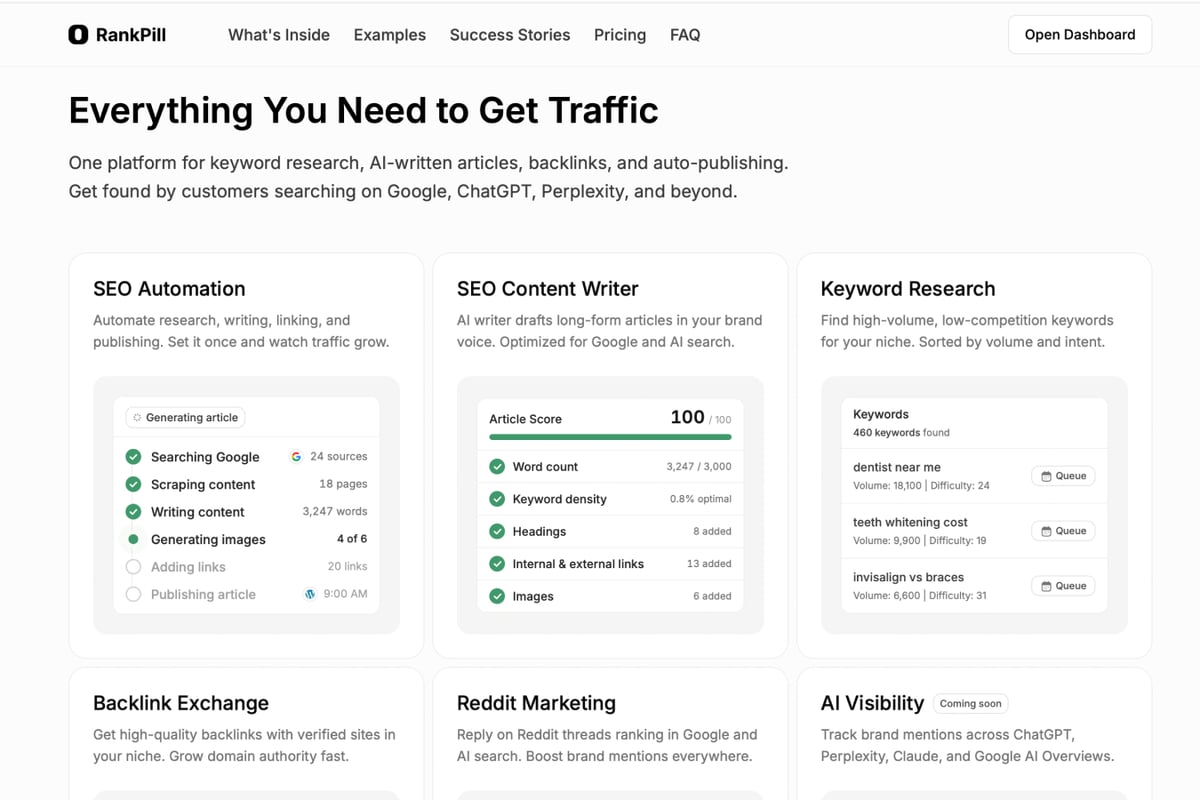
Tools like RankPill's SEO Content Writer help create structured, optimized articles that serve as solid foundations for adding these unique elements. The AI handles research and structure, while human expertise provides differentiation.
Common Myths About AI Content Penalties
Misinformation about Google's treatment of AI content creates unnecessary anxiety and poor strategic decisions. Debunking these myths helps businesses make informed choices about content production.
Myth 1: Google Can Detect All AI Content
No reliable evidence suggests Google has foolproof AI content detection. Policy analysis confirms that Google focuses on quality signals rather than detection tools. Even if detection were possible, Google's stated position is that creation method doesn't matter.
Reality check:
| Myth | Reality |
|---|---|
| Google flags all AI content | Google evaluates quality, not origin |
| AI detectors are accurate | Most AI detectors have 30-40% false positive rates |
| Humanizing tools guarantee safety | Quality improvement matters more than detection evasion |
| Manual review catches all AI | Reviewers look for guideline violations, not AI signatures |
Myth 2: AI Content Never Ranks Well
This myth crumbles under scrutiny of actual search results. Studies on AI content performance demonstrate that well-optimized AI content regularly occupies top positions across competitive keywords.
The determining factors are familiar: relevance, comprehensiveness, authority, and user satisfaction. Content meeting these criteria ranks regardless of whether a human or AI wrote the first draft.
Myth 3: Using AI Violates Google Guidelines
This represents a fundamental misunderstanding of Google's spam policies. The question does Google penalize AI content assumes AI use itself constitutes a violation. Google's guidelines prohibit content created "primarily to manipulate search rankings," not content created with specific tools.
Permitted AI applications:
- Research assistance and data analysis
- Content structure and outline generation
- Grammar checking and style improvement
- Translation and localization
- Personalization and customization
The violation occurs when content provides no value beyond keyword targeting, whether AI or humans create it.
Practical Implementation for SEO Teams
Translating policy understanding into operational practices requires specific workflows and quality controls. SEO teams managing AI content at scale need systems preventing quality degradation while maximizing efficiency gains.
Building Editorial Guidelines
Clear editorial standards ensure consistency across AI-generated content. These guidelines should address the specific challenges AI content presents while maintaining quality benchmarks.
Essential guideline components:
- Minimum word count requirements based on topic complexity
- Required elements like expert quotes, data points, examples
- Prohibited practices such as keyword stuffing or thin content
- Fact-checking procedures for all statistical claims
- Citation standards for external sources and data
- Brand voice specifications maintaining consistent tone
- Update schedules ensuring content remains current
These standards answer does Google penalize AI content by ensuring your content never exhibits penalty-triggering characteristics. Quality controls prevent the scaled content abuse that actually triggers penalties.
Monitoring and Quality Assurance
Continuous monitoring catches quality issues before they impact rankings. Effective QA systems combine automated checks with human oversight.
Multi-layer monitoring approach:
- Automated readability scoring flagging unclear content
- Plagiarism detection ensuring originality
- Fact-checking protocols verifying claims
- User engagement tracking identifying underperforming content
- Ranking monitoring spotting sudden drops
- Manual content audits reviewing samples regularly
For businesses running automated SEO workflows, these quality gates become critical checkpoints preventing problematic content from publishing.
The Future of AI Content and Search
Looking ahead, the relationship between AI content and search continues evolving as both technologies advance. Understanding emerging trends helps businesses stay ahead of potential policy changes.
Search Engine Evolution
Search engines increasingly incorporate AI into their own operations, changing how they evaluate content. Research on generative AI's impact on web search reveals fundamental shifts in information retrieval and presentation.
Key developments shaping the future:
- AI-generated search summaries reducing click-through to source content
- Emphasis on authoritative sources for AI training data
- Preference for demonstrated expertise over generic information
- Focus on unique perspectives that AI can't synthesize from existing content
- Increased importance of brand signals and entity recognition
These trends suggest does Google penalize AI content will become increasingly irrelevant as the question shifts to "does your content provide value in an AI-saturated ecosystem?" Standing out requires genuine expertise and unique perspectives that pure AI generation cannot replicate.
Optimizing for AI Search Tools
Beyond traditional Google search, businesses must consider how their content performs in AI-powered search tools like ChatGPT, Perplexity, and Google's AI Overviews. Getting mentioned by AI systems requires different optimization approaches.
AI search optimization strategies:
- Structure content for easy extraction and citation
- Establish topical authority through comprehensive coverage
- Build strong E-E-A-T signals that AI systems recognize
- Create content that AI models want to reference
- Monitor AI search mentions and optimize accordingly
This dual optimization for traditional and AI search represents the future of SEO strategy, where content quality and authority matter more than ever.
Risk Management and Best Practices
Mitigating risks while leveraging AI efficiency requires balanced approaches that prioritize sustainable growth over short-term gains.
Red Flags to Avoid
Certain practices increase the likelihood that does Google penalize AI content becomes a real concern for your site. Recognizing and avoiding these red flags protects your search visibility.
High-risk practices:
- Publishing unedited AI output at scale
- Creating doorway pages targeting similar keywords
- Spinning existing content without adding value
- Fabricating expertise or credentials
- Hiding low-quality content from users but showing to bots
- Building massive content volumes without editorial oversight
These practices violate Google's guidelines whether you use AI or not. The technology simply makes executing these violations easier and faster, which is precisely why Google's 2026 enforcement focuses on scaled content abuse.
Sustainable AI Content Practices
Long-term success requires treating AI as one component of a comprehensive content strategy rather than a replacement for strategic thinking.
| Sustainable Practice | Benefit | Implementation |
|---|---|---|
| Human expert review | Ensures accuracy and depth | Subject matter experts verify all technical content |
| Original research integration | Creates unique value | Include proprietary data and insights |
| User feedback loops | Improves relevance | Monitor comments and engagement metrics |
| Regular content updates | Maintains currency | Schedule quarterly reviews of top content |
| Quality over quantity | Builds authority | Publish fewer, better articles |
These practices ensure your content strategy remains resilient regardless of how Google's algorithms evolve. Quality content serves users first and search engines second, which aligns with Google's fundamental mission.
The answer to does Google penalize AI content is clear: Google penalizes low-quality content designed to manipulate rankings, not the tools used to create it. Success requires focusing on user value, demonstrating expertise, and maintaining quality standards that would apply to any content. If you're ready to scale your content production while maintaining the quality signals Google rewards, RankPill provides automated SEO services that handle keyword research, article creation, and publishing while keeping quality and compliance at the forefront of every piece of content.
Unlock Traffic on Autopilot
Grow organic traffic on autopilot. RankPill will research, write, optimize, and publish articles to your website daily.
 WordPress