Grey Hat SEO: Risks, Tactics & Smart Boundaries in 2026

Modest Mitkus · October 2, 2026
The digital marketing landscape has always operated in shades of complexity, and nowhere is this more apparent than in search engine optimization. Grey hat SEO occupies the controversial middle ground between approved white hat tactics and prohibited black hat manipulation. These techniques don't explicitly violate search engine guidelines, yet they push boundaries and exploit ambiguities in ways that carry real risk. For businesses looking to scale organic traffic in 2026, understanding where these boundaries lie is essential to making informed strategic decisions.
Understanding the Grey Hat SEO Spectrum
Grey hat SEO refers to optimization tactics that exist in the undefined space between completely legitimate strategies and outright search engine manipulation. Unlike white hat approaches that strictly follow guidelines, grey hat methods leverage loopholes, outdated policies, or practices that haven't been explicitly condemned.
The challenge lies in the fact that search engines rarely provide black-and-white rules for every scenario. Google's algorithms evolve constantly, and what qualifies as acceptable today might trigger penalties tomorrow. This uncertainty creates the grey zone where marketers operate at their own risk.
Why Grey Hat SEO Persists
Several factors drive continued interest in grey hat tactics despite their inherent risks:
- Speed to results: Many grey hat methods deliver faster rankings than purely white hat approaches
- Competitive pressure: When competitors use aggressive tactics, businesses feel pressure to match their strategies
- Ambiguous guidelines: Vague or incomplete documentation from search engines leaves room for interpretation
- Cost efficiency: Some grey hat techniques appear cheaper than building genuine authority
- Detection lag: Search engines don't catch every violation immediately, creating temporary opportunities
The reality is that grey hat SEO continues because it sometimes works-at least in the short term. The question businesses must answer is whether the temporary gains justify the long-term risks.

Common Grey Hat SEO Techniques in 2026
Understanding specific grey hat tactics helps marketers recognize them in the wild and make conscious choices about which practices to avoid.
Parasite SEO and Third-Party Authority
Parasite SEO involves publishing content on high-authority third-party platforms to rank quickly by leveraging their established domain strength. While guest posting on relevant sites is legitimate, parasite SEO crosses into grey territory when:
- Content has minimal relevance to the host platform
- The primary purpose is funneling traffic rather than providing value
- Marketers pay to publish on platforms that don't require payment for genuine contributions
- Content quality is low but ranks due to domain authority alone
Google has increasingly targeted parasite SEO through algorithm updates, yet it remains prevalent because the line between legitimate guest content and exploitative parasiting isn't always clear.
Paid Link Networks and Private Blog Networks (PBNs)
Link building remains a cornerstone of SEO, but the methods matter enormously. While modern link building strategies emphasize earning links through quality content, grey hat practitioners often turn to:
| Tactic | Grey Hat Version | White Hat Alternative |
|---|---|---|
| Guest posting | Paying for links disguised as editorial content | Earning placements through genuine expertise |
| Link exchanges | Automated reciprocal linking at scale | Strategic partnerships with relevant sites |
| Directory submissions | Mass submission to low-quality directories | Selective listing in industry-specific directories |
| Sponsored content | Undisclosed paid links without nofollow tags | Transparent sponsorships with proper attributes |
The automation of link building pushes many tactics into grey territory. When tools automatically generate backlinks without human oversight or quality control, the result often violates the spirit of search engine guidelines even if it doesn't trigger immediate penalties.
Content Automation and AI-Generated Material
The explosion of AI writing tools in 2025-2026 has created new grey areas. Search engines don't prohibit AI content outright, but they do penalize low-quality, thin, or manipulative content regardless of how it's produced.
Grey hat content practices include:
- Publishing AI-generated articles with minimal human review or enhancement
- Spinning or slightly rewriting competitor content using AI tools
- Creating massive content volumes focused on keyword stuffing rather than user value
- Auto-generating location pages or product variations with minimal unique information
The key distinction is intent and quality. Tools that help create genuinely useful content serve legitimate purposes, while those designed purely to game algorithms cross into problematic territory. For businesses seeking to scale content production responsibly, platforms that prioritize quality and search intent over pure volume offer a more sustainable path.
The Ethical and Business Risk Calculation
Beyond the technical aspects, grey hat SEO raises fundamental questions about business ethics and risk management.
Penalty Consequences and Recovery Costs
When search engines detect manipulative practices, the consequences can be severe:
- Rankings drop: Pages can fall from top positions to page five or beyond overnight
- Traffic collapse: Organic visits can decline by 50-90% within days
- Manual actions: Human reviewers may impose penalties requiring extensive cleanup
- Recovery time: Rebuilding lost rankings can take 6-18 months even after addressing violations
- Reputation damage: Public penalties can harm brand credibility with customers and partners
The financial impact extends beyond lost traffic. Businesses must factor in the cost of hiring specialists to fix problems, creating replacement content, and rebuilding link profiles from scratch.
The Moving Target of Algorithm Updates
What qualifies as grey hat shifts constantly as search engines refine their policies. Google's spam policies evolve regularly, and tactics that flew under the radar in 2024 might trigger penalties in 2026.
This creates a precarious situation where today's grey hat tactic becomes tomorrow's black hat violation without any action on the marketer's part. The algorithm simply catches up.

Multi-Search Engine Considerations
Most discussions focus on Google, but businesses should recognize that other search engines like Bing also enforce quality guidelines. A tactic that works on one platform might fail on another, and penalties can compound across search ecosystems.
As AI-powered search experiences like ChatGPT search gain prominence, the definition of quality content continues to evolve. Grey hat tactics optimized for traditional algorithms may become increasingly ineffective as search technology advances.
Building Sustainable Traffic Without the Grey Zone
For businesses committed to long-term growth, the most reliable approach involves staying clearly within white hat boundaries while leveraging legitimate automation and scale.
Quality-Focused Content Strategies
Rather than exploiting loopholes, successful SEO programs in 2026 prioritize:
- Search intent matching: Creating content that genuinely answers user questions
- Comprehensive coverage: Developing authoritative resources rather than thin pages
- Original research: Adding unique data and insights competitors can't replicate
- User experience: Optimizing for engagement metrics that signal quality to algorithms
- Regular updates: Maintaining content freshness through ongoing improvements
These approaches take longer to show results but build durable traffic sources resistant to algorithm changes.
Legitimate Automation Approaches
Automation itself isn't grey hat-the application determines the category. White hat automation focuses on efficiency without sacrificing quality:
- Streamlining keyword research to identify genuine opportunities
- Organizing content calendars and publishing workflows
- Generating content outlines based on search intent analysis
- Automating technical SEO audits and monitoring
- Managing internal linking structures systematically
The distinction lies in keeping human oversight and quality control in the process. When automation enhances rather than replaces human judgment, it serves legitimate business purposes. Many companies find that choosing the right SEO automation tools allows them to scale efficiently while maintaining quality standards.
Backlink Acquisition Best Practices
Building high-quality backlinks remains essential, but the methods matter enormously:
- Create linkable assets like original research, tools, or comprehensive guides
- Develop genuine relationships with industry publications and influencers
- Earn coverage through newsworthy activities and unique perspectives
- Participate authentically in industry communities and forums
- Leverage content partnerships with complementary businesses
The pattern is clear: strategies that create genuine value for link sources tend to remain white hat, while those that exist purely for SEO manipulation fall into grey or black territory.
The Compliance Framework for Long-Term Success
Businesses serious about sustainable organic growth should implement formal processes to ensure their SEO practices remain compliant.
Establishing Internal Guidelines
Creating clear documentation helps teams make consistent decisions:
- Define acceptable practices: List specific tactics your organization will and won't use
- Require approval processes: Implement reviews for new strategies or vendors
- Document decision rationale: Record why certain tactics were rejected or approved
- Regular training: Keep team members updated on evolving search engine policies
- Audit existing practices: Review current tactics against updated guidelines quarterly
This framework prevents well-intentioned team members from accidentally implementing grey hat tactics without realizing the risks.
Vendor and Tool Evaluation
When outsourcing SEO or using automation platforms, businesses should ask:
- What specific tactics does the tool or agency use?
- Are there any practices that exploit loopholes or push guideline boundaries?
- How does the provider stay current with search engine policy changes?
- What happens if tactics previously used become violations?
- Can you get detailed reporting on all activities performed?
Transparency from vendors is essential. Any provider unwilling to explain their methods in detail deserves scrutiny.
Monitoring and Early Warning Systems
Implementing monitoring helps catch potential issues before they become catastrophic:
| Metric | Warning Sign | Action Required |
|---|---|---|
| Organic traffic | Sudden unexplained drops | Audit recent changes and check for manual actions |
| Ranking volatility | Unusual fluctuation patterns | Review content quality and backlink profile |
| Indexing status | Pages dropping from index | Check for technical issues or policy violations |
| Crawl errors | Increased error rates | Investigate potential cloaking or access issues |
| Backlink profile | Spikes in low-quality links | Disavow harmful links and audit link building practices |
Early detection allows businesses to address problems before they compound.

The Business Case Against Grey Hat SEO
While grey hat tactics might seem attractive for their potential speed and cost advantages, the long-term business case rarely supports them.
Opportunity Cost Analysis
Time and resources spent on grey hat approaches represent investments that could fund sustainable strategies:
- Short-term focus: Grey hat tactics require constant monitoring and adjustment as algorithms evolve
- Replacement costs: When tactics stop working, you start from scratch rather than building on progress
- Team expertise: Developing skills in manipulation rather than genuine marketing limits career growth
- Strategic distraction: Focus on loopholes diverts attention from product quality and customer experience
Organizations that invest in building genuine authority develop assets that compound over time rather than requiring constant replacement.
Competitive Positioning
Businesses caught using grey hat tactics face reputational risks beyond search engine penalties. In an era where transparency and ethical AI practices increasingly matter to consumers and partners, getting caught manipulating search results can damage brand perception.
Competitors can also use evidence of manipulative tactics in comparative marketing or to file spam reports with search engines. The potential embarrassment and lost business relationships add to the risk calculation.
Resource Allocation and ROI
Grey hat SEO often appears cheaper upfront but becomes expensive when full costs are considered:
- Initial tactic implementation costs
- Ongoing monitoring and adjustment expenses
- Risk mitigation and backup plan development
- Recovery costs when tactics fail or trigger penalties
- Lost opportunity costs from traffic declines
- Reputation management expenses if violations become public
When businesses calculate total cost of ownership rather than just initial implementation expenses, white hat approaches frequently offer better return on investment over multi-year periods.
Transitioning from Grey to White Hat Practices
Organizations that previously relied on grey hat tactics can successfully transition to sustainable approaches, though the process requires planning and patience.
Audit and Inventory Current Practices
The first step involves honest assessment:
- Document all current SEO tactics and tools in use
- Classify each practice as clearly white hat, clearly black hat, or grey
- Identify which grey practices carry the highest risk
- Map dependencies-which traffic sources rely on questionable tactics
- Calculate what percentage of organic traffic comes from risky sources
This inventory provides the foundation for developing a transition plan.
Gradual Migration Strategy
Rather than abruptly discontinuing all grey hat practices-which could cause immediate traffic collapse-smart businesses phase transitions:
- Immediate: Stop clearly black hat practices and high-risk grey tactics
- 30 days: Launch white hat alternatives for medium-risk grey practices
- 90 days: Monitor traffic from new white hat sources and optimize
- 180 days: Discontinue remaining grey tactics as white hat traffic grows
- 365 days: Review results and refine white hat approach based on performance
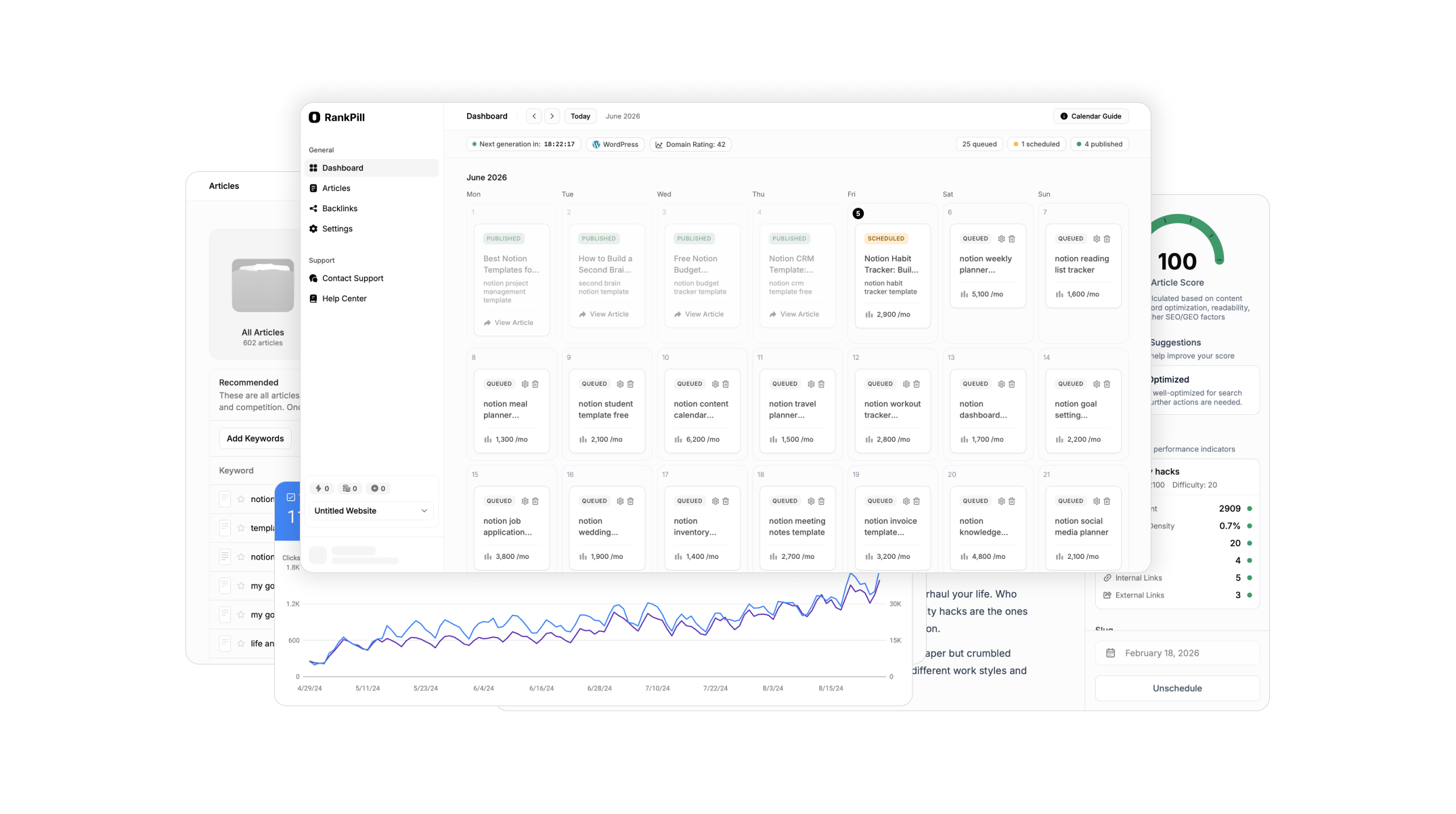
This phased approach minimizes disruption while building sustainable traffic sources. Automated platforms that focus on quality and compliance can help businesses scale white hat content production to replace traffic from questionable sources. RankPill's SEO automation helps teams maintain publishing velocity while ensuring content meets search engine quality standards, making the transition more manageable.
Measuring Success Beyond Rankings
As organizations shift to white hat approaches, success metrics should expand beyond simple keyword rankings:
- Traffic quality: Measure engagement, time on site, and conversion rates
- Brand search volume: Track growth in branded search queries as authority builds
- Backlink quality: Monitor referring domain authority and relevance rather than just quantity
- Content performance: Assess how well content serves user intent based on engagement metrics
- Business outcomes: Connect SEO metrics to revenue, leads, and customer acquisition costs
These broader metrics better capture the value of sustainable SEO than rankings alone.
Grey hat SEO represents a high-risk, short-term approach that rarely justifies its costs when businesses account for penalties, recovery expenses, and opportunity costs. The most successful organizations in 2026 build organic traffic through quality content, genuine link earning, and user-focused optimization. RankPill helps businesses scale SEO production while maintaining quality standards, automating keyword research, content creation, and publishing without resorting to grey hat tactics that jeopardize long-term growth.
Unlock Traffic on Autopilot
Grow organic traffic on autopilot. RankPill will research, write, optimize, and publish articles to your website daily.