
Helpful Content Update: What It Means for SEO in 2026

Modest Mitkus · June 12, 2026
Google's search landscape has undergone significant transformation since the introduction of the helpful content update, fundamentally changing how websites approach content creation and SEO strategy. This algorithmic shift prioritizes genuine value and user satisfaction over traditional optimization tactics, forcing businesses to reconsider their entire content approach. Understanding the nuances of this update is essential for maintaining and growing organic visibility in 2026.
Understanding the Helpful Content Update Framework
The helpful content update represents Google's commitment to rewarding people-first content that demonstrates expertise, experience, authority, and trustworthiness. This system-wide ranking change evaluates entire websites rather than individual pages, creating a site-wide reputation score that influences all content performance.
Core Principles Behind the Algorithm
Google designed this update to identify content created primarily for search engines versus content created for human readers. The algorithm examines multiple quality signals across your entire domain:
- Original insights and analysis that demonstrate firsthand experience
- Clear demonstration of expertise in the subject matter
- User satisfaction metrics including time on page and bounce rates
- Content depth and comprehensiveness relative to search intent
- Regular updates and maintenance of existing content
The system penalizes websites that publish large volumes of thin content targeting various trending topics without genuine expertise. This particularly impacts sites using automated content generation without proper oversight or quality control.

How the Helpful Content Update Affects Different Content Types
The helpful content update has evolved significantly through multiple iterations, each refining how Google evaluates various content formats. Understanding these nuances helps content creators align their strategies with current ranking factors.
Product Reviews and Commercial Content
Product review content faces particularly stringent evaluation under this update. Google expects reviews to include:
- Physical product testing or genuine service experience
- Quantitative measurements and comparative analysis
- Links to purchase sources from multiple vendors
- Multimedia evidence like photos or videos of actual use
- Discussion of alternatives and competitive options
Commercial content must demonstrate clear value beyond driving transactions. Thin affiliate pages that simply rewrite manufacturer descriptions face significant visibility losses.
Educational and Informational Content
Informational content must demonstrate subject matter expertise through detailed explanations, practical examples, and nuanced perspectives. The update rewards content that:
| Content Quality Factor | Positive Signals | Negative Signals |
|---|---|---|
| Depth of Coverage | Comprehensive analysis with specifics | Surface-level overview with generalities |
| Source Citations | Original research and expert quotes | Unsupported claims and speculation |
| Practical Application | Step-by-step guidance and examples | Theoretical discussion without context |
| Content Freshness | Regular updates with current information | Outdated facts and deprecated advice |
News and Trending Topics
News content requires demonstrated reporting credentials and adherence to journalistic standards. Sites publishing trending topic content without relevant expertise or original reporting consistently underperform since the helpful content update implementation.
Strategic Adjustments for Helpful Content Compliance
Adapting to the helpful content update requires comprehensive content strategy revision rather than simple tactical adjustments. Successful websites demonstrate consistent commitment to quality across their entire content ecosystem.
Content Audit and Pruning Methodology
Begin by evaluating your existing content inventory against helpful content criteria:
- Identify low-performing pages with minimal organic traffic despite optimization
- Assess genuine value proposition of each piece independently
- Remove or consolidate thin content that doesn't serve user needs
- Update outdated information with current data and insights
- Enhance high-performing content with additional depth and media
Many businesses discover that removing 30-40% of their content actually improves overall site performance by strengthening domain-wide quality signals. This counterintuitive approach aligns with how the helpful content update evaluates entire domains.
Author Expertise and E-E-A-T Signals
Demonstrating expertise requires more than author bylines. Implementing robust E-E-A-T signals throughout your content helps Google understand your credibility:
Author Credentials:
- Detailed author biographies with relevant qualifications
- Links to professional profiles and published works
- Consistent authorship across related topics
- Editorial oversight and fact-checking processes
Content Attribution:
- Primary source citations for statistical claims
- Expert interviews and original research
- Transparent methodology explanations
- Regular content reviews and updates
The helpful content update particularly values demonstrated experience. Personal anecdotes, case studies, and original data significantly strengthen content credibility compared to aggregated third-party information.

Technical SEO Considerations for the Helpful Content Update
While the helpful content update primarily evaluates content quality, technical factors influence how effectively Google can assess and reward your content. Proper technical SEO implementation ensures your quality signals reach search algorithms effectively.
Site Structure and User Experience
Technical elements that support helpful content rankings include:
- Fast page load speeds reducing bounce rates
- Mobile-responsive design ensuring accessibility
- Clear navigation hierarchies helping users find information
- Internal linking strategies connecting related content
- Structured data markup clarifying content purpose
Sites with poor technical foundations face difficulty recovering from helpful content update penalties even after improving content quality. User experience metrics directly influence how Google perceives content helpfulness.
Content Freshness and Update Patterns
The helpful content update rewards websites that maintain current, accurate information through regular content updates. Establish systematic review cycles:
| Content Type | Recommended Update Frequency | Priority Elements |
|---|---|---|
| Time-Sensitive Topics | Weekly or monthly | Statistics, current events, regulations |
| Evergreen Guides | Quarterly | Best practices, tool recommendations |
| Product Reviews | Semi-annually | Pricing, features, alternatives |
| Company Resources | As needed | Contact information, services, policies |
Regular updates signal ongoing commitment to accuracy and relevance, key factors in helpful content evaluation. Automating content maintenance helps ensure consistency without overwhelming manual workloads.
Creating Content That Survives Algorithm Updates
Future-proofing your content strategy against the helpful content update and subsequent algorithm changes requires fundamental commitment to user value rather than reactive tactical adjustments.
User Intent Alignment
Understanding search intent goes beyond keyword matching to address underlying user needs:
- Research actual questions users ask about topics
- Analyze SERP features indicating intent types
- Create content formats matching user expectations
- Provide clear answers before supplementary information
- Include multiple content formats for diverse preferences
The helpful content update particularly rewards content that efficiently satisfies user needs without forcing prolonged page engagement or multiple page views. Prioritize user satisfaction over engagement metrics manipulation.
Original Research and Data
Publishing original research significantly differentiates content under helpful content evaluation. Consider:
Primary Research Methods:
- Customer surveys and industry polls
- Product testing and performance benchmarking
- Expert interviews and practitioner insights
- Case studies demonstrating real implementations
- Proprietary data analysis and trend identification
Original data provides citation opportunities from other publishers, creating natural backlink profiles that reinforce expertise signals. This creates compounding benefits as other quality sites reference your work.
Content Depth Without Fluff
The helpful content update distinguishes between genuine comprehensiveness and artificial word count padding. Quality content demonstrates depth through:
- Multiple perspectives on complex topics
- Nuanced discussion of edge cases and exceptions
- Practical examples illustrating abstract concepts
- Step-by-step implementation guidance
- Troubleshooting common challenges
Avoid repetitive statements, excessive introductions, or tangential information added solely for length. Concise, information-dense content often outperforms longer pieces lacking substance.
Measuring Helpful Content Update Impact
Quantifying how the helpful content update affects your site requires monitoring specific metrics beyond standard traffic reports. Understanding these signals helps identify issues and measure recovery progress.
Key Performance Indicators
Track these metrics to assess helpful content compliance:
- Organic traffic trends across entire domains versus individual pages
- Bounce rate changes indicating content relevance
- Average session duration showing user engagement
- Pages per session demonstrating content interconnectivity
- Conversion rates proving genuine user value
Sudden domain-wide traffic drops often indicate helpful content penalties, while individual page fluctuations typically reflect different ranking factors. Recovery requires addressing site-wide quality perceptions rather than isolated page optimizations.
Search Console Insights
Google Search Console provides valuable signals about helpful content performance:
- Monitor impressions without clicks suggesting poor title/description relevance
- Track average position changes across content categories
- Analyze query diversity indicating topical authority breadth
- Review mobile usability issues affecting user experience
- Check Core Web Vitals impacting overall site quality
Sites affected by the helpful content update often see gradual position declines across multiple queries rather than sudden ranking losses, reflecting the algorithm's ongoing evaluation process.
AI-Generated Content and the Helpful Content Update
The intersection of AI content generation and the helpful content update presents unique challenges and opportunities for automated SEO strategies. Google's stance on AI content focuses on quality and usefulness rather than creation method.
Quality Standards for Automated Content
AI-generated content can satisfy helpful content requirements when properly implemented. Key considerations include:
Editorial Oversight:
- Human review and fact-checking of AI output
- Expert refinement adding original insights
- Quality control processes ensuring accuracy
- Attribution of AI assistance when appropriate
Value Addition:
- Unique data and analysis not available elsewhere
- Original formatting and presentation approaches
- Updated information reflecting current conditions
- Practical examples and implementation guidance
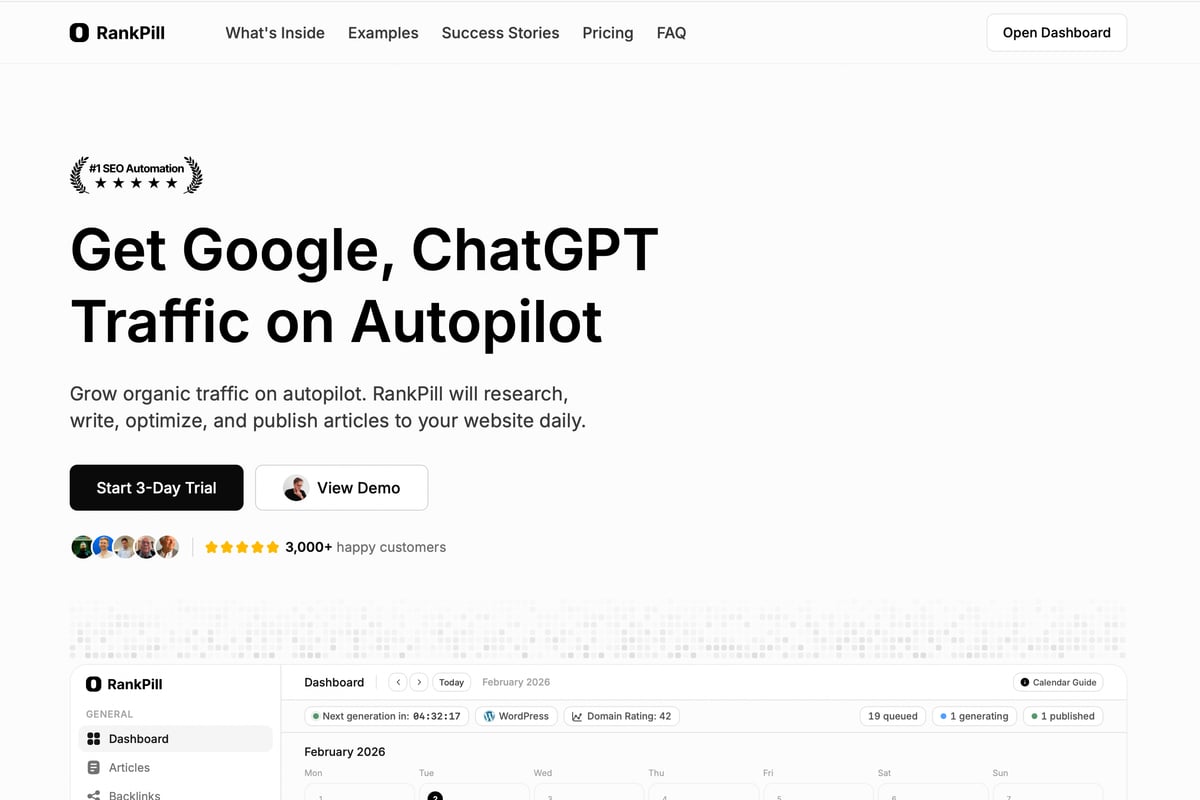
Platforms like RankPill demonstrate that automated content generation can meet quality standards through careful prompt engineering, comprehensive research integration, and strategic human oversight. The key differentiator is genuine value delivery rather than creation methodology.
Avoiding AI Content Pitfalls
The helpful content update particularly targets certain AI content patterns:
- Generic information aggregation without synthesis
- Factual errors from outdated training data
- Repetitive phrasing and formulaic structures
- Lack of specific examples and practical application
- Missing author expertise and credibility signals
Successful AI content strategies combine automation efficiency with human expertise, creating scalable quality that satisfies both user needs and algorithmic requirements.
Industry-Specific Helpful Content Considerations
Different industries face unique challenges adapting to the helpful content update based on content types, competition levels, and expertise requirements. Understanding sector-specific implications helps tailor effective strategies.
E-Commerce and Product Content
Online retailers must balance commercial intent with genuine helpfulness:
| Content Element | Helpful Approach | Unhelpful Approach |
|---|---|---|
| Product Descriptions | Detailed specifications with use cases | Manufacturer copy republication |
| Category Pages | Buying guides with comparison criteria | Keyword-stuffed introductions |
| Blog Content | Usage tips and maintenance guides | Generic product promotions |
| Review Pages | Detailed testing methodology | Affiliate link collections |
E-commerce sites benefit from demonstrating product expertise through detailed specifications, comparison tools, and genuine customer feedback integration.
Service-Based Business Content
Professional service providers must prove expertise through content demonstrating practical knowledge:
- Detailed case studies showing real client results
- Process explanations revealing methodology transparency
- Industry insights demonstrating market awareness
- Common challenge solutions addressing client pain points
Service businesses often struggle with content volume compared to product-focused competitors, making quality and specificity even more critical under the helpful content update evaluation.
Publishing and Media Sites
Content publishers face particularly intense helpful content scrutiny due to high publication volumes. Successful strategies include:
- Topic specialization rather than broad coverage
- Journalist credentials and reporting standards
- Original reporting versus aggregation
- Source transparency and fact-checking
- Clear editorial standards and corrections policies
Publishers benefit from reducing content volume while increasing depth and originality, counterintuitive to traditional digital publishing models focused on constant output.
Recovery Strategies After Helpful Content Penalties
Sites affected by the helpful content update can recover, though the process requires genuine quality improvements rather than superficial changes. Recovery typically takes several months as Google reassesses domain-wide quality signals.
Comprehensive Recovery Roadmap
Phase 1: Assessment and Planning (Weeks 1-2)
- Conduct thorough content audit identifying quality issues
- Analyze competitor content approaches and performance
- Develop content standards and quality guidelines
- Establish author expertise verification processes
Phase 2: Content Remediation (Weeks 3-8)
- Remove or consolidate thin, low-value content
- Enhance high-priority pages with depth and expertise
- Add author credentials and E-E-A-T signals
- Implement structured data and technical improvements
Phase 3: Monitoring and Iteration (Weeks 9+)
- Track ranking and traffic recovery progress
- Gather user feedback on content improvements
- Continuously refine content based on performance
- Maintain quality standards for new content
Recovery requires patience as the helpful content update evaluates sites over extended periods. Expect gradual improvement rather than sudden ranking restoration.
Avoiding False Starts
Common recovery mistakes include:
- Cosmetic changes without genuine quality improvement
- Inconsistent application of standards across content
- Premature celebration of temporary ranking fluctuations
- Reverting to old practices after initial recovery
- Neglecting ongoing maintenance and updates
Sustainable recovery demands permanent commitment to helpful content principles rather than temporary compliance efforts. Sites that maintain quality standards see continued improvement while those reverting to previous approaches face renewed penalties.
Future Implications of the Helpful Content Update
The helpful content update continues evolving as Google refines its ability to assess content quality and user satisfaction. Understanding likely future developments helps create resilient long-term strategies.
Integration with AI Search Features
Google's expanding AI Overview features create new dimensions for content evaluation:
- Citation-worthy content appearing in AI-generated responses
- Factual accuracy becoming increasingly critical
- Structured information presentation facilitating AI extraction
- Authoritative source signals determining inclusion likelihood
Content optimized for traditional search must now also consider how to get mentioned by AI search features, requiring additional structural and quality considerations.
Personalization and Context Awareness
Future helpful content evaluations will likely incorporate:
- User-specific quality assessments based on individual preferences
- Geographic relevance for location-dependent queries
- Expertise matching connecting specialized content with appropriate audiences
- Historical interaction patterns influencing content recommendations
- Device and context optimization for various search scenarios
These developments emphasize the importance of clearly defined target audiences and specific use case optimization rather than broad generic content approaches.
The helpful content update fundamentally reshaped SEO strategy by prioritizing genuine user value over traditional optimization tactics. Success requires comprehensive quality commitment across your entire content ecosystem, demonstrating expertise through original insights and practical guidance. RankPill helps businesses maintain quality standards at scale through automated keyword research, content generation with built-in optimization, and strategic backlink building, ensuring your content satisfies both algorithmic requirements and user needs while growing organic traffic consistently.
Unlock Traffic on Autopilot
Grow organic traffic on autopilot. RankPill will research, write, optimize, and publish articles to your website daily.
 WordPress