
How to Start SEO: Complete Guide for Beginners in 2026

Modest Mitkus · June 6, 2026
Search engine optimization transforms how businesses attract customers online, but many founders and marketers struggle with where to begin. Understanding how to start SEO requires breaking down a complex discipline into manageable steps that build upon each other. This guide provides a practical roadmap for beginners who want to grow organic traffic without getting overwhelmed by technical jargon or expensive agency contracts.
Understanding SEO Fundamentals
Search engines serve as gatekeepers to billions of daily searches, and SEO represents the methodology for earning visibility in those results. When you learn how to start SEO, you're essentially learning how search engines discover, interpret, and rank content.
How Search Engines Work
Search engines use automated crawlers to discover web pages, index their content, and determine relevance for specific queries. Google's algorithm evaluates hundreds of ranking factors, but the core principle remains consistent: deliver the most relevant, authoritative content that satisfies user intent.
The three-stage process includes:
- Crawling – Bots discover and scan pages across the web
- Indexing – Content gets analyzed and stored in massive databases
- Ranking – Algorithms determine which pages appear for each query
According to Ahrefs' comprehensive SEO guide, understanding this process helps you optimize at each stage rather than guessing what might work.

The Four Pillars of SEO
Coursera's SEO learning guide identifies four foundational pillars that support every successful SEO strategy. These categories provide structure when you're figuring out how to start SEO from scratch.
| Pillar | Focus Area | Key Activities |
|---|---|---|
| Technical SEO | Site infrastructure | Speed optimization, mobile responsiveness, crawlability |
| On-Page SEO | Individual page elements | Title tags, meta descriptions, header structure, internal linking |
| Content SEO | Information quality | Keyword targeting, user intent, comprehensiveness, freshness |
| Off-Page SEO | External signals | Backlinks, brand mentions, social signals, domain authority |
Each pillar requires different skills but contributes to overall search visibility. Beginners should start with on-page and content fundamentals before tackling technical complexities.
Setting Up Your SEO Foundation
Before diving into tactics, establish the infrastructure that enables measurement and improvement. These foundational tools and configurations determine whether you can track progress effectively.
Essential SEO Tools Configuration
Every SEO journey begins with proper tracking and analysis tools. Google Search Console serves as your direct communication channel with Google, showing how the search engine sees your site.
Set up these core tools immediately:
- Google Search Console – Monitor indexing status, search queries, and technical issues
- Google Analytics 4 – Track user behavior, traffic sources, and conversion patterns
- Keyword research platform – Identify opportunities and search volume data
- SEO crawler – Audit technical issues and site structure
SEO.com's beginner guide emphasizes that proper tool setup prevents months of wasted effort by ensuring you're measuring the right metrics from day one.
Website Technical Checklist
Technical preparation ensures search engines can properly crawl and index your content. Even with brilliant content, poor technical setup limits visibility.
Critical technical elements include:
- XML sitemap submitted to Search Console
- Robots.txt file properly configured
- HTTPS security certificate installed
- Mobile-responsive design implemented
- Core Web Vitals optimized (loading speed, interactivity, visual stability)
Address these technical requirements before investing heavily in content creation. TechRadar's SEO mastery guide highlights that technical issues can prevent even excellent content from ranking.
Conducting Keyword Research
Keyword research reveals what your target audience searches for and identifies content opportunities where you can compete. This step determines your content strategy direction and prioritization.
Understanding Search Intent
Not all keywords represent the same value or opportunity. Search intent categorizes why users perform specific searches, and matching your content to that intent determines ranking success.
The four primary intent types:
- Informational – Users seeking knowledge ("how to start SEO")
- Navigational – Users finding specific websites or pages
- Commercial – Users researching products or services before purchase
- Transactional – Users ready to complete an action or purchase
Align your content format and depth with the dominant intent behind your target keywords. A keyword with transactional intent requires different content than one with informational intent.
Finding Low-Competition Keywords
Beginners should target keywords where they can realistically compete within 3-6 months. Climb the Ladder's beginner steps recommends focusing on long-tail keywords with lower search volume but higher specificity.
Look for opportunities with these characteristics:
| Metric | Beginner-Friendly Range | Why It Matters |
|---|---|---|
| Search Volume | 100-1,000 monthly | Enough traffic to matter, not overcrowded |
| Keyword Difficulty | 0-30 | Lower competition from established sites |
| Cost Per Click | $1+ | Indicates commercial value even at low volume |
| Word Count | 3+ words | More specific intent, easier to rank |
Tools like the RankPill Keyword Research Tool help you identify these opportunities without expensive subscriptions, focusing on keywords your competitors miss.

Creating SEO-Optimized Content
Content represents your primary asset in organic search. When learning how to start SEO, many beginners focus exclusively on technical tricks while neglecting content quality and structure.
Content Structure Best Practices
Search engines and readers both prefer well-organized content with clear hierarchy. Proper structure helps crawlers understand your content and improves user engagement metrics.
Essential structural elements:
- H1 tag – Single, descriptive title containing primary keyword
- H2 headings – Major section breaks that organize main topics
- H3 headings – Subsections that add depth and scanability
- Opening paragraph – Hook readers and establish relevance immediately
- Short paragraphs – Mix 1-2 sentence paragraphs with longer 3-4 sentence blocks
Semrush's learning roadmap emphasizes that content structure impacts both SEO performance and reader retention, making it doubly important.
On-Page Optimization Elements
Each page contains specific elements that communicate relevance to search engines. Optimizing these components strengthens topical signals without keyword stuffing.
Key on-page elements to optimize:
- Title tag – 50-60 characters with primary keyword near the beginning
- Meta description – 140-160 characters compelling users to click
- URL structure – Short, descriptive, keyword-inclusive slugs
- Image alt text – Descriptive text for accessibility and image search
- Internal links – Contextual connections to related content on your site
These elements work together to reinforce your content's topic and value proposition. Consistency across elements creates stronger relevance signals than optimizing any single component.
Content Depth and Comprehensiveness
Surface-level content rarely ranks in competitive spaces. Ahrefs' SEO process guide demonstrates that comprehensive coverage of topics signals expertise and satisfies user intent more effectively.
Aim for content that:
- Answers primary questions thoroughly without fluff
- Addresses related subtopics users might explore
- Includes examples, data, and actionable advice
- Updates regularly to maintain freshness
- Exceeds competitor content in depth or clarity
For most topics, this translates to 1,500-2,500 words, though length should serve comprehensiveness rather than arbitrary word counts.
Building Quality Backlinks
Links from other websites signal authority and trustworthiness to search engines. When figuring out how to start SEO, link building often presents the biggest challenge for beginners.
White-Hat Link Building Strategies
Sustainable link building focuses on earning links through value creation rather than manipulation. These strategies require more effort but avoid penalties and deliver lasting results.
Effective beginner strategies include:
- Guest posting – Write valuable content for relevant industry blogs
- Resource pages – Identify curated lists where your content belongs
- Digital PR – Create newsworthy content that attracts media coverage
- Broken link building – Find dead links and suggest your content as replacement
- Content partnerships – Collaborate with complementary businesses
Search Engine Journal's comprehensive guide recommends starting with relationship-based tactics before scaling to more advanced outreach.
Link Quality Over Quantity
A single link from a highly authoritative, relevant site outweighs dozens from low-quality directories. Evaluate potential link sources based on domain authority, topical relevance, and traffic.
| Quality Factor | Good Signal | Warning Sign |
|---|---|---|
| Domain Authority | 30+ DA from established sites | Sub-10 DA from new domains |
| Relevance | Same or adjacent industry | Completely unrelated niche |
| Traffic | Real visitors and engagement | No organic traffic visible |
| Link Profile | Natural, diverse backlinks | Spammy, automated links |
The RankPill backlink exchange helps you connect with quality websites for link swaps without resorting to low-quality link farms or expensive outreach services.
Leveraging SEO Automation
Manual SEO tasks consume enormous time, especially for small teams managing multiple priorities. Automation handles repetitive workflows while maintaining quality and consistency.
What to Automate in SEO
Not every SEO task benefits from automation, but certain repetitive processes see improved efficiency and consistency through systematic approaches. Focus automation on high-volume, rule-based activities.
Prime automation candidates:
- Keyword research – Regular discovery of new opportunities
- Content publishing – Scheduled releases and distribution
- Technical audits – Recurring site health checks
- Link monitoring – Tracking backlink acquisition and losses
- Performance reporting – Regular metric updates and dashboards
Platforms focused on AI and SEO integration now handle these workflows end-to-end, reducing the manual burden significantly.
Automated Content Workflows
Content creation represents the most time-intensive SEO activity. Automation streamlines research, drafting, optimization, and distribution without sacrificing quality when implemented properly.
Modern SEO automation handles keyword research, content creation, internal linking, and publishing in a unified workflow. This approach ensures consistency while freeing teams to focus on strategy and specialized content.
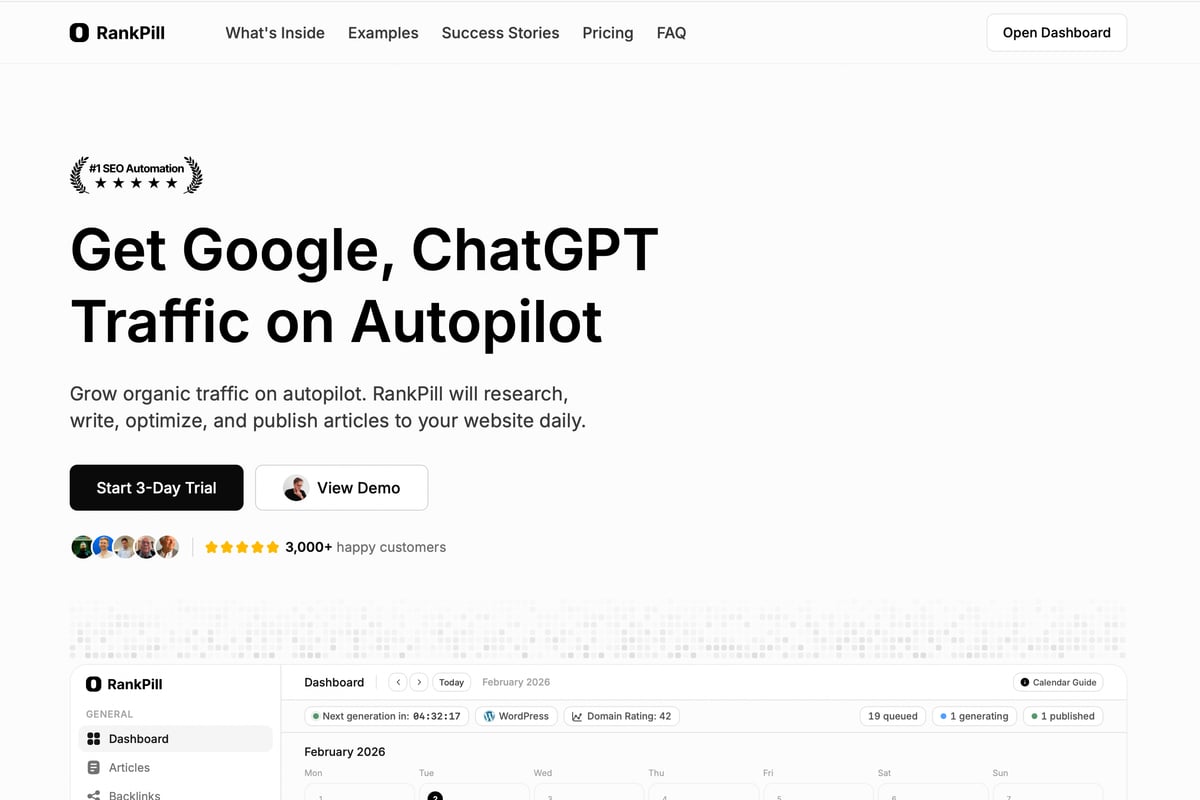
For businesses needing to publish consistently at scale, automated SEO solutions eliminate the bottleneck of manual content production. RankPill automates the entire content workflow from keyword research through publishing, creating optimized articles daily while maintaining quality and strategic focus.
Measuring SEO Performance
Tracking the right metrics helps you understand what's working and where to adjust your strategy. When learning how to start SEO, beginners often track vanity metrics instead of indicators that correlate with business outcomes.
Essential SEO Metrics
Different metrics serve different purposes in your SEO strategy. Focus on measurements that connect directly to your business goals rather than collecting data for its own sake.
Core metrics to monitor:
- Organic traffic – Users arriving from non-paid search results
- Keyword rankings – Position for target terms over time
- Click-through rate – Percentage of searchers clicking your results
- Conversion rate – Organic visitors completing desired actions
- Page load speed – Technical performance affecting user experience
These metrics interconnect, creating a complete picture of SEO health and opportunity areas.
Setting Realistic Timeframes
SEO delivers compounding results over time rather than immediate wins. Ahrefs' SEO basics guide notes that most sites see meaningful results within 3-6 months for low-competition keywords and 6-12 months for moderate competition.
Typical SEO timeline expectations:
| Timeframe | Expected Milestones |
|---|---|
| 0-3 months | Technical fixes implemented, initial content published, foundation established |
| 3-6 months | First rankings appear, traffic begins growing, engagement patterns emerge |
| 6-12 months | Ranking improvements accelerate, authority builds, conversion optimization opportunities |
| 12+ months | Compounding returns, broader keyword coverage, sustainable traffic growth |
Patience and consistency outperform sporadic intense efforts in SEO. Regular publishing and optimization compound over time.

Optimizing for AI Search
Traditional search engines now compete with AI-powered answer engines that synthesize information rather than just linking to sources. Understanding how to start SEO in 2026 requires preparing for this dual landscape.
AI Search Optimization Strategies
AI engines like ChatGPT prioritize factual accuracy, clear structure, and authoritative sources. Content optimized for traditional search often needs adjustments to appear in AI-generated responses.
Key AI optimization tactics:
- Structured data markup to help AI understand content elements
- Clear, concise answers to specific questions
- Citation-worthy facts and statistics
- Authoritative author profiles and credentials
- Topic cluster organization linking related content
Generative engine optimization represents the next evolution of SEO strategy, focusing on visibility in AI-generated answers rather than just traditional search results.
Getting Mentioned by AI
AI engines reference sources they consider authoritative and well-structured. Optimizing for AI citations requires different approaches than traditional link building.
Focus on creating content that AI can confidently cite by including verifiable data, clear attributions, and expert perspectives. Learn more about getting mentioned by AI to prepare for this evolving search landscape.
Common SEO Mistakes to Avoid
Beginners often fall into predictable traps that waste time or trigger penalties. Recognizing these patterns helps you skip months of unproductive effort.
Keyword Stuffing and Over-Optimization
Forcing keywords unnaturally into content creates poor user experiences and triggers search engine filters. Modern algorithms detect and penalize this practice.
Signs of over-optimization:
- Keyword density exceeding 2-3% of total words
- Awkward phrasing to include exact-match keywords
- Repeating keywords in every heading and paragraph
- Sacrificing readability for SEO tactics
Write primarily for humans, incorporating keywords naturally where they fit contextually.
Neglecting Mobile Experience
Over 60% of searches occur on mobile devices, and Google uses mobile-first indexing. Sites that deliver poor mobile experiences lose rankings regardless of desktop performance.
Ensure your site:
- Loads quickly on cellular connections
- Displays properly on various screen sizes
- Offers easy navigation with touch targets
- Avoids intrusive interstitials blocking content
Ignoring Technical SEO
Content excellence can't overcome technical barriers that prevent crawling and indexing. Regular technical audits identify issues before they impact rankings.
Critical technical elements:
| Element | Purpose | Impact of Neglect |
|---|---|---|
| XML Sitemap | Helps crawlers discover pages | Slow or incomplete indexing |
| Robots.txt | Controls crawler access | Accidental blocking of important pages |
| Canonical Tags | Prevents duplicate content issues | Diluted ranking signals |
| HTTPS | Security and trust signal | Lower rankings, browser warnings |
| Core Web Vitals | User experience metrics | Ranking penalties, poor engagement |
Address technical issues systematically rather than chasing content volume alone.
Learning how to start SEO requires commitment to consistent execution across multiple disciplines, but the fundamentals remain accessible to beginners who follow structured approaches. Focus on building strong technical foundations, creating valuable content, and earning quality backlinks while measuring progress toward business outcomes. RankPill automates the most time-intensive SEO workflows, handling keyword research, content creation, and daily publishing so you can focus on strategy and growth rather than manual execution.
Unlock Traffic on Autopilot
Grow organic traffic on autopilot. RankPill will research, write, optimize, and publish articles to your website daily.
 WordPress