
Keyword Research Automation: Scale SEO in 2026

Modest Mitkus · June 5, 2026
Keyword research has always been the foundation of effective SEO, but the manual process of identifying, analyzing, and prioritizing keywords can consume dozens of hours each month. As search behaviors evolve and competition intensifies, businesses need faster, more systematic approaches to keyword discovery. Keyword research automation transforms this time-intensive task into a streamlined workflow that identifies opportunities, analyzes metrics, and prioritizes terms based on your specific business goals. Whether you're managing a single website or an entire portfolio of content properties, automated systems can process thousands of keyword variations, competitor insights, and search trends in the time it takes to manually review a few dozen terms.
The Foundation of Keyword Research Automation
Keyword research automation relies on programmatic systems that collect, normalize, and analyze search data from multiple sources simultaneously. These systems eliminate the repetitive tasks that consume hours when performed manually, such as exporting CSV files, cross-referencing metrics across tools, and manually categorizing keywords by intent or topic cluster.
Modern automation platforms integrate directly with search APIs, competitor analysis tools, and content management systems to create a continuous feedback loop. Data aggregation engines pull keyword suggestions from search autocomplete features, related searches, competitor rankings, and question-based queries that match your seed terms. This multi-source approach ensures you capture keyword variations that single-tool research might miss.
The comprehensive guide by Semrush outlines the fundamental importance of understanding search intent and competition, which automated systems can now evaluate at scale.
Components of an Automated Research System
A complete keyword research automation system consists of several interconnected components working together:
- Seed keyword expansion engines that generate hundreds of variations from your core terms
- Metric aggregation modules that pull search volume, difficulty scores, and cost-per-click data
- Intent classification algorithms that categorize keywords by commercial, informational, navigational, or transactional intent
- Clustering mechanisms that group related keywords into topical content opportunities
- Prioritization frameworks that score keywords based on your custom criteria
According to Trysight AI's analysis, effective data aggregation engines can efficiently collect and normalize keyword data from multiple sources, creating a unified dataset that reveals patterns invisible when examining single sources.

Automating Keyword Discovery and Expansion
The discovery phase traditionally requires manual brainstorming sessions, competitor analysis, and tool-hopping to compile an initial keyword list. Automation accelerates this process by simultaneously querying multiple data sources and applying expansion algorithms that identify semantic variations, question modifiers, and long-tail opportunities.
Automated discovery systems start with your seed keywords and systematically explore related terms through multiple expansion methods. They analyze Google's "People Also Ask" sections, extract keywords from competitor pages ranking for similar terms, and identify trending search queries in your niche. This parallel processing approach can generate thousands of keyword candidates in minutes rather than days.
One significant advantage of automated expansion is consistency. Manual research often produces different results depending on the researcher's expertise, biases, and available time. Automated systems apply the same methodology across every keyword cluster, ensuring comprehensive coverage without gaps.
| Manual Discovery | Automated Discovery |
|---|---|
| 50-100 keywords per session | 1,000+ keywords per run |
| 2-4 hours per topic cluster | 5-15 minutes per cluster |
| Results vary by researcher | Consistent methodology |
| Limited source diversity | Multi-source aggregation |
Question-Based Keyword Mining
Question keywords represent high-intent searches where users actively seek specific information or solutions. Automated systems can extract these opportunities by monitoring question patterns across forums, social platforms, and search features.
Advanced automation tools identify question modifiers (who, what, when, where, why, how) and combine them with your seed terms to generate relevant queries. They can also analyze search volume trends to identify rising questions before competitors target them. This proactive approach positions your content to capture emerging search demand.
The SEO-Wiki guide to keyword research tools categorizes various automation tools and their specialized functions, helping you select the right combination for your specific needs.
Competitive Intelligence Through Automation
Understanding which keywords drive traffic to competitor sites provides invaluable intelligence for your own strategy. Keyword research automation enables systematic competitive analysis that tracks competitor rankings, identifies their content gaps, and reveals untapped opportunities in your shared market space.
Automated competitive research tools continuously monitor competitor domains, tracking new content publications, ranking movements, and emerging keyword targets. This ongoing surveillance eliminates the need for monthly manual competitor audits, providing real-time alerts when competitors make strategic moves.
Automation platforms can reverse-engineer competitor strategies by analyzing their highest-traffic pages, identifying the primary and secondary keywords each page targets, and mapping their internal linking structure. This intelligence reveals which content clusters competitors prioritize and where they allocate resources.
Gap Analysis at Scale
Gap analysis identifies keywords where competitors rank but your site doesn't appear in search results. Manual gap analysis requires exporting competitor keyword lists, cross-referencing them against your rankings, and prioritizing opportunities based on multiple factors.
Automated gap analysis performs these tasks continuously, maintaining an updated list of opportunities ranked by potential traffic value, competitive difficulty, and strategic alignment with your content goals. Some systems even estimate the content investment required to compete effectively for each gap keyword.
- Compare your rankings against multiple competitors simultaneously
- Filter gaps by search volume thresholds and difficulty scores
- Identify quick-win opportunities where competitors have weak content
- Track gap closure progress as you publish new content
- Receive alerts when new gaps emerge in priority topics
The integration of keyword research with topical authority and linking strategies demonstrates how automation can identify not just individual keyword opportunities but entire content cluster strategies.

Metric Analysis and Prioritization
Raw keyword lists without proper prioritization provide little strategic value. Keyword research automation excels at applying consistent scoring frameworks that evaluate multiple metrics simultaneously, ranking opportunities based on your specific business objectives.
Automated prioritization systems evaluate keywords across dimensions including search volume, ranking difficulty, commercial intent, current ranking position, and estimated traffic value. They can apply weighted scoring models that emphasize the metrics most important to your strategy, whether that's quick wins, high-volume targets, or commercial intent.
Custom scoring frameworks allow you to define your own prioritization criteria. For example, an e-commerce site might heavily weight commercial intent and transaction keywords, while a content publisher might prioritize informational keywords with high volume and low competition. Automation applies these preferences consistently across thousands of keywords.
Intent Classification and Filtering
Search intent classification determines whether users searching a keyword want information, navigation to a specific site, commercial comparison, or transaction completion. Proper intent matching ensures your content satisfies user expectations and ranks effectively.
Automated intent classification analyzes SERP features, page titles, content types ranking in top positions, and linguistic patterns to categorize keywords. This classification happens instantly across your entire keyword database, enabling you to filter lists by intent type and align content formats with user expectations.
RankPill's platform demonstrates how keyword research automation integrates with content creation workflows. The AI SEO platform automatically researches keywords, classifies intent, and generates optimized content that matches search expectations without manual intervention.
| Metric Type | Manual Analysis | Automated Analysis |
|---|---|---|
| Search Volume | One tool at a time | Multi-source average |
| Keyword Difficulty | Subjective interpretation | Algorithmic scoring |
| SERP Analysis | Manual review per keyword | Automated feature extraction |
| Intent Classification | Manual categorization | Machine learning classification |
| Traffic Potential | Rough estimates | Historical data modeling |
Integration with Content Workflows
The true power of keyword research automation emerges when it integrates seamlessly with your content planning, creation, and optimization workflows. Isolated keyword lists that require manual transfer to content calendars or writing briefs create friction that slows execution.
Modern automation platforms connect keyword research directly to content management systems, editorial calendars, and writing tools. They can automatically generate content briefs with target keywords, recommended word counts, related terms to include, and competitive benchmarks to exceed.
From Research to Publishing
End-to-end automation creates a continuous pipeline from keyword discovery through content publication. Systems can identify opportunities, prioritize them based on your criteria, generate detailed content briefs, and even create initial drafts optimized for target keywords.
The automation of keyword research combined with automated content creation eliminates the handoff delays between research, planning, and execution phases. Content teams receive ready-to-execute briefs with all necessary research compiled, while automated systems track which keywords have assigned content and which remain unaddressed.
This integration proves particularly valuable for teams managing large content volumes across multiple topics or markets. Instead of manually maintaining spreadsheets tracking keyword assignments, automation systems provide real-time visibility into keyword coverage and content gaps.
Tools and Technologies Powering Automation
The keyword research automation landscape includes specialized tools for different aspects of the research workflow, as well as comprehensive platforms that handle multiple stages.
Standalone automation tools focus on specific tasks like competitor tracking, question mining, or SERP analysis. These specialized solutions often integrate via APIs with broader content management platforms. Understanding the keyword research tools used by professionals provides insight into how to build an effective automation stack.
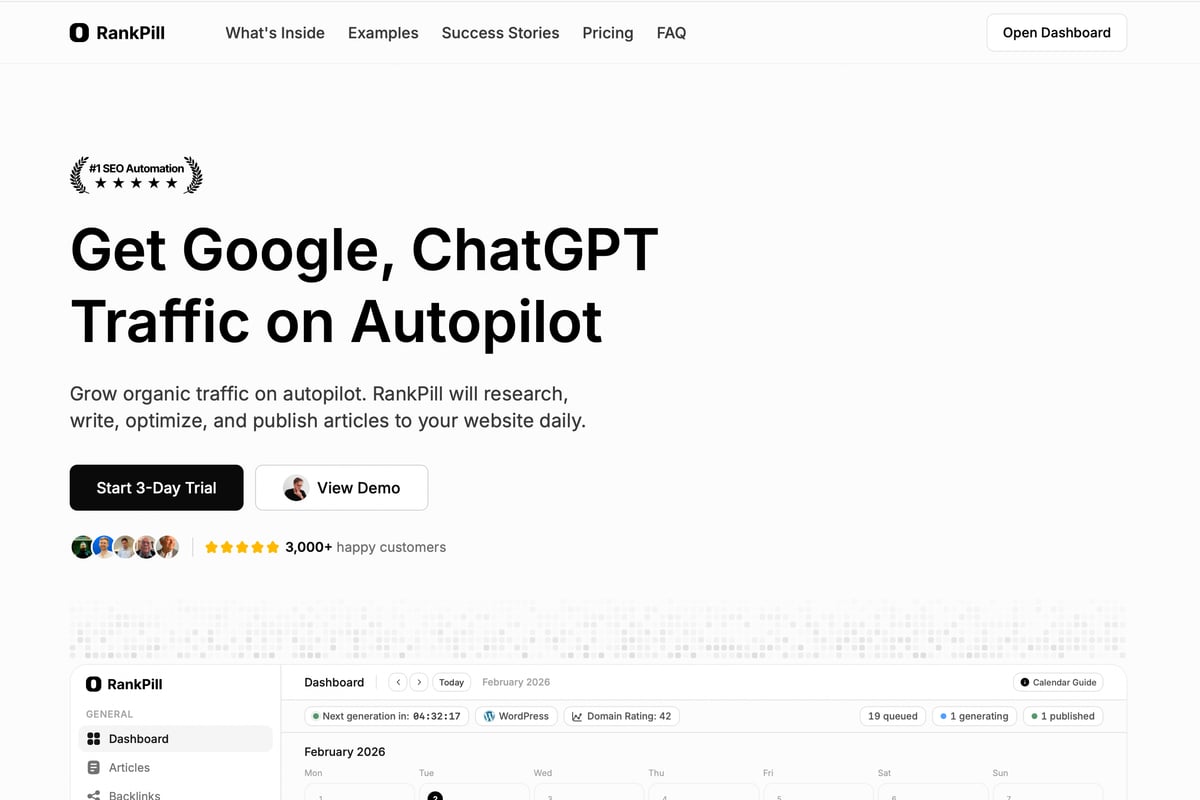
Comprehensive platforms like RankPill handle the entire workflow from keyword discovery through content publication. These integrated systems eliminate the complexity of connecting multiple tools while ensuring data flows seamlessly between research, creation, and optimization stages.
API-Driven Research Systems
Application programming interfaces (APIs) enable automated systems to query keyword databases, pull search metrics, and analyze competitor data programmatically. API-driven research eliminates manual tool interaction, enabling scheduled research runs, continuous monitoring, and instant data retrieval.
Advanced users build custom automation workflows using research APIs combined with scripting languages or automation platforms. These custom systems can implement proprietary scoring algorithms, integrate with internal data sources, and automate reporting distribution to stakeholders.
Academic research on keyword management frameworks provides theoretical foundations for systematic approaches to keyword selection and prioritization that inform automation platform design.
- Search Console API for tracking actual search performance and identifying rising queries
- Keyword database APIs for programmatic access to search volume and difficulty metrics
- SERP scraping tools that extract ranking data and competitive intelligence
- Natural language processing APIs that classify intent and extract topics
- Content management APIs that enable automated brief creation and publishing
Scaling Across Multiple Markets and Languages
Keyword research automation becomes essential when scaling content strategies across multiple geographic markets, languages, or product lines. Manual research simply cannot maintain the velocity required to identify opportunities across dozens of keyword sets simultaneously.
Automated systems can run parallel research processes for different markets, applying market-specific search databases and competitive landscapes. They adjust prioritization criteria based on local search behaviors, competition levels, and business objectives for each market.
The multi-language SEO capabilities demonstrated by modern platforms show how automation handles the complexity of researching keywords in languages the team may not speak fluently, ensuring each market receives native-level keyword targeting.
Content Cluster Development
Topical authority requires comprehensive content clusters covering all aspects of a subject area. Manually mapping these clusters involves identifying pillar topics, supporting subtopics, and the keyword relationships between them.
Automation platforms use semantic analysis and keyword clustering algorithms to identify natural topic groupings and suggest pillar-cluster architectures. They can visualize these relationships, highlight coverage gaps, and recommend content priorities that build authority systematically.
Understanding how to identify authoritative sources and link opportunities within topic clusters helps automation systems suggest not just keyword targets but complete content strategies including internal linking structures.
Maintaining Research Quality and Accuracy
Automation speed means nothing without accuracy and relevance. Quality assurance mechanisms ensure automated keyword research produces actionable insights rather than overwhelming lists of marginally relevant terms.
Filtering algorithms remove irrelevant keywords, duplicate variations, and terms that don't align with business objectives. They can identify and exclude branded terms from competitors, filter out keywords triggering YMYL (Your Money or Your Life) requirements your site can't meet, and eliminate terms with misleading metrics.
Regular calibration ensures automation systems reflect current search landscape realities. Search algorithms evolve, user behaviors shift, and competitive dynamics change. Automated research systems require periodic review of their filtering criteria, scoring weights, and data source reliability.
Human-in-the-Loop Validation
Fully automated research benefits from strategic human oversight that validates recommendations, adjusts priorities based on business context automation systems don't fully understand, and identifies emerging patterns worth investigating further.
Effective implementations establish review checkpoints where subject matter experts validate automation-generated keyword clusters before content creation begins. This validation catches edge cases, confirms intent classification accuracy, and ensures keyword targets align with actual business capabilities and content expertise.
The perspectives from web agency owners on keyword research tools reveal how professionals balance automation efficiency with strategic oversight to maintain quality.
Continuous Monitoring and Opportunity Detection
Keyword research shouldn't be a quarterly project but an ongoing process that identifies emerging opportunities as search behaviors evolve. Automation enables continuous monitoring that alerts you to rising keywords, competitor movements, and shifting search trends.
Automated monitoring systems track your target keyword universe, flagging significant changes in search volume, difficulty scores, or SERP features. They identify when new competitors enter your space, when existing competitors publish content targeting your keywords, and when search intent shifts require content updates.
This continuous intelligence flow supports agile content strategies that respond quickly to opportunities rather than following static annual plans. When automation detects a rising keyword trend in your niche, you can commission content immediately rather than discovering the opportunity months later during your next manual research cycle.
- Trend detection algorithms that identify search volume acceleration before competitors notice
- Seasonality tracking that forecasts when to publish content for time-sensitive keywords
- SERP feature monitoring that alerts when new opportunities like featured snippets appear
- Competitor content tracking that identifies when rivals target your priority keywords
- Performance regression alerts when your rankings decline for important terms
Exploring AI-driven keyword research approaches reveals how machine learning models can predict keyword performance and identify patterns human researchers might miss.
Implementation Strategies for Different Business Types
The optimal keyword research automation strategy varies based on business model, content volume, team size, and technical capabilities. E-commerce sites, SaaS companies, publishers, and agencies each benefit from different automation approaches.
E-commerce operations prioritize product-focused keywords with commercial intent, requiring automation that tracks product category opportunities, identifies long-tail variations that indicate purchase readiness, and monitors competitor product page rankings. Integration with product catalogs enables automated matching of keywords to specific products.
SaaS companies focus on problem-solution keywords where potential customers describe challenges their software addresses. Their automation needs emphasize question keywords, comparison terms, and alternative software phrases that indicate evaluation-stage prospects.
Publisher and Content Site Strategies
Publishers producing high-volume content across multiple topics need automation that identifies trending opportunities quickly, suggests content angles with lower competition, and tracks content performance against keyword targets.
The integration of automated SEO with content publishing workflows demonstrates how publishers can maintain consistent keyword targeting across dozens or hundreds of monthly articles without bottlenecking on manual research.
Content sites benefit particularly from automation that identifies content refresh opportunities, suggesting when existing articles should be updated to target additional keywords or improve rankings for current targets.
Keyword research automation transforms SEO from a periodic manual exercise into a continuous, data-driven process that identifies opportunities faster than competitors can respond. By systematically collecting keyword data, analyzing competitive landscapes, and prioritizing opportunities based on your business objectives, automation ensures you never miss valuable search traffic. RankPill takes this automation further by connecting keyword research directly to content creation and publishing, handling the entire SEO workflow from opportunity identification through optimized article publication, so you can focus on growing your business while your organic traffic scales on autopilot.
Unlock Traffic on Autopilot
Grow organic traffic on autopilot. RankPill will research, write, optimize, and publish articles to your website daily.
 WordPress