
Local SEO for Small Business: A Step-by-Step Guide

Modest Mitkus · November 14, 2026
Local SEO for small business means getting your company to show up when people nearby search for what you sell. You do it by completing your Google Business Profile, keeping your name, address and phone number consistent online, earning reviews, and publishing pages and articles that match local searches.
This guide walks through those steps in order. You can finish the basics in a weekend. The ongoing work takes a few hours a month.
What local SEO is and why it works for small businesses
Local SEO is the set of tasks that help your business appear in Google Maps, the local pack (the map with three listings), and organic results for searches tied to a place. Examples: "plumber near me," "dentist in Austin," "best bakery downtown."
Searchers do this a lot. In BrightLocal's 2025 consumer search survey, many respondents estimated that a large share of their searches were for information about local businesses. The same survey found that Google is the default platform for most consumers' local searches.
It also levels the field. You do not need to beat national brands. You need to beat the other three or four businesses in your area that do what you do.
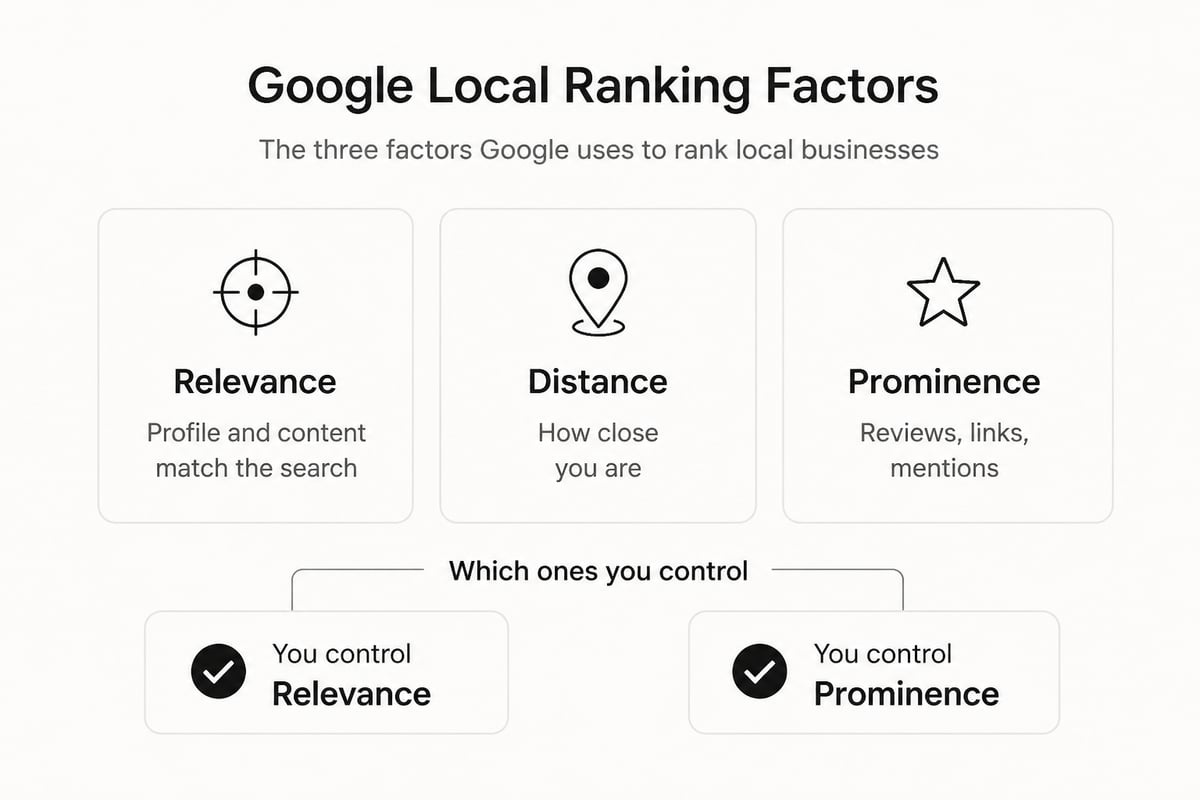
Google tells you how local ranking works. Local results are mainly based on relevance, distance, and prominence. You control relevance and prominence. You cannot control distance. Google also states there is no way to request or pay for a better local ranking, so be wary of anyone who sells one.
If you are still deciding whether SEO is worth the time, our piece on whether SEO is worth it for small businesses covers the math.
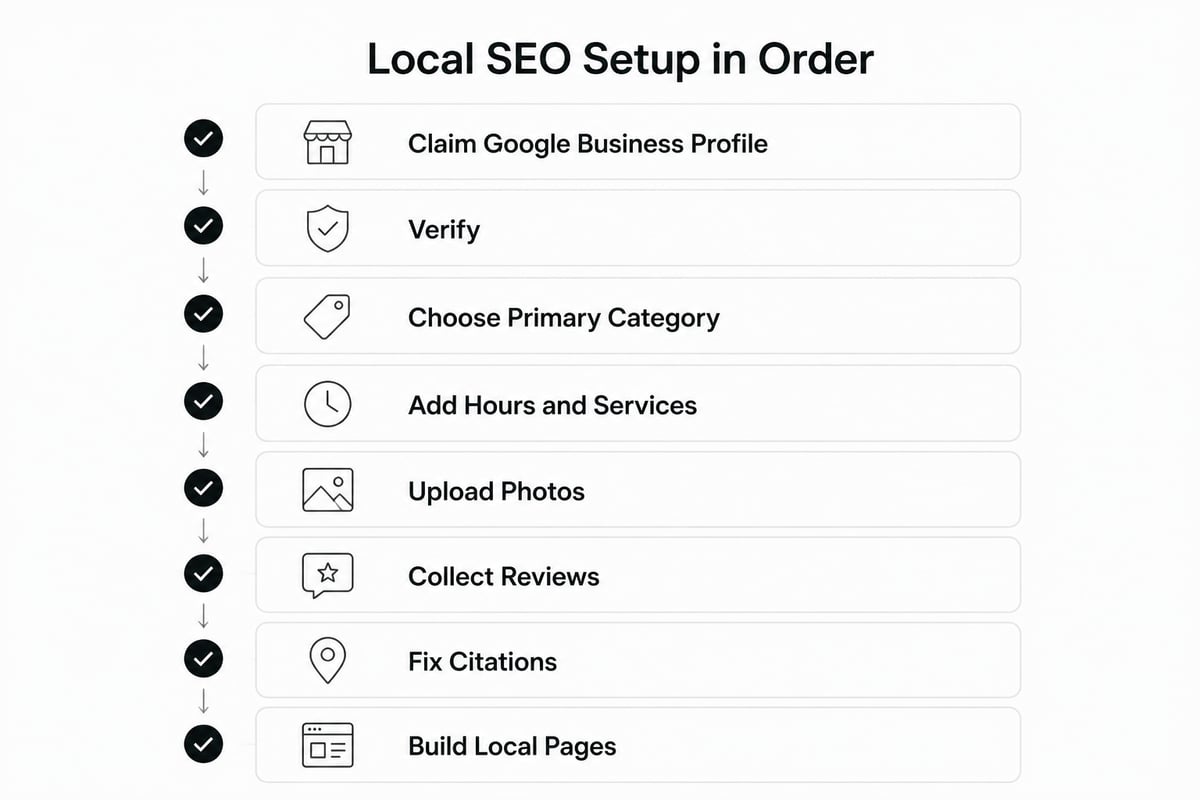
Step 1: Claim and complete your Google Business Profile
Your Google Business Profile is the most important local asset you own, and it is free. Google says businesses with complete and accurate information are more likely to appear in local search results.
Do these in order:
- Search for your business on Google and Maps. Claim the listing if it exists. Create one if it doesn't.
- Verify it. Google will ask for a postcard, phone call, email or video, depending on your business.
- Pick your primary category. Google's guidance is to use the fewest categories needed to describe your core business and to keep one profile per business. A plumber who adds "hardware store" as a category hurts relevance, not helps it.
- Add your hours, including holiday hours, your phone number, website and service area.
- List your services or products with short descriptions and prices where you can.
- Upload real photos: the storefront, your team, finished work. Add new ones monthly.
- Turn on messaging or booking links if you can answer them quickly.
A few traps to avoid. Do not put a keyword in your business name unless it is your legal name. Do not create a second profile for the same location. Both can get your listing suspended.
If you run a service-area business such as a contractor or gate installer, hide your home address and set the areas you serve instead.
Step 2: Make your name, address and phone number consistent
Consistency of your name, address and phone number (NAP) across the web tells Google your business is real and stable. Mismatches create doubt.
Your NAP should be identical on your website, Google Business Profile, Facebook, Yelp, Apple Business Connect, Bing Places and any industry directory. "Main St." in one place and "Main Street" in another is a small problem. A different phone number is a bigger one.
Here is a quick way to audit it:
- List every place your business appears. Search your business name and phone number in quotes.
- Note every mismatch in a simple spreadsheet.
- Fix the biggest directories first, then the long tail.
- Remove duplicate listings if you moved or changed your name.
Citations (mentions of your NAP on other sites) matter less than they once did, but wrong ones still cause damage. You do not need 200 directories. Twenty accurate ones beat a hundred sloppy ones.
Step 3: Find local keywords customers actually use
Local keywords combine what you sell with where you sell it, and they are usually less competitive than national terms. Start with three types:
- Service plus city: "roof repair Denver"
- Service plus neighborhood: "emergency plumber Camden"
- Near me and problem phrases: "gate won't close" or "basement leaking after rain"
The problem phrases are easy to miss. People often search for the symptom before the service. A foundation repair company wins by answering "why are my basement walls cracking," not only by targeting "foundation repair." A site like Aspen Foundation Repairs in Colorado shows how a local contractor can pair a service with the questions homeowners ask before they call.
To find these terms, use Google's autocomplete, the "People also ask" box, and your own customer emails and call notes. A keyword tool with real search volume and difficulty helps you pick the ones you can win. Aim for terms with some demand and low competition, not the biggest number.
Step 4: Build location and service pages that earn rankings
Each core service in each area you serve should have its own page. A single "Services" page cannot rank for ten different searches.
A good local page includes:
- A clear title with the service and place ("Gate Repair in Los Angeles")
- Two or three paragraphs written for a real customer, with details only a local would know
- Your NAP, an embedded map and your hours
- Photos of actual jobs in that area
- A few customer quotes from people nearby
- A plain call to action: call, book or request a quote
Do not clone one page and swap the city name. Google treats thin, near-identical pages as low value. If you cannot write something specific about a town, do not make a page for it.
You can also add Local Business structured data so search engines read your details cleanly. Google recommends validating it with the Rich Results Test, and notes that after publishing it may take some time for Google to find and crawl the page.
For a wider look at the basics, see our guide to SEO for small business.
Step 5: Earn reviews and handle them well
Reviews affect both ranking and conversion. Google notes that more reviews and positive ratings can help local ranking. They also shape what people decide. BrightLocal found that nearly half of consumers read Google's review summary before reading individual reviews.
A simple review routine:
- Ask every happy customer, ideally within a day of the job.
- Send a direct link to your Google review form by text or email.
- Reply to every review, good or bad, within two days.
- Keep replies short, specific and calm. Never argue in public.
- Flag fake or conflicting reviews to Google.
Stay inside the rules. Google prohibits fake or incentivized reviews and rating manipulation, and its prohibited content policy is worth reading before you build a review campaign. Do not offer discounts in exchange for five stars, and do not review your own business.
A steady flow beats a burst. Five new reviews a month looks healthier than fifty in one week followed by silence.
How much does SEO cost for a small business per month?
Local SEO for a small business can cost nothing or several thousand dollars a month, depending on who does the work. The free route is your own time on the Business Profile, citations and review requests. Agency retainers for ongoing content and link work can be substantial.
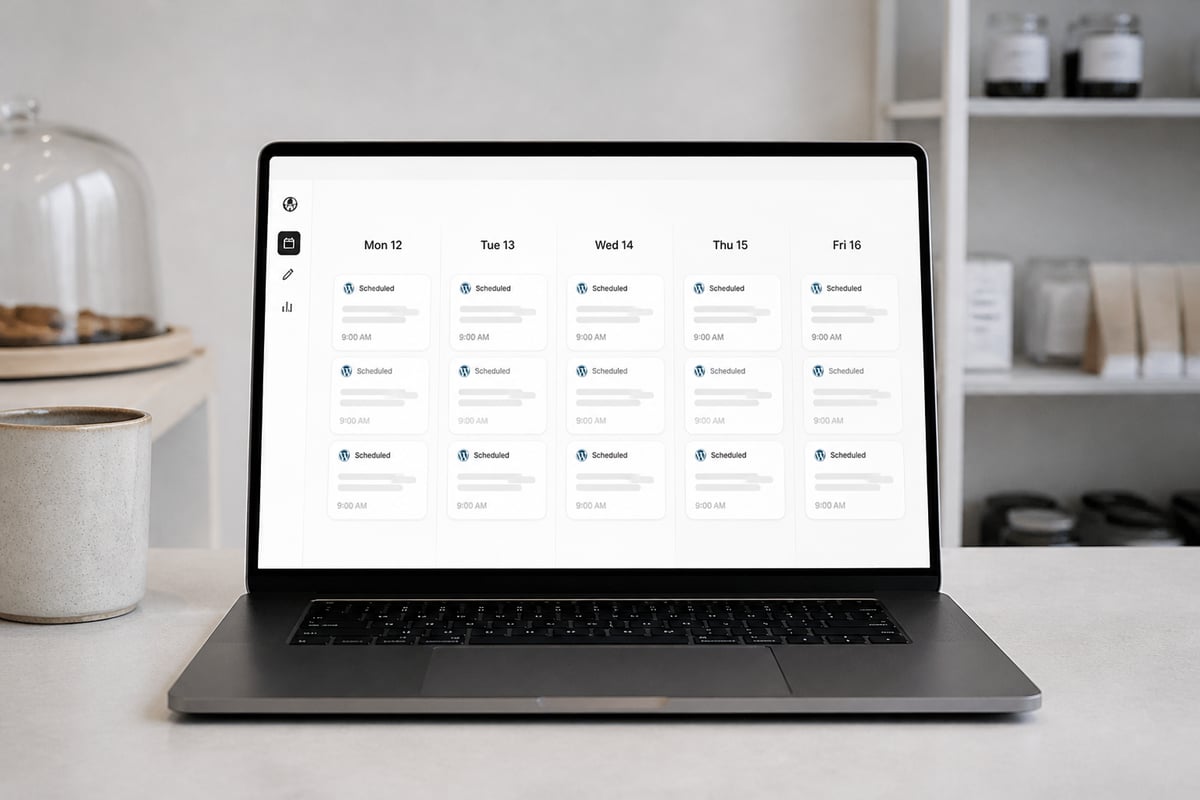
Content is usually the largest ongoing cost. If you write it yourself, the cost is hours. If you hire writers, you pay per article. If you automate it, a tool like RankPill plans, writes and publishes articles for $99 a month per website (30 articles a month), which works out to about $3 an article on that plan. New customers can start with a 3-day trial for $1.
RankPill is built for owners who want to publish steadily without writing every post. If you only want hand-written content, or your site cannot connect to a supported publishing platform, it is not the right fit. In that case, budget for a freelance writer.
For more on keeping spend under control, read our post on affordable SEO for small business.
Step 6: Publish helpful local content on a schedule
Content gives you more places to rank than a service page alone can. Many local competitors publish little, so steady articles can pull ahead.
Good local article ideas:
- Answers to the questions customers ask on the phone
- Cost guides for your area ("what does a boiler service cost in London")
- Seasonal checklists tied to local weather or rules
- Project write-ups with before and after photos
- Comparisons that help a buyer choose between options
Example: a plumbing and gas company such as OnSite Contractors and Plumbing Ltd could publish pieces on winter boiler checks or what to do when a pipe freezes. Each one answers a real question and points to a service page.
A safety training provider such as Certified Safety Training could write about which first aid or forklift certification a worksite needs, tagged to cities it serves.
Consistency matters more than volume. One good article a week for six months is worth more than thirty in a weekend. If you cannot keep that pace by hand, automation can carry it. RankPill finds keywords from your site and competitors, writes the articles with images and internal links, and publishes to WordPress, Shopify, Webflow, Wix, Framer or any site through webhooks on the schedule you set. You can choose to approve each article before it goes live. Our guide to writing articles for SEO covers how to structure them.
Results take time. Many sites see early impressions within a few weeks, with steadier growth from month three or four. Nobody can promise a timeline.
Step 7: Earn local links and mentions
Links from other local websites signal that your business is known in its area. A few good ones beat many weak ones.
Realistic sources:
- Your chamber of commerce or business association
- Local news sites, blogs and newsletters
- Sponsorships of youth teams, charities or events
- Suppliers, partners and clients who will link from their sites
- Local supplier directories or "who we work with" pages
Offer something useful. A local data point, a how-to for readers in your town, or an expert quote gets more replies than a plain request. Our post on digital PR for SEO explains how to pitch.
Avoid bought links and link swaps with unrelated sites. They carry risk and little reward.
Step 8: Make your site fast and easy on a phone
Most local searches happen on a phone, often by someone ready to call or visit. If your site loads slowly or hides your number, you lose them.
Check these:
- Your phone number is tap-to-call at the top of every page.
- Pages load in a few seconds on mobile data.
- Text is readable without zooming.
- Forms are short: name, phone, a message.
- Your address and hours are visible without scrolling far.
Run your key pages through Google's free tools and fix what they flag.
Step 9: Get found in AI search too
People now ask ChatGPT, Gemini and Google's AI Overviews for local recommendations. These tools pull from pages on the web, so clear, accurate, well-sourced content about your services and area helps you appear. You do not need to rank first on Google to be cited.
What helps:
- Specific answers to local questions, stated plainly near the top of a page
- Consistent business details everywhere
- Genuine reviews that mention what you do and where
- Pages that name your services, prices and service area
Tracking this by hand is slow. RankPill Plus checks up to 50 prompts a day in ChatGPT, Gemini and Google AI Overviews and shows mentions, cited sources and sentiment, at $199 a month per website. It does not track Perplexity or Claude yet. For the fundamentals, see SEO for ChatGPT.
How to measure local SEO results
Measure a handful of numbers monthly, not dozens. A short scorecard keeps you honest.
- Calls, direction requests and website clicks from your Business Profile insights
- Impressions, clicks and average position in Google Search Console, which is free
- Review count and average rating, compared with your top three local rivals
- Leads by source: ask every new customer how they found you
- Rankings for five to ten core keywords, checked from a location near you
Check the numbers on the first of each month and write down one change to try. Small, repeated adjustments add up.
What is the 80/20 rule in SEO?
The 80/20 rule in SEO says that about 20% of your pages or tasks bring in roughly 80% of your results. For a local business, that usually means a complete Business Profile, a few strong service pages and a steady stream of reviews do most of the work. Do those well before spending time on the long tail.
FAQ
How do I create a local SEO plan from scratch?
Start with your Google Business Profile, then fix your name, address and phone number across directories. Next, build one page per core service and area, ask for reviews, and publish helpful articles on a schedule. Review your numbers monthly.
How long does local SEO take to work?
Profile fixes can change your visibility within weeks. Content and links often take several months to show clear gains, depending on competition and how established your site is. Nobody can guarantee a timeline.
Can I do local SEO myself without an agency?
Yes. The core steps need no technical skill, only consistency. Hire help for work you cannot keep up, such as writing or link outreach, and keep control of your Business Profile and reviews.
Pick one task today: open your Google Business Profile and check that your category, hours and phone number are correct. Once the basics are set, the harder part is publishing helpful content week after week. RankPill can take that part off your plate by planning, writing and publishing articles to your site on your schedule, and you can Try RankPill with a 3-day trial for $1 to see how it fits your business at RankPill.
Unlock Traffic on Autopilot
Grow organic traffic on autopilot. RankPill will research, write, optimize, and publish articles to your website daily.