
Print on Demand SEO: Strategies to Rank and Grow

Modest Mitkus
June 19, 2026
Print on demand businesses face unique challenges in the competitive e-commerce landscape. Unlike traditional retail models, POD stores often struggle with duplicate content, limited product differentiation, and fierce competition for the same keywords. Mastering print on demand SEO requires a strategic approach that combines technical optimization, content marketing, and smart keyword targeting to stand out in search results and attract qualified buyers.
Understanding Print on Demand SEO Fundamentals
Print on demand SEO differs significantly from traditional e-commerce optimization because you're competing with thousands of other sellers offering similar products. The core challenge lies in creating unique value when your products might be identical to competitors using the same fulfillment platforms.
Search engines prioritize websites that provide unique, valuable content paired with excellent user experience. For POD stores, this means going beyond basic product descriptions and building a comprehensive content ecosystem that answers customer questions, showcases your unique designs, and establishes authority in your niche.

Why Traditional SEO Tactics Fall Short
Many POD store owners make the mistake of copying manufacturer descriptions or using generic templates across hundreds of products. This approach creates thin content that search engines ignore or penalize. According to research on print-on-demand SEO mistakes, duplicate content remains one of the most common barriers to organic growth.
Key differences in POD SEO strategy:
- Product descriptions must emphasize unique design elements rather than generic item features
- Category pages need robust content beyond simple product grids
- Brand storytelling becomes critical for differentiation
- Long-tail keywords often outperform broad product terms
The print-on-demand industry has evolved dramatically over the past decade, with barriers to entry dropping significantly. This means your SEO strategy must be more sophisticated than simply optimizing for "funny t-shirts" or "custom mugs."
Keyword Research for Print on Demand Success
Effective print on demand SEO starts with understanding what your target customers actually search for. Generic product keywords like "t-shirt" or "poster" are dominated by major retailers with massive budgets and domain authority. Your opportunity lies in the long-tail.
Finding Your Keyword Sweet Spot
Start by identifying niche-specific phrases that combine product type, design theme, and buyer intent. Tools like the keyword research tool help you discover low-competition opportunities that major competitors overlook.
| Keyword Type | Example | Competition Level | Conversion Potential |
|---|---|---|---|
| Generic | "t-shirt" | Extremely High | Low |
| Product + Niche | "vintage motorcycle t-shirt" | High | Medium |
| Long-tail + Intent | "retro harley davidson gift for dad" | Medium | High |
| Ultra-specific | "1970s bobber motorcycle art print for garage" | Low | Very High |
Focus your initial efforts on keywords with 500-3,000 monthly searches and lower competition scores. These represent realistic ranking opportunities where your unique designs and optimized content can actually compete.
Mapping Keywords to Product Categories
Organize your keyword strategy around clear product categories and design themes. This structure helps both search engines and customers understand your store's organization while enabling you to target multiple related keywords efficiently.
Strategic keyword mapping approach:
- Identify 3-5 primary niche categories for your store
- Research 10-15 long-tail keywords per category
- Create dedicated category pages targeting primary keywords
- Optimize individual products for ultra-specific variations
- Build supporting content around customer questions and use cases
The case study on Gelato's SEO success demonstrates how systematic keyword targeting at the category and product level can drive exponential growth in organic visibility.
Optimizing Product Pages for Search Engines
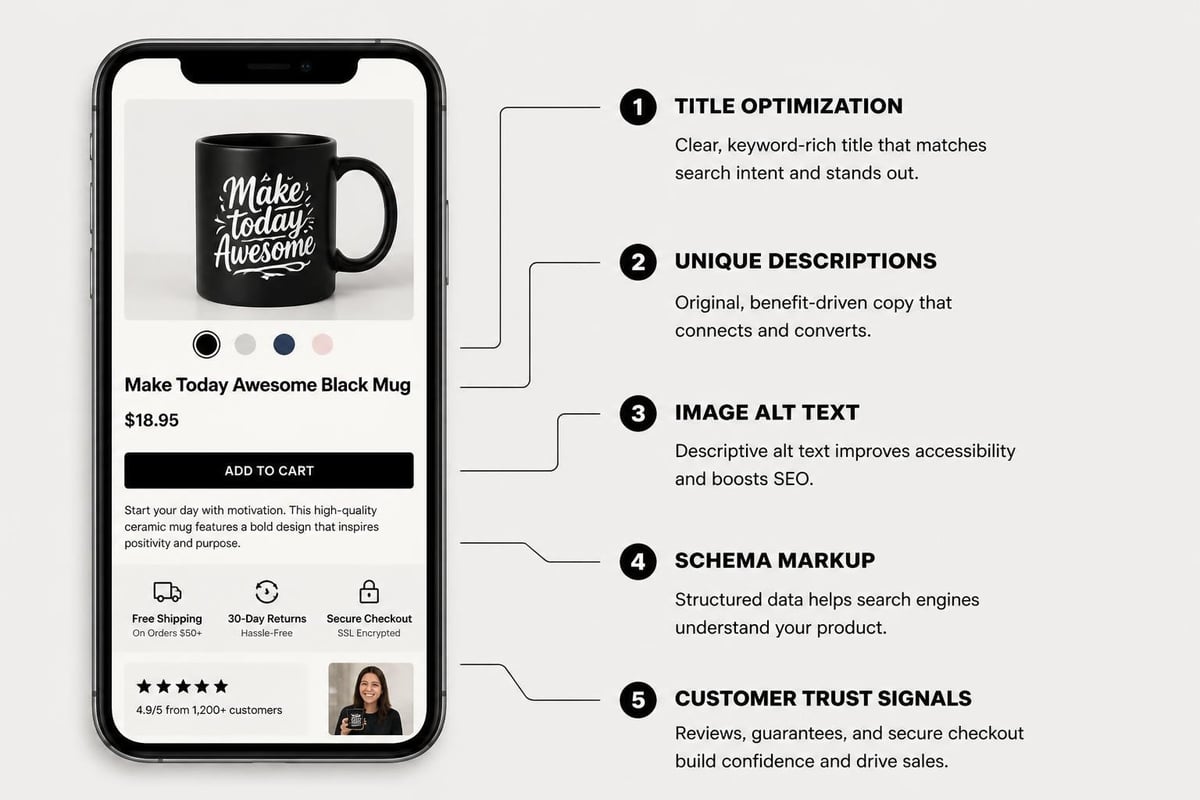
Product page optimization represents the foundation of print on demand SEO. Each product page should serve as a standalone landing page capable of ranking for its target keywords while providing comprehensive information that converts browsers into buyers.
Crafting Unique Product Descriptions
Never use the same description across multiple products, even if they share the same base item. Search engines reward unique content, and customers need specific information about each design.
Essential elements for optimized product descriptions:
- Primary keyword in the first 100 words naturally
- Detailed design description highlighting unique artistic elements
- Specific use cases and occasions for the product
- Material and quality information that differentiates your offering
- Emotional benefits beyond physical product features
Write at least 300 words for each main product page. This length provides enough content for search engines to understand relevance while giving customers the information they need to make confident purchase decisions.
Technical SEO Elements That Matter
Beyond content, technical elements significantly impact how well your product pages rank. Title tags should include your primary keyword and unique design identifier within 60 characters. Meta descriptions must compel clicks while incorporating secondary keywords naturally.
Image optimization deserves special attention in print on demand SEO. Your product images showcase your unique designs, making them critical for both user experience and search visibility. Use descriptive file names like "vintage-motorcycle-bobber-art-print.jpg" rather than "image001.jpg."
Image SEO checklist:
- Descriptive, keyword-rich file names
- Compressed file sizes for fast page loading
- Alt text describing the design and product type
- Multiple angles and lifestyle shots when possible
- High-quality images that showcase design details
Implementing structured data markup helps search engines understand your product information and can enable rich snippets in search results. Product schema should include price, availability, reviews, and detailed product specifications.
Building Content Beyond Product Pages
Successful print on demand SEO extends far beyond optimizing individual product listings. A comprehensive content strategy attracts visitors at different stages of the buying journey and establishes your store as an authority in your niche.
Creating Valuable Blog Content
Blog content serves multiple purposes in your SEO strategy. It targets informational keywords that bring early-stage researchers to your site, provides linkable assets that attract backlinks, and demonstrates expertise that builds trust with potential customers.
The content marketing workflow case study shows how POD businesses successfully integrate blogging with product promotion to drive sustainable organic growth. Topics should address customer questions, showcase design inspiration, and provide value beyond sales pitches.
High-performing content types for POD stores:
- Design inspiration guides for specific occasions or themes
- Gift guides targeting seasonal search trends
- How-to articles related to your product categories
- Behind-the-scenes content about your design process
- Customer story features and product use cases
Target 1,500-2,500 words for cornerstone content pieces, optimizing each article for a primary keyword while incorporating related semantic terms naturally. This approach mirrors effective strategies used in AI content for SEO, where comprehensive coverage signals authority to search engines.
Developing Category and Collection Pages
Category pages represent critical opportunities in print on demand SEO. These pages can rank for broader, higher-volume keywords while organizing your products logically for both users and search engines.
Each category page should include 500+ words of unique content explaining the theme, showcasing featured designs, and providing context that helps customers understand why your collection matters. This transforms simple product grids into valuable landing pages.
| Category Element | SEO Purpose | User Benefit |
|---|---|---|
| Introductory paragraph | Keyword targeting | Understanding collection theme |
| Featured products | Internal linking | Quick access to popular items |
| Design story | Unique content | Emotional connection |
| Buying guide | Long-tail keywords | Decision support |
| FAQ section | Question-based queries | Objection handling |
Building robust category pages also creates natural internal linking opportunities. Link from blog posts to relevant collections, from products to related categories, and from category pages to your most popular items within each theme.
Link Building Strategies for POD Stores
Backlinks remain a critical ranking factor, but earning quality links poses challenges for print on demand businesses. Your link building strategy should focus on creating linkable assets and building relationships within your niche community.
Partnering with platforms like RankPill's backlink exchange provides a white-hat approach to building domain authority through reciprocal linking with complementary businesses. This method helps POD stores establish foundational link profiles without resorting to spammy tactics.

Creating Link-Worthy Resources
The most effective link building starts with content people actually want to reference. Design-focused resources, industry guides, and data-driven insights naturally attract links from bloggers, journalists, and other websites.
Linkable asset ideas for POD businesses:
- Annual design trend reports for your niche
- Comprehensive buyer's guides for product categories
- Free design templates or inspiration galleries
- Industry statistics and original research
- Expert roundups featuring designers and influencers
Promote these resources through social media, email outreach to relevant websites, and submissions to industry directories. Quality matters far more than quantity in link building, especially for newer POD stores establishing credibility.
Local SEO Opportunities
Even purely online POD businesses can benefit from local SEO tactics. Creating a Google Business Profile, getting listed in local business directories, and targeting location-specific keywords for shipping and custom design services can drive qualified traffic with less competition.
Technical Performance and Site Speed
Site speed directly impacts both user experience and search rankings. Print on demand stores often suffer from slow loading times due to large image files and complex product catalogs, making performance optimization essential for effective print on demand SEO.
Core Web Vitals Optimization
Google's Core Web Vitals measure real-world user experience across loading performance, interactivity, and visual stability. POD stores must prioritize these metrics to maintain competitive rankings.
Critical performance optimizations:
- Implement lazy loading for product images below the fold
- Use next-generation image formats like WebP
- Minimize JavaScript and CSS file sizes
- Enable browser caching for static resources
- Choose hosting optimized for e-commerce platforms
Many successful POD businesses use platforms like Shopify or WooCommerce that provide built-in performance features. However, customizations and third-party apps can negate these benefits if not carefully managed.
The SEO case study for Century Type Print demonstrates how technical SEO improvements, including site speed optimization, contributed to a 554% increase in organic traffic over 12 months.
Automation and Scaling Your SEO Efforts
Managing print on demand SEO across hundreds or thousands of products presents scalability challenges. Manual optimization becomes impractical as your catalog grows, making automation essential for sustainable growth.
Platforms focusing on SEO automation can streamline content creation, keyword research, and optimization tasks that would otherwise consume excessive time. This allows POD store owners to focus on design creation and customer service while maintaining strong organic visibility.
Systematic Optimization Workflows
Develop repeatable processes for optimizing new products as you add them to your catalog. Templates ensure consistency while incorporating unique elements for each design that prevent duplicate content issues.
Automated optimization workflow:
- Generate unique product descriptions using templates with design-specific variables
- Create optimized title tags and meta descriptions automatically
- Apply consistent image naming conventions and alt text structures
- Implement schema markup across all product pages
- Schedule regular content updates and keyword reviews
Understanding how AI tools support SEO helps POD entrepreneurs leverage technology without sacrificing the uniqueness that differentiates their brand. The goal is efficiency without losing the human touch that makes your designs appealing.
Measuring and Improving SEO Performance
Tracking the right metrics enables data-driven optimization decisions. Print on demand SEO success requires monitoring both traditional search metrics and e-commerce-specific performance indicators.
Essential SEO Metrics for POD Stores
Focus on metrics that directly connect to business outcomes rather than vanity numbers. Organic traffic matters only if it converts to actual sales.
| Metric | What It Measures | Target Benchmark |
|---|---|---|
| Organic traffic | Visitors from search engines | Month-over-month growth |
| Keyword rankings | Position for target terms | Top 10 for primary keywords |
| Conversion rate | Sales per organic visitor | 2-4% for POD stores |
| Revenue per session | Average order value from organic traffic | Higher than paid channels |
| Page load time | Technical performance | Under 3 seconds |
Use Google Analytics to segment organic traffic by landing page, identifying which products and content pieces drive the most valuable visitors. Google Search Console reveals which queries bring users to your site and where ranking opportunities exist.
Continuous Optimization Strategies
Print on demand SEO is not a one-time project but an ongoing process of testing, measuring, and refining. Regularly review the comprehensive SEO checklist to ensure you're covering all optimization fundamentals.
Monthly SEO review process:
- Analyze top-performing products and identify common optimization factors
- Review keyword rankings and adjust targeting for declining terms
- Update older product descriptions with fresh content and current keywords
- Identify low-traffic pages and improve their optimization
- Build new content targeting emerging search trends
Seasonal trends significantly impact POD businesses. Plan content and optimization efforts around major holidays, events, and seasonal themes at least three months in advance to capture search traffic as interest builds.
Competitive Analysis and Market Positioning
Understanding how competitors approach print on demand SEO reveals both opportunities and threats. Regular competitive analysis helps you identify gaps in their strategies that you can exploit.
Analyzing Competitor Strategies
Study the top-ranking POD stores in your niche to understand what makes them successful. Examine their site structure, content approach, keyword targeting, and backlink profiles for insights you can adapt to your unique brand.
Competitive research tactics:
- Identify their highest-ranking keywords and assess your ability to compete
- Analyze their content strategy and publication frequency
- Review their backlink sources for potential outreach opportunities
- Study their product page optimization patterns
- Monitor their social media engagement and content promotion
Use these insights to inform your strategy rather than simply copying competitors. The goal is differentiation through superior execution, not imitation.
Finding Your Unique SEO Angle
Successful print on demand SEO requires carving out a distinct position in your market. Broad niches like "funny t-shirts" are saturated, but specific sub-niches offer realistic ranking opportunities for newer stores.
Consider the intersection of multiple interests or demographics to find underserved markets. A store targeting "vintage motorcycle art for home bars" faces less competition than one simply selling "motorcycle posters."
Review the detailed keyword and content tips to identify strategic approaches that align with your unique market position while following proven optimization principles.
Platform-Specific SEO Considerations
Different e-commerce platforms offer varying levels of SEO control and built-in optimization features. Understanding your platform's capabilities and limitations shapes your print on demand SEO strategy.
Shopify SEO Optimization
Shopify provides solid basic SEO functionality but requires customization for optimal performance. The platform handles technical fundamentals well but offers limited control over URL structures and certain on-page elements.
Shopify-specific optimizations:
- Customize theme templates to improve title tag and heading structure
- Use apps to enhance schema markup and rich snippets
- Optimize collection page URLs and descriptions
- Implement breadcrumb navigation for better site structure
- Enable AMP for faster mobile loading
Many successful POD entrepreneurs using Shopify complement the platform's built-in features with third-party SEO apps that provide advanced optimization capabilities.
WordPress and WooCommerce Advantages
WordPress with WooCommerce offers maximum SEO flexibility through plugins and complete control over site structure. This combination allows for sophisticated optimization strategies that may be difficult on closed platforms.
Popular WordPress SEO plugins like Yoast and RankMath provide comprehensive optimization tools specifically designed for e-commerce sites. These solutions enable advanced schema markup, automated XML sitemaps, and detailed on-page analysis.
The trade-off involves increased technical management responsibilities. WordPress requires regular updates, security monitoring, and performance optimization that platforms like Shopify handle automatically.
Mastering print on demand SEO requires a comprehensive approach that combines technical optimization, strategic content creation, and ongoing performance analysis. By focusing on unique value creation, systematic optimization processes, and data-driven improvements, POD businesses can build sustainable organic traffic that drives sales without relying on expensive paid advertising. RankPill automates the most time-consuming aspects of SEO, from keyword research to content creation and backlink building, allowing print on demand entrepreneurs to focus on what they do best while growing organic visibility on autopilot.