
SEO Automation for Custom Website: Complete Guide

Modest Mitkus · June 10, 2026
Custom websites offer unparalleled flexibility and control over your online presence, but they also demand consistent SEO management to stay competitive in search rankings. Manual optimization across multiple pages, content creation schedules, technical audits, and link building campaigns can quickly overwhelm small teams and solo founders. This is where seo automation for custom website solutions transforms how businesses approach search visibility, turning time-intensive tasks into systematic processes that run continuously in the background. By implementing automation strategically, you can maintain consistent optimization efforts while focusing your energy on core business activities.
Understanding SEO Automation for Custom Websites
SEO automation refers to the systematic use of tools and workflows that handle repetitive optimization tasks without constant manual intervention. Unlike website builders with pre-packaged SEO features, custom websites require tailored automation approaches that integrate with your specific tech stack.
The foundation of seo automation for custom website strategies rests on three core pillars: content optimization, technical SEO maintenance, and authority building. Each pillar contains dozens of tasks that automation can streamline, from meta tag generation to broken link monitoring and backlink outreach.
Key Automation Opportunities
Custom websites present unique automation opportunities because you control the entire codebase and infrastructure:
- Automated schema markup generation based on content type and page structure
- Dynamic XML sitemap updates whenever new content publishes
- Programmatic internal linking that connects related content automatically
- Scheduled technical audits that flag issues before they impact rankings
- Content publishing workflows that optimize and publish articles on autopilot
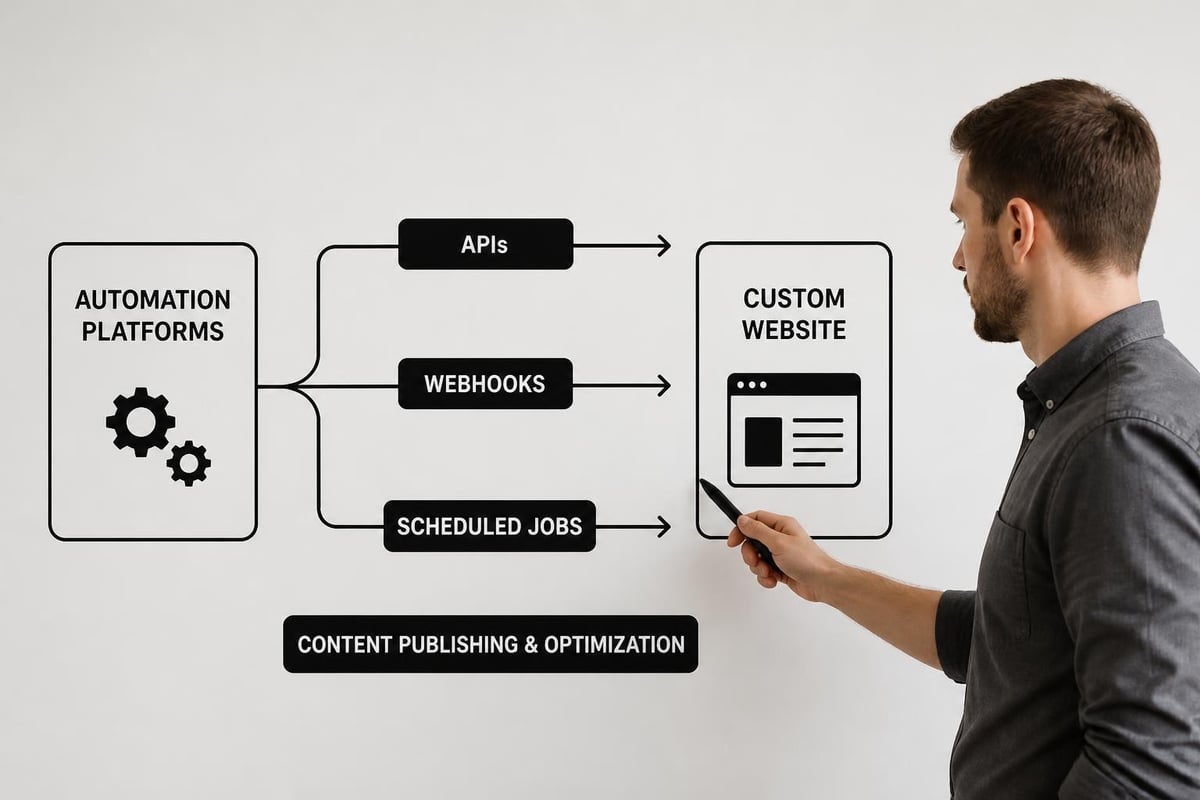
Modern automation platforms can integrate directly with custom CMS systems through APIs, webhooks, and plugins. This seamless connection ensures that optimization happens in real-time as your website evolves.

Content Automation Strategies
Content remains the primary driver of organic traffic, yet producing optimized articles consistently challenges most businesses. Automation transforms content creation from a bottleneck into a competitive advantage.
Keyword Research Automation
Manual keyword research consumes hours of analysis across competitor websites, search volume data, and ranking difficulty metrics. Automated systems can scan thousands of keyword opportunities daily, identifying gaps your competitors haven't addressed.
| Manual Approach | Automated Approach |
|---|---|
| 2-4 hours per topic cluster | 15 minutes for hundreds of keywords |
| Limited competitor analysis | Comprehensive competitor gap analysis |
| Static keyword lists | Dynamic, updated keyword databases |
| Gut-feel prioritization | Data-driven opportunity scoring |
Platforms like SEMrush and Ahrefs offer API access that enables programmatic keyword discovery, letting you build automated pipelines that continuously feed content calendars with high-potential topics.
AI-Powered Content Generation
The barrier between keyword research and published content has collapsed thanks to AI writing systems trained on search intent patterns. These tools analyze top-ranking pages, extract structural patterns, and generate comprehensive articles that match user expectations.
For businesses running custom websites, AI content automation doesn't mean sacrificing quality. Modern systems produce 2,000+ word articles with:
- Proper heading hierarchy optimized for featured snippets
- Semantic keyword integration that sounds natural, not stuffed
- Contextual internal links to relevant site pages
- External citations to authoritative sources
- Image suggestions with alt text optimization
Implementing an AI SEO platform specifically designed for automation can dramatically accelerate your content production while maintaining editorial standards through customizable tone, style, and fact-checking workflows.
Publishing Automation
Creating content is only half the battle. Getting it live on your custom website at optimal times requires publishing automation that connects directly to your CMS.
WordPress, for example, supports REST API connections that enable scheduled publishing from external platforms. Custom-built CMS systems can implement similar webhook receivers that accept formatted content and automatically:
- Create new posts or pages with correct taxonomies
- Generate and optimize meta descriptions
- Upload and compress associated images
- Build internal link structures
- Submit updated sitemaps to search engines
This end-to-end automation means you can maintain a consistent publishing schedule without daily manual uploads, creating the content frequency that search algorithms reward.
Technical SEO Automation
Technical optimization forms the invisible foundation that either enables or prevents content from ranking. Custom websites require ongoing technical maintenance that automation handles more reliably than manual audits.
Automated Site Audits
Specialized SEO automation tools conduct comprehensive technical audits that identify issues across thousands of pages simultaneously. These platforms crawl your custom website regularly, flagging problems like:
- Broken internal and external links
- Missing or duplicate meta tags
- Slow-loading pages and oversized images
- Mobile usability issues
- Crawl errors and redirect chains
- Missing structured data markup
Rather than waiting for quarterly manual reviews, automated audits run daily or weekly, catching problems before they accumulate and damage rankings.
Code-Level Optimization
One significant advantage of seo automation for custom website applications is the ability to automatically implement code fixes. Some platforms generate patches for common technical issues:
| Issue Type | Automated Fix |
|---|---|
| Missing alt text | AI-generated descriptive alt attributes |
| Uncompressed images | Automatic compression and format conversion |
| Render-blocking resources | Deferred loading implementation |
| Missing canonical tags | Self-referencing canonical insertion |
These automated improvements maintain technical health without requiring developer intervention for every minor adjustment.
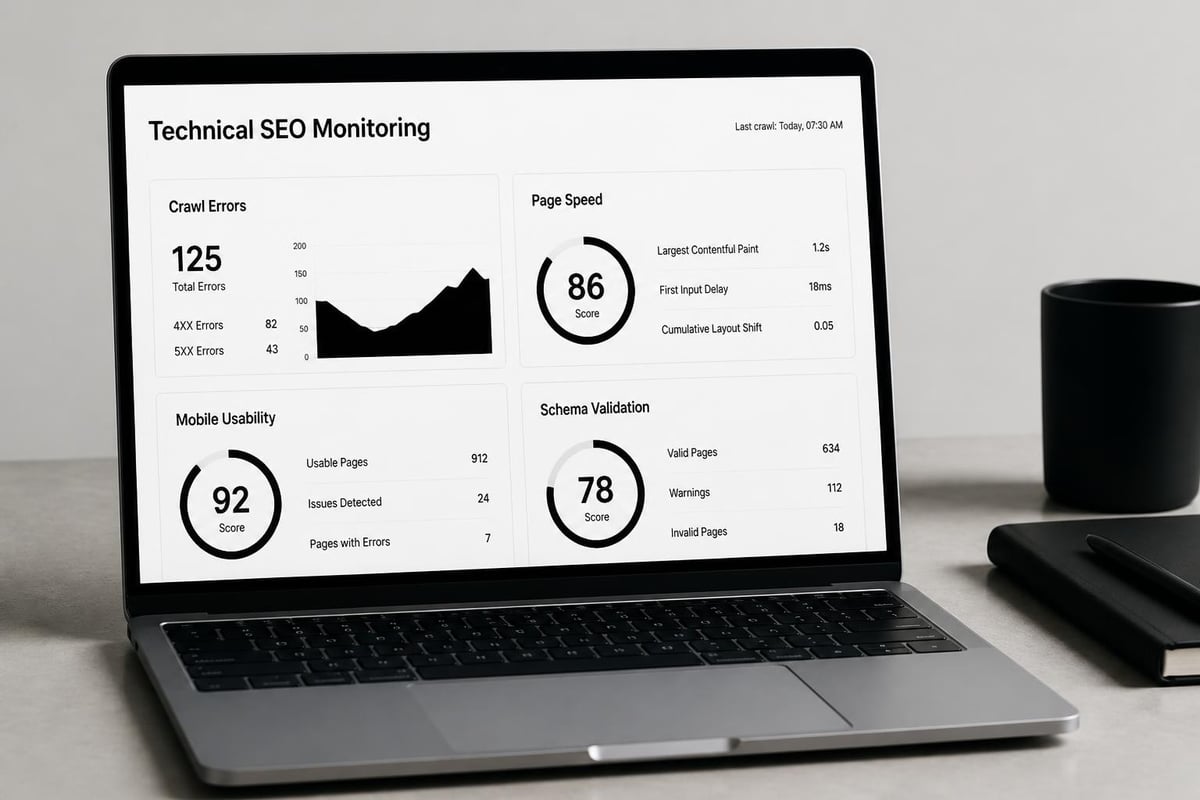
Performance Monitoring
Page speed directly impacts both user experience and search rankings. Automation tools continuously monitor Core Web Vitals metrics-Largest Contentful Paint, First Input Delay, and Cumulative Layout Shift-alerting you when performance degrades.
Integration with tools like Google PageSpeed Insights API enables automated testing after every deployment, ensuring new features don't inadvertently slow your custom website. Performance budgets can trigger automatic rollbacks or optimization scripts when thresholds are exceeded.
Link Building Automation
Authority signals through backlinks remain crucial ranking factors, yet manual outreach campaigns consume enormous time with unpredictable results. Strategic automation streamlines link acquisition while maintaining quality standards.
Automated Backlink Monitoring
Understanding your current backlink profile and tracking new links as they appear forms the baseline for any link building strategy. Automation platforms monitor:
- New backlinks from referring domains
- Lost or removed backlinks
- Competitor backlink gains
- Anchor text distribution
- Link quality metrics (domain authority, spam score)
This real-time monitoring enables quick response to negative SEO attacks and helps identify successful content types that naturally attract links.
Systematic Internal Linking
Internal links distribute page authority across your custom website while helping users discover related content. Manual internal linking becomes impractical as content libraries grow beyond a few dozen pages.
Automation solutions analyze content similarity, topic relationships, and existing link structures to suggest or automatically insert contextual internal links. When new content publishes, the system identifies older articles that should link to it, creating a self-reinforcing content network.
Backlink Exchange Networks
Building quality backlinks traditionally requires extensive manual outreach to website owners in complementary niches. Automated backlink exchange platforms connect website owners who can mutually benefit from reciprocal linking.
These systems match websites based on relevance, authority metrics, and content alignment. For instance, a platform might offer free monthly credits that let you propose link exchanges with vetted partners, automating the discovery and initial outreach phases while you maintain control over final placement decisions.
Automation Implementation for Custom Websites
Successfully deploying seo automation for custom website environments requires thoughtful planning around your technical infrastructure and team capabilities.
Integration Requirements
Custom websites typically need these technical components to support automation:
- API access to your CMS or content management database
- Webhook endpoints that receive automated updates
- Authentication systems that secure automated connections
- Staging environments where automation can be tested safely
- Version control that tracks automated changes
Most modern frameworks like Django, Ruby on Rails, Node.js, and Laravel include built-in capabilities for these requirements. Even static site generators like Jekyll or Hugo can integrate automation through build pipelines and Git-based workflows.
Choosing Automation Tools
The automation landscape offers hundreds of specialized tools. For custom websites, prioritize platforms that provide:
- Flexible API integration rather than platform-specific plugins
- Customizable workflows that adapt to your specific SEO strategy
- Transparent reporting showing exactly what automation has changed
- Human oversight options for quality control checkpoints
- Scalable pricing that grows with your content volume
Many businesses find success with comprehensive automation platforms that handle multiple SEO aspects through a single integration, reducing technical complexity and consolidating reporting.
Setting Up Content Automation
Implementing content automation for a custom website typically follows this process:
Phase 1: Research Automation Connect keyword research tools to identify opportunities based on your target topics, competitor gaps, and search trends. Export results to a centralized content database.
Phase 2: Generation Automation Configure AI writing systems with your brand voice, target audience parameters, and content structure preferences. Set up quality filters that ensure output meets your standards.
Phase 3: Publishing Automation Establish API connections between your automation platform and custom website CMS. Define publishing schedules, category assignments, and URL structure patterns.
Phase 4: Optimization Automation Implement post-publish optimization that automatically adds internal links, updates older content with fresh information, and optimizes meta data based on performance metrics.
RankPill's SEO Automation platform handles this entire workflow, from automated keyword research through AI-written articles to smart linking and auto-publishing directly to custom CMS platforms, all running continuously in the background.
Measuring Automation Success
Deploying automation without measuring its impact leads to wasted resources and missed optimization opportunities. Establish clear metrics before implementing seo automation for custom website projects.
Key Performance Indicators
Track these metrics to evaluate automation effectiveness:
| Metric Category | Specific KPIs |
|---|---|
| Content Production | Articles published per week, time from research to publish, content cost per article |
| Technical Health | Issues detected vs. resolved, average time to fix, crawl error reduction |
| Ranking Performance | Keywords in top 10, average ranking position, featured snippet captures |
| Traffic Growth | Organic sessions, new vs. returning visitors, traffic value |
| Authority Building | New backlinks per month, domain authority trend, referring domains |
Modern analytics platforms can automate reporting itself, delivering weekly dashboards that show how automation initiatives drive results.
A/B Testing Automation
Even automated SEO benefits from experimentation. Implement A/B testing frameworks that automatically try variations of:
- Title tag formulas and length
- Meta description styles
- Internal linking density
- Content structure patterns
- Publishing frequency
Statistical significance testing built into automation platforms identifies winning variations and automatically applies them across future content, creating a continuously improving system.
Advanced Automation Techniques
As your basic automation matures, advanced techniques can further amplify results on custom websites.
Programmatic SEO
Programmatic SEO generates hundreds or thousands of optimized pages from structured data sources. E-commerce sites, directories, and location-based businesses particularly benefit from this approach.
The automation process involves:
- Identifying high-volume, low-competition keyword patterns
- Creating page templates optimized for these patterns
- Populating templates with unique data from databases or APIs
- Generating pages programmatically with proper optimization
- Managing crawl efficiency through intelligent pagination and internal linking
This technique transforms a single template into thousands of ranking opportunities, though it requires careful implementation to avoid thin content penalties.
AI Search Optimization
Traditional search engines aren't the only discovery channel. AI-powered search platforms like ChatGPT increasingly answer user queries directly. Optimizing for these systems requires different automation approaches focused on:
- Structured data markup that AI models can easily parse
- Authoritative citations that increase trust signals
- Clear, concise answers to common questions in your niche
- Entity relationships that connect your brand to relevant topics
Understanding how to get mentioned by AI systems requires new optimization techniques that automated platforms are beginning to incorporate alongside traditional SEO.
Multi-Language Automation
Custom websites targeting international audiences need localized SEO across multiple languages. Automation makes this feasible by:
- Conducting keyword research in each target language using native search behavior
- Generating content written for local audiences, not machine-translated
- Implementing hreflang tags automatically for proper language targeting
- Building region-specific backlinks through localized outreach
Each language market operates as an independent SEO channel with its own research, content, and optimization requirements. Automation platforms that handle multi-language workflows can dramatically expand global reach without proportionally increasing team size.
Common Automation Pitfalls
While seo automation for custom website implementations offers tremendous advantages, certain mistakes can undermine results or even trigger penalties.
Over-Automation Without Oversight
Fully automating SEO without human review creates risks. AI-generated content occasionally produces factual errors, awkward phrasing, or off-brand messaging. Technical automation might implement changes that conflict with custom functionality.
Best practice: Implement quality checkpoints where human editors review samples of automated output before it goes live. Even reviewing 10% of automated content catches systematic issues before they scale.
Ignoring E-E-A-T Signals
Google's emphasis on Experience, Expertise, Authoritativeness, and Trustworthiness means automation must incorporate these signals. Purely automated content lacking author credentials, expert citations, or original insights struggles to rank for competitive queries.
Supplement automation with:
- Author bios and credentials for content
- Expert quotes or contributions
- Original research and data
- Editorial review processes
Neglecting Content Uniqueness
Automation tools trained on similar data sources might produce content that resembles competitor articles too closely. Search engines reward unique perspectives and fresh information.
Configure automation to include proprietary data, unique examples from your business experience, and perspectives that differentiate your content from the thousands of generic articles on the same topics.
Future Trends in SEO Automation
The automation landscape continues evolving rapidly, with several trends shaping how custom websites will handle SEO in coming years.
AI Agent-Based Automation
Rather than rule-based automation, AI agents will make contextual decisions about optimization strategies. These systems will analyze ranking factors, competitor movements, and algorithm updates to autonomously adjust tactics.
Research into web automation tools demonstrates how AI agents can navigate complex tasks with minimal human guidance, suggesting future SEO platforms will require only high-level strategic direction.
Real-Time Optimization
Current automation typically operates on schedules-daily keyword checks, weekly content publishing, monthly technical audits. Emerging systems will optimize in real-time, instantly responding to ranking fluctuations, competitor content, and search trend shifts.
This continuous optimization ensures custom websites maintain competitive positions even in rapidly changing SERPs.
Integrated Multi-Channel Automation
SEO automation will increasingly connect with other marketing channels, creating unified systems that optimize across search, social media, email, and emerging platforms simultaneously. Content created for SEO will automatically adapt for social distribution, email newsletters, and AI search platforms.
Implementing seo automation for custom website environments transforms optimization from a resource-intensive burden into a systematic competitive advantage. By automating repetitive tasks across content creation, technical maintenance, and authority building, businesses can achieve consistent organic growth without proportionally scaling team size. The key is selecting automation tools that integrate flexibly with custom infrastructure while maintaining quality through strategic oversight. RankPill provides comprehensive automation that handles keyword research, AI-written content, smart linking, and auto-publishing to custom CMS platforms, enabling businesses to grow organic traffic on autopilot while focusing on core operations.
Unlock Traffic on Autopilot
Grow organic traffic on autopilot. RankPill will research, write, optimize, and publish articles to your website daily.
 WordPress