Shopify Plus SEO: Advanced Strategies for 2026

Modest Mitkus · October 1, 2026
Shopify Plus powers some of the world's fastest-growing ecommerce brands, but the platform's enterprise features only deliver results when paired with sophisticated SEO strategies. While Shopify Plus removes many technical limitations of standard Shopify plans, store owners still face unique challenges around site architecture, performance, and scalability. Understanding how to leverage Shopify Plus SEO capabilities separates stores that plateau at a few thousand monthly visitors from those that scale to millions.
Understanding Shopify Plus SEO Architecture
Shopify Plus SEO differs from standard Shopify optimization in several critical ways. The platform provides dedicated infrastructure, advanced customization options, and access to exclusive apps that fundamentally change how you approach search visibility.
Enterprise Infrastructure Advantages
Shopify Plus merchants benefit from priority infrastructure that affects search performance directly. Your store runs on dedicated servers with guaranteed uptime, faster response times, and the ability to handle traffic spikes without performance degradation. These factors contribute to Core Web Vitals scores, which Google uses as ranking signals.
Key infrastructure benefits include:
- Dedicated server resources preventing slowdowns during peak traffic
- Priority CDN edge locations for faster global content delivery
- Advanced caching mechanisms reducing server response time
- Checkout optimization that maintains speed during conversion
The platform also provides access to Shopify Scripts, enabling custom discounts and checkout modifications without third-party apps that slow page load times. Fewer apps mean cleaner code and faster pages, which directly impacts your shopify plus seo performance.

Technical SEO Customization Options
Unlike standard Shopify plans, Shopify Plus grants access to the checkout.liquid file and advanced theme customization. This access enables comprehensive technical SEO implementations that smaller merchants cannot achieve.
You gain control over critical elements such as structured data implementation across checkout flows, custom canonical tag logic for variant-heavy catalogs, and advanced redirect management through Shopify Flow. The official Shopify Help Center provides technical documentation, but implementing these features at scale requires strategic planning.
| Technical Feature | Standard Shopify | Shopify Plus | SEO Impact |
|---|---|---|---|
| Checkout customization | Limited | Full access | Improved conversion signals |
| Shopify Scripts | Not available | Available | Faster page speed |
| API rate limits | 2 calls/second | 4 calls/second | Better integration performance |
| Wholesale channels | Limited | Advanced | Duplicate content control |
| Automation (Flow) | Basic | Advanced | Technical SEO at scale |
Scaling Content Operations for Shopify Plus SEO
Enterprise ecommerce requires content volume that matches your product catalog scale. Stores with thousands of SKUs need systematic approaches to product descriptions, category content, and supporting blog articles.
Automating Product Content Optimization
Manual product description writing becomes impossible when managing catalogs with 10,000+ variants. Successful Shopify Plus merchants implement content workflows that balance automation with quality control.
The challenge lies in creating unique, SEO-optimized descriptions that avoid thin content penalties while maintaining brand voice across thousands of pages. SEO automation tools can streamline this process by generating optimized content at scale, though human oversight remains essential for brand consistency.
Effective product content automation includes:
- Template-based frameworks with dynamic attribute insertion
- Automated schema markup generation using product metafields
- Bulk content generation with AI assistance and editorial review
- Systematic internal linking between related products and categories
- Regular content audits identifying thin or duplicate descriptions
For brands managing extensive Shopify Plus catalogs, automating keyword research ensures each product targets relevant search terms without manual analysis of thousands of individual pages. This systematic approach to shopify plus seo content enables scalable optimization that maintains quality standards.
Category and Collection Page Strategy
Category pages represent your highest-value SEO opportunities on Shopify Plus. These pages typically have higher authority potential and can rank for competitive head terms that individual product pages cannot capture.
However, Shopify's default collection pages provide minimal content sections, requiring custom theme development to add substantial text content. Your development team should create flexible collection templates supporting:
- Introductory content sections (200-400 words) above product grids explaining category context and answering common questions
- FAQ schema integration addressing category-specific customer queries
- Faceted navigation with crawlable filter options generating additional landing pages
- Related collection cross-linking building topical authority across your catalog
- Custom breadcrumb structures leveraging Shopify's metaobjects for enhanced navigation
Google's ecommerce URL structure guidance emphasizes the importance of logical category hierarchies. Shopify Plus allows custom URL structures through redirects and automation, enabling better alignment with user search patterns.
Technical Performance Optimization
Page speed remains one of the most impactful shopify plus seo factors. While Shopify Plus provides superior infrastructure, theme code quality and app selection determine actual performance.
Theme Selection and Optimization
Your theme choice affects every page load across your entire store. Shopify's theme store ratings don't adequately reflect SEO performance, requiring independent evaluation of code quality and Core Web Vitals scores.
Search Engine Journal's theme selection guide outlines critical evaluation criteria. Beyond aesthetics, assess themes based on:
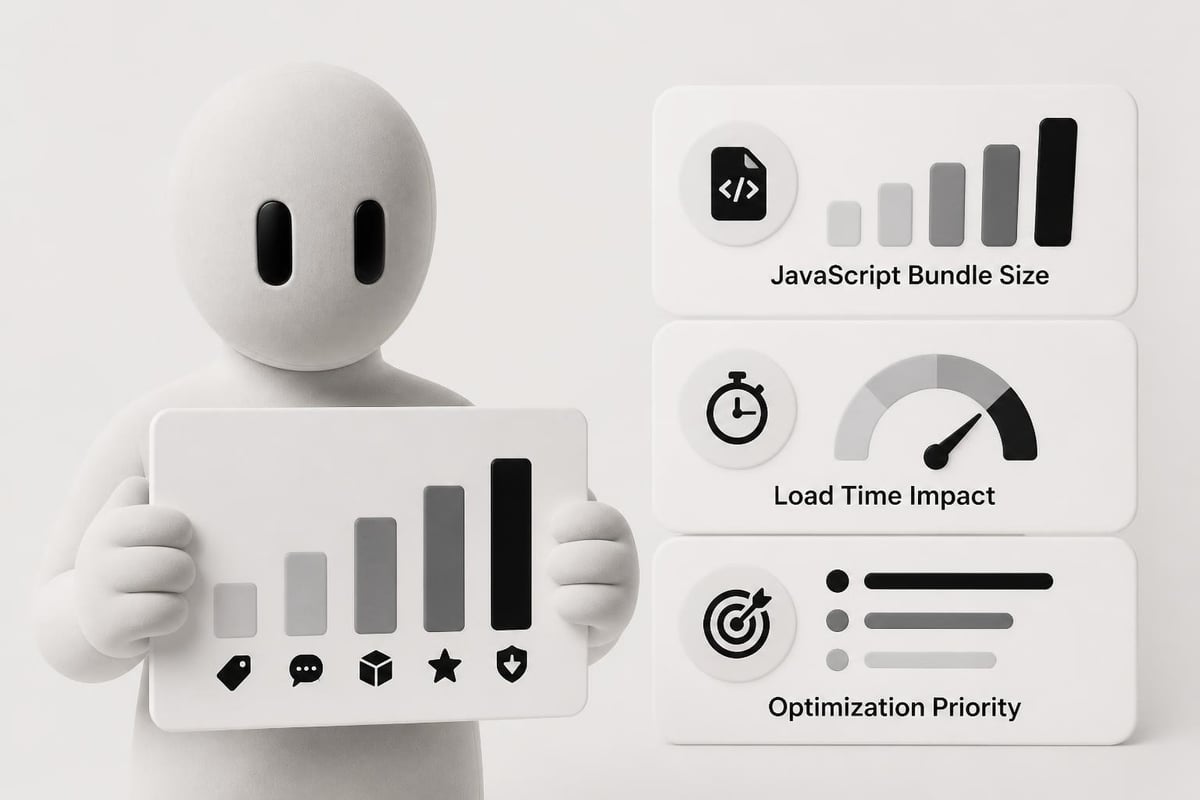
- Initial JavaScript bundle size (target under 200KB)
- CSS delivery method and unused code removal
- Image lazy loading implementation quality
- Web font loading strategy preventing layout shifts
- Third-party script management capabilities
Many popular Shopify themes ship with bloated JavaScript frameworks that harm mobile performance. Custom theme development or heavily modified premium themes often outperform stock options for shopify plus seo performance.
App Ecosystem Management
Each Shopify app adds code to your storefront, creating cumulative performance impacts. Shopify Plus stores average 30-40 installed apps, many adding unnecessary scripts to every page load.
App audit methodology:
- Use Google Tag Manager's preview mode to identify all scripts loading on your pages
- Cross-reference scripts with installed apps using Shopify's app list
- Measure per-app performance impact using Chrome DevTools coverage analysis
- Eliminate apps with duplicate functionality or minimal business value
- Replace heavy apps with custom Shopify Scripts or Flow automations where possible
The Screaming Frog ecommerce auditing guide provides detailed methodologies for identifying technical issues across large Shopify Plus catalogs, including JavaScript rendering problems caused by app conflicts.
Advanced Schema Implementation
Structured data helps search engines understand your product catalog, enabling rich results that increase click-through rates. Shopify Plus stores should implement comprehensive schema beyond basic Product markup.
Multi-Type Schema Strategy
While Shopify automatically includes basic Product schema, enterprise stores benefit from additional structured data types. Implement schema for:
| Schema Type | Implementation Location | Business Impact |
|---|---|---|
| Organization | Homepage and about pages | Brand knowledge panel |
| BreadcrumbList | All pages via theme | Enhanced search snippets |
| AggregateRating | Product pages | Star ratings in results |
| FAQ | Collection and product pages | FAQ rich results |
| VideoObject | Product pages with media | Video carousel inclusion |
| OfferShippingDetails | Product pages | Shipping info in results |
The complexity increases when managing multiple currencies, regions, or B2B wholesale channels. Each variant requires proper schema configuration indicating availability, pricing, and shipping details specific to that market.
Review and Rating Schema
Customer reviews provide crucial trust signals and enable star rating rich snippets. However, Shopify's native reviews don't automatically generate proper schema markup in most themes.
Third-party review apps vary significantly in schema quality. Some generate invalid markup, while others create review schema without proper connection to product schema. Audit your implementation using Google's Rich Results Test to verify proper nesting and property relationships.
For stores with extensive review volumes, implementing aggregate rating schema at the collection level can generate category-page rich results, though this remains a gray area in Google's guidelines.
International and Multi-Storefront SEO
Shopify Plus enables multiple storefronts and Shopify Markets for international expansion. However, these features create complex shopify plus seo challenges around duplicate content, hreflang implementation, and regional optimization.
Market-Specific Optimization
Shopify Markets allows single-store international selling with automatic currency conversion and domain routing. While convenient operationally, this creates technical SEO considerations around content localization and regional targeting.
Critical implementation decisions include:
- Subdirectory versus subdomain structure for international markets
- Hreflang tag implementation across market-specific URLs
- Content localization depth beyond simple translation
- Regional keyword research reflecting local search behavior
- Currency and shipping information schema per market
The Shopify ecommerce SEO guide covers basic international setup, but enterprise implementations require custom development. Proper hreflang implementation prevents Google from treating market variants as duplicate content while ensuring users reach the appropriate regional version.
For brands expanding to multiple languages, AI-powered content solutions can accelerate localization workflows while maintaining SEO optimization across language variants. The key is ensuring each market receives native-level content quality, not just machine translation.
Managing Multiple Shopify Plus Stores
Some enterprise brands operate separate Shopify Plus stores for different markets, product lines, or customer segments. This approach provides maximum flexibility but introduces significant SEO complexity.
Cross-store canonicalization becomes critical when similar products appear in multiple stores. Without proper implementation, you risk splitting ranking signals across duplicate pages. Implement consistent canonical tag strategies pointing to the primary version of each product, typically your largest or oldest store.
Internal linking between stores can strengthen overall domain authority, but requires careful execution. Link from relevant content naturally, avoiding patterns that appear manipulative or overly promotional.
Link Building for Enterprise Ecommerce
Shopify Plus stores require sophisticated link acquisition strategies that scale with catalog size while building authority that benefits thousands of pages.
Content-Driven Authority Building
Product pages rarely earn natural backlinks. Authority-building content must extend beyond your product catalog into educational resources, industry tools, and thought leadership.
Successful Shopify Plus link strategies typically include:
- Comprehensive buying guides targeting informational keywords in your product categories
- Industry research and data providing linkable statistics and insights
- Free tools and calculators delivering value to your target audience
- Wholesale and B2B resources attracting supplier and partner links
- Sustainability and social impact content appealing to value-aligned publications
The Ahrefs Shopify SEO guide provides detailed link building tactics specific to ecommerce stores, including strategies for earning links to category pages rather than just blog content.
Leveraging Brand Partnerships
Shopify Plus merchants often have existing relationships with suppliers, distributors, and complementary brands. These relationships represent untapped link opportunities.
Formalize partnership link exchanges through co-marketing agreements, ensuring links appear in contextually relevant content rather than footer lists. Supplier pages, brand partnership announcements, and co-created content all provide natural link placement opportunities.
For systematic link acquisition at scale, platforms that automate relationship building and link exchange can supplement manual outreach efforts while maintaining quality standards. The key is ensuring relevance and editorial context for every acquired link.
Migration and Platform Transition
Many Shopify Plus merchants migrate from other platforms, creating critical shopify plus seo considerations around preserving existing rankings and authority.
Pre-Migration SEO Planning
Successful migrations begin months before launch with comprehensive crawls of your existing site. Document every indexed URL, redirect requirement, and technical implementation detail that must transfer to Shopify Plus.
Essential pre-migration tasks:
- Export all product and category URLs with traffic and ranking data
- Audit existing schema markup for replication in Shopify
- Document custom functionality requiring app identification or development
- Map existing URL structure to Shopify's conventions
- Plan redirects for URLs that cannot maintain identical paths
- Test checkout flow schema and conversion tracking migration
The Semrush Shopify optimization guide includes migration-specific checklists ensuring nothing falls through during platform transitions.
Post-Migration Monitoring
Even perfect migrations experience temporary ranking fluctuations as Google recrawls and reassesses your site. Implement comprehensive monitoring capturing:
- Daily ranking tracking for high-value keywords
- Traffic comparison at URL and category levels
- Crawl error monitoring through Google Search Console
- Core Web Vitals measurement across device types
- Conversion rate tracking identifying user experience issues
Most ranking recovery occurs within 4-6 weeks, but complex migrations may require 3-4 months for complete stabilization. Document every issue and resolution to inform future optimization decisions.
Ongoing Optimization and Measurement
Shopify plus seo success requires continuous improvement cycles based on performance data. Enterprise stores generate sufficient traffic for meaningful testing and iteration.
Testing and Experimentation Framework
Your traffic volume enables A/B testing of SEO elements at scale. Test systematically rather than making widespread changes that prevent attribution.
| Test Type | Implementation | Measurement Period | Success Metrics |
|---|---|---|---|
| Title tag optimization | 10% of category pages | 30 days | Impressions, CTR, rankings |
| Schema additions | Product subset | 45 days | Rich result eligibility, CTR |
| Content expansion | Collection pages | 60 days | Rankings, engagement time |
| Internal linking | Related products | 30 days | Crawl depth, page authority |
Use Shopify's built-in analytics alongside Google Analytics 4 and Search Console to measure test results. Statistical significance requires patience, particularly for lower-traffic segments.
Performance Dashboards
Enterprise SEO demands executive-level reporting connecting organic performance to business outcomes. Build dashboards tracking:
- Organic revenue by traffic source, device, and landing page category
- Keyword ranking distribution showing movement across position ranges
- Technical health scores monitoring crawl errors, speed, and mobile usability
- Content performance identifying high-value pages and optimization opportunities
- Competitive benchmarking tracking share of voice in key product categories
Regular reporting cadences (weekly tactical, monthly strategic) ensure teams stay aligned on priorities while maintaining agility to address emerging issues.
For brands managing extensive catalogs, automated SEO platforms can handle routine optimization tasks while human strategists focus on high-impact initiatives. This combination of automation and expertise enables shopify plus seo operations that scale with business growth.
Shopify Plus SEO requires balancing technical excellence with scalable content operations and strategic authority building. The platform provides enterprise infrastructure, but success depends on systematic optimization across thousands of pages, continuous performance monitoring, and data-driven refinement. RankPill helps Shopify Plus merchants automate critical SEO workflows including keyword research, content generation, and link building, enabling organic growth at scale without proportional increases in team size or agency spend.
Unlock Traffic on Autopilot
Grow organic traffic on autopilot. RankPill will research, write, optimize, and publish articles to your website daily.