
What Is Vibe Coding? A Plain-English Explanation

Modest Mitkus · November 26, 2026
Vibe coding is a way of building software where you describe what you want in plain English and an AI writes the code, while you judge the result by running it instead of reading it. The term was popularized by AI researcher Andrej Karpathy to describe "giving in to the vibes" and accepting AI-generated code you don't fully inspect. For a founder with no developer on staff, it means you can get a working landing page, internal tool or small app in an afternoon. It also means you own code you may not understand, and that has costs.
This article explains how vibe coding works, where it fits, where it fails, and how to think about it as a small business owner.
What is vibe coding, exactly?
Vibe coding is software development by conversation: you tell an AI what you want, it generates the code, you test it, and you describe what to change until it behaves the way you expect. The "vibe" part is the attitude. You steer by whether the thing feels and works right, not by reading every line.
Traditional programming asks you to know a language, structure the logic, and debug by hand. Vibe coding moves your job up a level. You become the person who describes the goal, spots what is wrong, and decides when it is done.
A few things separate it from ordinary AI-assisted coding:
- You mostly don't read the code. You run the app and judge the behavior.
- Errors go back to the AI. When something breaks, you paste the error message into the chat and let the model fix it.
- The prompt is the main input. Your skill is describing the problem clearly, not typing syntax.
A developer using an AI assistant to autocomplete a function while reading and approving every change is doing something different. That is AI-assisted engineering. Vibe coding is the looser end of the same spectrum.
How does vibe coding work?
Vibe coding works as a loop: describe, generate, run, react. You repeat it until the software does what you wanted.
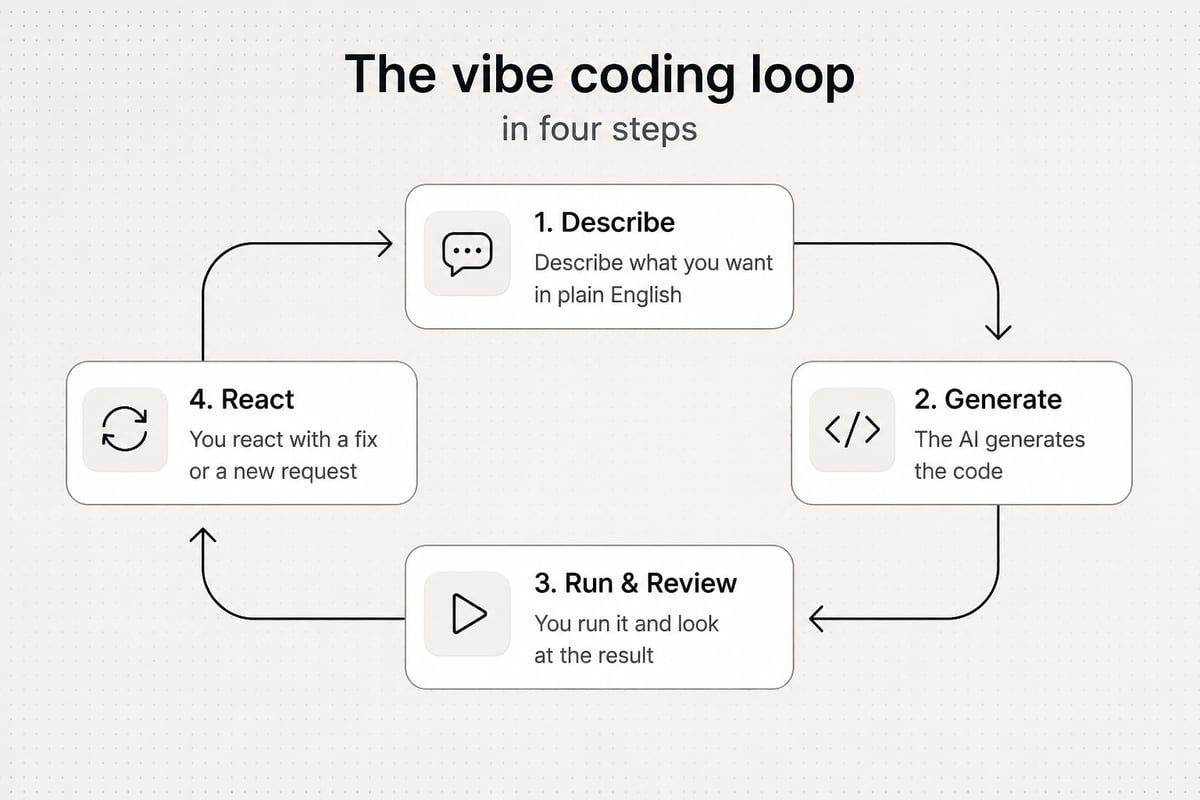
Here is what a typical session looks like.
- Start with a plain-language request. For example: "Build a page where customers enter their email and get a PDF checklist."
- The AI writes the code. It picks the framework, creates the files and sets up the layout.
- You run it. You click around and see what is broken or missing.
- You give feedback in plain words. "The button is too small. The confirmation message should say thanks by name."
- You paste errors straight back. If the app crashes, you copy the error text into the chat and ask for a fix.
- You stop when it behaves. There is no formal review step unless you add one.
The tools behind this fall into a few groups. Chat assistants such as ChatGPT can write code you copy into a project. Code editors with built-in AI let the model edit many files at once. App builders go further and give you a hosted, running app from a prompt, with no setup at all. They all do the same job: turn your description into code and let you iterate.
What is vibe coding good for?
Vibe coding is good for anything where speed matters more than polish and a failure costs little: prototypes, internal tools, simple websites and one-off scripts. In those cases, the usual drawbacks barely apply.
Concrete examples for a small business:
- A quote calculator. A plumber or landscaper wants a form where a customer enters square footage and sees a price range. That is a small, self-contained tool.
- A spreadsheet cleaner. A script that merges two customer lists and removes duplicates, run once and thrown away.
- A landing page test. A founder wants to see whether a new offer gets sign-ups before paying a developer. A rough page built in an hour answers that.
- An internal dashboard. A simple page that pulls numbers from a sheet and shows them in charts for a team of three.
- A prototype to show a developer. Instead of describing an idea in a document, you hand over something clickable.
The pattern is the same each time. The stakes are low, the user count is small, and if it breaks you can rebuild it in an hour. An ACM discussion of vibe coding makes the same split: it sees real promise in rapid prototyping and in letting more people take part in building software, while flagging concerns about code that is fragile, opaque and hard to maintain.
Where does vibe coding break down?
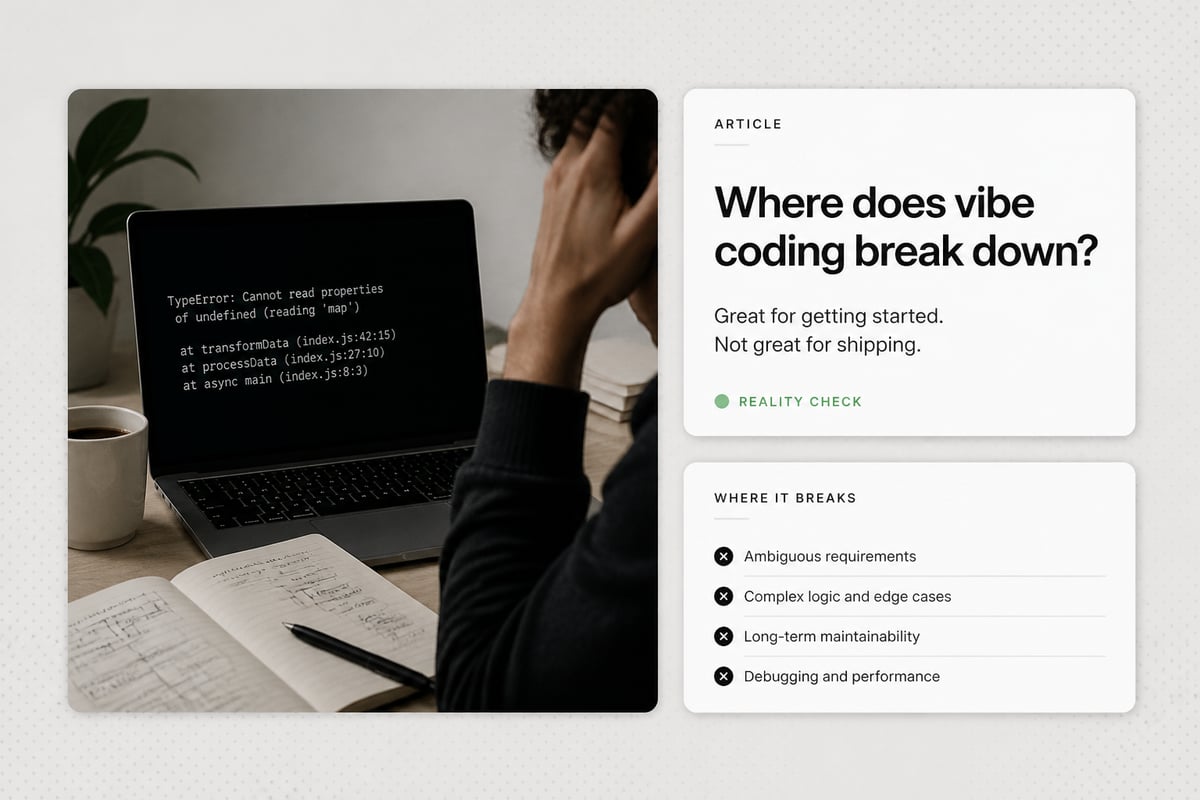
Vibe coding breaks down when the software has to be secure, reliable or maintained over time, because you cannot fix or audit code you never read. The AI will produce something that looks right and runs on the first try. That is not the same as being correct.
The common failure points:
- Security. Code that handles logins, payments or customer data needs real scrutiny. AI-generated code can skip input checks, expose keys or store data unsafely, and you will not see it unless you know where to look.
- Maintenance. After 20 rounds of "now change this," the code can become a tangle. Adding feature 21 may break features 3 and 9.
- Debugging past the easy cases. Pasting an error into the chat works until it doesn't. When the AI loops on a bug it cannot solve, you have no fallback.
- Hidden costs. App builders and AI usage can bill by the prompt or by the month. A project that "took an afternoon" can still carry ongoing fees.
- Ownership. If the code lives inside a builder's platform, moving it elsewhere may be hard.
Developers themselves are split on all this. In the Stack Overflow 2025 Developer Survey, most respondents said vibe coding was not part of their professional development work. Yet the same survey found that most developers use or plan to use AI tools in their development process. So developers are adopting AI broadly but keeping their hands on the code.
Trust is divided too. The survey reports that a slim majority of developers trust AI tools somewhat or highly, while a large minority distrust them somewhat or highly.
Vibe coding vs. traditional coding vs. AI-assisted coding
Vibe coding, AI-assisted coding and traditional coding differ mainly in how much of the code a human reads and understands. The table puts the three side by side.
| Traditional coding | AI-assisted coding | Vibe coding | |
|---|---|---|---|
| Who writes the code | A developer | Developer and AI together | The AI |
| Is the code read line by line? | Yes | Yes, by the developer | Rarely |
| Skill needed | Programming knowledge | Programming knowledge | Clear description, basic testing |
| Speed on a small project | Slow | Fast | Fastest |
| Suited to production software | Yes | Yes | Only with added review |
| Main risk | Slow and costly | Over-trusting suggestions | Unseen bugs and security holes |
GitHub's own guidance points the same way. Its responsible use documentation advises users to understand an AI coding assistant's purpose, capabilities and limitations when using its features. That is the opposite of "forget the code exists," and it is a fair note of caution even for people who like the vibe coding style.
Is vibe coding a legit skill?
Vibe coding is a legitimate skill in the way that writing a clear brief is a skill: it is real, learnable, and useful, but it does not replace knowing how software works. People who do it well share a few habits.
- They break a big idea into small requests instead of asking for a whole app at once.
- They test after every change, so a break is easy to trace.
- They keep copies of working versions before asking for a big edit.
- They describe the problem, the user and the constraint, not just the feature.
- They know when to stop and bring in a developer.
What it does not give you is engineering judgment. You can ship a working demo without it. You cannot reliably run a business-critical system without it. Treat vibe coding as a fast way to get a first version, not as a replacement for the people who keep software safe and running.
Can coding be done with AI?
Yes, coding can be done with AI, and most developers now do some of it. AI tools can write functions, explain unfamiliar code, convert code between languages and find simple bugs. The open question is how much a person should check what comes back.
Think of it as a dial rather than a switch. At one end, a developer uses AI for boilerplate and reviews everything. In the middle, a technical founder builds a prototype with AI and reads the important parts. At the far end is pure vibe coding, where nobody reads anything. The right setting depends on what happens if the code is wrong. A broken quote calculator costs you an annoyed customer. A broken payment flow costs you money and trust.
What does vibe coding mean for a small business?
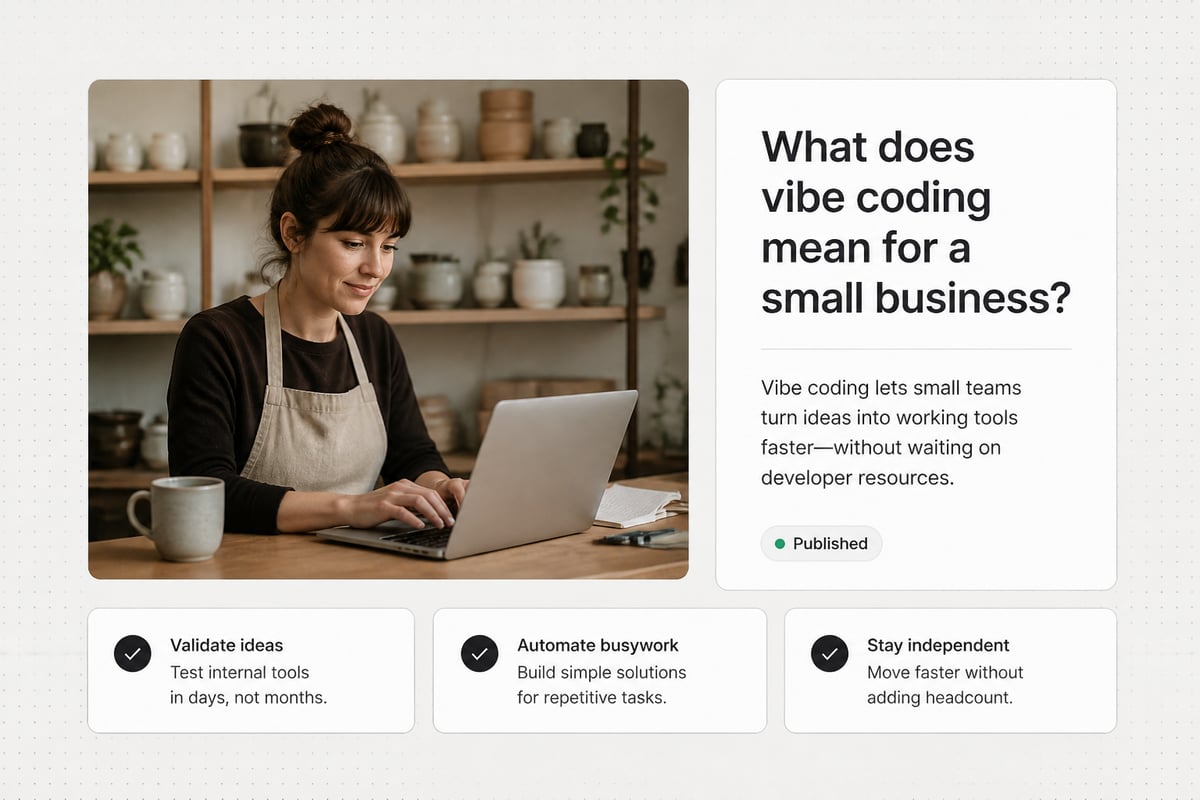
For a small business, vibe coding lowers the cost of building small custom tools, which used to mean hiring a freelancer or going without. It does not lower the cost of getting customers, which is the harder problem.
Hypothetical example: a small online shop builds a simple tool that lets visitors pick product options and see a recommended bundle. It can work well, but if nobody visits the site, nobody uses it. Building the tool was never the bottleneck. Traffic was.
That is the useful lens. Vibe coding speeds up making things. It does nothing for getting found. For most small businesses, steady search traffic is still what moves revenue, and that comes from publishing helpful content consistently over months. If you want to understand how that works, a plain guide to organic SEO is a good place to start.
The same idea of handing routine work to AI has reached search, too. Vibe SEO applies a similar mindset to content and rankings, and there is a broader look at AI business automation tools if you want to see where else automation pays off. As with code, the same warning holds: automate the repetitive work, and keep a human check on anything that affects your reputation. If you plan to put AI-written articles on your site, RankPill lets you choose to review each article before it goes live.
Some practical rules if you try vibe coding for your business:
- Keep customer data out of it. Don't build anything that stores passwords, cards or personal details unless a developer reviews it.
- Start with throwaway projects. Build something you can delete without regret.
- Save working versions. Copy the project before each major change.
- Set a spending limit. Check how your tool bills before you iterate for hours.
- Know the exit. If the project grows, budget for a developer to review or rebuild it.
Businesses that need help beyond code have other options. For example, if customer calls pile up as you grow, a provider like Focus Services offers call center outsourcing, which is a human-run solution to a problem software alone won't fix.
Related terms
A few terms come up often alongside vibe coding, and they are easy to mix up.
- Prompt engineering: the craft of writing instructions that get a good result from an AI model. Vibe coding relies on it, but prompt engineering applies to far more than code.
- AI pair programming: a developer works with an AI assistant, reviewing its output. It sits between traditional and vibe coding.
- No-code and low-code tools: visual builders that let you assemble apps with drag-and-drop blocks. They need no AI, but they solve a similar problem.
- Agentic coding: AI agents that plan and carry out multi-step coding tasks on their own, with less back-and-forth from you.
- Technical debt: the future cost of quick, messy code. Vibe coding can build it up fast.
- Generative engine optimization: making your content easy for AI assistants to cite. It is the search-side counterpart to AI-built software, and you can read more in this guide to generative engine optimization.
FAQ
Was Elon Musk a coder?
Elon Musk is known to have taught himself programming, and he has written code in his companies. He is not known as a vibe coder, and the term itself comes from Andrej Karpathy, not from him.
Is coding very difficult?
Learning to code takes months of steady practice, and getting good at it takes years, so it is a real commitment. The hard part is less the syntax and more learning to break problems into logical steps. AI tools make the first steps easier, but they do not remove the need to understand what the code is doing.
Do I need to know how to code to try vibe coding?
No, you can start without programming knowledge, which is much of its appeal. You do need patience, clear writing and a habit of testing each change. For anything touching customer data or payments, bring in someone who can read the code.
Pick one small, low-risk task this week, such as a quote calculator or a landing page test, and try building it by describing it to an AI, saving a working copy before every change. Then put the same energy into the part software can't fix on its own: getting people to your site. Try RankPill to have articles planned, written and published to your WordPress, Shopify, Webflow, Wix or Framer site on your schedule, starting with a 3-day trial for $1.
Unlock Traffic on Autopilot
Grow organic traffic on autopilot. RankPill will research, write, optimize, and publish articles to your website daily.