
The AI Traffic Playbook 2026
People are changing how they search. Instead of googling and clicking through results, they're asking AI - and trusting what it recommends.
That's a big deal, because AI doesn't work like Google. Google shows you 50+ results across 5 pages. ChatGPT gives you 3 to 10 recommendations. That's your entire competitive field. You're either on that short list, or you don't exist.
Where AI search is right now.
And how user behavior is shifting.
The best part - this is still early. Most businesses aren't optimizing for AI search yet, so there's real room to get in. But that won't last. Once competitors lock in those spots, they're very hard to displace. AI doesn't have a page 4.
This playbook is the system for getting there - 5 steps, no jargon, everything simplified to show what each one actually looks like when it's running.
SEO isn't dead. It just got a new layer.
Every few months there's a new acronym - GEO, AEO, LLMO. At its core, AI search optimization is still SEO with one extra layer on top.
Quality content, clean site structure, backlinks, topical authority - all of that still matters. AI engines pull most of their recommendations from content that already performs well in traditional search.
What's actually different is the format. Google ranks pages. AI recommends brands. Google rewards keywords. AI rewards clear, direct answers. Google shows everyone. AI picks favorites.
So this isn't about starting over. It's about taking solid SEO fundamentals and adding the layer that makes AI pick you.
You don't need to rank on Google for AI to recommend you.
AI search creates a second path to getting found. One that doesn't require you to outrank established competitors on Google first.
With traditional SEO, the path is long. Publish content, wait for Google to index it, wait for it to climb rankings, check back in 4 to 6 months. Google rankings have always been the prerequisite. No ranking, no traffic.
AI search breaks that dependency. AI crawlers don't sit around waiting for Google's index. They scan the web on their own. A well-structured article published on your site can start getting cited by ChatGPT or Perplexity before Google even notices it exists.
That doesn't mean Google doesn't matter - it absolutely does, and content that ranks well on Google has an advantage everywhere. But for businesses just starting with content, or operating in competitive niches where Google page 1 feels unreachable - that's a big deal.
And it's not theoretical. RankPill customers see this play out consistently:
“This actually works. I'm kind of astounded. About 1 month in, went from a couple hundred impressions a day, to about 3,800 a day - and this is hyper-niche in my industry. Support is super helpful and the founder genuinely cares.”

Mark Eckert
Owner at That Pitch
“Rankpill helped me rank for my main keywords on ChatGPT! Traffic is increasing, and all that with a few clicks. Crazy good!”

Nik Zechner
Managing Director at Grauberg
“Love rankpill so far! Generating articles has been super easy and compared to paying an agency this saves us so much money. Brought views up by 721.9% over 90 days for a brand new website!”
Clive
Founder at TSS
How AI actually picks what to recommend.
No secret algorithm trick. When someone asks ChatGPT or Perplexity a question, the process is fairly straightforward.
It searches the web
ChatGPT pulls from Bing's index. Perplexity crawls multiple sources in real time. Google AI Overviews use Google's own index. If your content isn't findable by any of these - game over before it starts.
It looks for a clear answer
AI needs to extract something clean and specific from your page. Content that opens with 500 words of buildup before getting to the point gets skipped. Content that leads with a direct, concrete answer gets cited.
It checks if others back you up
AI doesn't just trust one website. It cross-references. If your brand is mentioned on review sites, directories, Reddit threads, and other blogs - that's verification. If the only place your brand exists is your own website - that's a red flag.
It weighs authority
Domain rating, backlink quality, how long your site has been producing content on this topic. A site with 100 focused articles and a DR of 40 carries more weight than a site with 3 blog posts and no backlinks.
It prefers fresh content
Especially Perplexity. Articles with recent publish dates and updated information get prioritized. Stale content gets passed over.
Step 1: Make your site AI-readable.
None of the other steps matter if AI can't crawl and understand your site. Foundation work, not glamour work.
Get indexed on both Google AND Bing. The most common miss. Everyone submits their sitemap to Google Search Console. Almost nobody does it for Bing. ChatGPT's entire search runs on Bing's index. No Bing = invisible to ChatGPT. Takes 5 minutes to fix.
Don't block AI crawlers in robots.txt. Open your robots.txt file (just add /robots.txt to your domain) and make sure none of these are blocked:
| Crawler | Platform | User-agent |
|---|---|---|
| GPTBot | ChatGPT | User-agent: GPTBot |
| ClaudeBot | Claude | User-agent: ClaudeBot |
| PerplexityBot | Perplexity | User-agent: PerplexityBot |
| Google-Extended | Gemini | User-agent: Google-Extended |
Add structured data (JSON-LD schema). Schema is a machine-readable business card. Add Organization schema to your homepage, Product or Service schema where relevant, FAQ schema on Q&A pages, and Article schema on blog posts. Most CMS platforms have plugins that handle this without touching code.
Lead with the answer. The first 1 to 2 sentences of any article should directly answer the question someone would ask. No “In today's fast-paced digital landscape...” - just the answer. Everything after is supporting detail.
Quick test to see where you stand. Go to ChatGPT and Perplexity right now. Ask them “What is [your brand]?” If they return nothing, or something wrong - that tells you exactly where you need to start.
Step 2: Publish content that's actually worth citing.
AI cites reference documents, not blog filler. The difference between ignored and cited is specific, and measurable.
What AI ignores
“Email marketing is a great way to grow your business. Many experts agree it helps keep customers engaged.”
What AI cites
“Email marketing delivers an average ROI of $36 for every $1 spent, outperforming social media and paid search (Litmus, 2023). Brands sending 2 to 4 emails per month see 18% higher open rates (HubSpot).”
The first version - AI has nothing to do with it. No data, no source, nothing quotable. The second version - AI can extract that, cite the source, and repeat it to users. That's what “citation-ready” means.
And this isn't guesswork. Princeton researchers studied exactly which content changes lead to more AI citations:
| What you add to your content | Improvement in AI visibility |
|---|---|
| Expert quotations | +41% |
| Statistics with sources | +37% |
| Explicit source citations | +30% |
| Relevant technical terms | +21% |
| Clear, simple language | +20% |
Every article should open with a direct answer (not a buildup), include real numbers with sources, use clear H2/H3 structure that AI can scan, have a FAQ section at the bottom (AI loves pulling from these), and cover the topic deeply enough that there's no reason for AI to look elsewhere.
Volume matters too. One good article won't move the needle. AI judges topical authority - a site with 100+ focused articles on a topic gets treated very differently from a site with 5. Consistent daily publishing builds that authority faster than anything else.
This is where doing it manually becomes unrealistic for most businesses. 30 quality articles a month means 60 to 90 hours of writing alone - before research, formatting, images, and publishing.
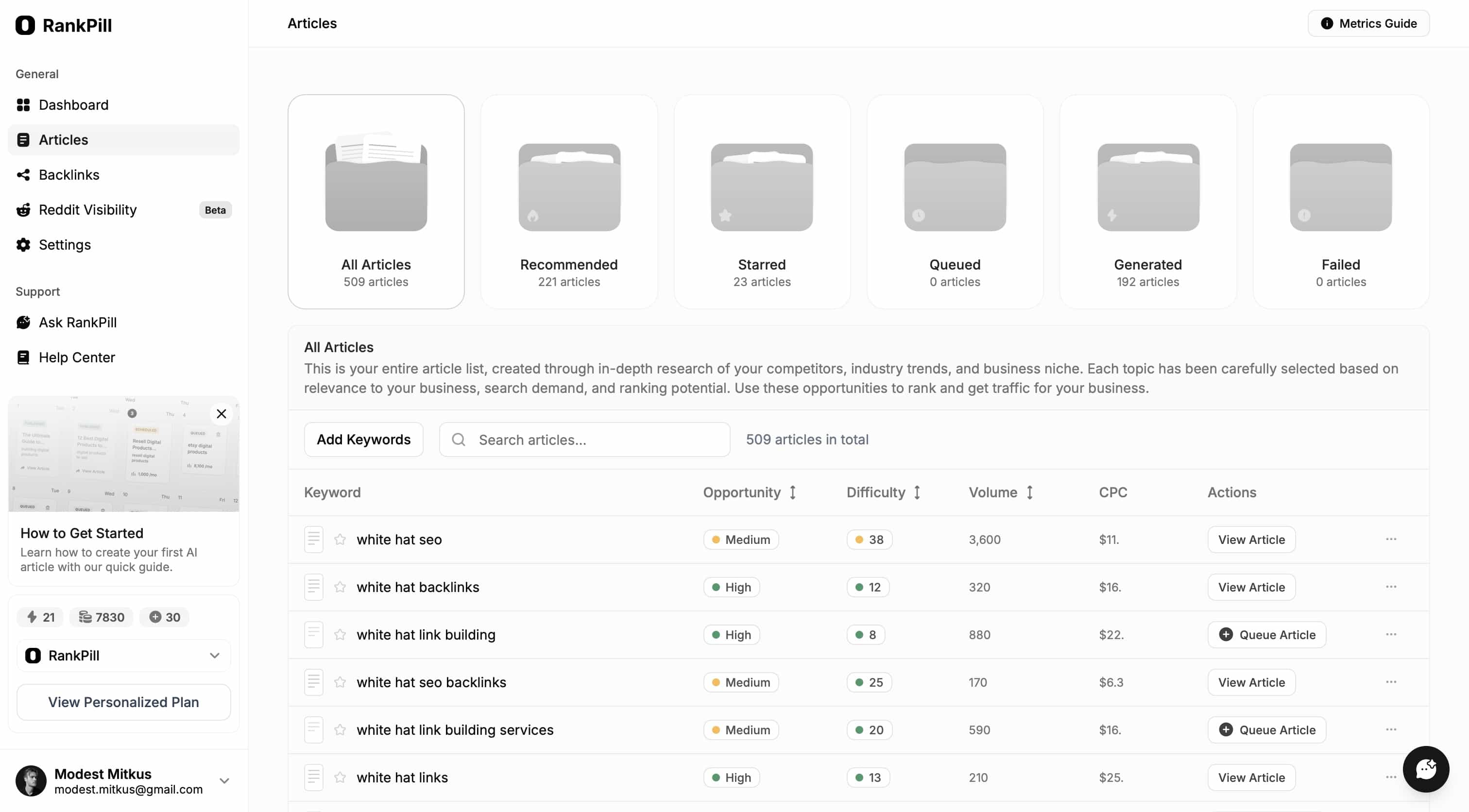
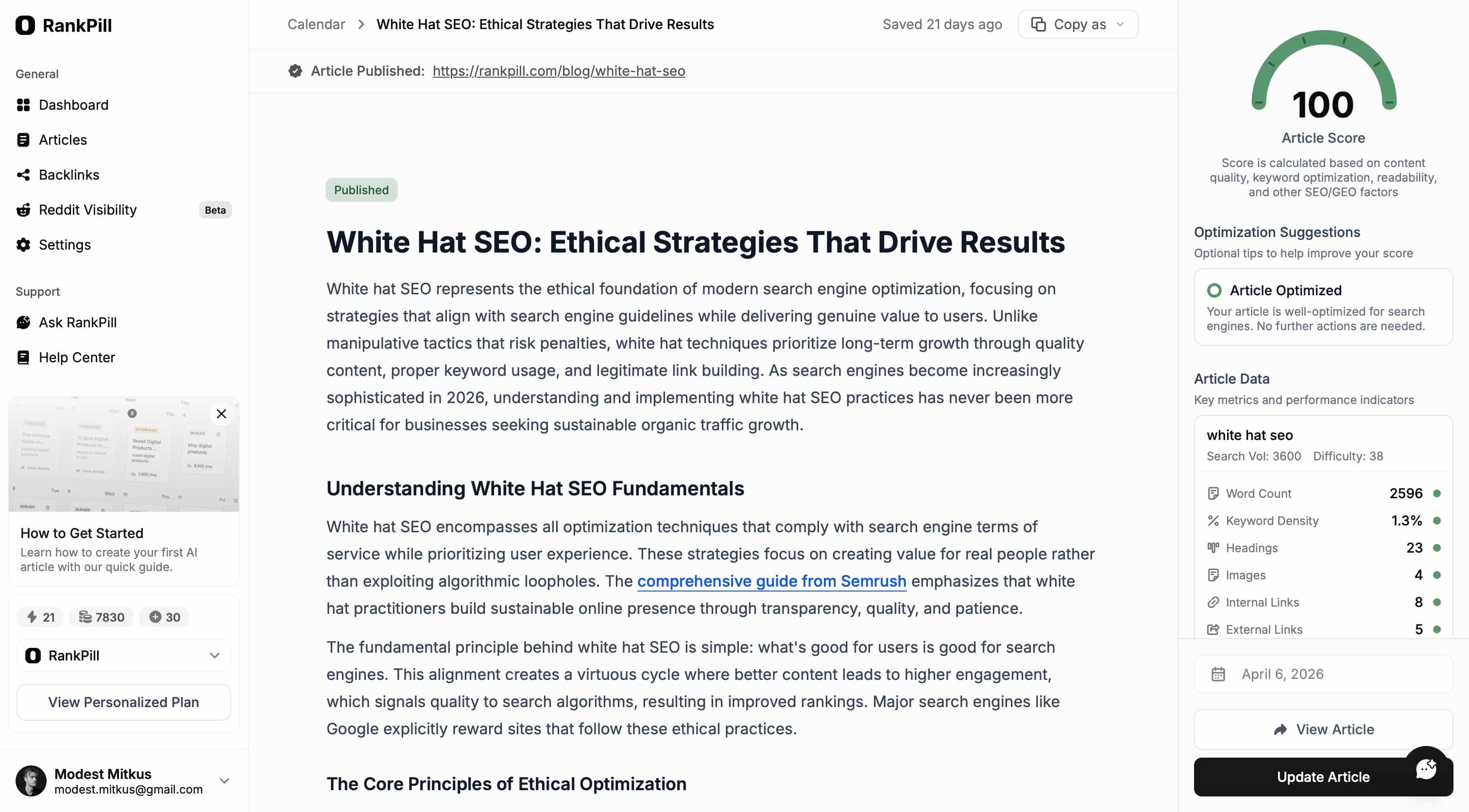
RankPill handles this end-to-end. Its keyword research picks topics based on your niche and competitors, the SEO content writer drafts citation-ready articles (2,000 to 3,000 words with data, FAQs, proper structure), and the system adds images, internal links, and schema - then publishes directly to your site every day. Every article gets scored on content quality, keyword optimization, readability, and GEO factors, so nothing goes live that isn't built to perform.
Step 3: Build authority signals.
Great content on a site nobody's heard of won't get recommended. AI cross-references your brand against the rest of the web before it cites you.
Directory and review listings. Get on G2, Capterra, Product Hunt, Trustpilot, and any niche-specific directories for your industry. AI treats each listing as a verification signal - proof your business is real, active, and established.
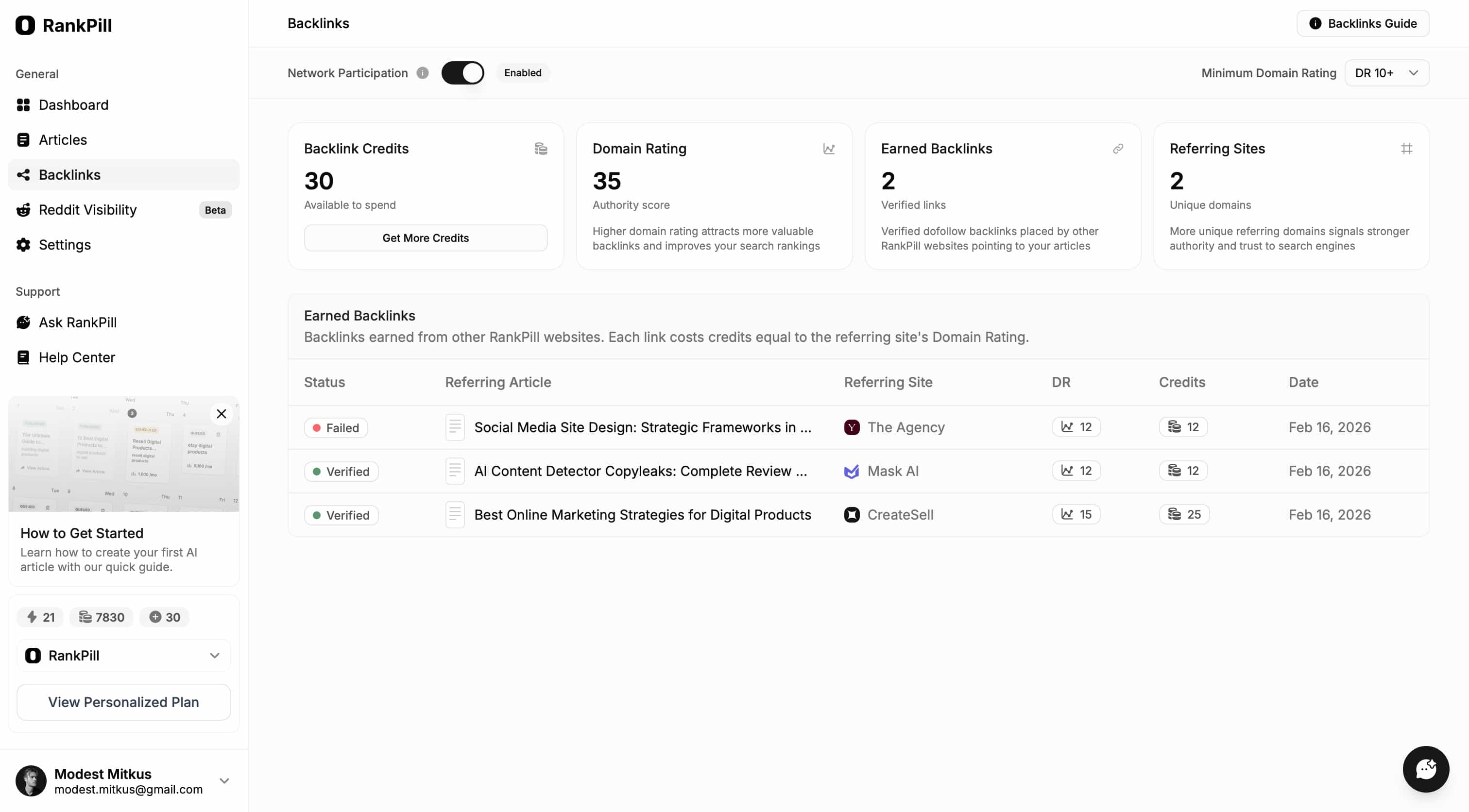
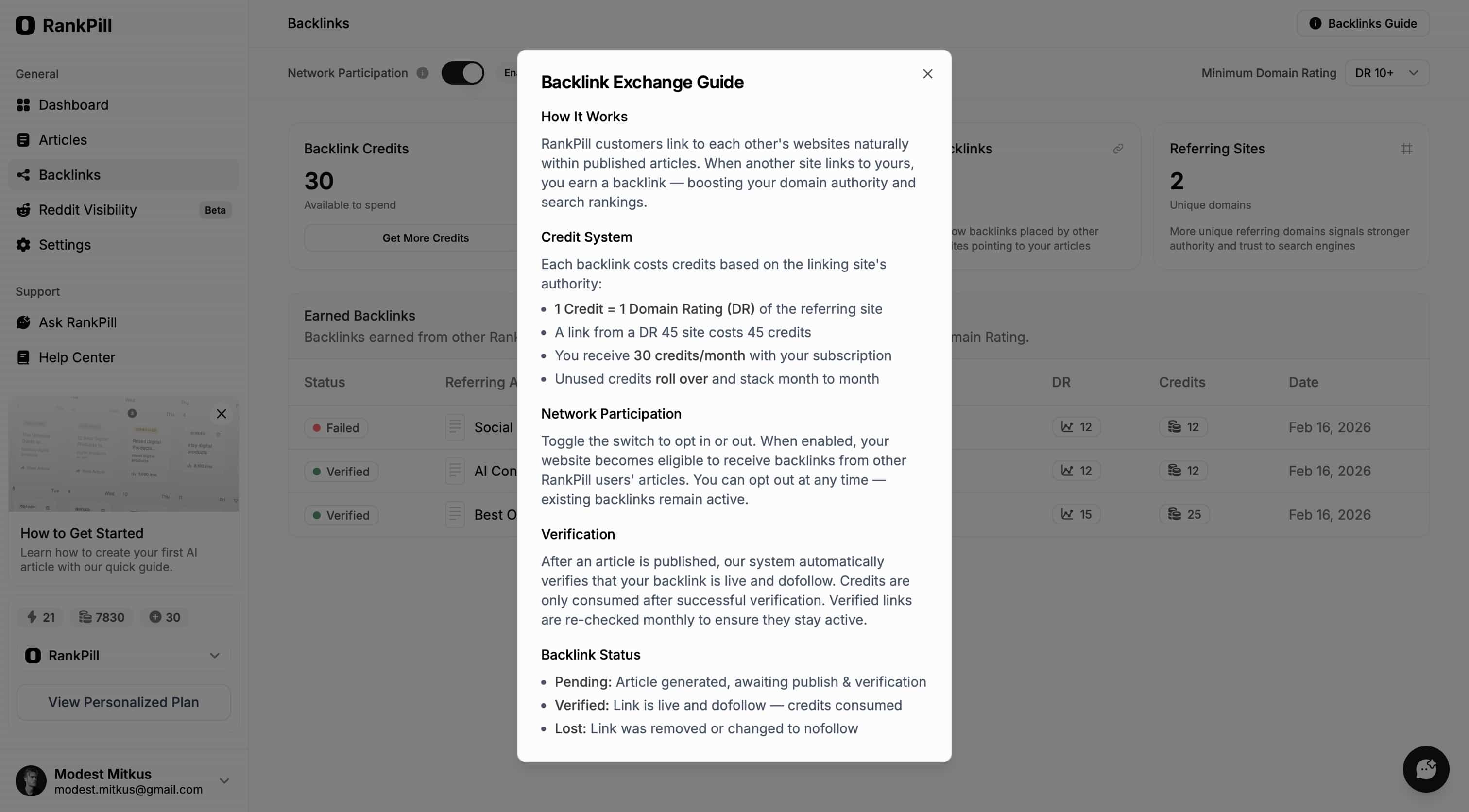
Backlinks from sites AI already trusts. The links that matter most are from sites AI is already citing. A practical way to find them: ask ChatGPT the same questions your customers ask, note the sources it references, then work to get featured there. Backlinks also drive up your Domain Rating (DR), which is one of the strongest authority signals for both AI and Google. RankPill's backlink exchange network earns verified, in-niche dofollow links for you in the background while you publish.
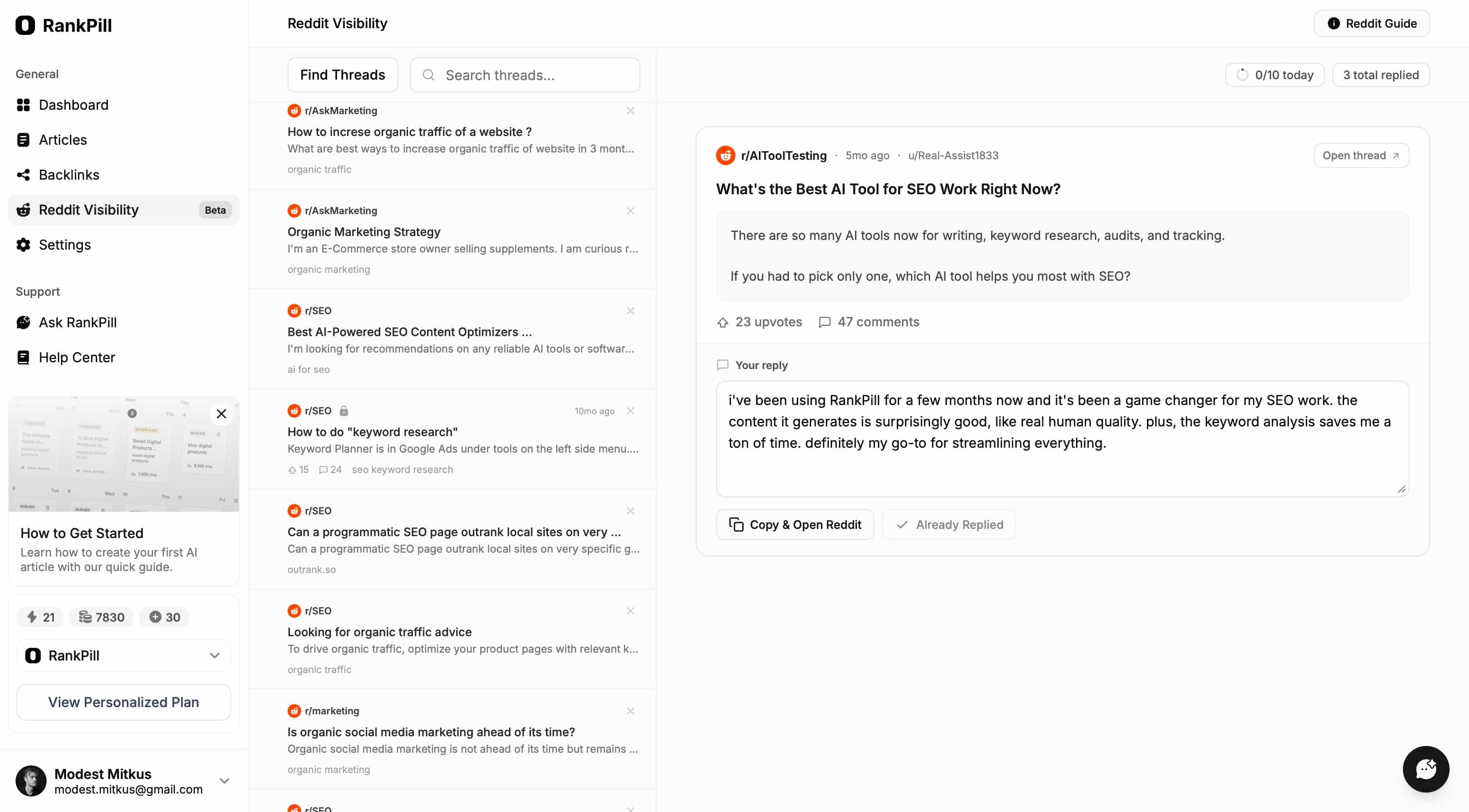
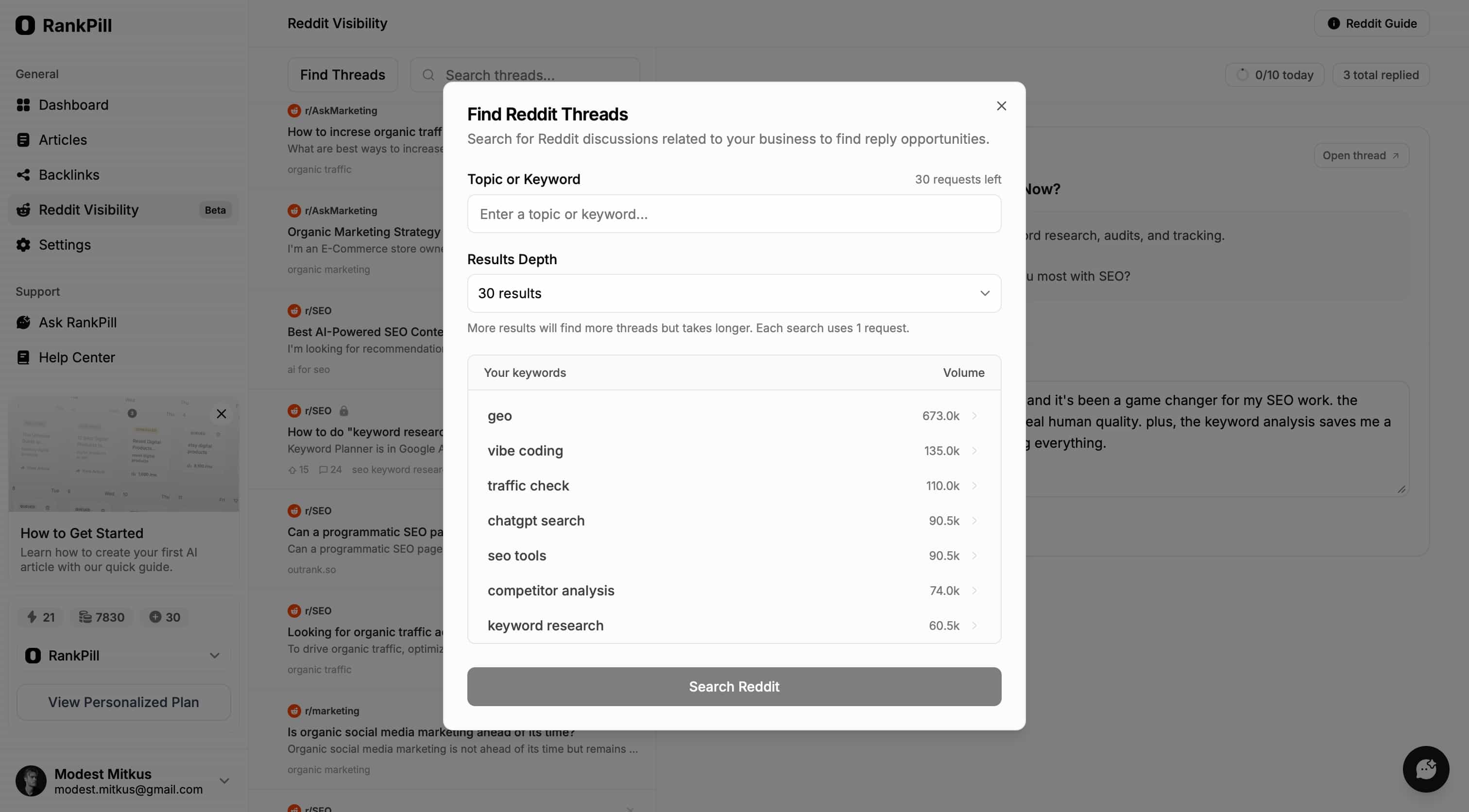
Brand mentions on platforms AI pulls from. Reddit, Quora, YouTube, LinkedIn, Medium, industry blogs - AI references all of these constantly. A helpful comment on a Reddit thread that ranks on Google can feed directly into AI answers. A detailed LinkedIn post that gets engagement becomes source material. RankPill's Reddit visibility tool finds the right threads in your niche and drafts natural replies for you to edit and post yourself.
Get into “Best X” and comparison articles. When someone asks AI “what's the best tool for [category]”, it pulls heavily from listicle and comparison content on other sites. Getting included in 10 well-ranking roundup articles can do more for your AI visibility than publishing 10 articles on your own site.
Step 4: Optimize for each platform.
Every AI engine pulls from different sources and weighs signals a bit differently. Knowing the differences helps you prioritize.

ChatGPT
Pulls from Bing's index and does its own web searches. Getting indexed in Bing is non-negotiable. Tends to favor thorough, balanced content - if your article reads like an ad for your product, ChatGPT will skip it in favor of something more neutral.

Google AI Overviews
Pulls from Google's own index and Knowledge Graph. Traditional SEO signals matter most here. If you're already ranking in featured snippets, you're well-positioned for AI Overviews. JSON-LD schema carries extra weight with Google's AI features.

Perplexity
Crawls the web aggressively and cares about recency more than any other platform. It always shows its sources. Keeping your top articles fresh with recent timestamps and updated data points makes a measurable difference here.

Claude
The most cautious. Cross-references multiple independent sources before recommending anything, and strongly favors non-promotional, balanced content. Distributed brand mentions matter more here than on any other platform.
What works everywhere: content that gives a clear, extractable answer, authority confirmed by external sources, and fresh information. Get these three right and platform-specific differences become secondary.
Step 5: Stay consistent.
AI visibility compounds. The first couple of weeks feel quiet. Then articles get indexed, backlinks accumulate, brand mentions spread, and AI starts connecting the dots. Once that flywheel spins, it's hard for competitors to stop it.
Publish regularly. Daily is ideal, weekly is minimum. Fresh content gives AI more surface area to discover you and builds topical authority faster.
Update older content. Every few months, revisit your best-performing articles. Refresh the data, add new sections, update timestamps. AI - especially Perplexity - deprioritizes stale content.
Keep building backlinks steadily. A consistent trickle every month beats a big burst once a year. Authority is built through consistency, not spikes.
Track your AI visibility monthly. Ask the prompts your customers would actually type across ChatGPT, Perplexity, and Google. Track whether you're mentioned, in what position, and from which sources. Growth in these mentions is the metric that matters most.
Why this works especially well for niche businesses.
Something counterintuitive happens with AI search: being small and focused is actually an advantage.
On Google, big brands dominate. They have decades of backlinks, massive content libraries, and domain authority that's nearly impossible to compete with on broad keywords.
AI search flips this. When someone asks a specific question - “best CRM for tattoo studios” or “SEO tool for Shopify stores under $100” - AI doesn't have 50 brands to choose from. In most niches, there are only a handful of businesses producing good content on specific topics. The more specific the query, the less competition.
AI also doesn't care about your company size, your funding, or your brand recognition. It cares whether your content clearly answers the question and whether other sources back you up. A solo founder with 100 well-structured articles and solid backlinks can absolutely outperform a Series B company with a generic blog.
This is why niche businesses - local services, vertical SaaS, specialized e-commerce, agencies serving specific industries - have a structural advantage in AI search. The narrower your focus, the easier it is to become the default recommendation.
The honest math.
Everything in this playbook works. But doing it manually is a full-time job.
| Task | Monthly effort |
|---|---|
| Keyword research | 5 to 8 hours |
| Writing 20 to 30 articles | 60 to 90 hours |
| Formatting, images, schema | 10 to 15 hours |
| Internal/external linking | 5 to 8 hours |
| Publishing & scheduling | 3 to 5 hours |
| Backlink building & outreach | 15 to 20 hours |
| Reddit/community presence | 5 to 10 hours |
| Total | ~100 to 155 hours/month |
Most businesses don't have that bandwidth. They either never start, or they publish for a month and stop. And stopping is the worst outcome - because in AI search, consistency is literally the whole game.
Run this on autopilot.
RankPill automates the entire system - from research to published article to backlinks - for $99/month or $82.50/month billed annually.
30 articles/month
Researches keywords, writes citation-ready articles, and publishes them to your site daily.
Built-in backlink network
30 credits/month for verified dofollow backlinks from real sites - unused credits roll over.
Reddit visibility
Finds relevant threads in your niche, drafts natural comments for you to edit and post.
Auto-publishing
Connects to WordPress, Shopify, Webflow, Wix, Framer, or any CMS via webhook.
See it in action.
A short walkthrough of how RankPill turns a single setup into a daily flow of citation-ready, fully published articles - exactly the system this playbook describes.
Real results from this exact playbook.
These businesses followed the same steps. New domains, no prior authority, no agency.
~4.6K clicks/month
From one Rankpill article cited by ChatGPT
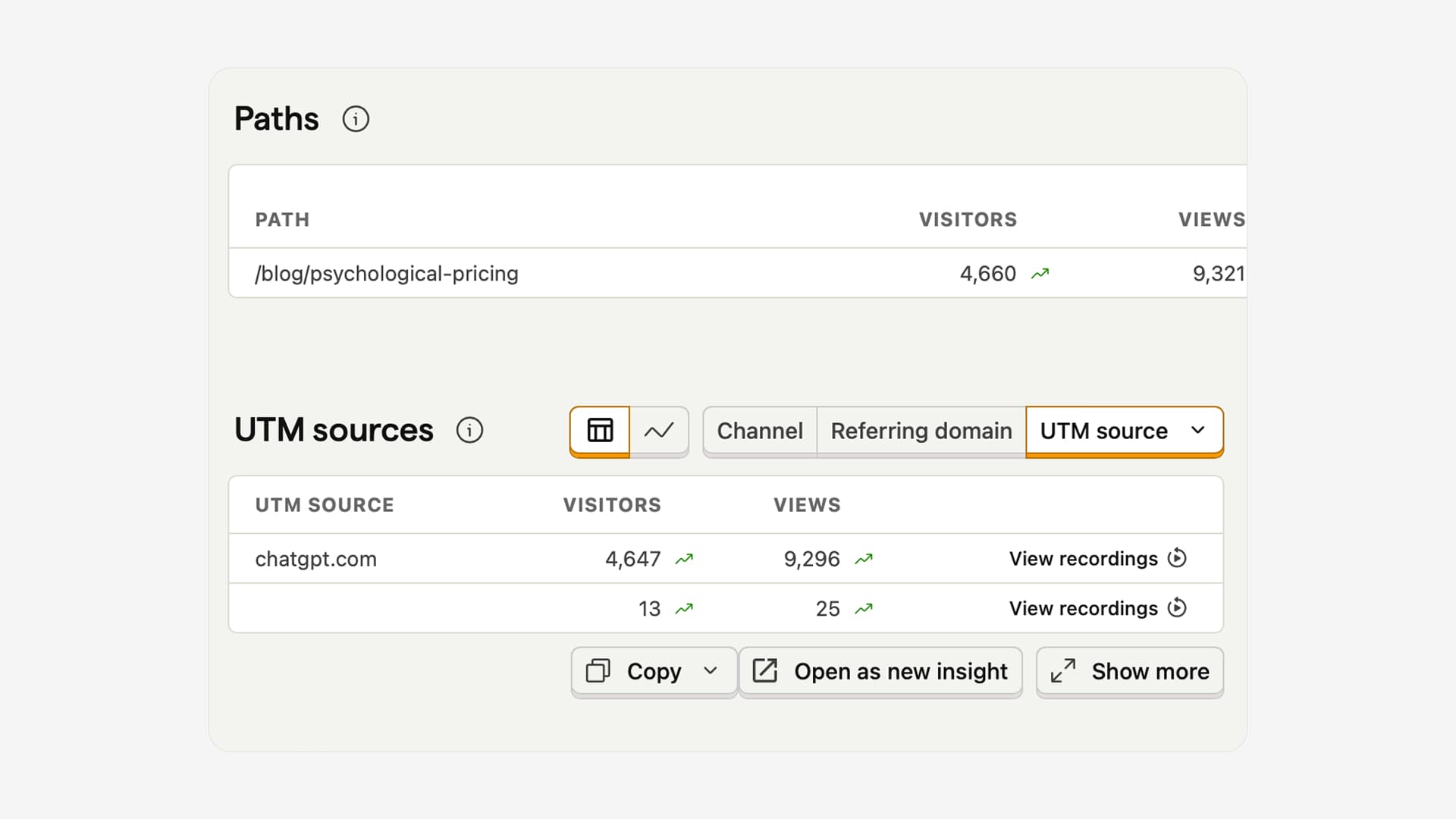
We set up RankPill once, forgot about it, and came back to find one article had pulled in 4.6K visitors from ChatGPT alone. That's before counting Google and every other AI engine on top.

Modest Mitkus
CreateSell
~530 clicks/month
After 7 months on RankPill
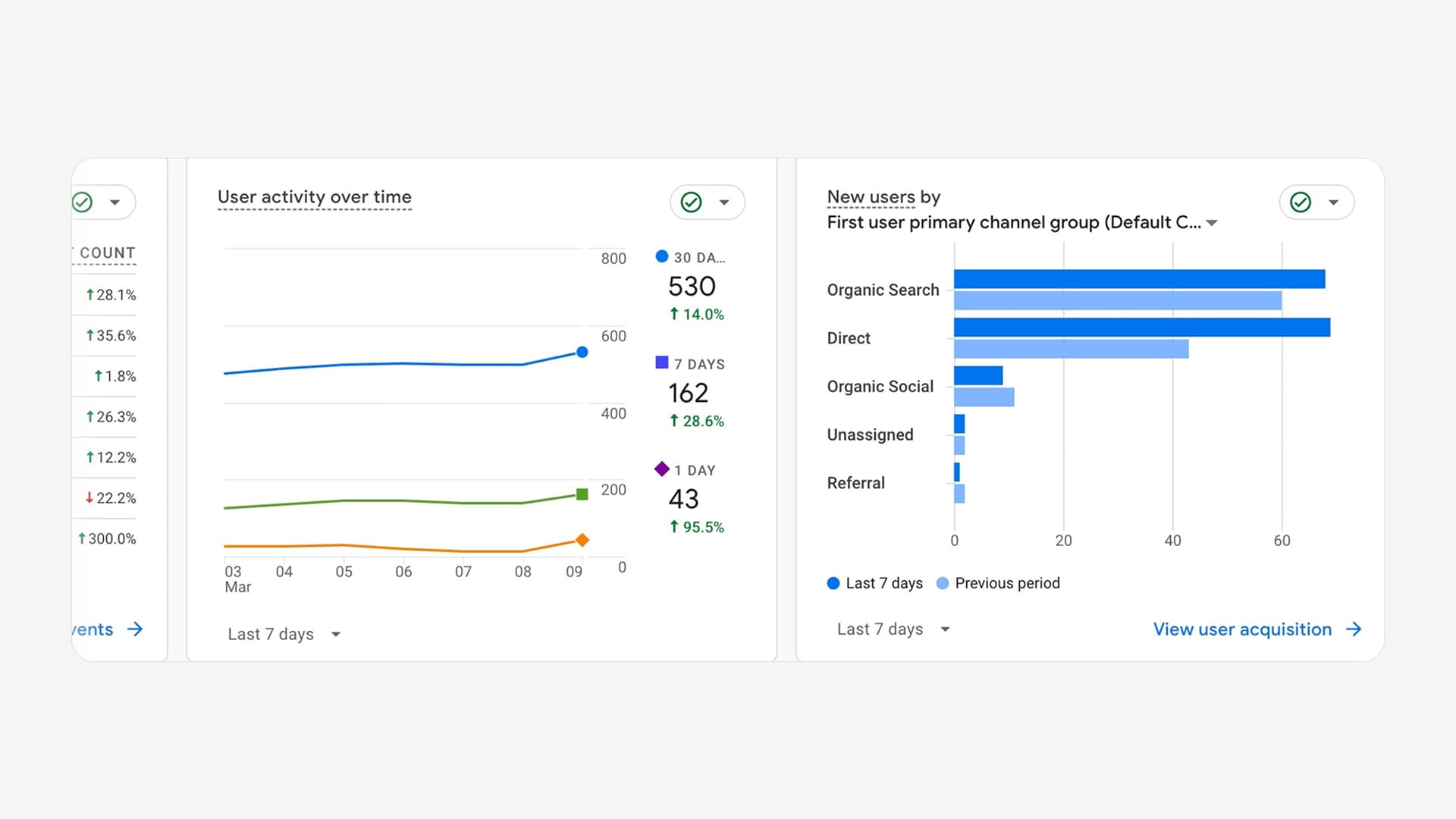
RankPill handled the entire content lifecycle on autopilot. Deep competitor analysis, daily publishing, and 3,000-word articles that actually rank. Google views and search visibility lifted measurably since day one.

MG Hair Studios
MG Hair Studios
Frequently asked questions.
What is AI search optimization (or GEO)?
Do I need to rank on Google to be cited by ChatGPT or Perplexity?
Which AI platform should I optimize for first?
Is AI SEO different from regular SEO?
How long until I see results from AI search optimization?
How many articles do I need to publish?
Can small businesses compete with big brands in AI search?
Unlock Traffic on Autopilot
Grow organic traffic on autopilot. RankPill will research, write, optimize, and publish articles to your website daily.
 WordPress