
Backlink Exchange Guide: How to Trade Links Safely in 2026

Modest Mitkus · November 7, 2026
A backlink exchange is an arrangement where two sites link to each other, or a group of sites link in a pattern, to help each other earn authority. It can work in 2026, but only when the links are relevant, limited in number and not obviously traded for rankings alone. Done badly, it is a fast route to a spam action from Google.
This guide covers what Google actually says about link trading, the formats that carry the most risk, how to vet a partner, and a simple process you can run without a full-time SEO.
What a backlink exchange is and why people use it
A backlink exchange is a trade: you place a link to another site, and they place a link to yours. The appeal is simple. Links still help pages rank, and most small sites have no budget for press outreach or paid placements.
There are three common formats:
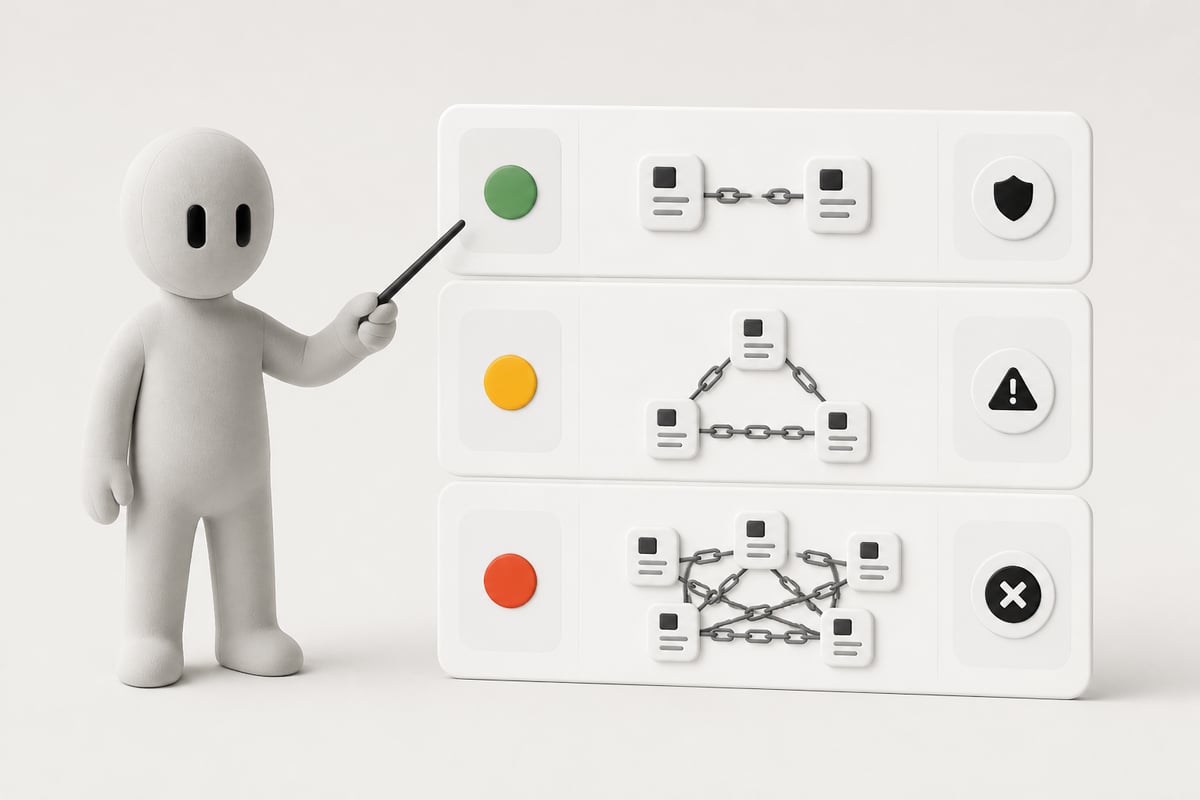
- Direct swap (A to B, B to A). Two sites link to each other. This is the easiest to set up and the easiest for Google to spot at scale.
- Three-way swap (A to B, B to C, C to A). Often called an ABC exchange. Each site links out to one partner and receives a link from another. The pattern looks less symmetrical.
- Network or platform exchange. A group of vetted sites trade links through a shared system, often with matching rules and quality filters.
For a founder with no time to cold email 50 site owners, the third format is the most practical. It cuts the outreach work. It does not remove the risk, which comes from how you use it.
What Google says about link exchanges
Google treats link exchanges as spam only when their main purpose is to manipulate rankings. Its spam policies define link spam as creating links to or from a site primarily to manipulate search rankings. The examples it lists include excessive reciprocal link exchanges and partner pages created solely for cross-linking.
Two details matter here.
First, the word is "excessive." A few relevant links between businesses that work in the same space are normal. A site with 200 reciprocal links and a "partners" page nobody visits is not.
Second, Google also flags links exchanged for money, goods or services when the goal is to manipulate rankings. If a trade involves anything of value beyond the link itself, such as free products or a paid fee, treat that link as paid. Google allows paid and sponsored links when they are qualified with rel="sponsored" or rel="nofollow". Its guidance on qualifying outbound links says it prefers sponsored for advertisements and paid placements, and nofollow remains acceptable.
Google also warns that excessive sponsored or guest posting without proper link tags can lead to algorithmic or manual actions, per its link spam update reminder. In short: the penalty risk is about intent and pattern, not about the existence of a trade.
Which exchange patterns carry the most risk
The riskiest patterns are the ones that look manufactured: high volume, identical anchor text, unrelated sites and links placed on pages that exist only to hold them.
Watch for these warning signs:
- Volume spikes. Going from 5 referring domains to 60 in a month looks unnatural for most small sites.
- Exact-match anchors. If every partner links to you with "best plumber in Austin," the pattern is obvious.
- Irrelevant partners. A SaaS startup linking to a pet grooming blog gives no reader a reason to click.
- Link pages. A "resources" or "partners" page full of outbound links, with no real content around it, is the classic footprint.
- Reciprocity at scale. One or two direct swaps are fine. Making every link a direct swap is not.
- Thin host pages. A link placed on a page nobody reads and no one links to carries little value and some risk.
None of these will trigger a penalty alone. Several together are what make a pattern look like an exchange scheme.
How to vet a link partner before you trade
Vet every partner on four things: relevance, real traffic, content quality and link behavior. This takes about 10 minutes per site and filters out most bad trades.
- Relevance. Would a reader of their page plausibly want your page? If you sell accounting software, a link from a small business finance blog works. A link from a travel coupon site does not.
- Traffic. Check that the site gets organic visits and ranks for something. A site with a high authority score and no search traffic may be a link farm.
- Content. Look for original, maintained articles. Avoid sites that publish thin or scaled content in bulk. Google's spam policies cover scaled content abuse and site reputation abuse, so partners that rely on those tactics are a liability.
- Outbound link habits. Open a few of their posts. If every article links out to casino, loan or pharma pages, walk away.
Then ask for a placement inside a useful article, not a footer or sidebar. A link in the body of a well-written post, with natural anchor text, is the version that holds up.
If you want a way to check what links you already have and what a partner's profile looks like, a free backlink checker is enough to start.
A safe process for running a backlink exchange
A safe backlink exchange is small, relevant and documented. Here is a process a founder can run in a couple of hours a month.
- Set a cap. Decide how many exchange links you will build per month. For a young site, two to five is a sensible ceiling.
- Define your criteria. Write down minimum traffic, topical fit and a minimum authority score. Stick to it.
- Vary the anchors. Use your brand name, the page title or a plain description. Avoid repeating your target keyword.
- Prefer contextual placements. The link should sit in the body of an article that makes sense without it.
- Qualify when value changes hands. If you pay, send free product or trade a service, ask for
rel="sponsored"ornofollow. Google explains these attributes in its post on identifying links. - Log every trade. Keep a spreadsheet with the partner, the URL, the date, the anchor and what you gave in return.
- Review quarterly. Remove links from sites that have dropped in quality or changed topic.
If you need a plan for the rest of your link work around this, RankPill's backlink building strategies cover what to run alongside exchanges.

Using a platform instead of manual outreach
A platform trades the research and email work for a matching system, but you still need to set the rules. For a small team with no outreach budget, that trade is often worth it.
RankPill runs its own backlink exchange between verified RankPill sites in your niche. Matches are filtered for relevance, traffic and spam risk, and you can set a minimum Domain Rating. Each earned link costs credits, and you can set a minimum Domain Rating for the sites you match with. It is a white-hat route to authority that skips buying links and cold outreach.
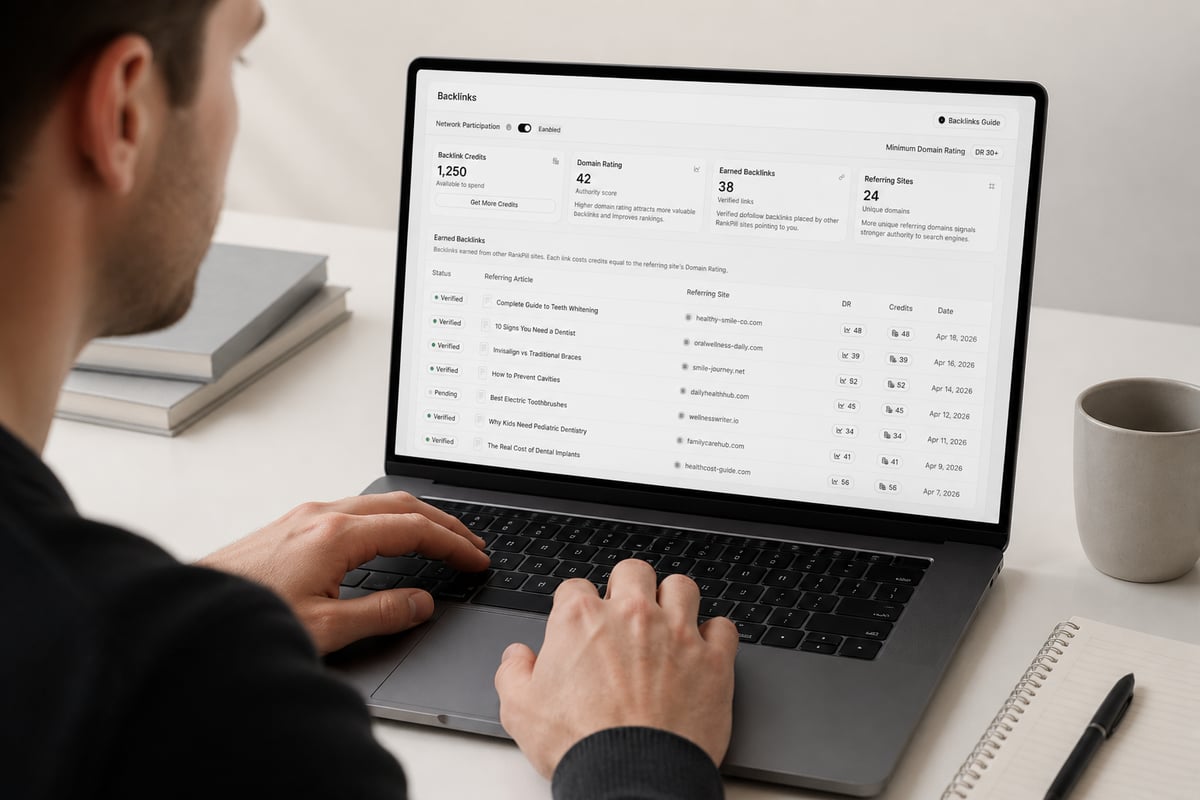
A platform has trade-offs. You are limited to the sites inside its network. Credits cap how many links you can earn each month. And a platform does not replace judgment: you still decide which matches fit your business.
RankPill is also built around publishing, not link trading alone. It is not the right fit if you only want hand-written content, or if your site cannot connect to a supported publishing platform.
Backlink exchange versus buying links versus outreach
Exchanges sit between buying links and cold outreach in cost, effort and risk. Here is how the three compare for a small business.
| Link exchange | Buying links | Cold outreach | |
|---|---|---|---|
| Cost | Low (time or credits) | Highest | Low in cash, high in time |
| Speed | Fast to moderate | Fast | Slow |
| Google risk | Low if small and relevant | High unless tagged sponsored |
Lowest |
| Control over anchor | Moderate | High | Low |
| Scales without a team | Yes, with a platform | Yes | No |
Buying links is not banned outright. Google allows paid links when they are qualified with sponsored or nofollow. Paid links that pass ranking credit are what its policies target.
Outreach earns the strongest links, since editors choose to link to you. It also takes the most time. Most small teams do best mixing a little of each, with exchanges covering the work they cannot do by hand.
Special cases: local, ecommerce and SaaS sites
The right exchange strategy depends on your business type, because relevance means different things for each.
- Local businesses. Trade with nearby, non-competing businesses: a bakery with a wedding planner, a plumber with a home inspector. Local relevance matters more than raw authority. If voice and map visibility is your focus, a specialist like Apex Media Solutions works on local and voice search optimization.
- Ecommerce stores. Product pages rarely earn links by themselves. Link from helpful guides, gift lists or how-to posts that sit near your products. Keep exchange links to editorial content, not category pages.
- SaaS and B2B. Look for partners whose readers are your buyers: integrations, adjacent tools, agencies. Case studies and comparison pages make natural link targets.
- Content sites and blogs. Trade links between posts that cover related topics. If you are building a blog for income, side hustle ideas sites in the same space are the kind of related, reader-friendly partners worth finding.
Across all four, one rule holds: if you would not be comfortable showing the link to a customer, do not build it.

Common mistakes in a backlink exchange
Most problems come from treating exchanges as a volume game. These are the mistakes that hurt small sites most.
- Chasing the highest authority score. A strong score on an irrelevant site helps less than a modest score on a close match.
- Exact-match anchor stuffing. Natural links use brand names and plain phrases.
- Ignoring link quality over time. A good partner today can be hacked, sold or turned into a spam site next year.
- Skipping the tags on paid deals. If something of value changed hands, tag the link.
- Leaving the rest of the site thin. Links to weak pages do little. People who click through need something worth reading.
- Expecting overnight results. A link takes time to be crawled, and rankings move over weeks, not days.
That last point is why exchanges work best next to a steady content engine. Links point at pages, and the pages have to be good. RankPill's guide to building backlinks goes through how links and content support each other, and the same logic applies to white-hat backlink methods in general.
How to measure whether an exchange worked
Judge an exchange by what happens to the linked page, not by the link count. Check four things 4 to 12 weeks after a link goes live.
- Indexing. Confirm the partner page is indexed and the link is still in place.
- Referral traffic. A relevant link should send some visitors. Zero clicks from a visible placement is a bad sign.
- Rankings and impressions. Watch the target page's impressions and average position in Search Console for the queries it targets.
- Link health. Re-check the partner site's traffic and content every quarter. Drop trades with sites that decline.
One more point matters in 2026: links also feed AI search. Pages that earn citations and mentions get picked up by answer engines, not just Google. If you want that traffic, strong content plus a few relevant links is the pairing to aim for, which is covered in RankPill's piece on ranking on ChatGPT. Tools like Catch Digital also work on wider growth systems if you outgrow a DIY approach.
Keep your expectations honest. A small, careful backlink exchange adds a modest push, not a jump. It is one input next to useful content, a clean site and time.
Your next step: open a spreadsheet, list the three most relevant non-competing sites you would be proud to be linked from, and check each against the four vetting points above before you contact anyone. If you would rather not run research, outreach and publishing by hand, Try RankPill to publish one long-form article a day and earn links through its backlink exchange, with a 90-day money-back guarantee if it is not a fit.
Unlock Traffic on Autopilot
Grow organic traffic on autopilot. RankPill will research, write, optimize, and publish articles to your website daily.