
Content Automation Platform: Scale SEO in 2026

Modest Mitkus · June 4, 2026
Managing content at scale has become a defining challenge for modern businesses. A content automation platform addresses this by streamlining the entire content lifecycle, from initial keyword research to final publication and distribution. These platforms leverage artificial intelligence and machine learning to handle repetitive tasks, allowing marketing teams to focus on strategy while maintaining consistent output across multiple channels. As search algorithms evolve to favor both traditional SEO and AI search optimization, automation has shifted from luxury to necessity for businesses competing in crowded digital markets.
Understanding Content Automation Platforms
A content automation platform integrates multiple tools and workflows into a unified system that manages content creation, optimization, and distribution. Unlike standalone writing tools or publishing schedulers, these platforms coordinate every stage of the content process through intelligent automation.
Core Components That Drive Automation
Modern platforms combine several essential elements to deliver comprehensive automation. The foundation starts with data-driven research capabilities that identify content opportunities based on search trends, competitor analysis, and audience behavior patterns. This research feeds directly into content generation systems that produce drafts aligned with specific keywords and search intent.
Publishing infrastructure represents another critical component, enabling automated distribution across content management systems, social platforms, and email channels. Advanced platforms incorporate digital marketing automation features that coordinate content releases with broader campaign strategies, ensuring consistent messaging across all touchpoints.
Quality control mechanisms monitor output for accuracy, originality, and brand consistency. These systems flag potential issues before publication while maintaining the speed advantages that automation provides. Integration capabilities allow the platform to connect with existing marketing technology stacks, from CRM systems to analytics tools.

Key Features That Define Platform Effectiveness
The most valuable platforms share specific characteristics that separate them from basic automation tools. Intelligent keyword targeting goes beyond simple volume metrics to identify opportunities where content can realistically rank, considering domain authority, competition levels, and search intent alignment.
Content generation engines must produce material that reads naturally while incorporating SEO elements strategically. This includes proper header hierarchy, semantic keyword usage, and structured data markup. Platforms that excel in this area understand context and can adapt tone, style, and formatting to match brand guidelines.
| Feature Category | Basic Automation | Advanced Platform |
|---|---|---|
| Keyword Research | Manual input required | Automatic discovery and prioritization |
| Content Quality | Template-based output | Context-aware generation |
| Publishing | Single channel | Multi-channel coordination |
| Optimization | Static rules | Continuous learning |
| Analytics | Basic metrics | Predictive insights |
Multi-language capabilities have become increasingly important as businesses expand globally. Platforms supporting this feature don't simply translate content but conduct independent keyword research and optimization for each target market, recognizing that search behavior varies significantly across languages and regions.
Strategic Implementation for Maximum Impact
Deploying a content automation platform requires careful planning to align automation capabilities with business objectives. Organizations that rush implementation often struggle with output quality or miss opportunities to leverage advanced features effectively.
Establishing Clear Content Goals
Before selecting or configuring a platform, define specific outcomes you want to achieve. Traffic growth targets should be quantified with realistic timelines, considering your current domain authority and competition levels. Some businesses prioritize volume to capture long-tail keywords, while others focus on fewer high-value topics that drive conversions.
Content variety also factors into strategic planning. A balanced approach typically includes:
- Educational articles that build topical authority
- Product-focused content that captures commercial intent
- Comparison pieces targeting decision-stage searchers
- Trending topics that capitalize on temporary interest spikes
Workflow integration determines how smoothly automation fits into existing processes. Map current content creation steps, identifying bottlenecks where automation delivers the greatest value. Many teams find that automating research and first-draft generation provides the best balance, preserving human oversight for strategic decisions while eliminating time-consuming preliminary work.
Configuring for Brand Consistency
Automation without proper guardrails produces generic content that fails to differentiate your brand. Investment in configuration upfront pays dividends through consistently on-brand output that requires minimal editing.
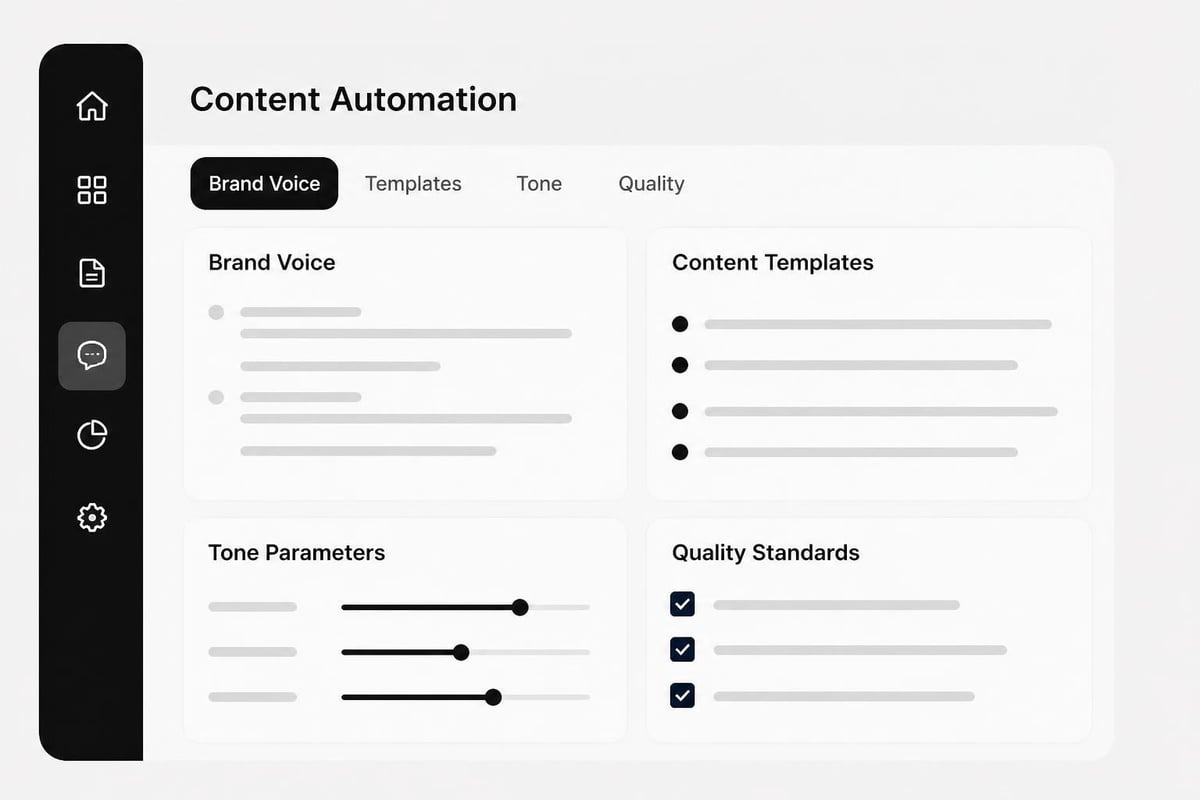
Voice and tone parameters should reflect your brand personality across different content types. A platform serving both formal B2B communications and casual blog content needs distinct profiles for each application. Training the system with examples of approved content helps it learn stylistic preferences that algorithms alone cannot capture.
Content templates provide structural consistency while allowing topical flexibility. These frameworks specify required sections, typical word counts, and formatting standards. Well-designed templates guide the automation system toward predictable quality without constraining creativity where it matters most.
Technical Considerations for Platform Selection
Choosing the right content automation platform requires evaluating technical capabilities against specific business requirements. The wrong choice leads to integration headaches, scalability limitations, or feature gaps that undermine automation benefits.
Integration Architecture and Compatibility
Your platform must connect seamlessly with existing systems to avoid creating data silos or manual workarounds. CMS integration tops the priority list for most organizations, with direct publishing to WordPress, Shopify, Webflow, and other popular platforms eliminating transfer friction.
API availability and documentation quality indicate how well the platform supports custom integrations. Businesses with unique technology stacks need flexible connection options that standard integrations don't cover. Platforms offering webhook support, REST APIs, and comprehensive developer resources adapt more readily to complex environments.
Authentication and security protocols protect sensitive content and account credentials. Look for platforms supporting OAuth, API key rotation, and role-based access controls that align with enterprise security standards. These features become critical when multiple team members access the platform or when handling client content in agency environments.
Scalability and Performance Parameters
Growth trajectories vary dramatically across businesses, making scalability assessment essential. A platform perfect for publishing ten articles monthly may collapse under the demands of daily publication schedules or multi-site management.
Processing capacity determines how quickly the platform can research keywords, generate content, and execute publishing tasks. Peak demand scenarios should guide capacity planning. For example, brands running seasonal campaigns need platforms that handle 5-10x normal volume without degradation in quality or delivery speed.
| Scalability Factor | Small Business Needs | Enterprise Requirements |
|---|---|---|
| Monthly Articles | 10-50 | 500+ |
| Concurrent Projects | 1-3 | 20+ |
| Team Members | 1-5 | 50+ |
| Language Support | 1-2 | 10+ |
| API Calls | 1,000/month | 100,000+/month |
Storage and archival capabilities affect long-term platform viability. Content libraries grow quickly, especially when supporting multiple brands or maintaining extensive revision histories. Platforms with robust organization, tagging, and search features help teams navigate large content repositories efficiently.
Optimizing Content Quality in Automated Workflows
Automation speed means little if output quality fails to meet publication standards. The challenge lies in maintaining consistency and value while processing content at scale. Advanced platforms incorporate multiple quality mechanisms that work together to elevate automated output.
Multi-Layer Quality Assurance
Effective quality systems operate at several stages throughout the content creation process. Pre-generation validation checks keyword viability, topic feasibility, and search intent alignment before committing resources to content development. This prevents wasted effort on topics unlikely to perform regardless of execution quality.
During generation, real-time monitoring tracks readability scores, keyword density, semantic relevance, and structural completeness. Content failing to meet thresholds triggers automatic revision cycles or flags items for human review. This catches issues early when corrections require minimal effort.
Post-generation review combines automated checks with strategic human oversight. While machines excel at spotting technical SEO issues, grammar errors, and formatting inconsistencies, humans better evaluate:
- Brand message alignment and positioning
- Factual accuracy and claim verification
- Competitive differentiation and unique value
- Emotional resonance and persuasive effectiveness
Platforms enabling efficient review workflows support quality without sacrificing throughput. Features like side-by-side comparison, suggested edit highlighting, and bulk approval streamline the human component of quality control.
Continuous Improvement Through Performance Data
Quality assessment shouldn't end at publication. The most sophisticated content automation platforms track performance metrics and feed insights back into the generation process, creating continuous improvement loops.
Ranking trajectory monitoring reveals which content characteristics correlate with search success. Articles consistently reaching page one share identifiable patterns in structure, length, keyword usage, and topic coverage. Platforms that identify these patterns and incorporate findings into future content generation improve output quality over time without manual intervention.
Engagement metrics provide another quality dimension. Content driving low bounce rates, high time-on-page, and strong conversion rates delivers business value regardless of ranking position. Analyzing this high-performing content reveals audience preferences that purely SEO-focused analysis might miss.
Platforms like RankPill excel at this continuous optimization approach, automatically adjusting content strategies based on actual performance data rather than relying solely on static best practices. The system learns what works for your specific audience and domain, becoming more effective with each publication cycle.
Advanced Automation Strategies for Competitive Advantage
Basic automation handles standard content workflows, but advanced strategies unlock competitive advantages that separate industry leaders from followers. These approaches require deeper platform capabilities and more sophisticated implementation.
Dynamic Content Networks and Internal Linking
Strategic internal linking strengthens topical authority and distributes page authority throughout your site. Manual linking becomes impractical at scale, creating opportunities for intelligent automation.
Semantic relationship mapping identifies connections between content pieces based on topic overlap, keyword relationships, and user journey logic. Platforms analyzing these relationships automatically insert contextual internal links that guide readers through related content while signaling topical clusters to search engines.
Link insertion timing affects both user experience and SEO value. Adding links during initial publication establishes immediate connections, while retrospective linking integrates new content into existing networks. Advanced platforms handle both scenarios, updating older content with relevant links to newer pieces as your content library expands.
Anchor text variation prevents over-optimization penalties while maintaining relevance signals. Rather than repeatedly using identical phrases, sophisticated systems rotate semantically related terms that feel natural to readers while preserving SEO value.
Multi-Channel Content Adaptation
Content rarely exists in isolation. A single piece of research often supports blog posts, social updates, email campaigns, and more. Automation platforms that recognize this reality enable efficient multi-channel strategies.
Format transformation adapts core content to different channel requirements. A comprehensive blog article becomes an email series, social media snippets, or video script outlines. Platforms handling these transformations intelligently preserve key messages while adjusting length, tone, and format to match channel expectations.
Timing coordination ensures cohesive multi-channel campaigns. When launching new content, synchronized publication across channels amplifies reach and reinforces messages. Platforms with campaign management features orchestrate these coordinated releases, handling timezone adjustments and platform-specific scheduling requirements.
Performance feedback loops span channels, revealing which formats and platforms deliver best results for different content types. This intelligence guides future distribution decisions, gradually optimizing channel mix for maximum impact.
Measuring ROI and Performance Optimization
Investment in a content automation platform demands measurable returns. Proper tracking and analysis ensure automation delivers on its promise while revealing optimization opportunities.
Establishing Meaningful Metrics
Generic vanity metrics provide little insight into true platform value. Focus instead on measurements directly tied to business outcomes.
Organic traffic growth represents the most fundamental success indicator. Track not just total visits but segment by content type, topic category, and traffic source. This granularity reveals which automation strategies drive results and which need refinement. Month-over-month comparisons show trajectory, while year-over-year data accounts for seasonal fluctuations.
Keyword ranking distribution illustrates SEO progress across your content portfolio. Monitor movements in these segments:
- Featured snippet captures (position zero)
- Top three rankings (primary click zone)
- Page one presence (positions 4-10)
- Page two progress (positions 11-20)
- Ranking count expansion (total keywords tracked)
Conversion attribution connects content to revenue, the ultimate business metric. While attribution modeling complexity varies, even basic tracking reveals which automated content drives leads, sales, or other valuable actions. This justifies platform investment and guides topic prioritization toward commercially valuable areas.
Cost Efficiency Analysis
Automation value extends beyond output metrics to include resource savings and efficiency gains. Comprehensive ROI assessment accounts for both sides of this equation.
| Cost Factor | Traditional Production | Automated Platform |
|---|---|---|
| Research Time | 2-3 hours/article | Automated |
| Writing Time | 4-6 hours/article | 15 minutes review |
| Editing Time | 1-2 hours/article | 30 minutes refinement |
| Publishing Time | 30 minutes/article | Automated |
| Total Labor Cost | $300-500/article | $50-100/article |
Time-to-publish metrics measure how quickly ideas become live content. Traditional workflows often span days or weeks between concept and publication, limiting responsiveness to trends and opportunities. Automation compresses timelines dramatically, enabling same-day publication when needed. This agility provides competitive advantages in fast-moving markets.
Team productivity changes reveal automation's operational impact. When content teams shift from execution to strategy, their value contribution increases even if output volume remains constant. Track how automation redistributes work toward higher-leverage activities like audience research, competitive analysis, and performance optimization.
Navigating Common Implementation Challenges
Despite clear benefits, content automation platform deployment encounters predictable obstacles. Anticipating these challenges and preparing mitigation strategies increases implementation success rates.
Overcoming Initial Quality Concerns
Teams accustomed to fully manual content creation often express skepticism about automated output quality. This resistance can derail implementation before platforms demonstrate value.
Pilot programs address concerns through controlled testing. Select a low-risk content category or publication channel for initial automation, preserving manual processes for high-visibility content. Successful pilots build confidence while revealing platform strengths and limitations in your specific context.
Transparent quality tracking during pilots provides objective assessment. Compare automated content performance against manually created pieces using consistent metrics. Many teams discover that properly configured automation matches or exceeds manual quality while delivering speed and volume advantages.
Iterative refinement acknowledges that initial automation results rarely achieve full potential. Platforms like those detailed in research on AI-driven content generation improve through configuration tuning, template optimization, and feedback incorporation. Allow time for this learning curve rather than expecting perfection immediately.
Managing Workflow Transition
Shifting from established manual processes to automated workflows disrupts comfortable routines. Change management principles apply as much to content automation as to any organizational transformation.
Role redefinition helps team members understand how automation changes their responsibilities rather than eliminating them. Writers become editors and strategists. SEO specialists focus on opportunity identification and performance analysis. Content managers orchestrate automation rather than executing every task manually.
Training requirements vary based on platform complexity and team technical sophistication. Comprehensive onboarding covering both technical operation and strategic application sets teams up for success. Ongoing education addresses advanced features and emerging best practices as platforms evolve.
Hybrid workflows often work best during transition periods. Maintain manual processes for specific content types while gradually expanding automation's scope. This phased approach builds competency and confidence without overwhelming teams or risking quality across your entire content portfolio.
Future Trends Shaping Content Automation
The content automation landscape continues evolving rapidly, driven by advances in artificial intelligence, changing search algorithms, and shifting user expectations. Understanding emerging trends helps businesses select platforms positioned for long-term relevance.
AI Search and Answer Engine Optimization
Traditional search engine optimization increasingly shares the stage with optimization for AI-powered answer engines. Platforms like ChatGPT, Perplexity, and Google's AI overviews change how users discover information, creating new requirements for content visibility.
Forward-thinking content automation platforms already incorporate strategies for getting mentioned by AI systems. This includes structured data implementation, authoritative source citation, and answer-focused content formatting that AI models prefer when generating responses.
Entity-based optimization helps content appear in knowledge graphs and structured results that AI systems reference. Platforms supporting schema markup, entity relationships, and fact-based writing position content for visibility across both traditional search and emerging AI discovery channels.
Hyper-Personalization at Scale
Content that speaks directly to individual user needs outperforms generic information across all metrics. Automation platforms increasingly enable personalization that was previously impractical at scale.
Dynamic content assembly creates customized experiences by mixing and matching content modules based on user attributes, behavior, or preferences. Rather than creating entirely separate content for each audience segment, platforms assemble optimal combinations from reusable components.
Predictive content recommendations guide users through optimized journeys based on demonstrated interests and goals. Automation platforms tracking user behavior feed this intelligence back into content creation priorities, creating virtuous cycles where content gets more relevant over time.
Platforms supporting extensive B2B content marketing applications recognize that business audiences demand particularly targeted content addressing specific roles, industries, and challenges. Personalization capabilities become differentiators in these contexts.
Integration with Broader Marketing Ecosystems
Standalone content tools give way to platforms functioning as central hubs within comprehensive marketing technology stacks. This integration trend accelerates as businesses demand unified data and coordinated campaigns.
Customer data platform connections enable content personalization based on comprehensive user profiles spanning all touchpoints. When content automation platforms access CRM data, purchase history, and engagement records, they generate highly targeted material aligned with customer journey stages.
Marketing automation integration coordinates content publication with email campaigns, social promotion, and paid advertising. Rather than operating in isolation, content becomes a coordinated element of larger campaign strategies. Platforms like those described in Avid's content automation initiatives demonstrate this comprehensive approach.
Analytics consolidation provides unified performance views across all marketing activities. When content metrics integrate with broader marketing dashboards, teams gain clearer understanding of content's contribution to overall business results.
Selecting the Right Platform for Your Business
The content automation platform market offers numerous options spanning various price points, capabilities, and specializations. Systematic evaluation prevents expensive mismatches between platform capabilities and business needs.
Assessment Framework for Platform Evaluation
Begin with clear requirement documentation covering must-have capabilities, nice-to-have features, and deal-breakers. This framework guides evaluation and prevents distraction by impressive but ultimately irrelevant features.
Business model alignment ensures the platform supports your content strategy. Publishers with advertising-based models prioritize volume and traffic, while SaaS companies focus on conversion-optimized content targeting specific buyer keywords. E-commerce businesses need product-focused content automation that traditional platforms may not support well.
Technical requirements include integration needs, scalability projections, and team capabilities. Highly technical teams may embrace platforms offering extensive customization through APIs and configurations, while less technical users need intuitive interfaces requiring minimal setup.
Budget considerations extend beyond subscription costs to include implementation time, training requirements, and ongoing management needs. Apparently cheaper platforms that demand extensive configuration or generate content requiring heavy editing may cost more in total than premium platforms delivering superior results with less intervention.
Trial and Testing Strategies
Most platforms offer trial periods or freemium tiers enabling hands-on evaluation. Maximize these opportunities through structured testing rather than casual exploration.
Representative content testing uses topics and keywords from your actual content strategy rather than generic examples. This reveals how the platform performs against real requirements, exposing strengths and weaknesses you'll encounter in production use.
Quality comparison tests automated output against your current content, either manual or competitor benchmarks. Use consistent evaluation criteria spanning SEO optimization, readability, accuracy, and brand alignment. Platforms should meet or exceed current standards to justify adoption.
Support and documentation assessment often predicts long-term satisfaction better than feature lists. Responsive support teams and comprehensive documentation help overcome inevitable implementation challenges. Test support responsiveness during trials by asking specific questions about your use case.
Content automation platforms represent essential infrastructure for businesses competing in modern digital markets where content volume, quality, and speed all matter. The right platform transforms content from a resource-intensive bottleneck into a scalable competitive advantage, enabling consistent organic growth without proportional increases in team size or budget. RankPill delivers exactly this transformation through comprehensive automation spanning keyword research, content generation, optimization, and publishing, helping businesses establish sustainable organic growth engines that operate continuously without manual intervention.
Unlock Traffic on Autopilot
Grow organic traffic on autopilot. RankPill will research, write, optimize, and publish articles to your website daily.
 WordPress