
Keyword Tool AI: Automating SEO Research in 2026

Modest Mitkus
June 25, 2026
The evolution of search engine optimization has reached a critical inflection point where manual keyword research becomes increasingly inefficient compared to AI-driven automation. Keyword tool AI represents a fundamental shift in how marketers identify content opportunities, analyze search intent, and build comprehensive SEO strategies. These intelligent platforms leverage machine learning algorithms to process massive datasets, uncover hidden patterns, and deliver actionable insights that would take human researchers weeks to compile. As businesses compete for visibility across traditional search engines and emerging AI platforms like ChatGPT, understanding how to harness keyword tool AI capabilities has become essential for sustainable organic growth.
Understanding the Evolution of Keyword Tool AI
Traditional keyword research tools provided basic metrics like search volume and competition scores, requiring marketers to manually interpret data and make strategic decisions. The introduction of artificial intelligence fundamentally transformed this process by automating pattern recognition, predictive analysis, and semantic understanding.
Modern keyword tool AI platforms analyze billions of search queries to identify emerging trends before they reach peak popularity. Machine learning models process historical data to predict seasonal fluctuations, forecast search volume changes, and identify topics gaining momentum in specific industries.

Core Technologies Powering Keyword Tool AI
Several breakthrough technologies enable keyword tool AI to outperform manual research methods:
- Natural Language Processing (NLP) interprets user intent behind search queries
- Neural networks identify semantic relationships between keywords and topics
- Predictive analytics forecast keyword performance and trend trajectories
- Clustering algorithms group related keywords into thematic content opportunities
- Sentiment analysis evaluates the emotional context of search queries
The integration of these technologies creates a comprehensive research environment where AI handles data processing while marketers focus on strategic implementation. According to research on AI-powered SEO platforms, tools incorporating these features demonstrate 40-60% time savings compared to manual research workflows.
Key Features That Define Advanced Keyword Tool AI
The capabilities separating basic keyword tools from sophisticated keyword tool AI systems extend far beyond simple search volume reporting. Advanced platforms provide multi-dimensional analysis that considers competition, user intent, content gaps, and ranking potential.
Search Intent Classification and Analysis
Understanding why users search for specific terms determines content success more than keyword selection alone. Keyword tool AI automatically categorizes searches into informational, navigational, commercial, and transactional intent categories.
| Intent Type | User Goal | Content Format | Conversion Potential |
|---|---|---|---|
| Informational | Learning/Research | Blog posts, guides | Low (awareness stage) |
| Navigational | Finding specific site | Landing pages | Medium (brand searches) |
| Commercial | Comparing options | Product comparisons | High (consideration) |
| Transactional | Making purchase | Product pages | Very High (decision) |
This classification enables content teams to align article formats with user expectations, significantly improving engagement metrics and conversion rates. AI-powered SEO tools that incorporate intent analysis help businesses prioritize keywords that match their content capabilities and business objectives.
Competitor Gap Analysis Through AI
Rather than researching competitors manually, keyword tool AI automatically identifies content opportunities by comparing your keyword coverage against competing domains. Gap analysis features reveal which high-value keywords competitors rank for while your site remains invisible.
The process involves:
- Domain comparison across multiple competitors simultaneously
- Keyword extraction from competing pages ranking in top positions
- Opportunity scoring based on difficulty, volume, and relevance
- Content gap identification showing topics missing from your site
- Priority ranking of keywords offering the highest ROI potential
This automated competitive intelligence transforms keyword research from reactive to proactive, enabling businesses to identify opportunities before market saturation occurs.
Implementing Keyword Tool AI in Your SEO Workflow
Successfully integrating keyword tool AI requires understanding how these platforms fit within broader content production and optimization processes. The most effective implementations combine AI efficiency with human strategic oversight.
Building Automated Research Pipelines
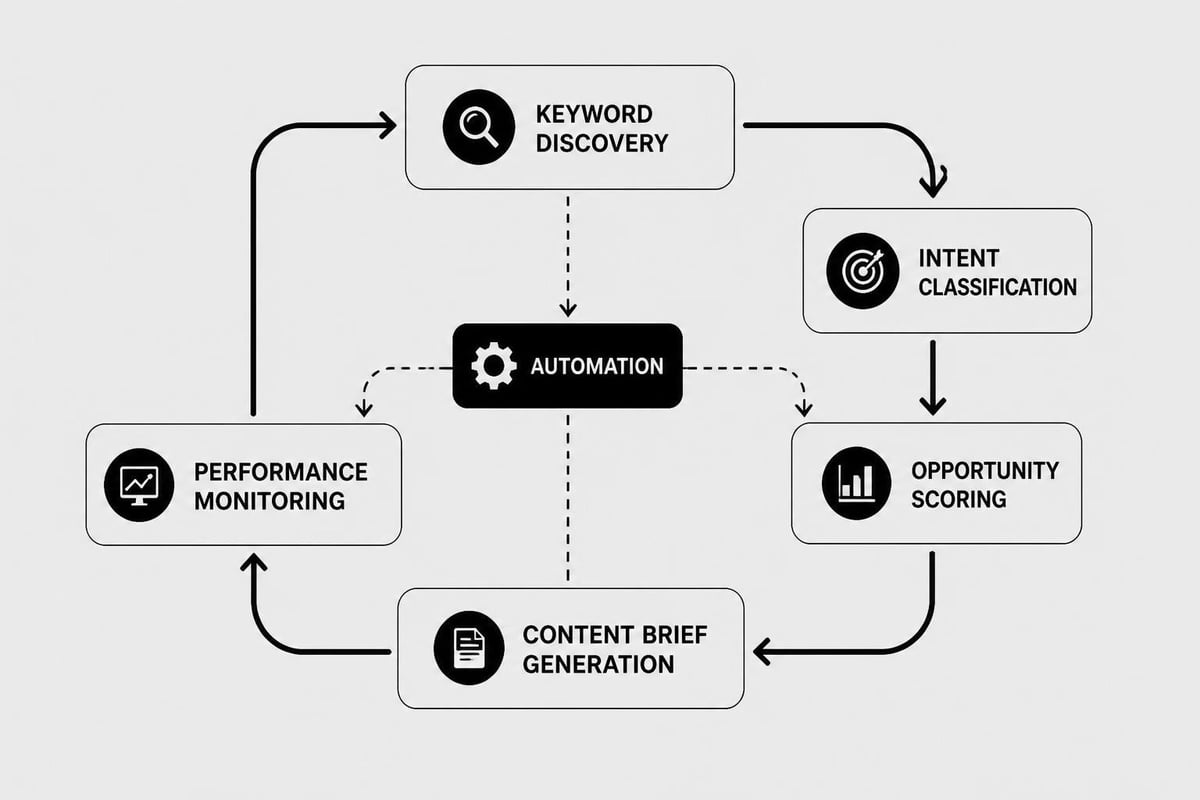
Creating systematic workflows ensures keyword tool AI delivers consistent value rather than sporadic insights. Research pipelines automatically generate keyword lists, categorize opportunities, and route data to content teams.
Effective automation workflows include:
- Scheduled research scans that monitor keyword rankings and new opportunities weekly
- Alert systems notifying teams when trending keywords emerge in your niche
- Integration with content calendars to automatically populate topics
- Performance tracking comparing predicted vs. actual keyword rankings
- Refinement loops where AI learns from successful content to improve future recommendations
Platforms like RankPill's Keyword Research Tool demonstrate how free tools can provide sophisticated AI analysis without enterprise-level budgets, making these capabilities accessible to small businesses and independent marketers.
Optimizing Content Creation With AI Insights
The true value of keyword tool AI emerges when research insights directly inform content production. Rather than creating generic articles targeting broad keywords, AI-driven insights enable hyper-targeted content addressing specific user questions and search patterns.
Modern content optimization involves:
- Using AI-identified long-tail variations to capture niche audiences
- Incorporating semantic keyword clusters that comprehensively cover topics
- Structuring content around question-based queries revealed through AI analysis
- Optimizing for featured snippet opportunities identified by AI pattern recognition
When combined with automated publishing platforms, this approach creates scalable content engines. AI and SEO integration represents the convergence of research automation and content production, eliminating traditional bottlenecks in organic growth strategies.
Advanced Strategies for Keyword Tool AI Mastery
Beyond basic implementation, sophisticated users leverage keyword tool AI for strategic advantages that compound over time. These advanced techniques separate occasional users from SEO professionals who build sustainable competitive moats.
Multilingual Keyword Research at Scale
Global businesses face exponential complexity when researching keywords across multiple languages and regional markets. Keyword tool AI eliminates the need for native speakers to manually research each market by automatically adapting strategies to local search behaviors.
Regional customization features include:
- Automatic translation with cultural context adjustment
- Local search engine preferences (Google, Baidu, Yandex)
- Regional competition analysis within specific markets
- Seasonal trend variations by geography
- Local search volume and CPC data
The best free keyword research tools for 2026 increasingly incorporate multilingual capabilities, though comprehensive international research typically requires dedicated platforms. This capability proves essential for businesses expanding into new markets without establishing local SEO teams.
Predictive Keyword Forecasting
One of keyword tool AI's most powerful but underutilized features involves forecasting future keyword performance based on historical patterns, industry trends, and external market signals. Predictive models identify opportunities 3-6 months before they reach competitive saturation.
| Forecasting Factor | Data Source | Prediction Output |
|---|---|---|
| Historical trends | Multi-year search data | Seasonal opportunity timing |
| Industry signals | News, events, launches | Emerging topic identification |
| Competitor activity | New content analysis | Market saturation warnings |
| Social media buzz | Mention volume tracking | Viral topic detection |
| Economic indicators | Market data integration | Commercial intent shifts |
Businesses implementing predictive strategies gain first-mover advantages, establishing authority before competitors recognize emerging opportunities. This approach transforms SEO from reactive optimization to proactive market positioning.
Measuring ROI From Keyword Tool AI Investment
Justifying keyword tool AI subscriptions requires demonstrating measurable impact on business metrics beyond vanity rankings. The most successful implementations tie keyword research directly to revenue, lead generation, and customer acquisition cost reduction.
Key Performance Indicators Worth Tracking
When evaluating keyword tool AI effectiveness, focus on metrics connecting research quality to business outcomes:
- Time savings compared to manual research (measured in hours per campaign)
- Keyword win rate showing percentage of targeted terms reaching page one
- Organic traffic growth attributed to AI-identified opportunities
- Content production velocity enabled by streamlined research
- Cost per acquisition reduction from improved keyword targeting
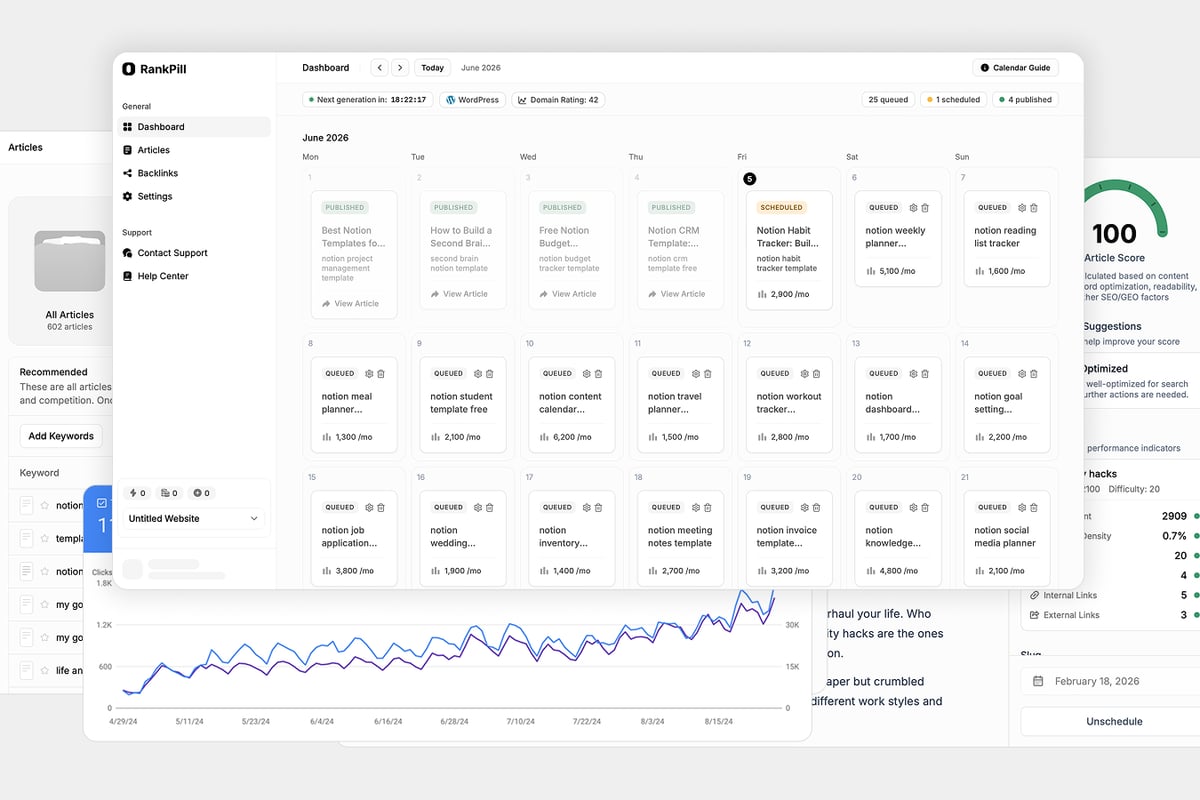
The automation capabilities within modern SEO platforms enable teams to increase output without proportional headcount expansion. Automated SEO services combine keyword research, content creation, and publishing into unified workflows that traditional agencies cannot match on cost efficiency.
Avoiding Common Implementation Pitfalls
Even sophisticated keyword tool AI requires proper utilization to deliver maximum value. Several common mistakes limit ROI from these platforms:
Relying exclusively on AI recommendations without human strategic oversight often results in chasing vanity metrics rather than business-aligned keywords. Strategic filtering ensures AI-identified opportunities support broader marketing objectives.
Additionally, focusing solely on high-volume keywords ignores the compounding value of long-tail terms. Keyword tool AI excels at identifying thousands of low-competition variations that collectively drive more qualified traffic than competitive head terms.
Finally, failing to act on research insights negates the investment entirely. The most expensive mistake involves paying for keyword tool AI subscriptions without implementing systematic content production based on the intelligence gathered.
Integration Capabilities and Technical Considerations
Modern keyword tool AI platforms function as components within broader marketing technology ecosystems rather than standalone applications. Integration architecture determines how effectively research insights flow into content production, publishing, and performance measurement systems.
Essential Platform Integrations
The most valuable keyword tool AI solutions connect seamlessly with existing marketing infrastructure:
- Content management systems for automatic keyword insertion into publishing workflows
- Project management tools to assign keyword-focused content briefs to writers
- Analytics platforms tracking keyword performance against business KPIs
- Rank tracking software monitoring position changes for targeted terms
- Content optimization tools ensuring published articles leverage researched keywords effectively
WordPress SEO optimization becomes significantly more effective when keyword tool AI feeds directly into plugin recommendations, creating closed-loop optimization systems. Similarly, Shopify integration enables e-commerce businesses to align product descriptions and category pages with AI-researched purchase intent keywords.
API Access and Custom Development
Enterprise users often require custom integrations connecting keyword tool AI with proprietary systems and workflows. API availability enables development teams to build automated pipelines extracting research data programmatically.
Common API use cases include:
- Automatically populating content calendars with keyword opportunities
- Triggering content creation workflows when new opportunities emerge
- Syncing keyword performance data with business intelligence dashboards
- Building custom reporting combining keyword metrics with revenue data
- Creating industry-specific tools layered on top of core keyword AI engines
Technical teams should evaluate API documentation and webhook support when selecting keyword tool AI platforms for enterprise deployment. Robust programmatic access often justifies premium pricing through efficiency gains in custom workflow automation.
Future Trends Shaping Keyword Tool AI Development
The rapid evolution of search behavior, AI capabilities, and content consumption patterns continuously reshapes how keyword tool AI platforms develop new features and methodologies. Understanding emerging trends helps businesses select tools that will remain relevant as the SEO landscape transforms.
Voice Search and Conversational Queries
Voice-activated searches fundamentally differ from typed queries in structure, length, and intent. Keyword tool AI increasingly incorporates voice search analysis, identifying conversational long-tail phrases people speak rather than type.
Voice optimization features include:
- Question-based keyword identification matching natural speech patterns
- Local intent recognition for "near me" conversational searches
- Featured snippet optimization for voice assistant responses
- Conversational keyword clustering around topic-based searches
As voice search adoption accelerates, AI search optimization strategies must account for this behavioral shift. Keyword tool AI platforms incorporating voice data provide competitive advantages as this search method gains market share.
AI Search Engine Optimization
The emergence of AI-powered search experiences like ChatGPT, Perplexity, and Google's AI Overviews creates entirely new optimization challenges. Traditional keyword targeting optimized for blue-link results requires adaptation for AI-generated answer formats.
Keyword tool AI evolution includes:
- Citation opportunity identification for AI answer sourcing
- Topical authority metrics measuring comprehensiveness across subject areas
- Answer box optimization targeting direct response formats
- Semantic relationship mapping ensuring content covers interconnected concepts
Generative engine optimization represents a parallel track to traditional SEO, requiring keyword strategies that prioritize comprehensive topic coverage over individual keyword rankings. Forward-thinking keyword tool AI platforms already incorporate these metrics.
Real-Time Trend Detection and Rapid Response
Market dynamics accelerate continuously, creating opportunities for businesses that identify and act on emerging keywords faster than competitors. Next-generation keyword tool AI leverages real-time data feeds from social media, news sources, and search engines to detect trend formation in hours rather than weeks.
Rapid response capabilities enable:
- Publishing content targeting trending keywords before competition intensifies
- Capitalizing on viral topics while audience attention remains high
- Identifying breaking news angles relevant to your industry
- Adjusting content calendars dynamically based on market signals
The competitive advantage from speed compounds in fast-moving industries where keyword opportunities have narrow windows before market saturation occurs. Platforms incorporating real-time intelligence provide tactical advantages beyond traditional monthly research cycles.
Selecting the Right Keyword Tool AI for Your Needs
The proliferation of keyword tool AI options creates decision paralysis for businesses evaluating which platform best serves their specific requirements. Systematic evaluation based on objective criteria ensures selection aligns with business objectives, technical capabilities, and budget constraints.
Evaluation Framework for Platform Selection
When comparing keyword tool AI solutions, assess these critical dimensions:
Data quality and coverage determine research accuracy and comprehensiveness. Platforms with proprietary data sources often provide insights competitors cannot access, while those relying exclusively on third-party APIs may offer limited differentiation.
Feature depth vs. usability represents a constant tradeoff. Enterprise platforms like Ahrefs provide exhaustive capabilities requiring significant learning curves, while streamlined tools prioritize accessibility over comprehensiveness.
Pricing structure and scalability must align with growth trajectories. Per-search pricing penalizes heavy users, while subscription models provide predictable costs but may include unnecessary features for smaller operations.
Integration ecosystem connectivity determines how effectively keyword tool AI fits within existing workflows. Native integrations with your CMS, project management, and analytics tools multiply efficiency gains.
Budget-Conscious Approaches to Keyword Tool AI
Businesses in early growth stages often cannot justify enterprise SEO tool subscriptions but still require competitive keyword research capabilities. Several approaches maximize keyword tool AI access within budget constraints:
- Free tier utilization across multiple platforms to access different data sources
- Seasonal subscriptions during intensive research periods followed by cancellation
- Team account sharing among multiple users in small organizations
- Open-source alternatives providing basic AI capabilities without subscription costs
Tools like SpyFu offer competitive intelligence at lower price points than comprehensive platforms, making them viable for businesses prioritizing competitor analysis over exhaustive keyword databases.
For organizations requiring consistent keyword research without ongoing costs, free keyword research tools provide baseline capabilities suitable for content planning and opportunity identification.
Keyword tool AI has fundamentally transformed SEO research from manual data compilation into intelligent automation that scales with business growth. The platforms dominating this space in 2026 combine machine learning, predictive analytics, and comprehensive data sources to deliver insights that would require entire research teams to replicate manually. RankPill puts these capabilities into action by automating your entire SEO workflow from keyword research through content creation and publishing, helping businesses grow organic traffic without the traditional agency overhead or manual bottlenecks.