
Topical Authority SEO: A Practical Guide for Small Sites

Modest Mitkus · November 16, 2026
Topical authority SEO means covering one subject so thoroughly, and so consistently, that Google treats your site as a reliable source on it. For a small site, the practical version is simple: pick a narrow topic, publish a connected set of pages that answer every question buyers ask about it, and link those pages to each other. Authority is not a score you can buy. It builds as your coverage grows and your pages prove useful.
This guide shows how to do that with a small team and a small budget. It covers what topical authority is, how to choose a topic, how to map and write the content, how to link it, and how to tell whether it is working.
What topical authority means for a small site
Topical authority is the degree to which a site is seen as a dependable, complete source on one subject. It comes from depth and consistency, not from any single page.
Google does not publish a "topical authority score," so treat the term as a working model, not an official metric. What Google does say is useful, though. Its ranking systems prioritize helpful, reliable information created to benefit people rather than content made to manipulate rankings. A site that answers a full set of related questions well is more likely to meet that bar than a site with one strong post surrounded by unrelated ones.
Two things shape how authority builds:
- Coverage. How many of the real questions in your niche your site answers.
- Quality. Whether each answer is accurate, specific and shows real experience. Google also asks whether content demonstrates first-hand expertise and leaves readers feeling they learned enough to reach their goal.
A small site cannot out-publish a large publisher on every topic. It can win on a narrow one. That is the whole strategy.
Topical authority vs. domain authority
Topical authority is about subject depth. Domain authority is a third-party estimate of overall link strength. They measure different things and you can have one without the other.
Domain authority (or Domain Rating, Domain Score and similar) comes from SEO tool vendors, not Google. It leans heavily on backlinks. A site with a high score can still rank poorly for a niche query if it has only a thin page on it. A newer site with a low score can rank well if it has covered the subject in depth and the competing results are weak.
For small sites, this is good news. You cannot catch a big brand on backlinks in six months. You can catch it on one subtopic in a narrow niche, because the bar there is lower.
Backlinks still help. They are one signal among several. If you want to earn them the safe way, the white hat SEO backlinks guide covers practical options.
How Google reads topical depth
Google does not read your site and decide you are an expert. It crawls pages, indexes them, and serves results, and it uses many signals along the way. Google describes Search as working in three stages: crawling, indexing and serving. Topical depth shows up in those stages in a few ways.
- Discovery through links. Google primarily discovers pages through links from pages it has already crawled. If your subtopic pages link to each other, they get found faster.
- Relevance signals. Pages that cover related terms, use consistent language and answer adjacent questions give Google more context about what your site is about.
- Engagement and usefulness. Readers who find what they need and stop searching are a sign the page did its job. Google does not confirm exactly how it uses these signals, so do not obsess over any one metric.
- Experience and trust. Named authors, original examples, accurate details and cited sources all push in the right direction.
You cannot force any of these. You can make them more likely by building a site where every page has a clear job and a clear connection to the others.
How to choose a topic you can own
Choose a topic where you have real knowledge, where buyers are searching, and where the top results are beatable. Those three tests cut most bad ideas quickly.
Run each candidate through these checks:
- Do you have first-hand knowledge? If a customer asked you the question tomorrow, could you answer it better than a generic article? If not, pick something closer to what you actually do.
- Does it connect to revenue? A topic with traffic but no link to what you sell brings visitors, not customers. A bakery supply store gains more from "commercial sourdough starter care" than from "history of bread."
- Is the search demand real? Check monthly search volume and keyword difficulty. A topic with dozens of related queries at low to moderate difficulty gives you room to build a cluster.
- Are the top results beatable? If page one is all large publishers with deep guides, move to a narrower angle. If it includes thin posts, forums and outdated pages, you have an opening.
- Is it wide enough to fill 20 or more pages? Too narrow and you run out of content. Too broad and you never finish.
Go narrower than feels comfortable. "SEO" is too broad. "SEO for Shopify stores selling handmade goods" is a topic a small site can finish. The SEO for Shopify store guide is an example of that kind of focused angle.
How to map subtopics before you write
A topic map is a list of every question and search intent inside your topic, grouped so each page has one job. Build it before you write anything, so you do not publish overlapping pages that compete with each other.
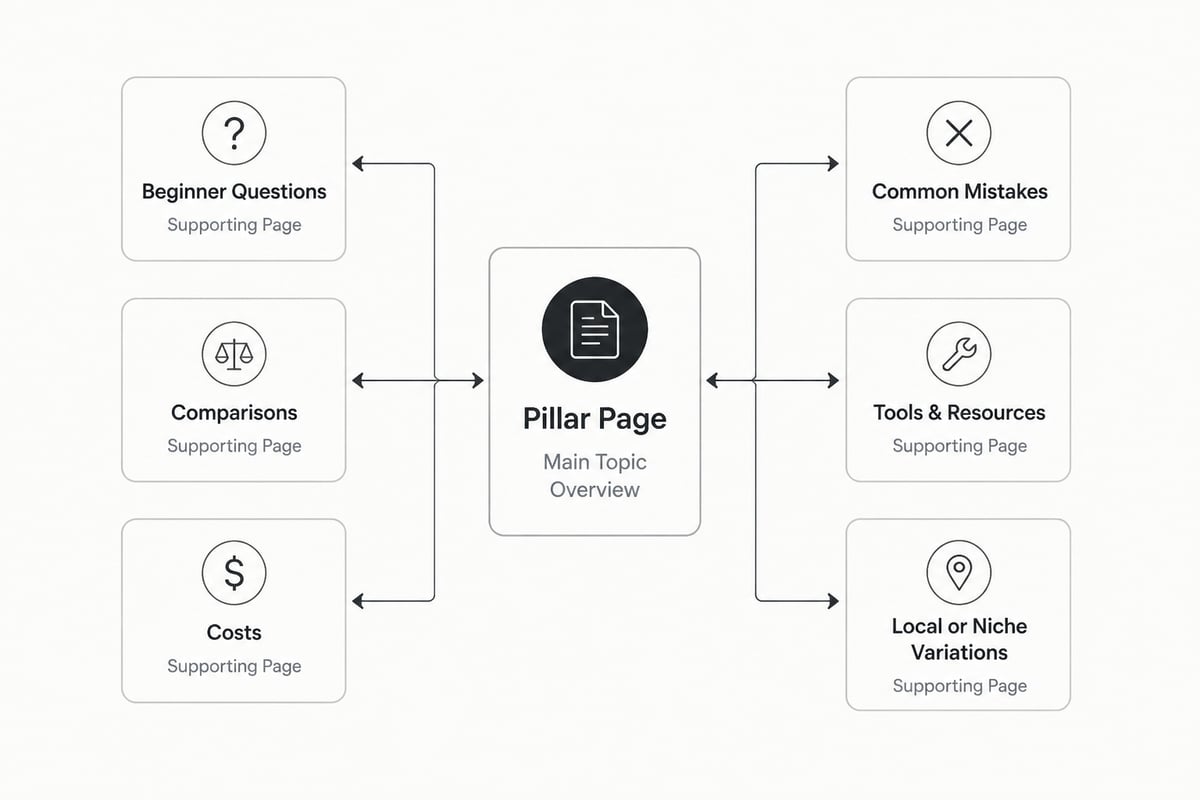
Start from one central page, often called a pillar. It covers the broad topic and links out. Then list supporting pages, each answering one narrower question. Semrush's overview of topical authority describes the same approach of connected, high-quality content built around subject expertise.
A simple way to fill the map:
- Beginner questions. "What is..." and "how does... work."
- Cost and decision questions. Pricing, comparisons, "is it worth it."
- Process questions. Step-by-step guides and checklists.
- Problem questions. Common mistakes, errors and fixes.
- Tool and tactic questions. What to use and how.
- Audience variations. The same topic for different industries or situations.
Pull the actual wording from search suggestions, "People also ask" boxes, customer emails, sales calls and support tickets. Real phrasing beats guesses.
Then assign one primary keyword per page and write it next to the page title. If two pages share a primary keyword, merge them or change the angle of one.
Hypothetical example: a small online store selling indoor plants decides its topic is "caring for low-light houseplants." The pillar is a full guide to low-light plant care. Supporting pages cover individual plants, watering schedules, common leaf problems, pots and soil, and plants safe for pets. Each answers one question and links back to the guide.

How to write pages that earn authority
Each page should fully answer its question, show real knowledge, and be easy to scan. Length matters less than completeness.
Google says content should be easy to read and well organized, with headings that help readers navigate. In practice:
- Open each section by answering the question its heading asks.
- Use specific numbers, steps and examples from your own work.
- Name trade-offs. Pages that only praise read as thin.
- Cite sources where you state facts or statistics.
- Add original material where you can: your own photos, data, screenshots or process notes.
- Keep terms consistent across the cluster so the subject is clear.
Match length to intent. A definition may need 800 words. A full guide may need 2,500. Padding a short answer to hit a word count hurts more than it helps.
Update old pages as you learn. A cluster that stays accurate keeps its value. One that goes stale loses it.
If you want a broader view of writing process, the guide on SEO content creation covers workflow in more detail.
Internal linking that ties the cluster together
Internal links tell Google, and readers, how your pages relate. Every supporting page should link to the pillar, and the pillar should link to every supporting page. Add links between sibling pages where one naturally leads to the next.
Follow a few rules:
- Use descriptive anchor text. "Low-light watering schedule" beats "click here."
- Make links crawlable. Google recommends making links crawlable and ensuring every page can be reached from another findable page. Use standard HTML links, not scripts that hide the URL.
- Avoid orphan pages. A page with no links pointing to it is hard to find and signals low importance.
- Link in context. A link inside a relevant sentence works better than a block of links in a footer.
- Do not over-link. If every sentence has a link, none of them stand out.
A sitemap helps too. Google says sitemaps can tell it which pages are important and help it prioritize crawling, though crawling is not limited to sitemap URLs. Also remember that robots.txt controls crawling, not indexing. To keep a page out of results, use a noindex tag instead.
For more on how crawling and indexing work, Google's crawling and indexing documentation covers sitemaps, canonicalization and URL structure.
How much content is enough, and how fast
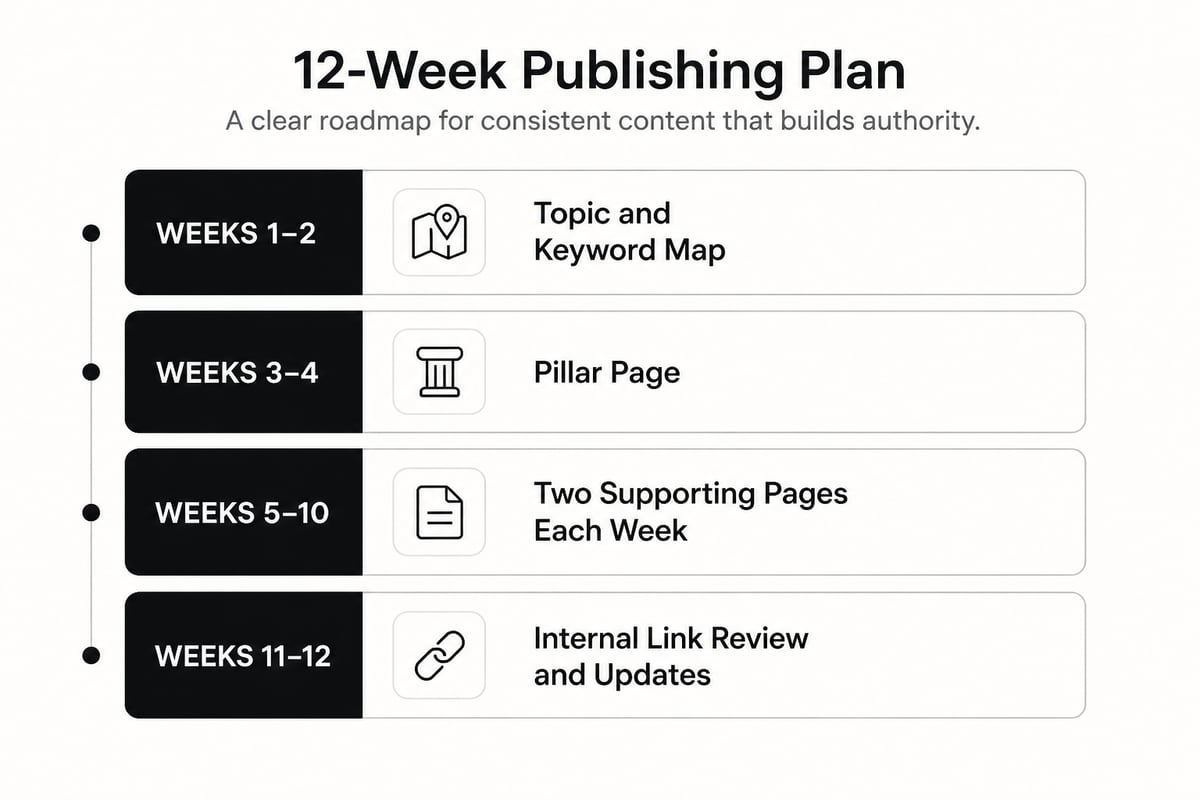
There is no fixed number of pages that guarantees authority. A reasonable starting target for a narrow topic is 15 to 30 well-linked pages, published steadily over a few months.
Pace matters because small sites have two limits: time and budget. A site that publishes two good pages a week for three months ends up with about 25. A site that publishes 25 pages in a weekend and then stops often does worse, because nothing keeps the cluster fresh or growing.
Be honest about timing. New pages usually take weeks to be indexed and start collecting impressions. Meaningful traffic from a new cluster more often shows after a few months, and it depends on your niche, the competition and how established your site is. Anyone promising a fixed timeline is guessing.
The trade-off is real. Depth takes time, and there is no shortcut that skips the work of covering the subject properly. What you can control is consistency and quality.
Doing the work without a content team
Most small teams do not fail at topical authority SEO because the idea is hard. They fail because publishing 25 or more good pages takes sustained effort that competes with running the business.
You have three realistic options:
- Write it yourself. Best quality control and lowest cash cost, but it costs hours every week.
- Hire writers or an agency. Faster, but agency rates add up. Agency pricing often runs well into the thousands of dollars a month.
- Use automation. An AI tool handles research, drafting and publishing, and you review the output.
If you pick automation, check that it does the parts that matter for authority: keyword research based on real volume and difficulty, articles that link to each other, and publishing on a steady schedule. The overview of autopilot SEO explains how that approach works and where it falls short.
RankPill is one option. It finds keywords your site can rank for, writes articles of about 1,000, 2,000 or 3,000 words with images, internal and external links and natural mentions of your products, and publishes them to WordPress, Shopify, Webflow, Wix, Framer or any site via webhooks on a schedule you set. The RankPill plan is $99 a month per website and includes 30 articles, and new customers can start with a 3-day trial for $1. You can also set it to wait for your approval before anything goes live.
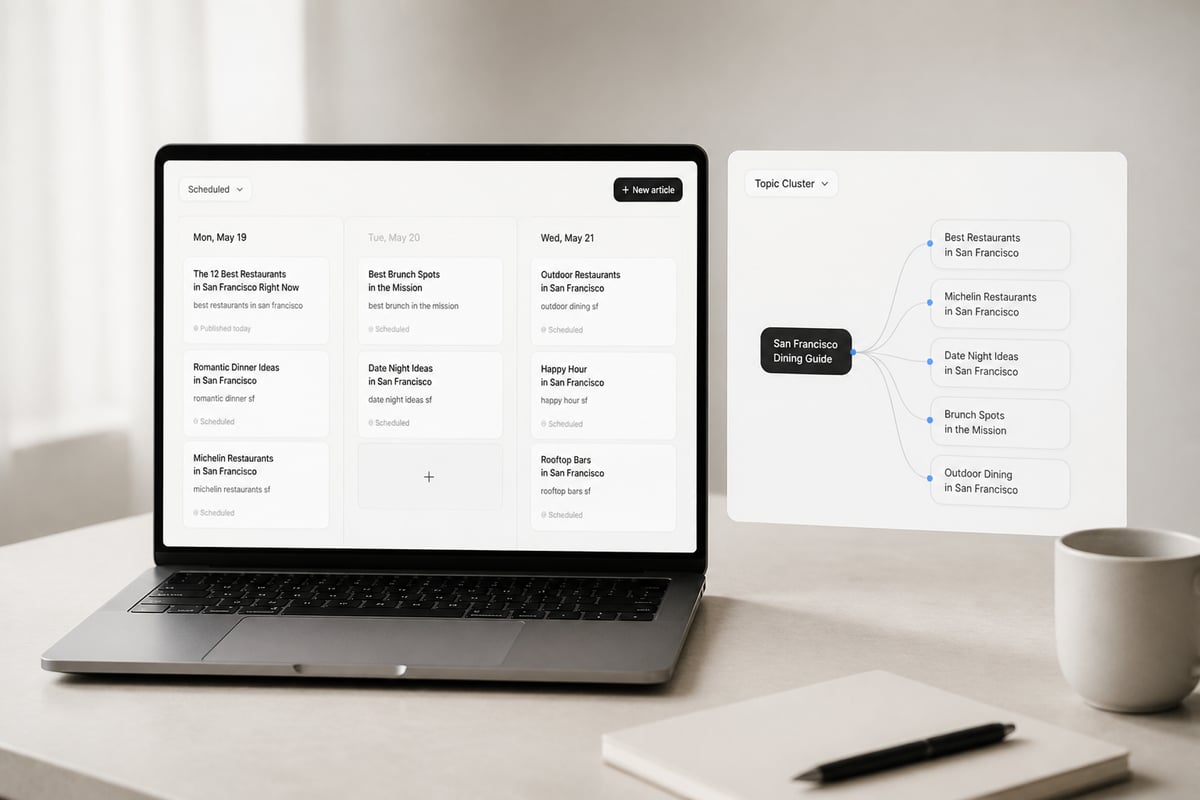
It is not the right fit if you only want hand-written content, or if your site cannot connect to a supported publishing platform. Automation also does not replace your own knowledge. The best results come when you tell the tool what your business actually sells and do a quick review pass on the output.
On quality concerns: Google has said it ranks helpful content regardless of how it is made, and that low-quality content is the problem whether a person or AI wrote it. Whoever or whatever writes the page, the same standard applies.
How to measure whether authority is building
Measure impressions, clicks and positions across the whole cluster, not page by page. Authority shows up as a trend across many related queries.
Connect Google Search Console, which is free, and check these signals monthly:
- Indexed pages. Are your new pages being found? A quick
site:search helps check whether Google has found your content. - Impressions across the cluster. Rising impressions on many related queries is the earliest sign.
- Average position for your target queries. Look for movement from page three toward page one.
- Clicks and click-through rate. Titles and meta descriptions that match intent lift clicks without any ranking change.
- Pages per query. If more of your pages show up for related searches, your coverage is registering.
- Mentions in AI answers. Clear, well-sourced pages on the questions your customers ask can also be cited by AI assistants. RankPill Plus tracks up to 50 prompts a day in ChatGPT, Gemini and Google AI Overviews if you want to watch this, at $199 a month per website.
Resist judging a cluster by one keyword. A page can sit at position 12 while the cluster as a whole drives steady traffic. For a deeper look at tracking, see the guide on automated SEO monitoring.
Mistakes that stall topical authority SEO
Most stalled clusters trace back to a handful of avoidable errors.
- Picking a topic that is too broad. You never finish, and nothing looks complete.
- Publishing in bursts, then stopping. The cluster goes stale and growth stalls.
- Writing overlapping pages. Two pages targeting the same query compete with each other.
- Skipping internal links. Pages sit isolated and are slow to be discovered.
- Thin pages written to hit a count. Quantity without usefulness fails Google's own helpfulness test.
- Chasing off-topic keywords. A high-volume term outside your subject dilutes the cluster.
- Ignoring updates. Outdated facts erode trust.
- Expecting results in two weeks. Most clusters need months.
If you avoid these, you are ahead of many sites that start the same way. Pick one topic, map it fully, publish steadily, link every page, and check the numbers once a month.
Your next step is to write down one topic you could cover in 20 pages, then list the 20 questions a customer would ask about it. If you would rather not write and publish those pages yourself, Try RankPill to have articles planned, written and published to your site on a schedule you choose, starting with the RankPill plan and its $1 three-day trial.
Unlock Traffic on Autopilot
Grow organic traffic on autopilot. RankPill will research, write, optimize, and publish articles to your website daily.