
What Is SEO and How Search Engine Optimization Works for Your Site

Modest Mitkus · November 28, 2026
SEO, short for search engine optimization, is the work of making your website easy for search engines to understand and easy for people to find. If you are asking what is SEO in practical terms, it means earning free traffic from Google and other search engines by publishing pages that answer what your customers are searching for. Google's own SEO Starter Guide describes it the same way: helping search engines understand your content and helping users find your site.
You do not pay Google for these visitors, which is the main reason founders care. A page that ranks keeps sending people for months or years. This article explains how search engines work, what SEO includes, how to measure it, and where the effort goes for a small team.
How Search Engines Find and Rank Pages
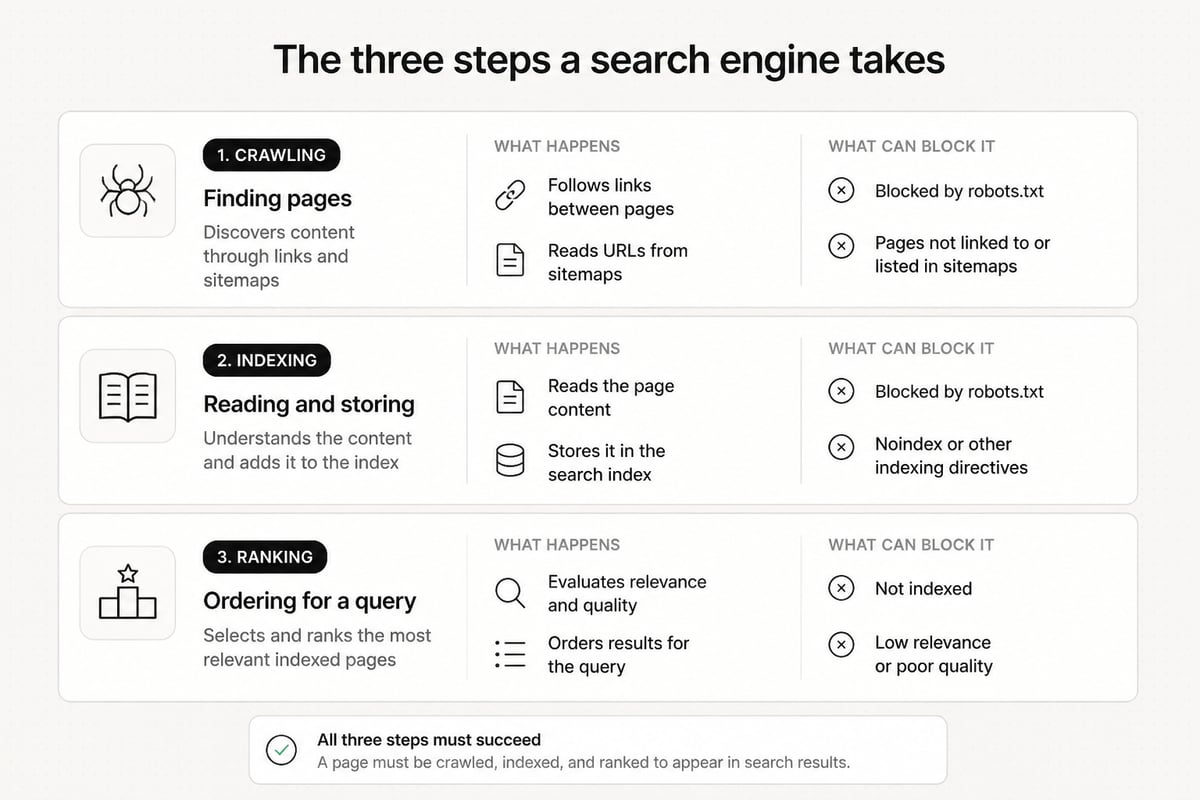
Search engines work in three steps: they crawl pages, store them in an index, and rank the indexed pages when someone searches. Each step can fail on its own, so it helps to know which one is your problem.
- Crawling. Automated programs follow links across the web and download pages. If no link points to a page and it is not in your sitemap, it may never be found.
- Indexing. The search engine reads the page, works out what it is about and stores it. Pages blocked by settings, duplicated, or thin on content often stay out.
- Ranking. When someone types a query, the engine picks the most useful indexed pages and orders them.
Ranking is the hard part. Google says its automated ranking systems assess many factors and signals across a very large body of web pages and other content in its Search index. Nobody outside Google knows the exact weights. What you can control is the quality of the page, how clearly it matches the query, and how well the site is built.
What Does SEO Include?
SEO covers four groups of work: on-page, technical, off-page and local. A small site does not need all four at full strength on day one, but each one affects the others.
On-page SEO
On-page SEO is everything you control on the page itself. That means the title tag, the meta description, headings, the body text, images with alt text, and links to your other pages. The main job is to match the page to one clear search intent. A page titled "Plumber in Denver" that talks about plumbing history will not hold a ranking.
Technical SEO
Technical SEO makes sure search engines can reach and read your site. It covers page speed, mobile layout, HTTPS, clean URLs, a sitemap and fixing broken links. A site with strong content and weak technical basics can sit unindexed for weeks. If you run on a specific platform, platform guides such as WordPress SEO checklist and SEO for a Shopify store cover the setup points that matter there.
Off-page SEO
Off-page SEO is what happens outside your site, mainly links from other sites to yours. A link from a respected, relevant site works as a vote of trust. Links from spammy or unrelated sites add little and can cause harm. For a closer look, see this explanation of white hat SEO backlinks.
Local SEO
Local SEO applies if you serve a city or region. It centers on a complete Google Business Profile, consistent name, address and phone details across the web, and reviews. Our breakdown of the four types of SEO goes into each one in more detail.
Why SEO Matters for a Small Business
SEO matters because it is one of the few channels where traffic keeps arriving after the work is done. An ad stops the day you stop paying. A good article keeps ranking.
Here is what that looks like in practice:
- Steady traffic. Each ranking page is a small, permanent entry point to your site.
- Better-qualified visitors. Someone searching "how to choose a standing desk" is already looking to buy or learn.
- Lower cost over time. An article costs money once, then keeps working.
- Trust. Pages that appear for several related questions make a brand look established.
There is a trade-off. SEO is slow. Most new pages need weeks to be indexed and months to build position, and nobody can promise a ranking. If you need customers next week, run ads. If you want a base of traffic in six months, start SEO now. The difference between the two is covered in SEO vs SEM.
What Is SEO Content, and What Makes It Rank?
SEO content is a page written to answer a specific search query better than the pages already ranking for it. The keyword tells you what people want. The page has to deliver it.
Google has said its helpful-content system is part of its core ranking systems. In practice that means pages written for readers, with real answers, tend to do better than pages written to catch keywords. Google also publishes guidance on creating helpful, reliable, people-first content with questions you can use to check your own pages.
A page that tends to rank usually does these things:
- Targets one main query and its close variations.
- Answers the question in the first few lines, then goes deeper.
- Uses real numbers, steps and examples instead of filler.
- Links to your own related pages and to outside sources.
- Loads fast and reads well on a phone.
Keyword research
Keyword research decides what to write. You look for queries with enough monthly searches to matter and low enough difficulty that your site can compete. A new site usually wins on narrow, specific queries first, not on broad terms like "marketing". A practical way to build that list is covered in this guide to an SEO keywords list.
How to Measure SEO Results
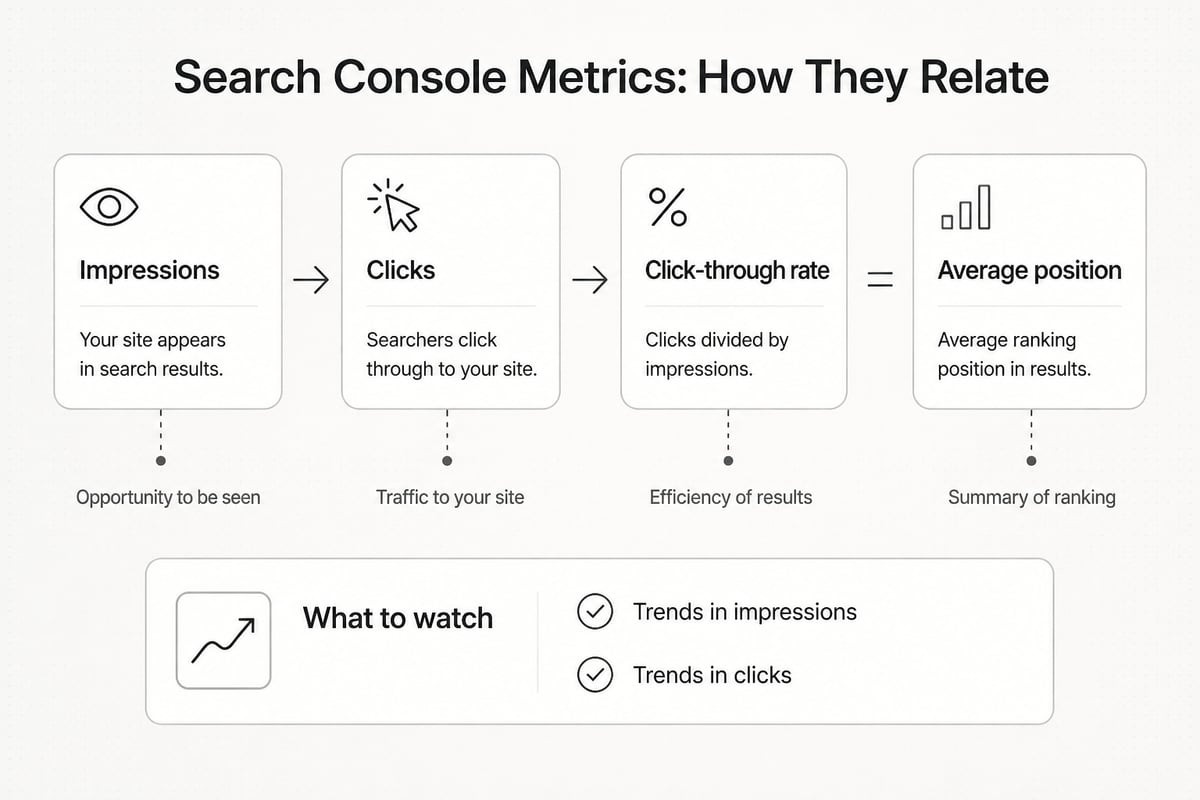
SEO results are measured with four numbers in Google Search Console: clicks, impressions, click-through rate and average position. The tool is free and shows what people searched before landing on your site.
Google's documentation says the Search results Performance report includes clicks, impressions, click-through rate and average position, and that click-through rate is clicks divided by impressions. The report shows the past three months by default.
| Metric | What it tells you |
|---|---|
| Impressions | How often your pages appeared in results |
| Clicks | How often someone visited from those results |
| Click-through rate | Clicks divided by impressions; a weak title or description lowers it |
| Average position | Where you rank on average across queries |
Do not chase average position alone. Google recommends focusing more on trends in impressions and clicks than on position by itself, because position averages every query, including ones where you barely appear.
A realistic early pattern: impressions rise first, clicks follow, and revenue comes later. If impressions are flat after three months of steady publishing, the problem is usually indexing, weak topics or content that does not match intent. For more on connecting traffic to outcomes, see SEO and traffic.
Is SEO Dead in 2026?
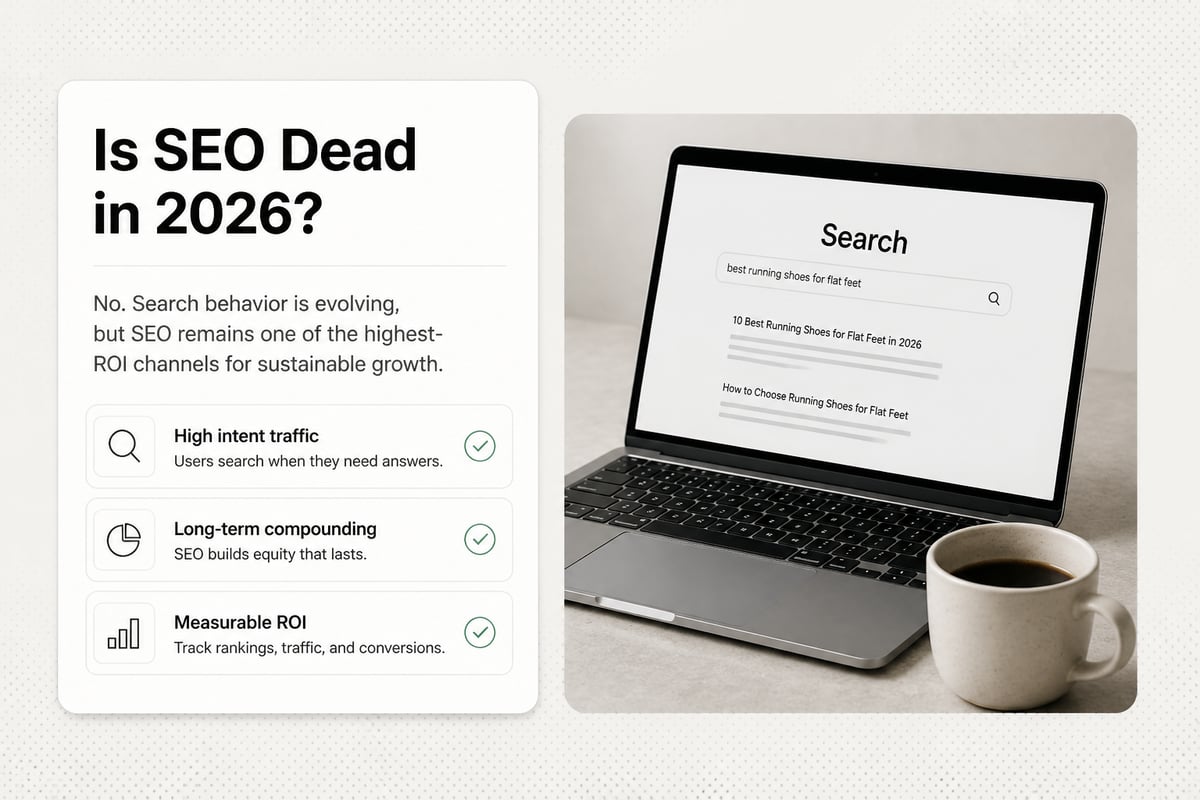
SEO is not dead in 2026, but the places people see answers have widened. People still search Google, and they also ask ChatGPT, Gemini and Google AI Overviews. All of these tools pull answers from pages on the web, so clear, well-sourced pages help in both places.
You do not need to rank first on Google to be cited by an AI assistant. A page that answers a specific question well, with named sources and plain structure, can be picked up even from lower positions. This overlap is why the work is often called generative engine optimization or AI visibility, and it builds on the same habits as classic SEO. Read more in SEO and AI and is GEO replacing SEO.
What has changed is the cost of weak content. Generic pages that repeat what ten others already say get little traction in either place. Specific answers with original detail do better.
Can You Do SEO Yourself, and What Does It Cost?
You can do SEO yourself, and many founders do, but the real cost is time, not tools. The free basics are Google Search Console, a sitemap, good titles and a steady writing habit. Our piece on free SEO lists what you can do at no cost.
The work that eats hours is the repeating part: finding keywords, writing articles, adding images and links, and publishing on a schedule. A freelance writer or agency takes that off your plate at a price. RankPill says an agency article typically costs more than a freelance one, while its own plan works out to a few dollars per article. Full ranges are in SEO price.
Where automation fits
RankPill is an AI SEO tool that finds keywords from your site, your competitors and live search data, writes articles of about 1,000, 2,000 or 3,000 words, and publishes them to WordPress, Shopify, Webflow, Wix, Framer or any site via webhooks. You pick the schedule, and you can set it to hold each article for your review before it goes live. It is built for owners who want steady organic content without writing it. It is not the right fit if you only want hand-written content, or if your site cannot publish articles at all.
Automation does not remove the need for judgment. You still decide what your business sells and which topics belong on your site, and you should read what goes out under your name. Google says it ranks helpful content regardless of how it was made, and penalizes unhelpful content whether a person or AI wrote it.
What Does an SEO Beginner Do First?
A beginner should do six things in order, and none of them needs a paid tool.
- Set up Google Search Console and submit your sitemap.
- Pick 10 to 20 keywords with real search volume that match what you sell.
- Write one page per keyword, answering the question early and clearly.
- Add internal links between related pages so crawlers and readers can move through the site.
- Fix the basics: page speed, mobile layout, HTTPS, broken links.
- Check Search Console monthly and update pages that get impressions but few clicks.
For a team starting from zero, our guide for startup SEO maps these steps onto the first six months.
Black hat and white hat
White hat SEO follows search engine guidelines. Black hat tries to trick them with tactics such as hidden text, bought link networks and mass-produced thin pages. These can bring a quick rise and then a penalty or a drop out of the index. Stick to white hat, which is explained further in black hat and white hat SEO.
Related Terms to Know
Learning the vocabulary makes reports and tools easier to read.
- Organic traffic: visitors who arrive from unpaid search results. See what organic search traffic is.
- SERP: the search engine results page.
- Keyword difficulty: an estimate of how hard it is to rank for a query.
- Backlink: a link to your site from another site.
- Domain Rating: a score of a site's link strength used by some tools.
- Search intent: the goal behind a query, such as learning, comparing or buying.
- Indexing: a search engine storing a page so it can appear in results.
- E-E-A-T: Google's shorthand for experience, expertise, authoritativeness and trust.
Resources from outside the SEO world can also be useful when you are building content. For example, a business that sells coffee might study how a specialist retailer such as Monexpresso structures its product categories, since clear category pages are an SEO basic. And if you run a manufacturing or print business, a service company like American Laser Mark shows how a niche service such as laser engraving and screen printing can be explained page by page.
FAQ
Can I do SEO for free?
Yes. Google Search Console, a sitemap, well-written pages and internal links cost nothing. What you pay with is time, since writing and publishing steadily is the bulk of the work.
What is an SEO course?
An SEO course is structured training that teaches keyword research, on-page work, technical checks and link building. It can help if you want to run SEO yourself. If you only want the outcome, a tool or a service may be a better use of your hours.
What is SEO on YouTube?
It is the same idea applied to video search. You use a clear title, a useful description, chapters and a thumbnail so YouTube and Google can understand the video and show it for the right queries. The video itself still has to hold viewers, because watch behavior affects how widely it is shown.
Start today by opening Google Search Console, submitting your sitemap and writing down ten questions your customers ask, because those become your first articles. If you would rather not write and publish them yourself, Try RankPill to have articles planned, written and published to your site on your schedule, starting with a 3-day trial for $1.
Unlock Traffic on Autopilot
Grow organic traffic on autopilot. RankPill will research, write, optimize, and publish articles to your website daily.