
Competitor Research Tools: A Guide for SEO Teams

Modest Mitkus · November 15, 2026
Competitor research tools show you which keywords, pages, links and ads your rivals use to win traffic, so you can find gaps in your own plan. Most SEO teams need three kinds: a keyword gap tool, a backlink checker and a content tracker. This guide covers what each does, how to pick, and how to turn the findings into published articles.
What Competitor Research Tools Actually Tell You
Competitor research tools answer five practical questions about a rival site: what it ranks for, where its traffic comes from, who links to it, what content it publishes, and where it spends on ads.
That is useful because you rarely need to invent a strategy from scratch. Your competitors have already tested topics, formats and keywords in the real market. You can read their results and decide where to follow, where to skip and where to do better.
Semrush's guide to comparing websites lists six comparison areas: organic traffic, keywords, backlinks, site architecture, advertising performance and site engagement. You do not need all six every month. Most small teams get most of the value from keywords, backlinks and content.
One caution. These tools estimate. Traffic numbers from third-party tools are models, not analytics. Use them to compare sites against each other and to spot direction, not to quote exact visitor counts.
The Four Types of Competitors to Track
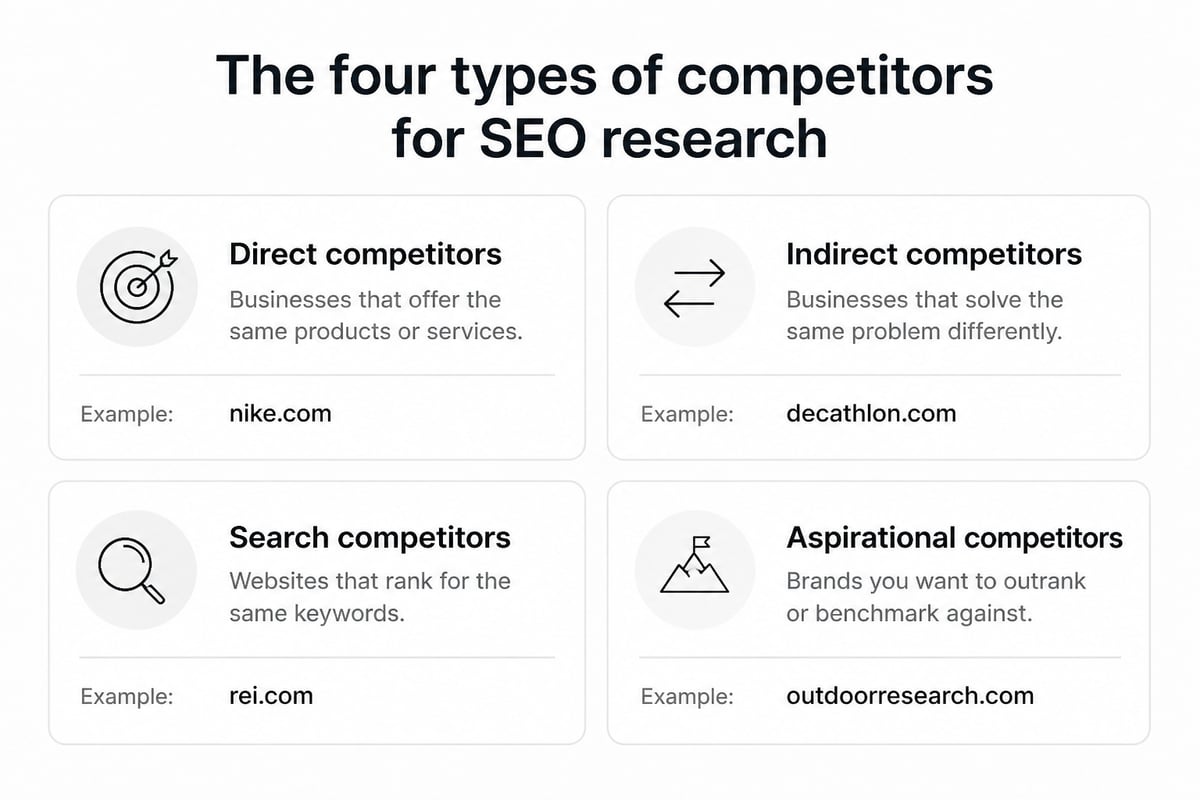
There are four types of competitors, and a good research setup tracks each one: direct, indirect, search and aspirational.
- Direct competitors sell the same thing to the same customers. These are the obvious names on your sales calls.
- Indirect competitors solve the same problem a different way. A project management app competes with a spreadsheet template site.
- Search competitors are any sites that rank for your target keywords, even if they sell nothing like you. A news site or a forum thread can take the click you wanted.
- Aspirational competitors are larger brands in your space. You will not outrank them soon, but their content structure shows what Google rewards in your niche.
Search competitors matter most for SEO and get tracked least. A small ecommerce store may find that three review blogs and a Reddit thread hold the top spots, not the brands it considers rivals. Build your research around who appears in the results, not who you think you compete with.
The Main Categories of Competitor Research Tools
Competitor research tools fall into six categories, and each answers a different question. Pick by the question you need answered, not by brand.
| Category | What it answers | Typical examples |
|---|---|---|
| All-in-one SEO suites | Rankings, traffic, backlinks and ads in one place | Semrush, Ahrefs, Moz, SE Ranking |
| Keyword gap and keyword research tools | Which keywords rivals rank for that you do not | Semrush Keyword Gap, SpyFu, KWFinder |
| Backlink analyzers | Who links to rivals and how | Majestic, Ahrefs, Moz Link Explorer |
| Traffic and audience tools | Total visits, sources and audience overlap | Similarweb |
| Content and social monitors | What rivals publish and what gets shared | BuzzSumo, Feedly, Google Alerts |
| Ad intelligence tools | Paid keywords and ad copy | SpyFu, iSpionage |
Some of these are free or have a free tier. Google Alerts costs nothing and tells you when a rival is mentioned or publishes something new. Google search operators like site:rival.com let you see every indexed page on a competitor's site for free.
All-in-one suites
Suites cover the most ground for the money. Semrush, Ahrefs and Moz each combine keyword, backlink and traffic data. The trade-off is price and complexity. Plans for full suites usually run from around $100 to several hundred dollars a month, and the dashboards are built for specialists. Check each vendor's pricing page before you commit, since plans change.
Traffic and market tools
Similarweb says its digital data and insights span more than 1 billion websites and 200 million mobile apps. It is strongest for comparing total traffic, channel mix and audience overlap between sites. It is weaker for the keyword-level detail an SEO team needs day to day.
Content and social monitors
BuzzSumo shows which competitor content earns shares and links. Feedly lets you follow rival blogs in one feed. These do not replace keyword tools, but they show you what topics a competitor is investing in before the rankings show up.
How to Analyze Your Competitors in Marketing: A Five-Step Workflow
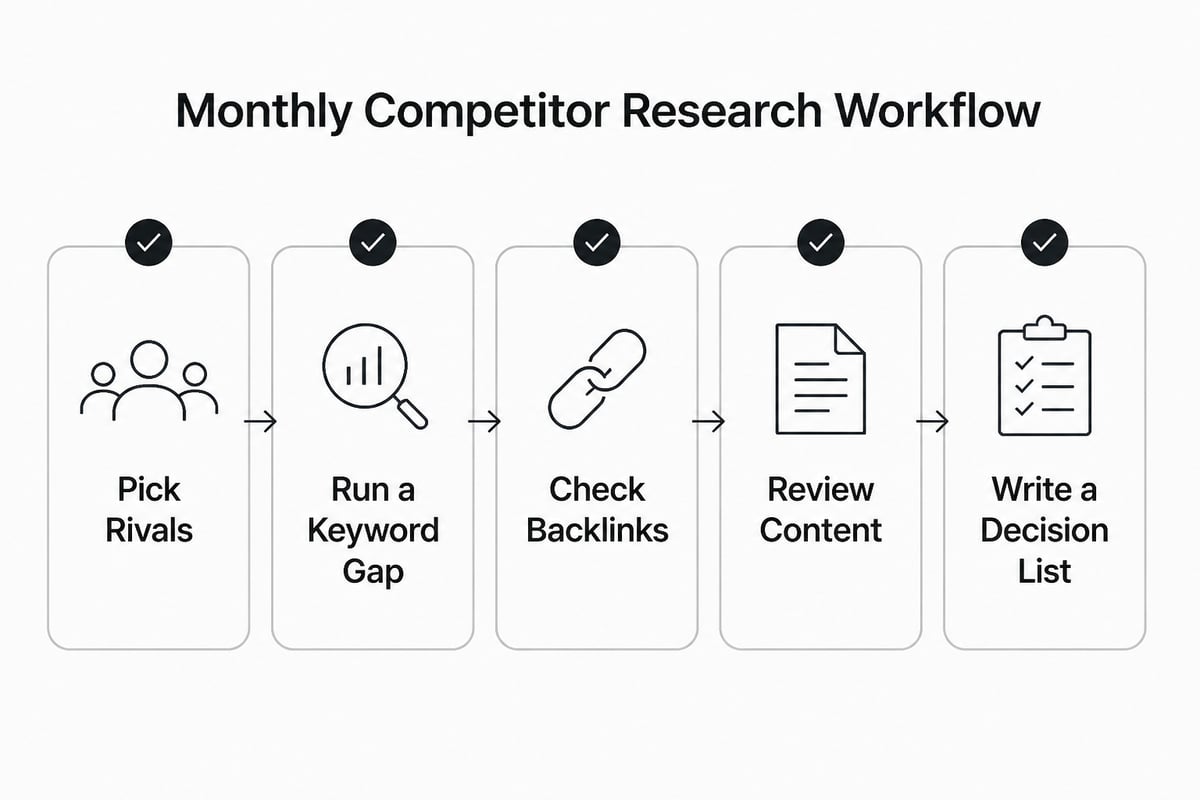
The simplest way to analyze competitors in marketing is to run the same five steps every month: pick rivals, compare keywords, check links, review content, then decide what to publish.
- Pick three to five real rivals. Search your top ten target keywords and note which domains appear most. Semrush's SEO competitive analysis walkthrough covers identifying organic competitors this way.
- Run a keyword gap. List keywords your rivals rank for that you do not. Semrush's Keyword Gap workflow supports comparing a site with up to four competitors, which is plenty for many teams.
- Check their backlinks. Look at which pages earned the most links and from which sites. A page with 40 linking domains tells you the topic is worth covering and the format works.
- Review their content. Open the top three pages for each gap keyword. Note length, headings, examples, freshness and what is missing.
- Write a decision list. For each gap, mark it as write now, update an existing page, or ignore. Do not leave the research as a spreadsheet nobody reads.
The last step is where most research dies. Findings only matter once they become pages on your site. If you want a deeper method for this, RankPill's guide to competitor analysis for SEO walks through it in more detail.
The Four P's of Competitor Analysis
The four P's of competitor analysis are product, price, place and promotion, the classic marketing mix applied to rivals. They help you look past SEO metrics to the full offer a customer sees.
- Product: what they sell, which features they push, how they describe it.
- Price: their plans, discounts and how they present cost on the page.
- Place: where they sell and where they show up: their site, marketplaces, directories, app stores.
- Promotion: how they get attention, including content, ads, email and social.
SEO tools mostly cover promotion and part of place. For product and price, you read their pages. Do this by hand once a quarter. It takes an hour and often reveals content angles no keyword tool will, such as a question every rival's pricing page leaves unanswered.
Turning a Keyword Gap Into a Content Plan
A keyword gap becomes a content plan when you filter it by difficulty, intent and fit, then schedule the winners. A raw gap list of 800 keywords is not a plan.
Start by removing keywords that do not match your offer. Then sort what is left by keyword difficulty and monthly search volume. For a newer site, low-difficulty keywords that rivals rank for with thin pages are the best first targets. Semrush also explains how to find competitor keywords through SERP research and overlap analysis if you want to go deeper.
Group the survivors into topics, not single keywords. One article can target a main keyword and its close variations. A list of 60 keywords often collapses into 15 to 20 articles.
This is the point where a tool that goes straight from research to a publishing calendar saves time. RankPill's Keyword Research Tool scans your website and your competitors, then builds a keyword list with real monthly search volume and keyword difficulty. Each keyword is tagged by opportunity and can be added to the calendar in one click, so you get a clear list of what to write next instead of a 50-column spreadsheet.
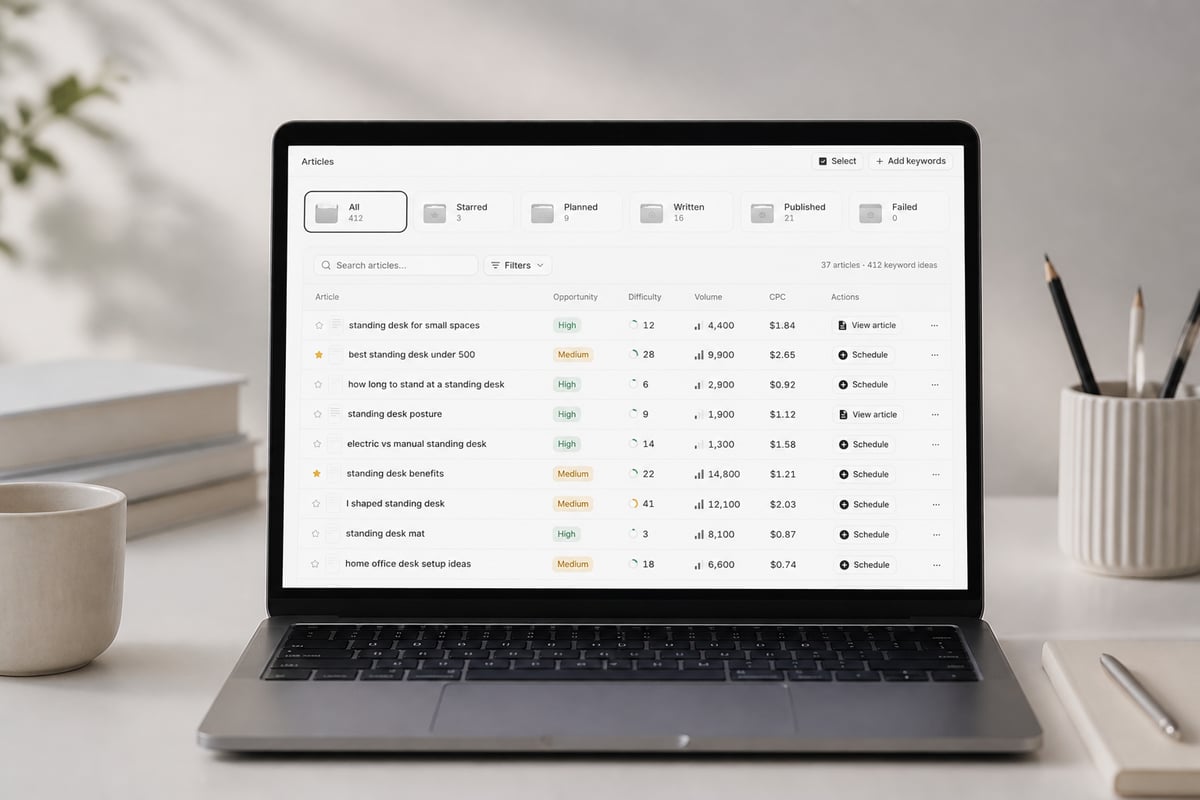
If you only want a quick look first, the free competitor keyword analyzer is a lighter place to start.
Competitor Research Tools for AI Search
Competitor research now includes AI search: you need to know which brands ChatGPT, Gemini and Google AI Overviews name when someone asks about your category.
This matters because AI answers are a growing share of results. Ahrefs reported that AI Overviews appeared in 16% of US searches when measured in 2025, more than double the March 2025 level. The same research family found that visitors from AI platforms are different from search visitors. An Ahrefs analysis of 81,947 websites found AI visitors averaged 4 pages per visit, 1.2 fewer than search visitors, and were 4.1% more likely to bounce than search visitors.
Two practical conclusions follow. First, AI mentions are worth tracking, because a citation can send visitors even when you do not rank first. Second, AI traffic is not a replacement for search traffic, so keep both in your plan.
You can check this by hand. Ask ChatGPT and Gemini the ten questions your customers ask, and write down which brands and sources appear. It is slow but free. RankPill Plus automates this by asking up to 50 prompts every day in ChatGPT, Gemini and Google AI Overviews and reporting mentions, cited sources, competitors named and sentiment. It does not track Perplexity or Claude yet. There is also a free AI visibility checker for a one-off look.
Can ChatGPT Do Market Research?
ChatGPT can help with parts of market research, such as summarizing a rival's positioning or brainstorming angles, but it cannot replace data tools for keywords and traffic.
It has no live access to search volume, rankings or backlink counts unless connected to a data source, and it can state wrong numbers with confidence. Use it for tasks where wrong details are easy to catch:
- Summarizing a competitor's pricing page you paste in.
- Grouping a long keyword list into topics.
- Drafting interview questions for customers.
- Suggesting counterarguments to a rival's claims.
Do not use it to produce traffic estimates, domain ratings or keyword volumes. Pull those from a tool that measures them, then use the AI for the thinking around the numbers.

How to Choose Competitor Research Tools for Your Team
Choose competitor research tools by team size, budget and the one question you need answered most, not by feature count.
A short decision guide:
- Solo founder or small business: start with Google Search Console (free), Google Alerts and one keyword gap tool. Skip enterprise suites. You will use 10% of them.
- Small marketing team: one all-in-one suite plus a content monitor like BuzzSumo or Feedly covers most needs.
- Agency with several clients: you need multi-project support, white-label reports and a way to keep each client's competitor set separate. RankPill's roundup of SEO tools for agencies covers what to look for.
Before paying, ask four things. Does it give real search volume and difficulty? Can you export the data? How many competitors can you track per project? Does the free trial let you run your own site, not a demo?
Also be honest about the limit of research tools. They tell you what to write. They do not write, publish or update anything. If research is not turning into published articles, the bottleneck is production, not data.
Where Automation Fits, and Where It Does Not
Automation handles the repeatable half of competitor research: finding gaps, planning topics and publishing on a schedule. A person still has to decide what the business is, who it serves and which rivals matter.
RankPill takes the findings from your site, your competitors and live search data, then plans, writes and publishes articles on the schedule you pick, up to one a day on the plan with 30 articles a month. Articles come with images, internal and external links, meta tags and natural mentions of your products. It publishes directly to WordPress, Shopify, Webflow, Wix and Framer, or any site through webhooks. At $99 a month per website, that works out to about $3 per article.
It is not the right fit if you want only hand-written content, or if your site cannot connect to a supported publishing platform. In those cases, use a research suite and a writer, and keep your gap list short enough to actually finish.
For teams that want to see how this connects, these guides go further: content competitor analysis for comparing page quality, and SEO automation tools for the production side.
What a Realistic Monthly Routine Looks Like
A sustainable routine takes about two hours a month for a small team: one hour of research and one hour of decisions.
- Week 1: Re-run the keyword gap against your three main search competitors. Note new keywords they entered.
- Week 2: Check new backlinks to their top pages. Flag one or two outreach or content ideas.
- Week 3: Review which of your articles gained or lost position. Update the ones that slipped.
- Week 4: Ask AI assistants your top customer questions and record who gets named.
Keep a single document with the date, the three biggest findings and the action you took. After three months you will see which rivals are moving and which tools earn their subscription. Google's Search Central SEO Starter Guide, as summarized by Semrush, recommends creating helpful, reliable, people-first content, and that is the standard to measure rival pages against too. If a competitor's page is thin, beating it is a writing task. If it is excellent, pick another keyword.
FAQ
How many competitors should I track?
Three to five is enough for most sites. More than that creates noise and slows decisions. Choose the ones that appear most often in search results for your target keywords.
Are free competitor research tools good enough?
For a small site, often yes. Google Search Console, Google Alerts, search operators and free checkers cover basic gaps. Paid tools add keyword volume, difficulty and backlink depth, which matter once you plan dozens of articles.
How often should I update my competitor research?
Review keyword gaps monthly and run a deeper content and pricing review each quarter. Rankings and rival content change slowly, so weekly checks mostly produce noise.
Open your top three target keywords in a search window today, write down which domains appear on page one, and run a keyword gap against the two that surprise you. Turning that list into published pages is the slow part, and RankPill handles it by planning, writing and publishing articles on your schedule, so you can try RankPill with a 3-day trial for $1 and see your first articles go live. The Keyword Research Tool is the best place to start if you only want the gap list first.
Unlock Traffic on Autopilot
Grow organic traffic on autopilot. RankPill will research, write, optimize, and publish articles to your website daily.