
How to Do Niche Research Tool Work for Your Website

Modest Mitkus · November 22, 2026
A niche research tool tells you whether a narrow topic has enough search demand and weak enough competition for your website to win traffic there. It does not pick the niche for you. You still decide, but the tool replaces guesses with search volume, difficulty scores and a list of who already ranks.
This article shows how to use one in a sequence that works for a small business or an agency: define the niche, check demand, size up competitors, find keywords, and turn the result into a publishing plan.
What "niche" means in research
In research, a niche is a narrow slice of a market with its own audience, its own vocabulary and its own search behavior. "Running shoes" is a broad market. "Running shoes for flat feet on trails" is a niche.
For SEO, the useful test is simple. Can you describe the people searching in one sentence, and do they use words a bigger site in the same market would not bother to target? If yes, you have a niche worth checking.
A niche is not the same as a keyword. One niche usually holds dozens or hundreds of keywords. Your job is to find out whether that pool is deep enough to build a content plan on.
How to pick a niche for your website
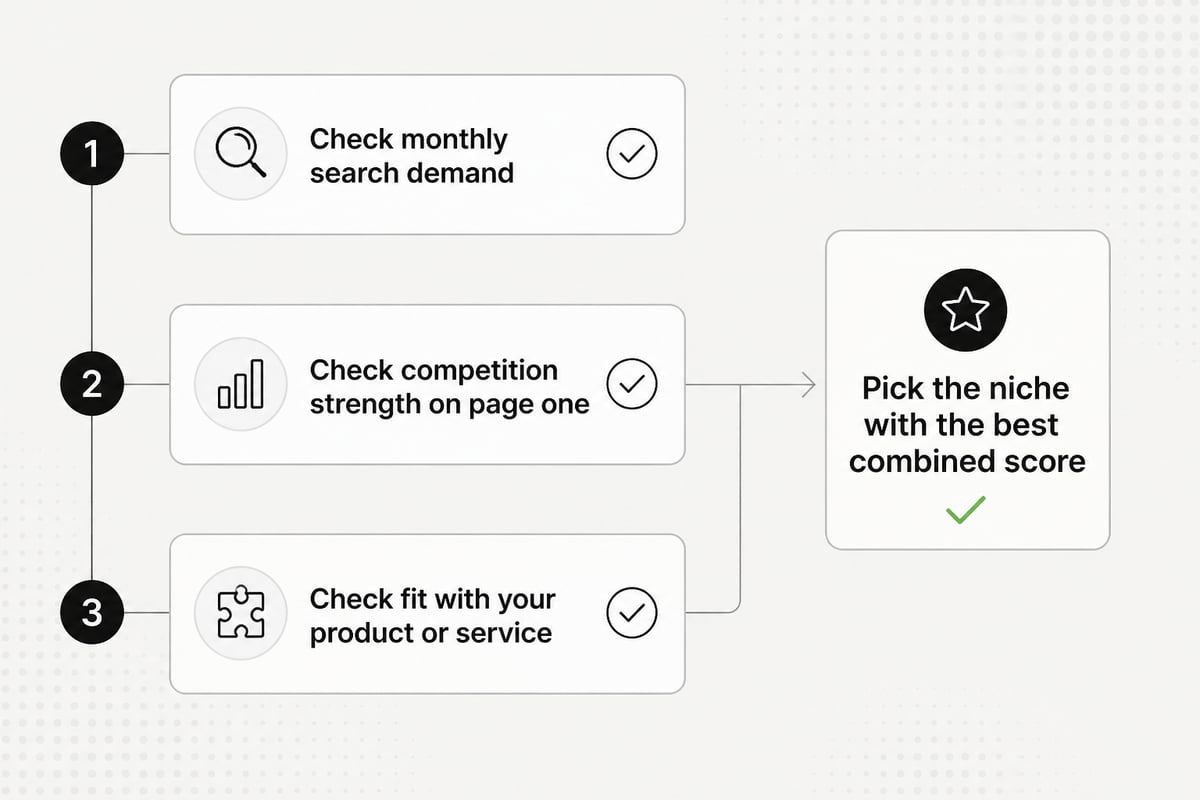
You pick a niche by scoring a short list of candidates against the same three criteria: demand, competition and fit with what you sell. Start with three to five ideas, not fifty.
Use these criteria:
- Demand. Are people searching for it every month? You need a number, not a feeling.
- Competition. Can a site your size reach page one? Look at who ranks today.
- Fit. Does an article in this niche lead a reader toward something you offer?
Fit is the one most tools cannot measure, and it decides whether traffic turns into customers. A niche with 5,000 monthly searches that never connects to your product is worth less than one with 800 searches from people ready to buy.
Write your shortlist in a plain table with one row per niche and one column per criterion. Fill it in as you work through the next sections. You will have a clear winner or a clear reason to drop an idea.
What a niche research tool actually measures
A niche research tool measures search demand, ranking difficulty and the strength of the pages already ranking, and each number has limits you should know before you trust it.
Here is what the main metrics mean:
- Search volume. Semrush defines search volume as the average number of monthly searches for a keyword. Ahrefs adds that it counts searches rather than unique searchers, is commonly reported as an annual average, and varies by country.
- Keyword difficulty. Semrush describes this as an estimate of how hard it is to rank in the top 10 results. Treat it as a rough guide, not a verdict.
- Trend data. Google Trends uses an anonymized, aggregated sample of actual Google searches, normalized by geography and time and scaled from 0 to 100. It shows relative interest, not absolute volume, so use it to see direction, not size.
Volume also overstates traffic. Ahrefs notes that ranking first for a keyword will rarely bring traffic exceeding 30% of that keyword's search volume, so a keyword with 1,000 monthly searches is realistically worth no more than about 300 visits.
That cuts both ways. Small numbers add up. Fifty keywords at 100 searches each can outperform one keyword at 3,000, and they are usually far easier to rank for.
Check demand before you commit
You check demand by confirming three things: the niche has steady searches, the trend is not falling, and the questions people ask are specific enough to answer in an article.
Run through it in this order:
- Enter your seed topics and note monthly volume for each.
- Open Google Trends and compare your niche term against a broader term. A flat or rising line is fine. A steep decline is a warning.
- Look at the questions and long-tail phrases people use. Specific questions are good news, because specific questions are easy to answer well.
- Check seasonality. A niche that peaks for six weeks a year needs a different plan from one that runs all year.
A fast tool saves you time here. Semrush's keyword research checklist notes its Keyword Overview tool can evaluate up to 100 search terms at once, which is enough to test a whole niche in one pass.
For local or service businesses, search data is only half the picture. The U.S. Census Bureau says Census Business Builder combines selected Census Bureau and other statistics to help small businesses research opening or expanding. Pair that with search data and you can see both who lives in your market and what they type into Google.
How to size up the competition
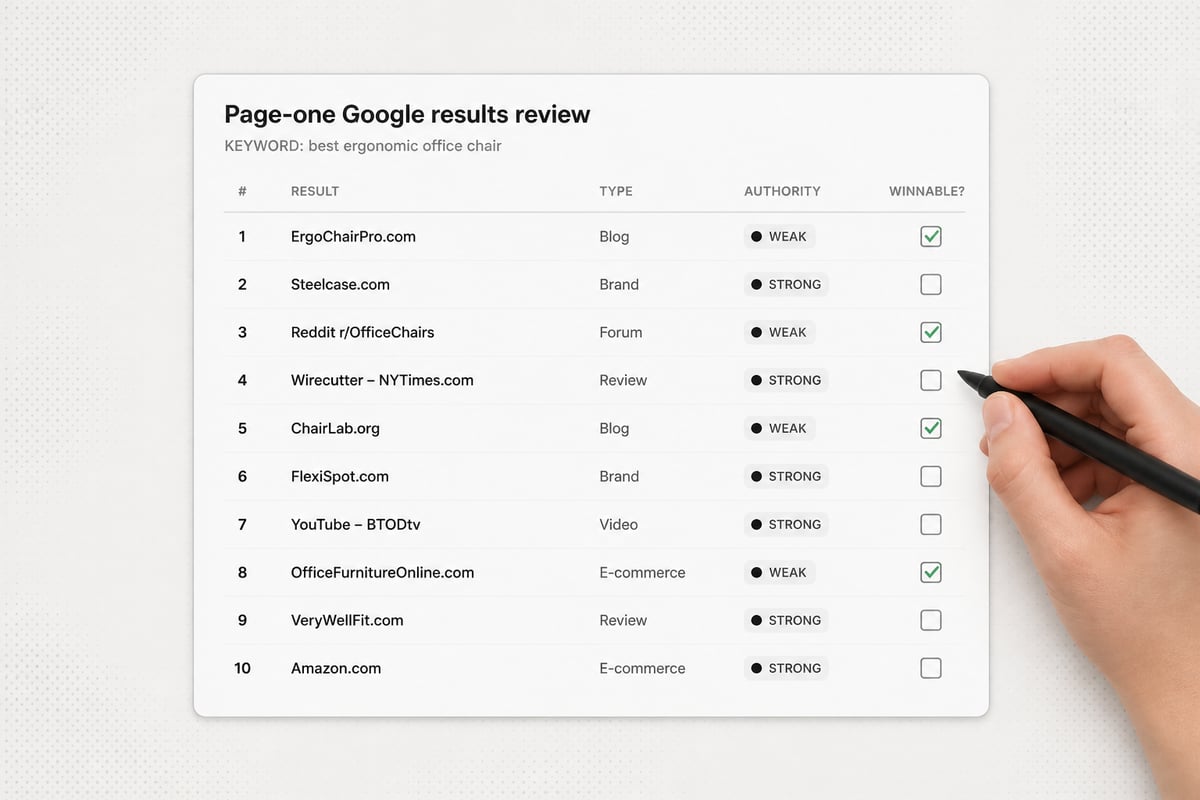
You size up competition by reading the actual page-one results for your main keywords and asking whether a new article from your site could beat them.
Open the top ten results for each of your core keywords and check:
- Site type. Are they large publishers and brands, or small blogs and niche sites? Small sites on page one mean the door is open.
- Content quality. Is the top result thin, outdated or off-topic? Weak pages are your opening.
- Content format. Do they rank with lists, guides, comparison pages or tools? Match the format Google already rewards.
- Domain strength. Use a domain rating checker to compare their authority with yours.
You can also run this the other way. Instead of studying one keyword at a time, look at what rivals already rank for and find the topics they cover that you do not. Our guides on competitor research and the keyword gap tool walk through that method.
Ten example niche product areas and how to test them
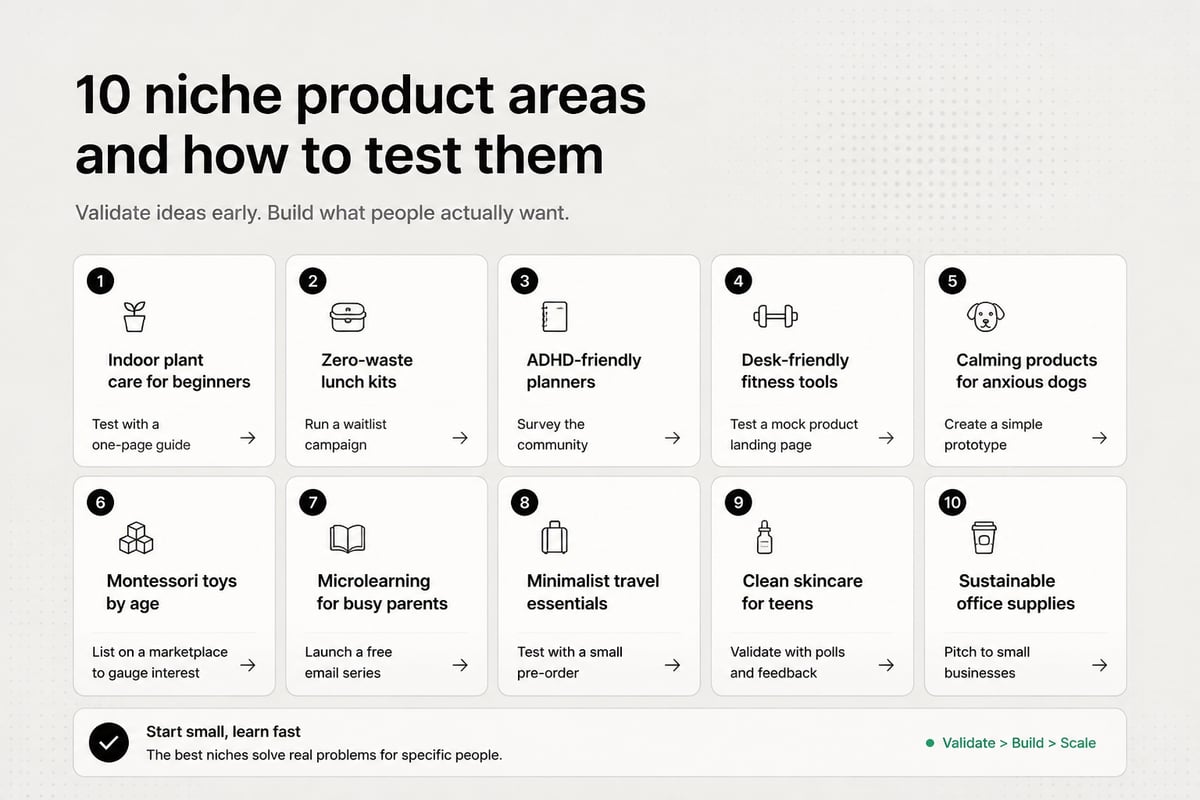
Profitable niche product areas share one trait: the buyer has a specific problem and searches for a specific solution. Here are ten broad areas to test. These are starting points to validate with your own data, not proven winners.
| Niche area | Example narrow angle | What to check |
|---|---|---|
| Pet care | Senior dog joint supplements | Volume and buying intent |
| Home fitness | Resistance bands for physical therapy | Question-style searches |
| Coffee | Pour-over gear for small kitchens | Product comparison keywords |
| Skincare | Fragrance-free routines for sensitive skin | Ingredient questions |
| Gardening | Container vegetables for balconies | Seasonal trend |
| Remote work | Ergonomic setups for small desks | Commercial keywords |
| Baby gear | Travel strollers for flights | Long-tail volume |
| Outdoor | Ultralight backpacking food | Forum and Reddit threads |
| Personal finance | Budgeting for freelancers | Competition from big brands |
| B2B software | Invoicing for small agencies | Cost-per-click as demand signal |
Pick two or three, run them through the demand and competition checks above, and drop any that fail. Most will. That is the point of testing.
Finding what is hot right now
You find what is trending by combining Google Trends with community signals and watching for sustained growth rather than one-week spikes.
Three places to look:
- Google Trends rising queries. Compare related queries over 12 months and 5 years. A term that has grown for years is a safer bet than a viral one.
- Forums and communities. Threads that get repeated questions show unmet demand. Reddit keyword research is a good way to mine this.
- Your own search data. If you have a site, Google Search Console shows queries where you already get impressions but rank low. Those are niches Google already associates with you.
Be careful with trends. A hot topic brings traffic fast and loses it fast. If you cover one, tie it to an evergreen angle so the article keeps earning after the spike.
Turn the research into keywords you can rank for
Once a niche passes the checks, you turn it into a keyword list sorted by how winnable each term is, then start with the easiest and most relevant ones.
A workable process:
- Collect 50 to 100 keywords around the niche, including questions and long-tail phrases.
- Remove anything that does not fit your product or audience.
- Sort by keyword difficulty, lowest first, then by volume.
- Group related keywords so one article covers one topic.
- Pick the first ten articles from the top of the list.
You can do this in a spreadsheet, and many people do. The cost is time, and the list goes stale. If you want to see how the options compare, our roundup of the best SEO keyword research tools covers them side by side.
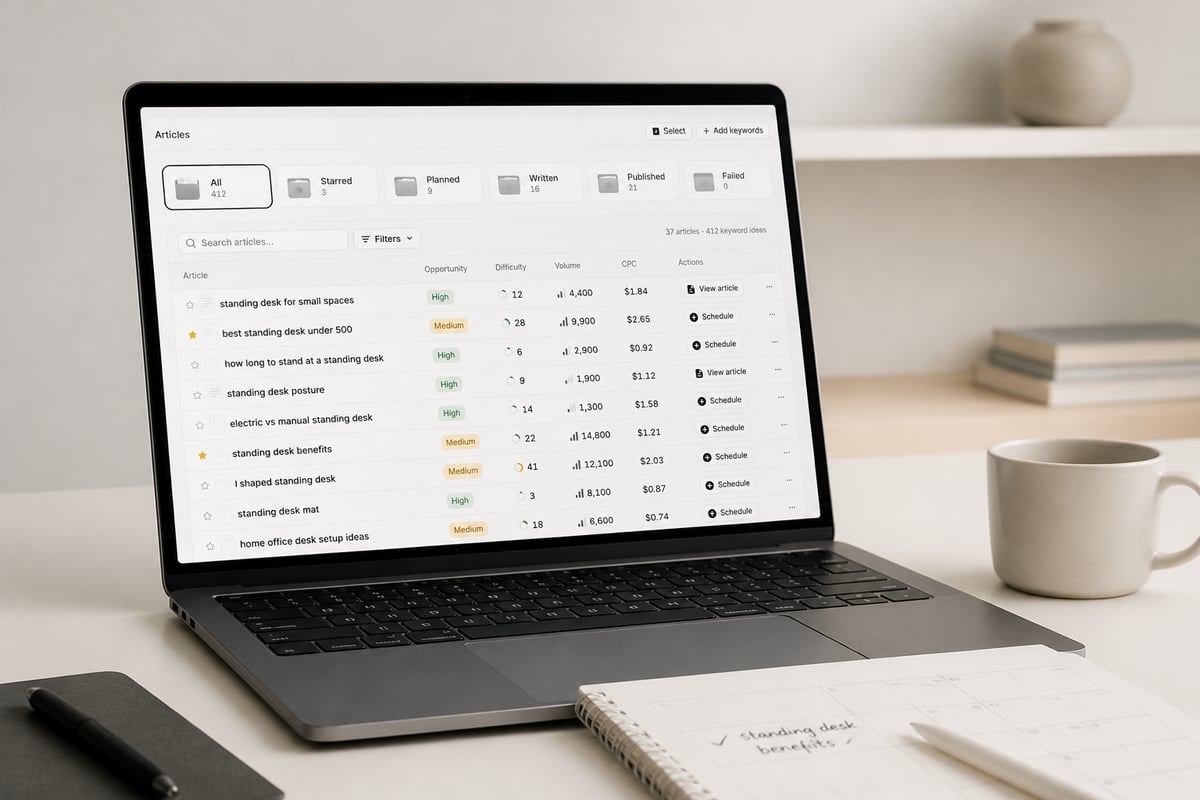
A site's keywords are also a good source of ideas. RankPill's Keyword Research Tool scans your website and your competitors, then builds a keyword list with real monthly search volume and keyword difficulty, with each keyword tagged by opportunity.
One caution on writing. Google says excessive repetition of keywords is keyword stuffing and violates its spam policies, and it does not use the meta keywords tag. Use your target phrase where it reads naturally, then write for the reader.
Build a publishing plan around the niche
A niche only produces traffic when you publish consistently, so the last step is a schedule you can actually keep.
Set a realistic cadence first. Two articles a week for six months beats ten articles in one burst and then silence. Many sites see their first articles getting impressions within a few weeks, and steady growth usually shows from month three or four, because traffic from articles compounds as more of them get indexed. There is no guaranteed timeline, and it depends on your niche and how established your site is.
Then plan the content in layers:
- Core pages. The two or three articles that define your niche and target its main keywords.
- Supporting articles. Narrow questions and long-tail topics that link back to the core pages.
- Commercial pages. Comparisons and buyer-intent articles that lead to what you sell.
Link the layers together with internal links so each article passes weight to the others. For more on the structure side, see our notes on niche site SEO.
The trade-off is time. Planning, writing, linking and publishing 30 articles a month is a full-time job. If you have no writer and no budget for an agency, that is where automation helps. RankPill plans, writes and publishes articles to your site on the schedule you set, up to one a day. On the $99 a month plan it works out to about $3 per article, compared with $133 or more per article from an agency. You can review every article before it goes live if you prefer to stay in control.
It is not the right fit if you want hand-written content only, or if your site cannot connect to a supported publishing platform.
Common mistakes when using a niche research tool
Most failed niche research comes from five avoidable mistakes:
- Chasing volume alone. High-volume terms are usually the hardest. Start where you can win.
- Ignoring intent. A keyword with 2,000 searches from readers who will never buy is not a good niche for a business.
- Trusting one metric. Difficulty scores are estimates. Always read the actual results page.
- Picking too broad. If you cannot describe the audience in one sentence, narrow it.
- Researching forever. A decent list you act on this week beats a perfect list you finish next quarter.
Treat the tool as a way to cut risk, not remove it. You will still be wrong about some keywords. Publishing and measuring tells you which ones.
FAQ
How do you pick a niche?
Shortlist three to five ideas, then score each on search demand, competition and fit with what you sell. Choose the one where demand is steady, page-one results are beatable and the audience would plausibly buy from you.
What niche is hot right now?
Check Google Trends rising queries over 12 months and 5 years, then confirm with community threads and your own Search Console data. Look for sustained growth rather than a single spike, because short-lived trends lose traffic quickly.
Can a niche research tool guarantee rankings?
No. It shows demand and difficulty, which lowers your risk, but rankings depend on your content, your site's authority and your competitors. Treat the data as a guide and measure results after you publish.
Pick one niche from your shortlist today and run its five or six main keywords through a keyword difficulty checker before you commit to anything. If the numbers hold up and you would rather not write the articles yourself, RankPill's Keyword Research Tool builds the keyword list from your site and competitors, and the rest of the platform writes and publishes on your schedule. Try RankPill with the $1 three-day trial and see the first articles go live without hiring a writer or an agency.
Unlock Traffic on Autopilot
Grow organic traffic on autopilot. RankPill will research, write, optimize, and publish articles to your website daily.