Best SEO Keyword Research Tools for 2026

Modest Mitkus · September 30, 2026
Keyword research remains the foundation of every successful SEO strategy, yet choosing the right tools can feel overwhelming in 2026. With AI-powered search transforming how people discover content and Google continuously refining its algorithms, marketers need tools that go beyond basic search volume data. The best SEO keyword research tools now balance traditional metrics with semantic understanding, competitor intelligence, and AI-driven insights to help you identify opportunities your competition is missing. Whether you're building an automated content pipeline or manually optimizing each article, the right keyword research platform shapes everything from topic selection to conversion rates.
Why Keyword Research Tools Matter More Than Ever
Search behavior has fundamentally changed. Users ask longer, more conversational questions, and AI platforms like ChatGPT now surface content in entirely new ways. Traditional keyword guessing doesn't cut it anymore.
The best SEO keyword research tools provide data-driven clarity on what your audience actually searches for, how difficult it is to rank, and which questions you need to answer. They reveal the gap between what you think people want and what they're genuinely typing into search bars.
Modern tools also help you understand search intent, which Google prioritizes above keyword density. A query like "best project management software" signals buying intent, while "what is project management" indicates early-stage research. Matching content to intent is how you win featured snippets and rank above competitors who target the same keywords but miss the underlying goal.

The Shift Toward Semantic and AI-Driven Search
According to research from Berkeley's Center for Marketing Research, generative engine optimization (GEO) is reshaping how businesses think about keyword targeting. Instead of obsessing over exact-match phrases, successful strategies now focus on topical authority and semantic relationships.
The best SEO keyword research tools in 2026 account for this shift. They don't just show you individual keywords; they map out topic clusters, related entities, and questions that demonstrate comprehensive coverage. This approach aligns with Google's Search Essentials, which emphasize helpful, people-first content over keyword stuffing.
Tools that integrate natural language processing can identify patterns in how people phrase questions, helping you create content that matches conversational queries and voice search. This capability is especially valuable as zero-click searches increase and users expect immediate answers directly in search results.
Core Features to Look for in Keyword Research Tools
Not all keyword tools are created equal. When evaluating platforms, focus on these essential capabilities:
- Search volume accuracy: Real monthly search estimates, not outdated or aggregated data
- Keyword difficulty scores: Transparent metrics showing how hard it is to rank
- SERP analysis: What's currently ranking, and why it's winning
- Question and long-tail discovery: LSI keywords, "People Also Ask" queries, and related searches
- Competitor gap analysis: Keywords your competitors rank for that you don't
- Search intent classification: Informational, navigational, commercial, or transactional
- Trend data: Seasonal patterns and momentum indicators
Accuracy and Data Sources
The reliability of keyword data separates professional-grade tools from freemium alternatives. Top-tier platforms pull from multiple data sources-Google Keyword Planner, clickstream data, autocomplete suggestions, and scraped SERP results-to provide more complete pictures.
Some tools refresh their databases daily, while others update monthly or quarterly. For fast-moving industries or trending topics, real-time data can make the difference between riding a wave and missing it entirely. Check how often your tool updates and whether it tracks sudden spikes or drops in search interest.
| Feature | Why It Matters | What to Check |
|---|---|---|
| Search volume | Validates demand before you invest time | Monthly updates, regional breakdowns |
| Keyword difficulty | Prevents wasted effort on impossible targets | Transparent calculation method |
| SERP features | Shows if you'll compete with ads, snippets, or local packs | Real-time SERP snapshots |
| Click-through rate estimates | Reveals how much traffic you'll actually get | Based on SERP position and features |
Top-Tier Enterprise Keyword Research Platforms
Enterprise-level platforms offer the most comprehensive data sets and advanced filtering options. These tools are ideal for agencies, large content teams, and businesses that rely heavily on organic search.
Ahrefs Keywords Explorer
Ahrefs maintains one of the largest keyword databases, with over 25 billion keywords across 170 countries. Its Keywords Explorer tool provides search volume, keyword difficulty, click metrics, and parent topic suggestions that help you target broader themes instead of isolated phrases.
The platform excels at showing you which keywords already drive traffic to competitors' pages. You can reverse-engineer successful content strategies by analyzing what ranks, how much traffic it generates, and which specific keywords contribute the most value.
Ahrefs also calculates "traffic potential" by looking at all the keywords a page ranks for, not just the primary target. This metric helps you prioritize topics that can attract compound traffic from multiple related searches.
SEMrush Keyword Magic Tool
SEMrush's Keyword Magic Tool generates thousands of keyword variations from a single seed term, organized into topic clusters and question-based groups. Its filtering system lets you narrow by search intent, keyword difficulty, word count, and inclusion/exclusion of specific terms.
One standout feature is the Keyword Gap tool, which compares your domain against up to four competitors simultaneously. You can see exactly where you're missing opportunities, where you overlap, and which keywords you own that they don't.
SEMrush also integrates keyword research with content templates that analyze top-ranking pages and recommend target word counts, readability scores, and semantic keywords to include.

Moz Keyword Explorer
Moz built its reputation on transparent, data-backed SEO metrics, and Keyword Explorer continues that tradition. The tool provides a proprietary Priority score that balances search volume, difficulty, and click-through rate potential into a single actionable metric.
Moz's SERP Analysis feature breaks down the top 10 results for any keyword, showing domain authority, page authority, and the number of linking domains for each competitor. This helps you assess whether you have a realistic chance of ranking based on your current site strength.
The platform also suggests related keywords organized by lexical similarity and search intent, making it easier to build content that covers a topic comprehensively rather than targeting isolated keywords.
Mid-Tier and Specialist Keyword Tools
Not every business needs enterprise-level complexity or pricing. Several mid-tier platforms deliver excellent keyword research capabilities at more accessible price points.
Ubersuggest
Neil Patel's Ubersuggest offers solid keyword data, competitor analysis, and content ideas for a fraction of enterprise tool costs. The interface is beginner-friendly, making it a strong choice for solo marketers and small teams.
Ubersuggest pulls keyword suggestions from Google Autocomplete and provides search volume, SEO difficulty, paid difficulty, and cost-per-click data. Its Content Ideas feature shows which articles already rank well for your target keywords, along with their social shares and backlink profiles.
The tool's limitations show up in database size and refresh frequency. It covers fewer international markets than Ahrefs or SEMrush, and its keyword difficulty calculations can be less nuanced for highly competitive niches.
Mangools KWFinder
KWFinder focuses specifically on finding low-competition, long-tail keywords that smaller sites can realistically rank for. Its difficulty score is calibrated for sites with modest domain authority, making it particularly useful for new blogs and niche websites.
The platform displays SERP results with link metrics for each ranking page, helping you quickly identify "weak" SERPs where you can compete. Its location-based search allows hyper-local keyword research, valuable for service businesses and regional campaigns.
AnswerThePublic
AnswerThePublic visualizes questions people ask around any topic, organized by who, what, when, where, why, and how. It's less about search volume data and more about discovering content angles and understanding how people frame their problems.
This tool pairs well with quantitative platforms. Use AnswerThePublic to generate a list of question-based keywords, then verify their search volume and difficulty in Ahrefs or SEMrush before committing to content creation.
Free and Freemium Keyword Research Options
Budget-conscious marketers can still access valuable keyword data without enterprise subscriptions. Several free tools provide legitimate research capabilities, though with limitations on query volume or feature depth.
Google Keyword Planner
Google Keyword Planner remains the most authoritative source for search volume data, since it comes directly from Google. However, it's designed primarily for Google Ads campaigns, which means the interface and suggestions lean toward paid search rather than organic optimization.
To get exact search volume numbers, you need an active Google Ads campaign. Otherwise, you'll see broad ranges like "1K–10K" instead of precise monthly estimates. Despite this limitation, the tool is valuable for validating whether keywords have legitimate search demand and for understanding seasonal trends.
RankPill Keyword Research Tool
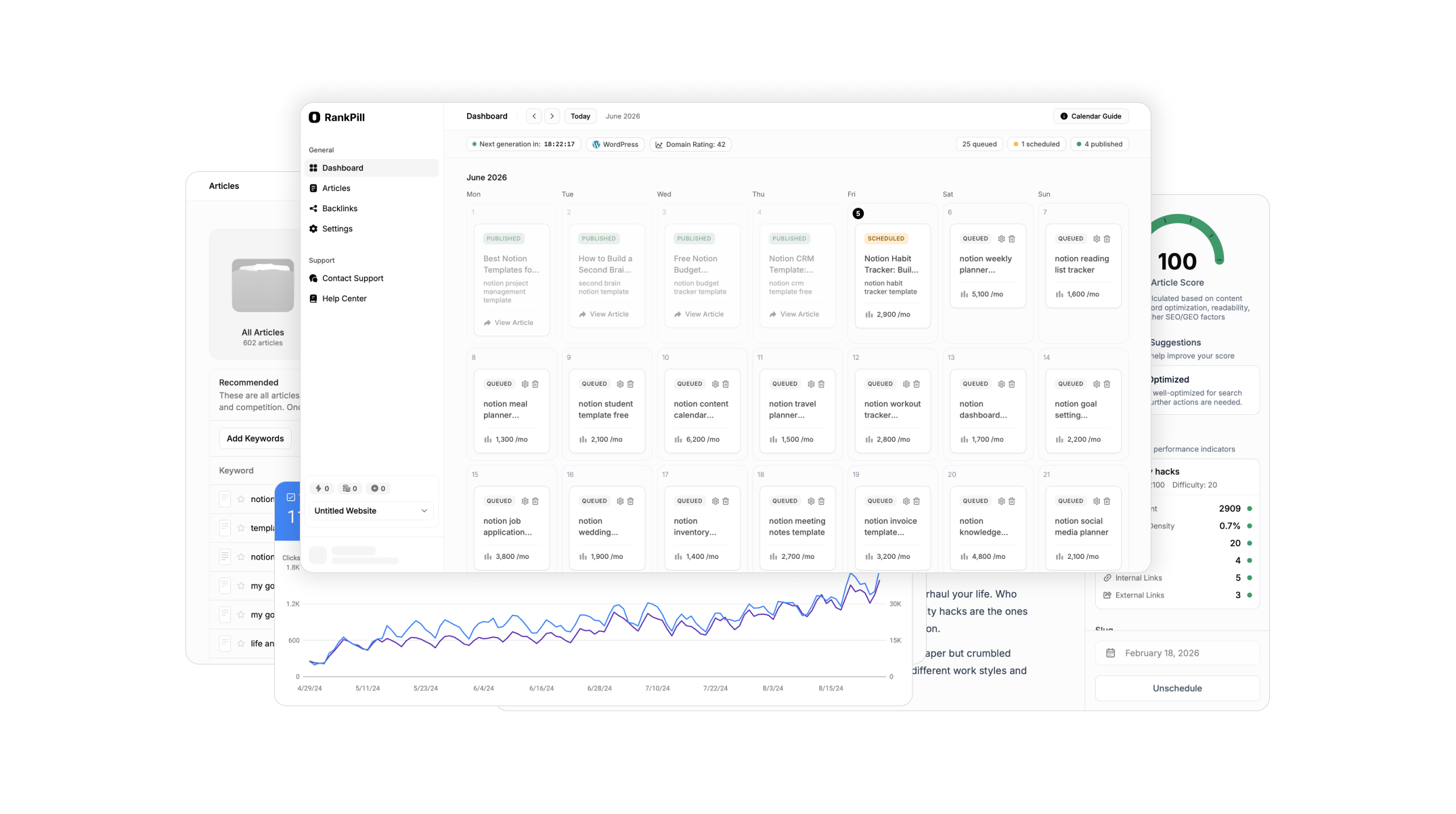
For businesses focused on SEO automation and content scaling, RankPill's free keyword research tool helps you find low-competition, high-intent keywords that traditional platforms often overlook. It's built specifically for identifying content opportunities that align with automated publishing workflows.
The tool provides search volume, difficulty scores, and content gap analysis without requiring expensive subscriptions. It's particularly useful for discovering the long-tail variations and question-based keywords that perform well in AI-driven search environments.
Google Search Console
While not technically a keyword research tool, Google Search Console reveals which keywords already drive impressions and clicks to your site. This data is gold for identifying optimization opportunities on existing pages and discovering valuable keywords you're ranking for but haven't deliberately targeted.
The Performance report shows queries, impressions, clicks, CTR, and average position. Filter by pages that rank in positions 5–15, where small improvements can yield significant traffic gains. You can also identify high-impression, low-CTR keywords that might benefit from meta description rewrites or title tag optimization.
Specialized Tools for Different Research Needs
Beyond general-purpose platforms, several tools excel at specific keyword research tasks or content types.
AlsoAsked
AlsoAsked maps out the "People Also Ask" questions that Google displays in search results, showing the relationships between questions and creating a visual hierarchy of user intent. This helps you structure long-form content around the questions people naturally ask next.
For any seed question, AlsoAsked generates a tree diagram showing related questions, which questions branch from those, and so on. This reveals the full scope of what users want to know about a topic, helping you create more comprehensive content that answers follow-up queries.
Keywords Everywhere
Keywords Everywhere is a browser extension that displays search volume, CPC, and competition data directly in Google search results, Amazon, eBay, and other platforms. It's convenient for quick keyword validation while you're already researching topics.
The tool also shows related keywords and "People Also Search For" suggestions on the search results page, streamlining the research process. While it doesn't replace dedicated platforms for deep analysis, it accelerates lightweight research and idea validation.
SpyFu
SpyFu specializes in competitor intelligence, showing every keyword your competitors have bought on Google Ads and every organic keyword they've ranked for over the past 17 years. This historical perspective reveals which keywords generated the most value over time, not just what's trending this month.
The platform's Kombat feature compares your domain against competitors to find shared keywords, unique opportunities, and ranking gaps. You can also download competitors' most profitable keywords and reverse-engineer their PPC and SEO strategies.
How to Build an Effective Keyword Research Workflow
Tools are only as valuable as the process you build around them. Here's how to structure keyword research for consistent, scalable results:
- Define your content goals: Are you building topical authority, targeting quick wins, or supporting specific landing pages?
- Generate seed keywords: Start with core topics from customer conversations, product features, and pain points
- Expand with tools: Use keyword research platforms to find variations, questions, and related terms
- Assess difficulty and opportunity: Filter by difficulty scores and SERP analysis to identify realistic targets
- Map to search intent: Classify keywords by intent and match them to appropriate content formats
- Prioritize by impact: Focus on keywords that align with business goals, not just vanity metrics
Balancing Volume, Difficulty, and Intent
The best SEO keyword research tools help you balance three competing factors. High-volume keywords drive more potential traffic but face stiffer competition. Low-difficulty keywords are easier to rank for but might not attract enough searches to matter. And keywords that match commercial intent convert better but often cost more to rank for in competitive industries.
Create a scoring system that weights these factors according to your situation. A new site might prioritize difficulty over volume, targeting easier wins to build domain authority. An established brand might chase high-volume commercial keywords where they already have competitive advantages.
According to Search Engine Journal's analysis, successful keyword strategies typically include a mix: 60% long-tail, low-difficulty keywords for steady traffic, 30% medium-difficulty keywords for growth, and 10% aspirational high-difficulty keywords for long-term authority building.

Integrating Keyword Research with Content Strategy
Keyword research shouldn't exist in isolation. The most successful content operations tie research directly to content creation, as explained in the Content Marketing Institute's guide to creating content people actually search for.
Topic Clusters and Pillar Pages
Instead of targeting individual keywords in isolation, organize your content into topic clusters. Create comprehensive pillar pages that target broad head terms, then build supporting cluster content around related long-tail keywords that link back to the pillar.
This structure signals topical expertise to Google and provides a better user experience. Someone searching for "email marketing" might land on your pillar page, then navigate to cluster articles about "email subject line best practices" or "email automation workflows" based on their specific needs.
HubSpot Academy's keyword research lesson demonstrates how to map keywords to topic clusters systematically, ensuring comprehensive coverage without keyword cannibalization.
Aligning Research with Publishing Cadence
If you're publishing content at scale, keyword research needs to feed directly into your editorial calendar. The best SEO keyword research tools offer export functions, API access, or integrations that move data seamlessly into project management systems.
For businesses running automated content operations, tools that integrate with SEO automation platforms create efficient pipelines from research to publication. Instead of manually tracking spreadsheets of keywords, automation routes research data directly to content briefs and writing workflows.
Advanced Techniques: AI and Machine Learning in Keyword Research
Academic research on deep-learning approaches for keyphrase extraction shows how AI is transforming keyword discovery. Modern tools use embedding-based models to understand semantic relationships that simple string matching would miss.
Natural Language Processing for Intent Classification
Advanced platforms now apply NLP to classify search intent with higher accuracy than simple keyword pattern matching. Instead of assuming all "how to" queries are informational, they analyze SERP features, ranking content types, and user behavior signals to determine true intent.
This matters because Google increasingly shows different SERP layouts based on intent. Commercial queries trigger shopping results and ads; informational queries feature featured snippets and "People Also Ask" boxes. Understanding which SERP layout you're targeting shapes content format, structure, and optimization approach.
Predictive Keyword Opportunity Scoring
Some cutting-edge tools use machine learning to predict which keywords will increase in search volume before the trend peaks. They analyze search trend velocity, social signals, news coverage, and seasonal patterns to identify emerging opportunities.
This predictive capability is particularly valuable for content teams that need lead time to create comprehensive articles. By identifying rising keywords three to six months before peak interest, you can publish authoritative content that's already ranking when demand surges.
Common Keyword Research Mistakes to Avoid
Even with the best SEO keyword research tools, poor methodology undermines results. Watch out for these frequent pitfalls:
- Chasing volume over relevance: A keyword with 100,000 monthly searches is worthless if those searchers aren't your target audience
- Ignoring SERP reality: If the first page is dominated by major brands, Wikipedia, and government sites, you likely can't compete regardless of "difficulty" scores
- Keyword cannibalization: Targeting the same keyword across multiple pages splits your authority and confuses Google about which page to rank
- Forgetting mobile and voice: Keyword research based solely on desktop searches misses the conversational queries common in mobile and voice search
- Static research: Search trends evolve; revisit keyword research quarterly to catch emerging opportunities and declining relevance
Validating Keyword Opportunity with Real Data
Before committing resources to targeting a keyword, validate the opportunity beyond tool metrics. Search the keyword yourself and analyze what's actually ranking. Do the top results match your content capabilities? Are they recent, or outdated articles holding positions by default?
Use Google Search Console data to see which related keywords already drive traffic to your site. Often, you're ranking in positions 15–30 for valuable keywords you didn't deliberately target, representing quick-win optimization opportunities that don't require new content.
Choosing the Right Tool for Your Business
The best SEO keyword research tools for your situation depends on team size, budget, technical sophistication, and content volume. Consider these factors:
| Business Type | Recommended Tool Tier | Key Priorities |
|---|---|---|
| Solo blogger / new site | Free or freemium | Low-difficulty long-tail keywords, question-based content |
| Small business / local service | Mid-tier ($50–100/mo) | Local keyword variations, competitor gap analysis |
| Growing SaaS / e-commerce | Enterprise platform | Comprehensive data, API access, team collaboration |
| Agency managing multiple clients | Enterprise + specialists | White-label reporting, bulk analysis, cross-client insights |
For businesses focused on scaling content production efficiently, integrating keyword research with automated SEO workflows eliminates the bottleneck between research and publication. When research data feeds directly into content creation systems, you can maintain consistent publishing cadence without manual coordination.
Real-World Application: From Research to Rankings
The best SEO keyword research tools are only valuable when they drive actual content that ranks and converts. Here's how a complete workflow looks in practice:
Start by identifying your core topic areas based on product features, customer questions, and business goals. Use broad seed keywords to generate hundreds of variations through your chosen tool. Export the data and filter by difficulty scores appropriate for your domain authority.
Group related keywords into topic clusters, identifying the primary keyword for each cluster and supporting long-tail variations. Map each cluster to a content type (comprehensive guide, how-to article, comparison post, FAQ page) based on search intent.
Create content briefs that specify target keywords, word count, required subtopics, and internal linking opportunities. As you publish, track rankings in Google Search Console and your keyword tool. Identify pages ranking in positions 5–15 and optimize them aggressively for the next ranking tier.
Monitor which keywords drive actual traffic and conversions, not just rankings. Refine your targeting based on performance data, doubling down on keyword types that deliver business results and deprioritizing those that generate vanity metrics without commercial value.
Finding the best SEO keyword research tools is essential, but execution matters more than the specific platform you choose. The most successful businesses combine reliable data with consistent content production and continuous optimization based on real performance metrics. RankPill automates the entire workflow from keyword research through publication, helping you identify opportunities and turn them into ranking content without manual bottlenecks. Start building your automated SEO engine at RankPill and turn keyword research into consistent organic growth.
Unlock Traffic on Autopilot
Grow organic traffic on autopilot. RankPill will research, write, optimize, and publish articles to your website daily.