Programmatic SEO: Scale Content & Traffic in 2026

Modest Mitkus · October 4, 2026
Programmatic SEO represents one of the most powerful approaches to scaling organic traffic in 2026. Unlike traditional content creation, where teams manually research, write, and publish each article, programmatic SEO leverages databases, templates, and automation to generate hundreds or thousands of optimized pages systematically. Companies from Zapier to TripAdvisor have used this methodology to dominate search results for entire categories of keywords. As search algorithms become more sophisticated and AI-driven SEO tools mature, understanding how to implement programmatic strategies without triggering quality penalties becomes essential for businesses seeking sustainable growth.
Understanding Programmatic SEO Fundamentals
Programmatic SEO is the practice of creating web pages at scale using a data-driven template system. Rather than writing individual articles, you build a single template that pulls from a structured database to generate multiple unique pages targeting specific keyword patterns.
The core components include a keyword pattern (like "best [product type] for [use case]"), a data source (product specifications, locations, statistics), and a template that combines them into unique, valuable pages. Each generated page targets a distinct search query while maintaining consistent structure and quality standards.
Why Programmatic Approaches Work in 2026
Search engines have become better at understanding user intent and content quality, which actually benefits well-executed programmatic strategies. When implemented correctly, programmatic pages solve real user problems at scale.
Key advantages include:
- Comprehensive coverage: Target entire keyword categories instead of cherry-picking individual terms
- Speed to market: Launch thousands of pages in weeks instead of years
- Consistency: Maintain uniform quality standards across all content
- Data-driven optimization: Test and improve templates based on performance metrics
- Resource efficiency: Scale content production without proportional increases in headcount
The difference between success and failure lies in execution quality. Google's spam policies explicitly target low-quality automatically-generated content, making thoughtful implementation critical.

Building Your Programmatic SEO Foundation
Successful programmatic campaigns start with strategic planning, not immediate execution. The foundation determines whether your pages will rank and convert or get demoted as thin content.
Identifying Scalable Keyword Patterns
The first step involves finding keyword patterns where search intent remains consistent across variations. Location-based searches ("plumber in [city]"), product comparisons ("[product A] vs [product B]"), and attribute-based queries ("[adjective] [product type]") all work well.
Analyze your existing keyword data to spot patterns. If you're ranking for "best CRM for small business," you likely have opportunities for "best CRM for [industry]" across dozens of industries. Long-tail keyword strategy becomes particularly powerful when applied programmatically.
Use these criteria to evaluate patterns:
- Search volume distribution: Sufficient volume across multiple variations
- Intent consistency: Users want similar information regardless of the modifier
- Data availability: You can acquire or create the necessary data
- Competition level: Mix of achievable and aspirational targets
- Business relevance: Keywords align with your offerings and expertise
Sourcing and Structuring Your Data
Quality data is non-negotiable. Your programmatic pages will only be as good as the underlying information you provide.
| Data Source Type | Pros | Cons | Best For |
|---|---|---|---|
| Public APIs | Fresh, authoritative | Limited fields, rate limits | Product specs, locations |
| Web scraping | Comprehensive | Legal/ethical concerns | Competitive research |
| Manual curation | High quality control | Not scalable | Expert insights, opinions |
| User-generated | Authentic, unique | Quality varies | Reviews, Q&A content |
Structure your data in a relational database where each record contains all fields needed for page generation. Include not just the basic facts, but unique insights, statistics, and details that differentiate your pages from competitors targeting the same keywords.
Designing High-Quality Templates
Your template is where programmatic SEO either delivers value or creates spam. The goal is creating pages that would be worth publishing even if you only made ten instead of ten thousand.
Template Architecture Best Practices
Start with a content outline that serves user intent comprehensively. If someone searches "best running shoes for flat feet," they want recommendations, features to look for, expert advice, and comparison criteria-not just a thin list of products.
Essential template elements:
- Unique introductions: Use data variables to create contextually relevant openings
- Dynamic headings: Incorporate modifiers naturally (not keyword-stuffed)
- Data-driven comparisons: Tables, charts, and structured information unique to each page
- Expert commentary: Template sections for analysis that changes based on the data
- Related resources: Programmatically link to relevant pages within your site
The SEO automation best practices that apply to individual pages still matter at scale. Each generated page needs proper title tags, meta descriptions, header hierarchy, and internal linking.
Ensuring Uniqueness at Scale
Google penalizes duplicate or near-duplicate content. Your templates must generate genuinely distinct pages even when covering similar topics.
Implement these differentiation strategies:
- Variable content blocks: Different introduction styles selected based on data attributes
- Conditional sections: Show or hide template sections based on available data
- Calculated insights: Generate statistics, comparisons, and analysis from your data
- User-contributed content: Integrate reviews, questions, or community input when available
- Media variation: Different images, videos, or interactive elements per page
A properly designed template might generate 40-60% unique content per page even before considering the data variations. This ensures both search engines and users encounter fresh information on each page.

Technical Implementation and Automation
The technical execution of programmatic SEO determines whether your strategy scales smoothly or collapses under its own weight. Automation tools and workflows become critical infrastructure.
Publishing and CMS Integration
Most programmatic strategies use one of three technical approaches: static site generation, server-side rendering, or database-driven dynamic pages. Each has trade-offs for crawlability, speed, and maintenance.
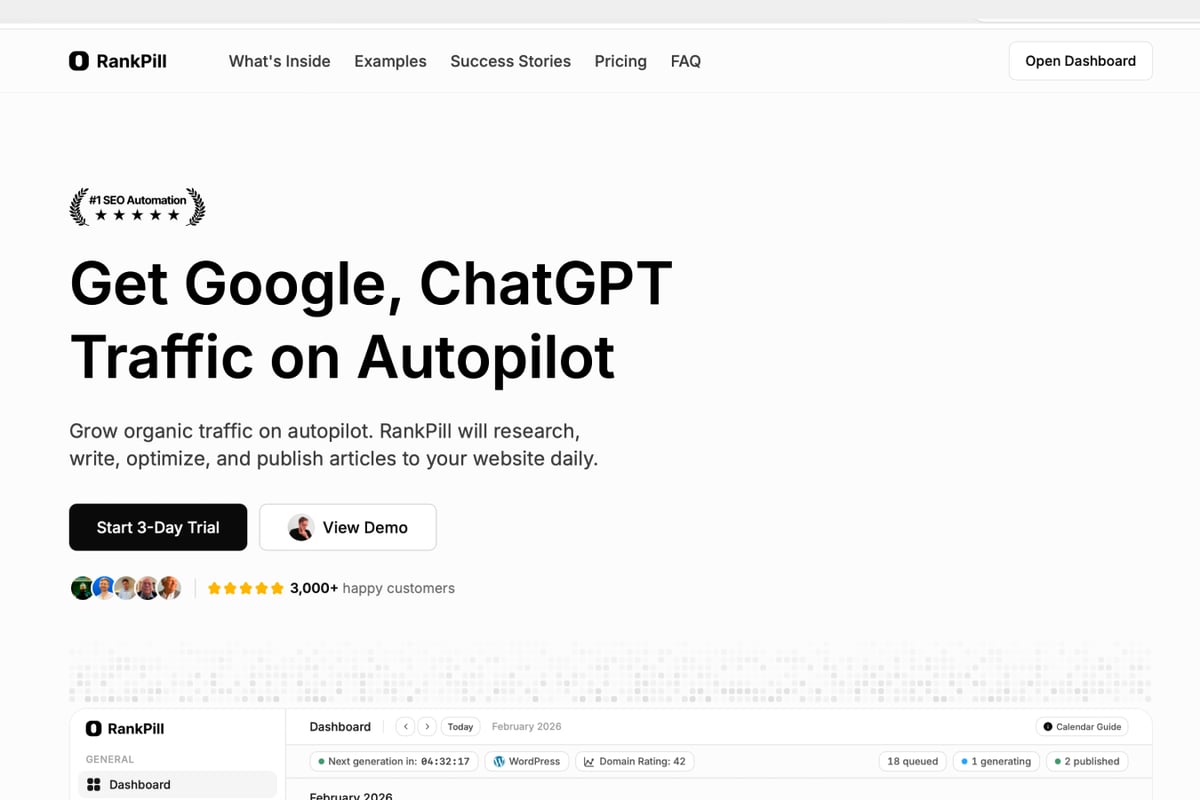
For businesses focused on automated SEO workflows, the publishing pipeline becomes crucial. You need systems that can generate, review, and publish pages systematically while maintaining quality controls. RankPill's automation approach handles the complete workflow-from keyword research through content generation to publishing-allowing businesses to scale content production without manual intervention in every step.
Critical technical considerations:
- Crawl budget optimization: Ensure search engines can discover and index all pages efficiently
- Site speed: Programmatic pages must load quickly despite potential database queries
- URL structure: Clean, logical URLs that reflect your keyword patterns
- XML sitemaps: Programmatically update sitemaps as new pages publish
- Structured data: Implement schema markup consistently across generated pages
Quality Control and Review Systems
You cannot manually review thousands of pages, but you can build systematic quality checks. Create automated tests that verify each page meets minimum standards before publication.
Implement these quality gates:
- Content length thresholds: Minimum word counts per section
- Uniqueness scoring: Check generated content against existing pages
- Link validation: Verify all internal and external links resolve correctly
- Image requirements: Ensure each page has appropriate media
- Readability metrics: Flag pages that score poorly on readability tests
Tools like Screaming Frog for programmatic content audits help identify technical issues across large page sets. Regular sampling and manual review of random pages helps catch template issues that automated checks might miss.
Programmatic SEO Strategy Variations
Different business models and industries require adapted programmatic approaches. Understanding which variation fits your situation improves implementation success.
Location-Based Programmatic Pages
Service businesses can create pages for every service-location combination. An electrician might generate "[service] in [city]" pages for dozens of cities and multiple services.
This approach works well when:
- Your business operates across multiple geographic markets
- Search behavior includes strong local intent
- You can provide genuinely local information (not just swapping city names)
- Competition for local terms remains manageable
The key challenge is adding true local value. Include local statistics, regulations, climate considerations, or area-specific advice. Generic templates with only the city name changed often fail.
Product and Comparison Pages
E-commerce and SaaS companies excel with product-focused programmatic content. Generate detailed pages for every product variant, comparison between products, or product-attribute combination.
Popular product-based patterns:
- [Product] reviews and specifications
- [Product A] vs [Product B] comparisons
- Best [product type] for [use case]
- [Product] alternatives and competitors
- [Product] pricing and plans comparison
Educational and Informational Content
Creating comprehensive educational resources programmatically requires robust data but delivers strong authority signals. Think of generating guides for every programming language, recipes for every ingredient combination, or tutorials for every software feature.
This approach demands the highest content quality but often faces less direct commercial competition than product or local pages. The Ahrefs guide to programmatic SEO provides excellent examples of companies scaling informational content effectively.

Avoiding Common Programmatic SEO Pitfalls
Programmatic strategies can backfire spectacularly when executed poorly. Understanding common failure modes helps you design around them.
Thin Content and Template Over-Reliance
The most frequent mistake is generating thousands of pages with minimal unique value. If your template produces pages where only a few words change, you're creating spam regardless of technical sophistication.
Google's algorithms specifically target automatically-generated content that doesn't serve users. The Search Engine Journal programmatic SEO guide emphasizes that scale alone doesn't make content valuable.
Warning signs of thin content:
- Less than 500 words of actual information per page
- Identical structure with only keyword swaps
- No unique data, insights, or analysis
- Missing media or visual elements
- Generic advice that applies to every variation
Indexing and Crawl Budget Waste
Publishing 10,000 pages without proper technical SEO wastes resources and can harm your entire site. Search engines have limited crawl budget-how many pages they'll crawl per visit.
Prioritize your most valuable programmatic pages. Use internal linking to signal importance. Consider staging releases instead of publishing everything simultaneously. Monitor Google Search Console for crawl errors and coverage issues.
Ignoring User Experience Signals
Pages that technically meet SEO requirements but deliver poor experiences won't rank long-term. Google increasingly uses behavioral signals-bounce rate, time on page, return visits-to evaluate content quality.
Test your templates for actual usability. Can users find information quickly? Do pages answer questions comprehensively? Is navigation intuitive? Mobile experience particularly matters for programmatic pages, which often target commercial or local intent where mobile search dominates.
Measuring and Optimizing Programmatic Performance
Unlike traditional SEO where you track individual page performance, programmatic strategies require cohort-based analytics. You're optimizing templates and patterns, not individual pages.
Key Performance Indicators for Scale
Track metrics at both the template and individual page level. Template-level metrics show whether your overall approach works, while page-level data helps identify outliers and opportunities.
| Metric Category | What to Measure | Why It Matters |
|---|---|---|
| Visibility | Impressions per keyword pattern | Shows total reach of your pattern |
| Engagement | Average CTR for page cohort | Indicates title/description effectiveness |
| Rankings | Median position across variations | Reveals competitive strength |
| Conversion | Goal completion rate by template | Measures business value |
| Technical | Indexation percentage | Catches crawl or quality issues |
Use Google's keyword research tools to track how your programmatic pages perform across the keyword patterns you're targeting.
Iterative Template Improvement
The beauty of programmatic SEO is that template improvements instantly affect hundreds or thousands of pages. A 10% CTR improvement on your template multiplies across your entire page set.
Run controlled experiments by testing template variations on subset cohorts. Change one element-headline formula, content structure, call-to-action placement-and measure the impact before rolling changes to all pages.
High-impact optimization areas:
- Title tag formulas: Test different modifier placements and length
- Content structure: Experiment with section ordering and depth
- Internal linking patterns: Optimize how programmatic pages link to each other
- Media integration: Test different image types and placements
- Schema markup variations: Try different structured data approaches
Performance analysis should happen continuously. Set up automated alerts for dramatic changes in impressions or rankings that might indicate template issues or algorithmic updates affecting your pages.
Scaling Programmatic SEO Safely in 2026
The programmatic SEO landscape continues evolving as search engines become more sophisticated at detecting and evaluating automatically-generated content. Success requires balancing scale with genuine value creation.
Working Within Search Engine Guidelines
Google doesn't penalize programmatic content inherently-they penalize low-quality, manipulative, or deceptive content regardless of how it's created. The Semrush programmatic SEO guide outlines practical approaches that comply with current guidelines.
Guidelines to follow:
- Create pages humans want to read, not just search engines want to rank
- Provide unique value in each generated page
- Maintain editorial oversight and quality standards
- Use structured data appropriately according to Schema.org specifications
- Avoid manipulative techniques like hidden text or keyword stuffing
- Respect robots.txt and crawl directives
Building for Long-Term Sustainability
Programmatic strategies that work in 2026 must be built to withstand algorithm updates and increasing quality standards. Focus on creating assets that would survive even if search engines completely changed their algorithms tomorrow.
This means investing in genuinely comprehensive data, creating templates that prioritize user experience, and building systems that allow rapid iteration when search landscapes shift. The businesses that succeed with programmatic SEO view it as infrastructure for serving users at scale, not a trick for gaming search rankings.
Consider how AI and SEO automation continue converging. Tools that seemed impossible three years ago now enable sophisticated content generation at scale. Staying current with automation capabilities while maintaining quality standards becomes increasingly important.
Advanced Programmatic Techniques
Once you've mastered basic programmatic SEO, advanced techniques unlock additional competitive advantages and efficiency gains.
Dynamic Content and Personalization
Modern programmatic strategies increasingly incorporate user signals to customize content dynamically. Show different product recommendations based on browsing behavior, adjust content based on geographic location, or personalize calls-to-action based on traffic source.
This requires more sophisticated technical implementation but dramatically improves conversion rates. Balance the SEO benefits of consistent, crawlable content with the conversion benefits of personalization by rendering core content server-side while personalizing non-essential elements client-side.
Programmatic Link Building
Internal linking becomes both a challenge and opportunity at programmatic scale. With thousands of pages, manual link building is impossible, but algorithmic linking often creates poor user experiences.
Design intelligent linking rules that:
- Connect related pages within the same keyword pattern
- Link to parent category and related category pages
- Identify and prioritize links to your highest-value conversion pages
- Avoid over-optimization by varying anchor text naturally
- Update automatically as new programmatic pages publish
External backlink building for programmatic pages requires creativity. Focus on making your data itself linkable-create statistics, charts, or tools that naturally attract citations. Consider how automated backlink strategies can scale alongside your content production.
Multi-Language and International Programmatic SEO
Programmatic approaches excel for international expansion. Once you've built templates and data pipelines for one language, adapting them for additional markets becomes relatively straightforward.
Key considerations include:
- Professional translation of template text (not just machine translation)
- Localized data sources appropriate for each market
- Cultural adaptation of examples and recommendations
- Proper hreflang implementation for international targeting
- Country-specific schema markup and structured data
Programmatic Content Refresh and Maintenance
Static programmatic pages decay over time as information becomes outdated. Build systems to automatically refresh content based on data changes or time-based triggers.
Implement automated updates when:
- Source data changes (prices, availability, specifications)
- Time-sensitive information expires (annual statistics, seasonal advice)
- Performance data suggests refreshes improve rankings
- External links break or become outdated
- Template improvements roll out
Create a programmatic SEO checklist for your specific implementation covering launch requirements, ongoing maintenance tasks, and quality assurance procedures.
Integration with Broader SEO Strategy
Programmatic SEO shouldn't exist in isolation. It works best when integrated with traditional content marketing, technical SEO, and link building efforts.
Balancing Programmatic and Manual Content
Most successful SEO programs combine programmatic scale with high-quality manual content. Use programmatic approaches to cover long-tail keyword variations comprehensively while creating in-depth manual content for high-value head terms.
This hybrid approach delivers several benefits:
- Manual content attracts backlinks that benefit the entire domain
- Programmatic pages capture traffic from countless long-tail variations
- Quality manual content establishes expertise and authority
- Programmatic efficiency frees resources for strategic content investments
- Combined approach provides resilience against algorithm changes
Supporting Programmatic Pages with Authority Building
Programmatic pages often struggle to rank initially because they lack the authority signals that manual content accumulates through promotion and link building. Support your programmatic content by:
- Strategic internal linking: Connect programmatic pages to high-authority manual content
- Category-level link building: Acquire links to category pages that internally link to programmatic variations
- Data promotion: Market the underlying data or insights your programmatic pages contain
- Tool creation: Build interactive tools that attract links while supporting programmatic page topics
- Expert content: Create authoritative guides that reference and link to your programmatic pages
Programmatic SEO represents the intersection of data, automation, and strategic content creation-enabling businesses to compete for thousands of keywords simultaneously while maintaining quality standards. The key to success in 2026 lies in viewing programmatic approaches as systematic value creation rather than shortcut tactics, building infrastructure that generates genuinely useful pages at scale. RankPill automates this entire workflow, from intelligent keyword research through content generation to publishing, allowing you to capture programmatic SEO opportunities without building complex infrastructure yourself. Ready to scale your organic traffic systematically? Start building your programmatic content engine today.
Unlock Traffic on Autopilot
Grow organic traffic on autopilot. RankPill will research, write, optimize, and publish articles to your website daily.