
Quora Marketing Strategy: A Guide for Small Teams

Modest Mitkus · November 10, 2026
A good Quora marketing strategy comes down to three habits: answer questions your buyers actually ask, write answers that stand on their own without a pitch, and track which threads send visitors to your site. Small teams can do this in about two hours a week. It won't replace SEO or ads, but it adds a channel where old answers keep getting read for years.
Quora is a question-and-answer site where anyone can ask a question and anyone can answer. Threads rank in Google, and AI assistants often pull from them. That is the reason to care. A single well-placed answer can reach people who are searching for exactly the problem you solve.
This guide is for founders and small teams with limited time. It covers where Quora fits, how to set up, how to pick questions, how to write answers, when ads make sense, and how to measure results.
Why Quora works for small teams (and where it doesn't)
Quora works for small teams because answers stay visible long after you post them, and the audience is already asking questions in buying mode. A thread you answer today can keep ranking in Google next year. You are not competing for attention in a feed that moves on in a few hours.
The trade-offs are real:
- Slow and uneven. Some answers get 50 views. A few get thousands. You can't predict which.
- Referral traffic is modest. Most readers stay on Quora. The wins are brand recall and the occasional click from a strong answer.
- Not every business fits. If nobody asks questions about your category, there's nothing to answer. B2B software, services, finance, health-adjacent products and consumer tools tend to have active threads. Very local or very niche products often don't.
- It needs a real human. Pasted promotional text gets downvoted or removed.
Think of Quora as a supporting channel. Your main traffic engine should still be your own site. If you want a broader view of how channels like this fit together, the guide to organic marketing covers the options and trade-offs.
Set up a profile that earns trust
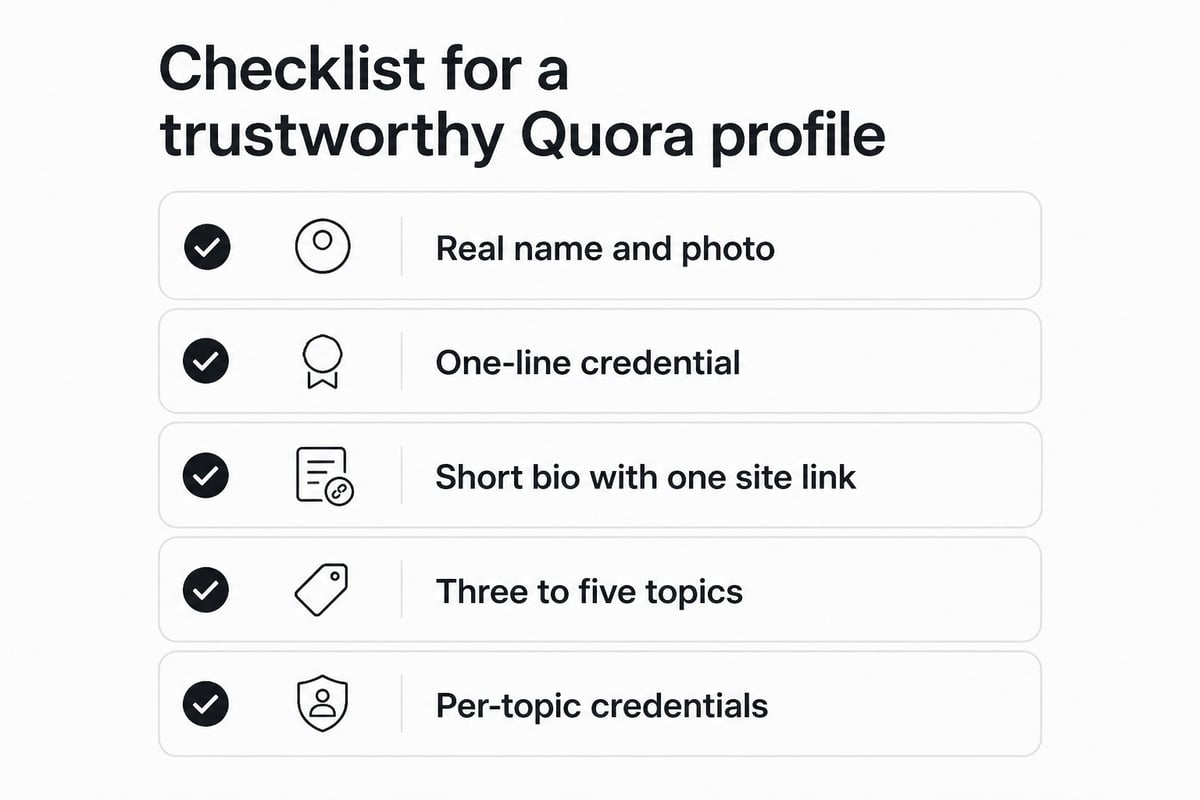
A Quora profile should look like a real person with relevant experience, because readers check it before they believe an answer. Spend 30 minutes on this once.
- Use your real name and photo. Anonymous or logo-only accounts get less trust.
- Write a one-line credential. For example: "Founder of a 6-person bookkeeping software company, 10 years in small business accounting." Be specific and true.
- Add a short bio. Two or three sentences on what you know and what you answer. A link to your site belongs here, once.
- Pick three to five topics. Follow and answer within them only. Spreading across 20 topics makes you look like a spammer.
- Add credentials per topic. Quora lets you attach a credential to each topic you answer. Use it. It shows next to your name on every answer.
Decide who owns the account. A founder's personal profile usually performs better than a brand profile, because people trust people. If you run a team, give each person their own profile and their own topics instead of sharing one login.
Find questions worth answering
The best questions to answer are ones where the asker is close to buying, the thread has steady views, and the existing answers are weak or out of date. Most of your results will come from a small number of threads, so choose carefully.
Start with the language your customers use. Pull ten phrases from your sales calls, support tickets and reviews. Search each one on Quora and Google. Look for threads that fit one of these patterns:
- Comparison questions: "What is the best invoicing tool for freelancers?"
- Problem questions: "How do I stop losing leads after a demo?"
- How-to questions: "How do I set up a content calendar for a small team?"
- Cost and decision questions: "Is it worth hiring an SEO agency for a 5-person company?"
Then check each thread before you write:
- Is it ranking in Google for a phrase you care about? Search the question title and see.
- Does it show a view count that suggests ongoing traffic?
- Is the top answer old, thin, or off-topic?
- Is the question asked by a buyer, or just a curious student?
Skip threads with a hundred strong answers already. You won't be seen. Go for the ones where you can add something concrete the others don't.
This is the same logic behind long-tail keyword strategy: specific questions with clear intent beat broad ones. If you want help finding threads, RankPill's Reddit & Quora feature finds threads about your keywords and drafts replies you edit and post yourself. More on that below.
Write answers that get read and upvoted
A strong Quora answer opens with a direct answer, adds one concrete example from your own work, and stops. Readers decide in two lines whether to keep going, so the first sentence carries most of the weight.
Use this structure:
- Answer first. One or two sentences that respond to the question directly.
- Give the reason. Explain why, in plain words.
- Add something only you know. A number, a mistake you made, a client situation (anonymized), a step you changed. First-hand detail is what separates your answer from a generic one. Google's own guidance on helpful content asks for first-hand expertise and depth of knowledge, and the same instinct applies here.
- Make it easy to scan. Short paragraphs, a list if the steps are parallel, bold for the one or two key terms.
- Link sparingly. One link to a useful resource, with a plain description of what it is. Never a link to your homepage as the closing line.
A few rules that keep you out of trouble:
- Disclose your affiliation when you mention your own product. "I run a tool in this space, so weigh my view accordingly" costs nothing and builds trust.
- Don't copy the same answer into ten threads. Quora flags it, and readers notice.
- Don't pad. Length is not the goal. Google says there is no preferred word count for content; the same holds on Quora. Answer the question, then stop.
- Never invent results. If you don't have a number, don't make one up.
A good answer is often 150 to 300 words. A deep how-to can run longer if every paragraph earns its place.
Use Quora ads and Spaces only when they fit
Organic answers should come first, and paid options only make sense once you know which topics resonate. Quora offers ads and a few other formats, and each has a narrow use.
- Ads. Quora sells text, image and promoted-answer placements through Quora for Business. If an answer of yours performs well organically, promoting it puts that same answer in front of more people in the topic. Start with a small test budget and a clear goal, such as email signups, not a vague "awareness" target.
- Spaces. These are topic communities. They can work if you already have an audience, but a new Space takes real effort to build. Most small teams should skip them at first.
- Anonymous questions. You can post a question yourself. It's useful for researching how people phrase a problem, but it won't bring sales on its own.
Be honest about the math. If your average customer is worth $50 and you can't tell whether Quora clicks convert, paid spend will burn cash. Test small, tag your links so you can see results, and stop if the numbers don't work.
Build a repeatable weekly routine
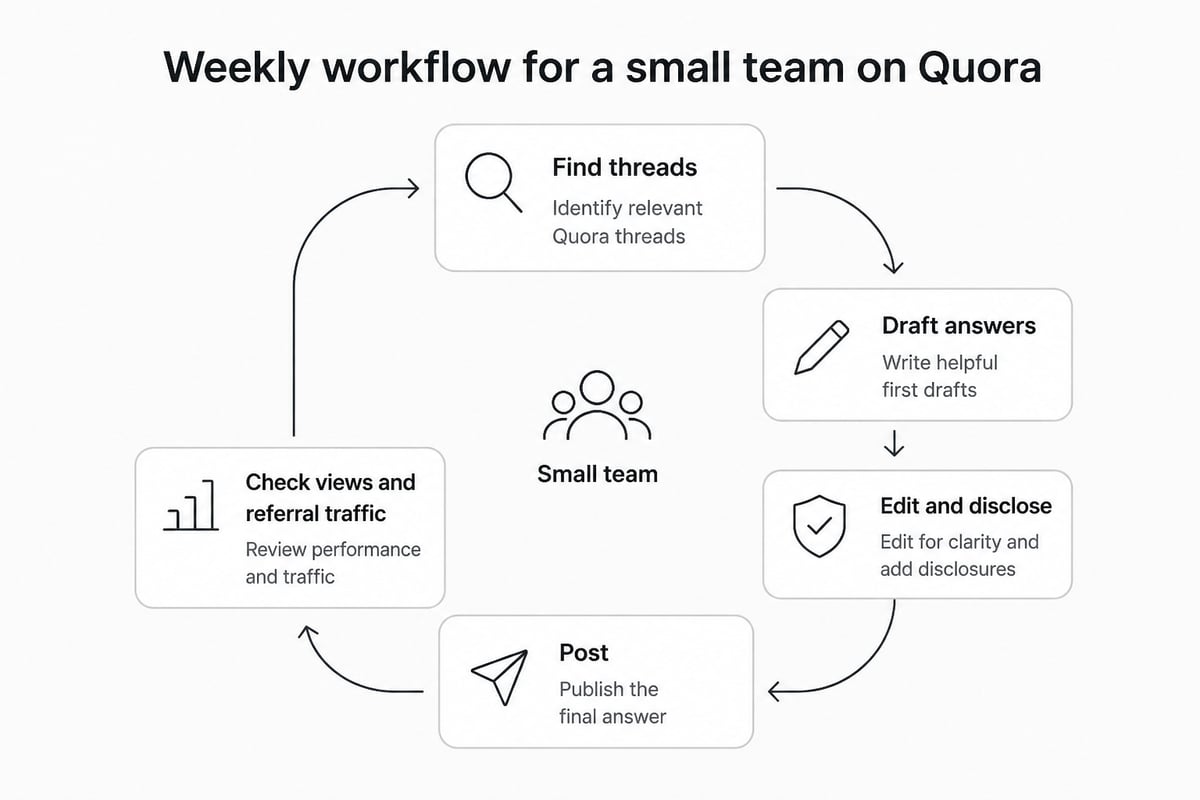
A routine matters more than a burst of effort, because Quora rewards steady, relevant answers over time. Here is a schedule that fits a small team:
| Task | Time per week | Notes |
|---|---|---|
| Find 5 to 8 candidate threads | 30 minutes | Use customer language and Google checks |
| Write 3 to 4 answers | 60 to 90 minutes | One concrete example per answer |
| Reply to comments and follow-ups | 15 minutes | Answering follow-ups lifts visibility |
| Review views and clicks | 15 minutes | Note which topics repeat |
Four answers a week is about 200 a year. If even a fifth of them keep drawing views, that adds up.
Two habits help:
- Keep a swipe file. Save the facts, numbers and stories you use, so each answer is faster to write.
- Recycle your best thinking. If an answer does well, turn it into a blog post on your own site. That puts the idea somewhere you control. The reverse also works: a blog post can be condensed into answers.
If writing is the bottleneck, drafting tools help, but the editing step is yours. A reader can tell when nobody with real experience looked at the text. Google's ranking systems prioritize helpful, reliable, people-first content, whether it is written by a person or with AI help, and that principle applies to your answers too.
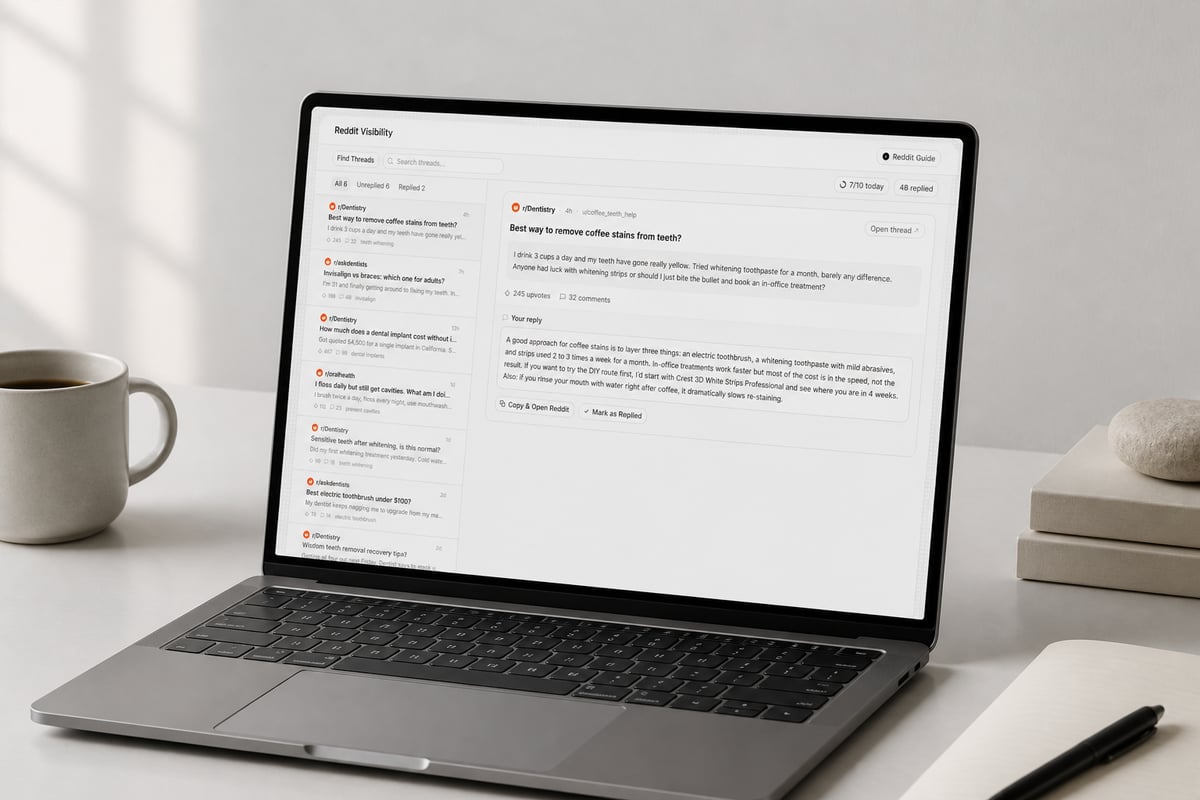
RankPill's Reddit Marketing feature fits the research and drafting steps. It finds Reddit and Quora threads about your keywords and drafts a reply for each, up to 30 a month. You edit each one and post it from your own account. RankPill never posts for you, which keeps the voice and the accountability yours.
Measure what matters
Measure Quora by the traffic and conversations it sends you, not by upvotes alone. Upvotes feel good, but they don't pay for anything.
Track four things:
- Views per answer. Quora shows these in your stats. Look for threads that keep gaining views month after month.
- Referral clicks. Add a tracking parameter to any link you post, then check your analytics for visits from Quora.
- Assisted signups. Add a "How did you hear about us?" field to your signup or contact form. People often remember the answer that convinced them.
- Branded search. If more people search your company name after you start answering, that's a signal even without a click.
Give it time. A fair test is about 90 days of steady posting. If after that you have no clicks, no mentions in "how did you hear" answers and no branded search lift, shift the hours elsewhere. Not every business should be on Quora, and it's better to find that out in a quarter than in a year.
For a sense of how to weigh channels like this against each other, see how to think about content marketing ROI.

How Quora fits with SEO and AI search
Quora is most useful as a layer on top of your own content, because both Google and AI assistants pull answers from the open web. Threads on Quora can rank for question searches, and your own articles can rank for the same questions. Owning both gives you more than one way to be found.
AI assistants make this more relevant. They draw answers from pages across the web, including Q&A threads, and cite sources. Clear, well-sourced answers on the questions your customers ask give you a shot at being mentioned. The guide to AI search strategy goes deeper on how to prepare for that.
The practical split looks like this:
- Your website is where you build long-term assets: articles targeting specific keywords, with internal links and a clear next step.
- Quora is where you meet people mid-question and give them a useful answer, with a link back when it truly helps.
If publishing regularly on your own site is the harder problem, that's where automation helps. RankPill plans, writes and publishes SEO articles on a schedule you choose, so your site keeps growing while you spend your hours on answers and customers. It isn't the right fit if you only want hand-written content, or if your site can't connect to a supported publishing platform. For everyone else, it removes the part of the work that tends to stall.
Common mistakes to avoid
Most Quora campaigns fail for a short list of reasons:
- Pitching in every answer. If every answer ends with "check out our product," readers and moderators stop trusting you.
- Answering dead threads. A question with 20 views from 2016 won't help you.
- Posting in bursts. Fifty answers in a week and then nothing looks like spam and builds no habit.
- Skipping disclosure. Hiding that you work for the product you recommend damages trust fast.
- Ignoring the rules. Quora's content policies are public. Read them once. Accounts that break them lose reach or get banned.
- Expecting fast results. This channel compounds slowly. Judge it after a quarter, not a week.
Frequently asked questions
Is Quora still worth it for marketing?
For many small teams, yes, in a limited role. It suits businesses whose customers ask detailed questions before buying. It is less useful for products with no search-style questions behind them. Test it for 90 days with a small, steady effort before deciding.
How many answers should I post a week?
Three or four good answers beat fifteen weak ones. Pick threads where you can add real experience, and keep a rhythm you can sustain for months.
Should I link to my website in answers?
Yes, but sparingly. Link only when the page truly helps the reader, and describe what they'll find. Put one link in your profile bio too. Many strong answers have no link at all.
Can I use AI to write Quora answers?
You can use it to draft, but you should edit every answer and add your own experience. Generic text gets ignored. First-hand detail is what makes an answer worth reading.
Do Quora ads work?
They can, once you know which topics and answers perform organically. Start small, set one clear goal, and track conversions. If you can't measure results, don't scale spend.
Pick three Quora threads this week where your customers are asking a question you can answer from experience, and write one answer to each. If you want help finding threads and drafting replies, and a steady stream of articles on your own site, Try RankPill and let it handle the planning, writing and publishing while you post answers from your own account with Reddit Marketing.
Unlock Traffic on Autopilot
Grow organic traffic on autopilot. RankPill will research, write, optimize, and publish articles to your website daily.