
Why Is My Website Not Ranking? Key Issues & Fixes

Modest Mitkus · June 9, 2026
You've invested time and resources into building your website, publishing content, and optimizing for search engines. Yet when you check Google, your pages are nowhere to be found. The frustration of invisible content is real, especially when competitors seem to dominate the search results effortlessly. Understanding why is my website not ranking requires a systematic approach that examines technical foundations, content quality, authority signals, and strategic execution.
The reality is that ranking issues rarely stem from a single cause. Multiple factors typically conspire to suppress your visibility, from technical barriers that prevent search engines from discovering your content to strategic missteps that misalign your efforts with user intent. This comprehensive analysis will walk you through the most common ranking obstacles and provide actionable solutions to help your website climb the search results.
Technical Barriers Preventing Discovery
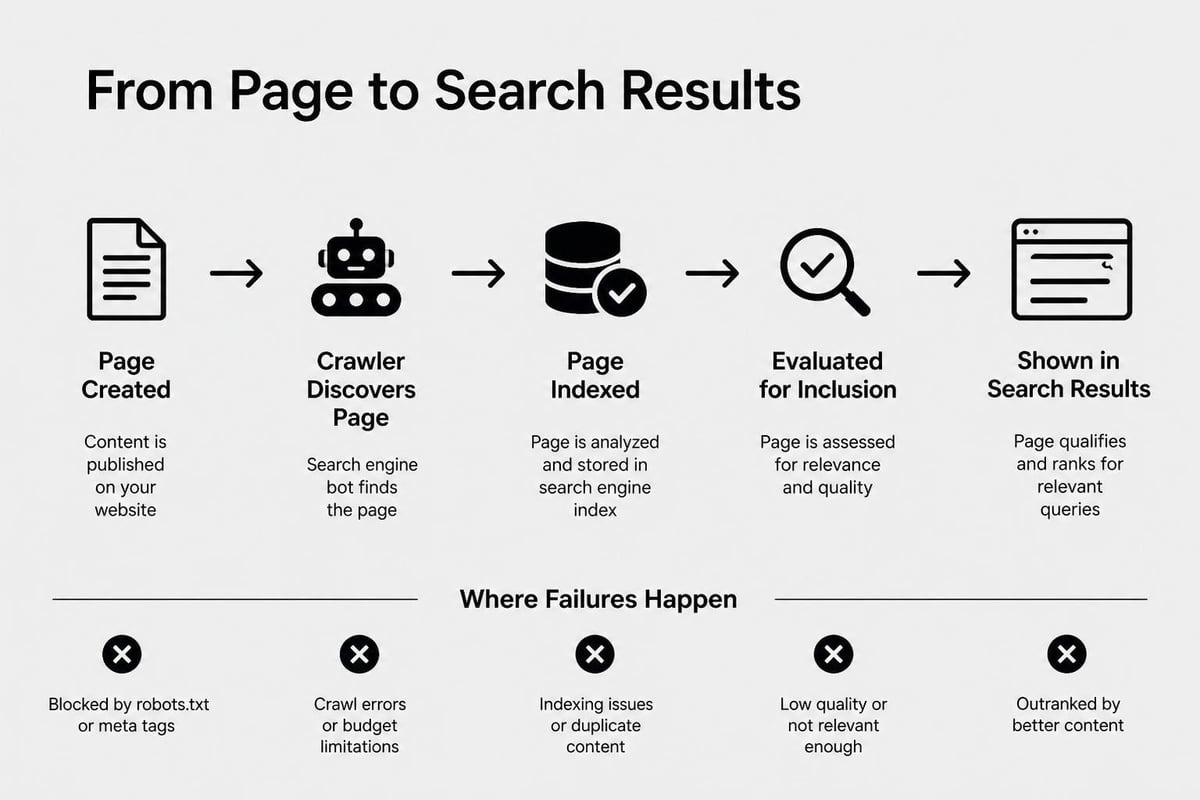
Search engines can't rank pages they can't find or understand. Technical issues represent the most fundamental obstacle to ranking success, and they're surprisingly common even on professionally designed websites.
Indexing Problems Block Visibility
If Google hasn't indexed your pages, they won't appear in search results regardless of content quality. Check your indexing status by searching "site:yourdomain.com" in Google. The results show which pages Google has discovered and added to its index.
Common indexing barriers include:
- Robots.txt files that accidentally block important pages
- Noindex tags left in place after site development
- XML sitemap errors or missing sitemap submission
- Server errors that prevent crawler access
- Redirect chains that confuse search engine bots
Your robots.txt file should allow crawler access to all public pages. Review your sitemap configuration to ensure it's properly formatted and submitted to Google Search Console. Many website owners discover their ranking issues stem from simple indexing errors that took minutes to fix but months to discover.
Site Speed and Mobile Performance
Page speed directly influences both user experience and search rankings. Google's Core Web Vitals have made performance a confirmed ranking factor, with mobile experience weighted especially heavily in 2026.
| Performance Metric | Target Threshold | Common Issues |
|---|---|---|
| Largest Contentful Paint (LCP) | Under 2.5 seconds | Unoptimized images, slow server response |
| First Input Delay (FID) | Under 100 milliseconds | Heavy JavaScript, render-blocking resources |
| Cumulative Layout Shift (CLS) | Under 0.1 | Missing image dimensions, dynamic content |
Test your site speed using Google PageSpeed Insights and address the specific issues identified. Compress images, leverage browser caching, and minimize JavaScript execution time. Mobile-first indexing means Google primarily uses the mobile version of your content for ranking, so responsive design isn't optional.
Crawl Budget Waste
Large websites with thousands of pages may exhaust their crawl budget on low-value pages, leaving important content undiscovered. Duplicate content, parameterized URLs, and infinite scroll implementations can trap crawlers in endless loops.
Consolidate duplicate content using canonical tags. Block crawler access to admin pages, search result pages, and filtered product variations. Focus your crawl budget on the pages that drive business value. Understanding technical SEO fundamentals helps you allocate crawler resources strategically.
Content Quality and Relevance Gaps
Even perfectly indexed websites fail to rank when content doesn't satisfy search intent or meet quality standards. Google's algorithms have grown sophisticated at evaluating content usefulness, making thin or irrelevant pages virtually invisible.
Misaligned Search Intent
Why is my website not ranking often comes down to a fundamental mismatch between what you're offering and what searchers actually want. A product page won't rank for informational queries. A blog post won't rank for transactional searches.
The four primary search intent categories:
- Informational - Users seeking knowledge or answers
- Navigational - Users looking for specific websites or brands
- Commercial - Users researching products before purchase
- Transactional - Users ready to buy or take action
Analyze the top 10 results for your target keywords. What content format dominates? Are they blog posts, product pages, videos, or comparison guides? Match your content type to the established pattern. If informational articles dominate, your product page won't rank regardless of optimization quality.
Thin or Duplicate Content
Pages with minimal unique value struggle to rank against comprehensive competitors. Google actively filters out duplicate content to avoid showing users redundant results.
Content length alone doesn't guarantee success, but comprehensive coverage of a topic typically requires substantial depth. Compare your content to top-ranking competitors. Are you providing equivalent or superior information? Have you addressed subtopics and related questions that users care about?
| Content Issue | Impact on Rankings | Solution |
|---|---|---|
| Thin content (under 300 words) | Minimal ranking potential | Expand with unique insights and depth |
| Duplicate content across pages | Cannibalization and filtering | Consolidate or differentiate clearly |
| Outdated information | Declining rankings over time | Regular content updates and refreshes |
| Missing search intent elements | High bounce rates, poor performance | Add expected content types and formats |
Many businesses struggle with content creation at scale while maintaining quality standards. The challenge intensifies when competing against established sites with extensive content libraries.

Keyword Strategy Failures
Targeting highly competitive keywords without sufficient authority guarantees frustration. A new website won't outrank established domains for broad, competitive terms regardless of content quality.
Start with long-tail keywords that have lower competition but clear commercial intent. Build topical authority gradually by covering related subtopics comprehensively. Use automated keyword research to identify opportunities your competitors haven't exploited.
Keyword stuffing damages rankings rather than improving them. Natural language processing allows Google to understand semantic relationships and topical relevance without requiring exact-match repetition. Focus on comprehensive topic coverage rather than keyword density manipulation.
Authority and Trust Deficits
Google evaluates website authority through backlinks, brand signals, and expertise indicators. New or low-authority sites face steep ranking challenges even with excellent content and technical execution.
Insufficient Backlink Profile
Backlinks remain a critical ranking factor. They signal to search engines that other websites consider your content valuable enough to reference. Without quality backlinks, your pages lack the authority signals needed to compete.
Essential backlink quality factors:
- Domain authority of linking sites
- Relevance of linking page to your content
- Anchor text diversity and naturalness
- Link placement within content (not footer or sidebar)
- Editorial nature of the link (not paid or exchanged)
Building backlinks requires strategic effort. Guest posting, digital PR, resource page outreach, and content promotion all contribute to link acquisition. However, automatic backlink building strategies can accelerate growth when implemented properly.
Avoid black-hat link schemes that violate Google's guidelines. Purchased links, link farms, and excessive reciprocal linking can trigger penalties that devastate rankings. Focus on earning links through genuinely valuable content that others want to reference.
Brand Recognition and E-E-A-T
Google's E-E-A-T framework (Experience, Expertise, Authoritativeness, Trustworthiness) influences rankings, especially for topics affecting health, finances, or major life decisions. Demonstrating expertise builds the trust signals that support higher rankings.
Author bylines with credentials, detailed about pages, and external recognition of expertise all contribute to E-E-A-T signals. For businesses in competitive industries, establishing thought leadership through speaking engagements, industry publications, and social proof becomes essential.
Brand searches signal authority to Google. When users specifically search for your brand name, it demonstrates awareness and trust. Building brand recognition through content marketing, social media presence, and PR efforts indirectly supports ranking performance.
Strategic and Competitive Disadvantages
Understanding why is my website not ranking sometimes reveals strategic gaps rather than technical failures. Competing in saturated markets or targeting the wrong audience creates uphill battles.
Overwhelming Competition Analysis
Your competitors didn't achieve their rankings by accident. They've invested in content, backlinks, technical optimization, and user experience over months or years. Matching their performance requires understanding their strategic advantages.
Conduct competitive gap analysis using SEO tools. Identify keywords where competitors rank but you don't. Examine their backlink sources. Review their content depth and format. Understanding their strategic approach reveals opportunities to differentiate or compete directly.
| Competitive Factor | Assessment Method | Strategic Response |
|---|---|---|
| Domain age | Whois lookup | Target newer, less competitive keywords |
| Backlink count | SEO tool analysis | Build links systematically through outreach |
| Content depth | Manual review of top pages | Match or exceed comprehensiveness |
| Technical performance | Speed and mobile tests | Optimize Core Web Vitals aggressively |
B2B content marketing strategies differ significantly from B2C approaches. Understanding your competitive landscape within your specific niche informs strategic decisions about where to compete and how to differentiate.
Geographic and Language Targeting
Local businesses need proper geographic signals to rank for location-based searches. Google My Business optimization, NAP consistency (Name, Address, Phone), and local citations all contribute to local search visibility.
International websites require proper hreflang implementation to signal language and regional targeting. Content in multiple languages needs dedicated optimization for each market, not simple translation. Dropshipping SEO challenges often include geographic targeting complexities when selling across regions.
Algorithm Updates and Penalty Recovery
Google's algorithm evolves continuously. What worked last year may actively harm rankings today. Staying current with algorithmic changes and recovering from penalties requires vigilance.
Core Algorithm Update Impact
Major algorithm updates can dramatically shift rankings overnight. The helpful content update, product reviews update, and spam updates have all caused significant volatility in recent years.
Monitor your rankings around known update dates. Traffic drops coinciding with algorithm rollouts suggest your content fell victim to the update's targeting. Recovery requires understanding the update's intent and adapting your content accordingly.
Google increasingly prioritizes genuinely helpful content created for users rather than search engines. Content that exists solely to rank for keywords faces declining performance. Focus on solving user problems and providing unique value that alternatives don't offer.

Manual Penalties and Recovery
Manual penalties require action through Google Search Console. These result from human reviewers identifying guideline violations like unnatural links, thin content, or deceptive practices.
Check Search Console for manual action notifications. If you have one, the notification specifies the issue. Address the underlying problem completely before submitting a reconsideration request. Partial fixes result in rejected requests and extended recovery times.
Algorithmic penalties don't appear in Search Console but manifest as ranking drops. Recovery requires systematic improvement rather than reconsideration requests. Identify the quality issues that triggered the algorithmic devaluation and address them comprehensively.
Automation and Scale Challenges
Growing websites face unique ranking challenges when scaling content production. Maintaining quality while increasing output requires strategic systems and tools.
Content Production at Scale
Publishing consistently provides ranking advantages through fresh content signals and expanded keyword targeting. However, quality degradation at scale creates more problems than it solves.
Manual content creation limits publication frequency, especially for small teams. The time investment for proper keyword research, writing, editing, and optimization makes daily publishing impossible for most organizations.
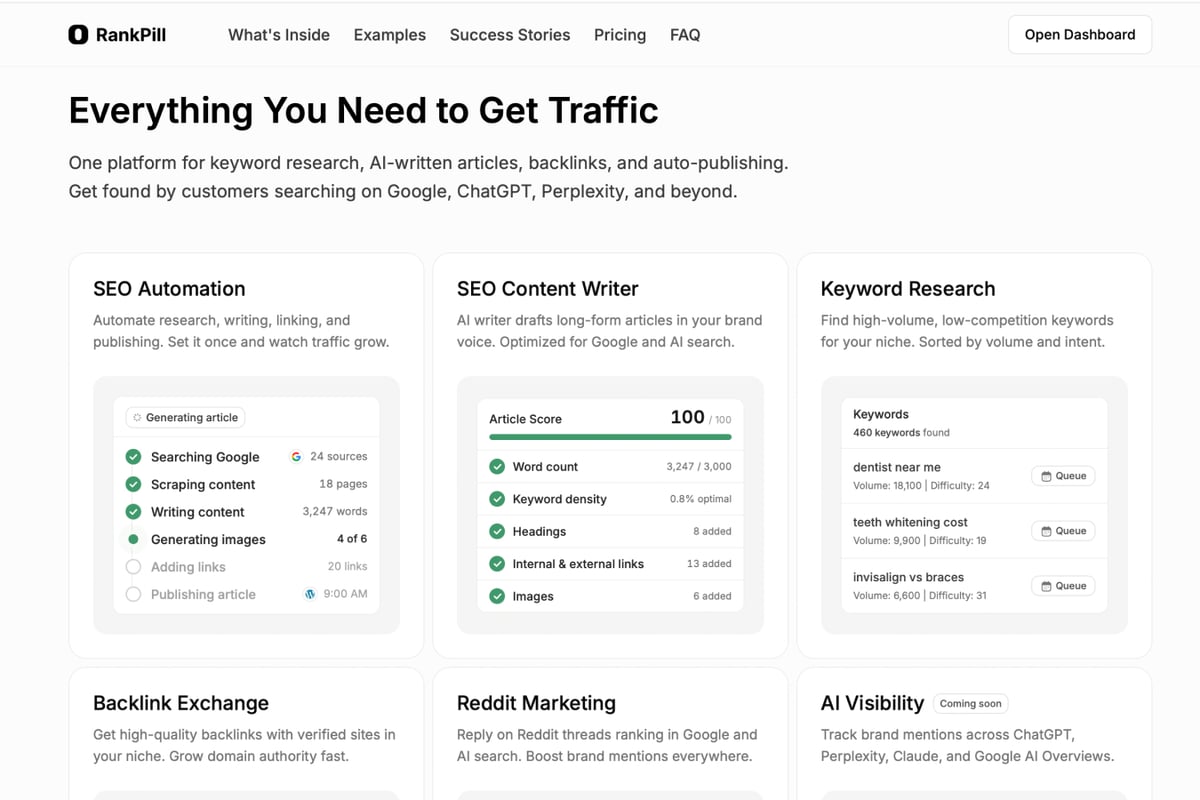
RankPill addresses this challenge through comprehensive automation that maintains quality standards while scaling output. The platform handles keyword research, content creation, internal linking, and publishing on autopilot, enabling consistent content production without hiring an agency.
Systematic Technical Optimization
Technical SEO requires ongoing attention. New pages need proper optimization. Internal linking structures grow complex as content libraries expand. Image optimization, schema markup, and performance monitoring demand consistent execution.
Automated SEO approaches handle repetitive technical tasks while allowing human oversight of strategic decisions. Automation ensures consistent implementation of best practices across hundreds or thousands of pages.
The key is balancing automation with quality control. Automated systems excel at scale but require proper configuration and monitoring to prevent systematic errors that affect entire websites.
User Experience and Engagement Metrics
Google increasingly uses user behavior signals to evaluate content quality. High bounce rates, short dwell times, and poor engagement metrics suggest content doesn't satisfy user needs.
Behavioral Ranking Factors
When users click your result in search then immediately return to Google, it signals dissatisfaction. Google interprets this "pogo-sticking" as evidence your content doesn't match the query intent.
Critical engagement metrics include:
- Click-through rate from search results
- Time on page and session duration
- Bounce rate and exit rate
- Pages per session
- Return visitor rate
Improve engagement through compelling meta descriptions that set accurate expectations. Use clear headlines and scannable formatting to help users find information quickly. Provide comprehensive answers that eliminate the need to consult additional sources.
Internal linking encourages deeper site exploration and longer sessions. Strategic content recommendations keep users engaged beyond their initial landing page. Understanding how to get mentioned by AI becomes increasingly important as search evolves beyond traditional blue links.
Mobile User Experience
Mobile users represent the majority of search traffic in 2026. Websites that frustrate mobile users with poor responsive design, intrusive interstitials, or difficult navigation face ranking penalties.
Test your mobile experience thoroughly. Buttons need adequate spacing for touch interaction. Text must remain readable without zooming. Critical content shouldn't hide behind multiple interactions or below the fold.
Accelerated Mobile Pages (AMP) no longer provides ranking advantages but can improve user experience for content-heavy sites. Focus on Core Web Vitals optimization and responsive design rather than implementing specific mobile frameworks.
Monitoring and Continuous Improvement
Ranking success requires ongoing monitoring and adaptation. SEO isn't a one-time project but a continuous process of testing, measuring, and refining.
Essential Tracking and Analytics
You can't improve what you don't measure. Implement comprehensive tracking to understand which strategies drive results and which waste resources.
| Metric Category | Key Indicators | Tracking Tools |
|---|---|---|
| Rankings | Keyword positions, visibility score | SEO platforms, Google Search Console |
| Traffic | Organic sessions, landing pages | Google Analytics, traffic analysis tools |
| Engagement | Bounce rate, time on page, conversions | Analytics platforms, heatmaps |
| Technical Health | Crawl errors, speed metrics, mobile usability | Search Console, speed testing tools |
Review Search Console regularly for new issues. Monitor ranking fluctuations to detect problems early. Track competitor movements to understand market dynamics and identify threats or opportunities.
Iterative Optimization Process
Why is my website not ranking rarely has a single answer that solves the problem permanently. Continuous improvement through systematic testing and refinement produces sustainable results.
Test different title formulations to improve click-through rates. Experiment with content structure and depth. Evaluate different internal linking strategies. Measure the impact of each change to understand what drives improvement.
The websites that consistently rank well invest in ongoing optimization rather than one-time fixes. They adapt to algorithm changes, respond to competitive threats, and continuously enhance user experience. Common SEO mistakes that prevent ranking often persist because websites lack systematic review processes.
Understanding AI and SEO integration becomes increasingly important as search engines incorporate generative AI features. Optimizing for traditional search while preparing for AI-mediated discovery requires forward-thinking strategies.
The question of why is my website not ranking typically reveals multiple issues working in combination rather than a single catastrophic failure. Technical barriers, content quality gaps, authority deficits, and strategic misalignments all contribute to ranking struggles. Systematic diagnosis and comprehensive remediation address these challenges effectively. RankPill automates the repetitive aspects of SEO including keyword research, content creation, and backlink building so you can focus on strategic decisions while the platform handles daily execution and technical optimization.
Unlock Traffic on Autopilot
Grow organic traffic on autopilot. RankPill will research, write, optimize, and publish articles to your website daily.
 WordPress